
Semi-Synthetic Grease Market Report 2026
Global Outlook – By Product Type (Lithium-Based Grease, Calcium-Based Grease, Polyurea Grease, Other Product Types), By Sales Or Distribution Channel (Original Equipment Manufacturer Factory Fill, Aftermarket Service And Maintenance Repair Overhaul, Direct Industrial Business-To-Business Sales, Distributor And Retail Operations), By Application (Bearings, Gears, Chassis, Electric Motors, Industrial Equipment, Other Applications), By End-User Industry (Automotive, Industrial Manufacturing, Construction, Agriculture, Oil And Gas, Food Processing, Other End-User Industries) – Market Size, Trends, Strategies, and Forecast to 2035
Semi-Synthetic Grease Market Overview
• Semi-Synthetic Grease market size has reached to $2.47 billion in 2025 • Expected to grow to $3.62 billion in 2030 at a compound annual growth rate (CAGR) of 7.8% • Growth Driver: Surge In Automotive Industry Fueling The Growth Of The Market Due To Increasing Vehicle Production • Market Trend: Heavy-Duty Semi-Synthetic Grease Developments Strengthen High-Load And High-Temperature Lubrication Offerings • North America was the largest region in 2025 and Asia-Pacific is the fastest growing region.What Is Covered Under Semi-Synthetic Grease Market?
Semi-synthetic grease is a lubricant formulated using a combination of mineral and synthetic base oils, together with a thickener and performance additives, to provide lubrication under a range of operating conditions. Depending on its formulation, it can offer improved thermal stability, oxidation resistance, wear protection, and water resistance compared with some conventional mineral-oil greases. It is used to reduce friction and wear and support the reliable operation of mechanical components. The main product types of semi-synthetic grease include lithium based grease, calcium based grease, polyurea grease, and other product types. Lithium based grease refers to a semi synthetic lubricant formulated with lithium based thickeners and a blend of synthetic and mineral base oils to provide effective lubrication, wear protection, and thermal stability. These greases are distributed through original equipment manufacturer factory fill, aftermarket service and maintenance repair and overhaul, direct industrial business to business sales, and distributor and retail operations. The various applications involved are bearings, gears, chassis, electric motors, industrial equipment, and others, and they are used by several end user industries such as automotive, industrial manufacturing, construction, agriculture, oil and gas, food processing, and others.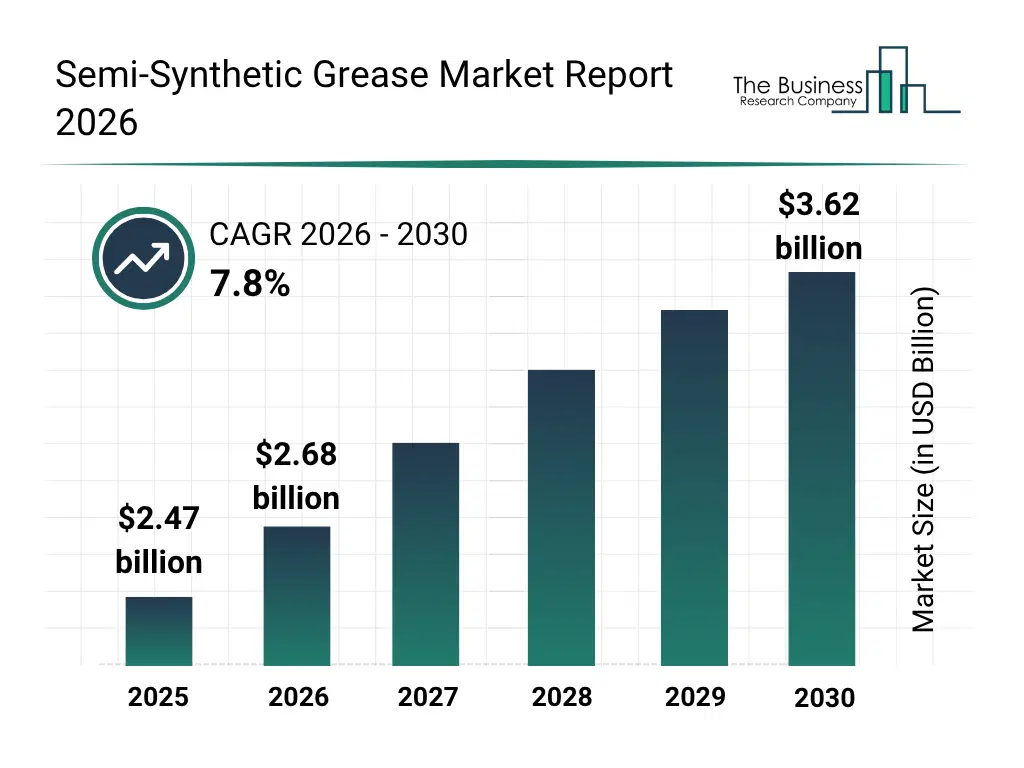
What Is The Semi-Synthetic Grease Market Size and Share 2026?
The semi-synthetic grease market size has grown strongly in recent years. It will grow from $2.47 billion in 2025 to $2.68 billion in 2026 at a compound annual growth rate (CAGR) of 8.3%. The growth in the historic period can be attributed to expansion of automotive production, growth in industrial machinery usage, increasing demand for improved wear protection, rising maintenance requirements for mechanical components, growing adoption of cost-effective lubricants.What Is The Semi-Synthetic Grease Market Growth Forecast?
The semi-synthetic grease market size is expected to see strong growth in the next few years. It will grow to $3.62 billion in 2030 at a compound annual growth rate (CAGR) of 7.8%. The growth in the forecast period can be attributed to increasing demand for longer equipment service life, rising adoption of electric vehicle components, expansion of construction and agricultural machinery, growing demand for high-temperature lubrication, increasing focus on lubrication efficiency and reduced maintenance costs. Major trends in the forecast period include development of high-performance semi-synthetic formulations, increasing demand for extended lubrication intervals, growing adoption of multi-purpose greases, rising demand for high-temperature grease performance, increasing use of water-resistant grease formulations.Tariff Impact On Semi-Synthetic Grease Market
Tariffs are impacting the semi-synthetic grease market by increasing the cost of imported base oils, thickeners, additives, packaging materials, and lubricant manufacturing inputs. Automotive and industrial manufacturing applications are likely to be most affected, particularly in North America, Europe, and Asia-Pacific where lubricant supply chains depend on cross-border raw materials and chemical products. Higher input costs can increase grease prices and pressure margins, while tariffs may also encourage regional sourcing, domestic production, and supply-chain diversification, creating opportunities for local manufacturers.
Global Semi-Synthetic Grease Market Segmentation
2) By Sales Or Distribution Channel: Original Equipment Manufacturer Factory Fill, Aftermarket Service And Maintenance Repair Overhaul, Direct Industrial Business-To-Business Sales, Distributor And Retail Operations 3) By Application: Bearings, Gears, Chassis, Electric Motors, Industrial Equipment, Other Applications 4) By End-User Industry: Automotive, Industrial Manufacturing, Construction, Agriculture, Oil And Gas, Food Processing, Other End-User Industries Subsegments: 1) By Lithium-Based Grease: Lithium Complex Grease, Conventional Lithium Soap Grease, Anhydrous Lithium Grease 2) By Calcium-Based Grease: Calcium Soap Grease, Calcium Complex Grease, Anhydrous Calcium Grease 3) By Polyurea Grease: Diurea Grease, Tetraurea Grease, Aliphatic Polyurea Grease, Aromatic Polyurea Grease 4) By Other Product Types: Aluminum Complex Grease, Bentonite Clay Grease, Silica Gel Grease, Sodium-Based Grease, Barium Complex Grease, Mixed Soap Grease, Polytetrafluoroethylene-Thickened Grease, Calcium Sulfonate Complex GreaseWhat Is The Driver Of The Semi-Synthetic Grease Market?
The growing automotive industry is expected to propel the growth of the semi-synthetic grease market going forward. The automotive industry refers to the sector involved in the design, manufacturing, assembly, marketing, sale, and maintenance of motor vehicles and their components. The growing automotive industry is driven by increasing vehicle production, as rising consumer demand, expanding transportation needs, and advancements in automotive technologies encourage manufacturers to produce more passenger and commercial vehicles. The growth of the automotive industry supports the semi-synthetic grease by increasing the demand for high-performance lubricants used in wheel bearings, chassis components, universal joints, electric motors, and other moving vehicle parts to reduce friction, minimize wear, improve operational efficiency, and extend component service life. For instance, in January 2026, according to the Society of Motor Manufacturers and Traders (SMMT), a UK-based trade association, total vehicle production rose 6.1% year-on-year, reaching 55,284 units in December 2025, up from 52,088 units in December 2024. Therefore, the growing automotive industry is driving the growth of the semi-synthetic grease industry.Key Players In The Global Semi-Synthetic Grease Market
Major companies operating in the semi-synthetic grease market are China Petroleum & Chemical Corporation, Exxon Mobil Corporation, Shell plc, BP p.l.c., Chevron Corporation, TotalEnergies SE, Dow Inc., Phillips 66 Company, ENEOS Holdings Inc., Indian Oil Corporation Limited, Petroliam Nasional Berhad, Idemitsu Kosan Co. Ltd., PJSC LUKOIL, Illinois Tool Works Inc., AB SKF, FUCHS SE, DuPont de Nemours Inc., Quaker Chemical Corporation, Klüber Lubrication München SE & Co. KG, Schaeffler AG, CONDAT SA, Lubrication Engineers Inc., ADDINOL Lube Oil GmbH, Setral Chemie GmbH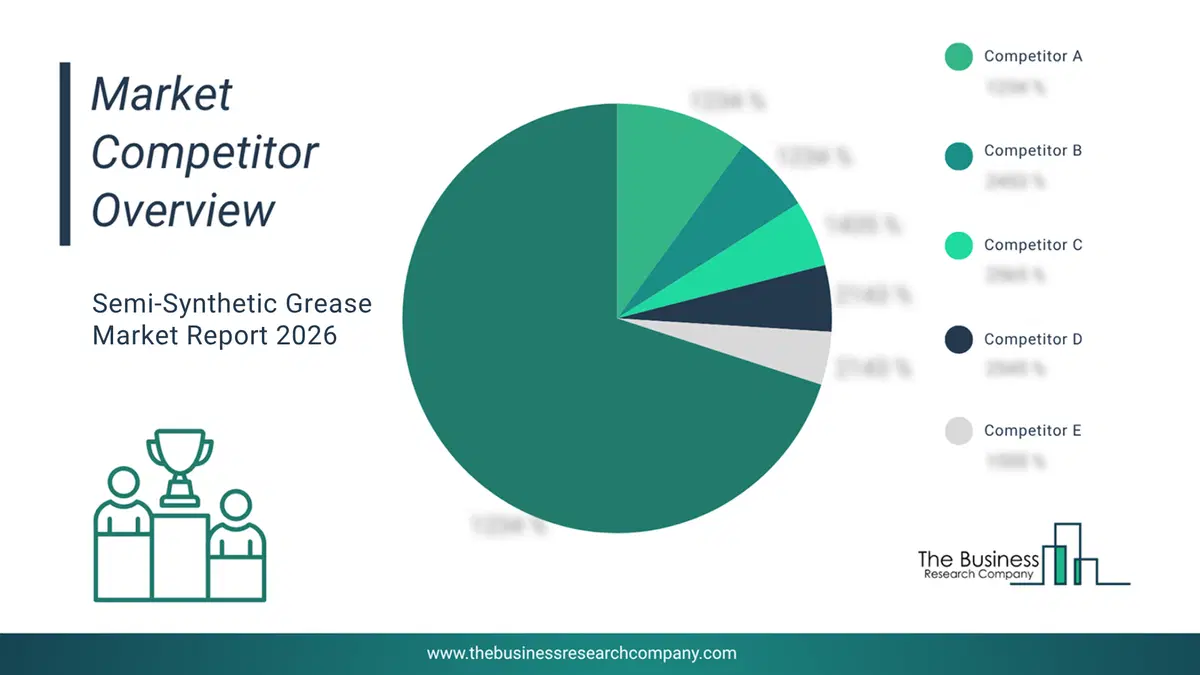
This chart is for illustrative purposes; the full report includes a detailed competitor analysis and comprehensive overview of the top 10 companies in the market.
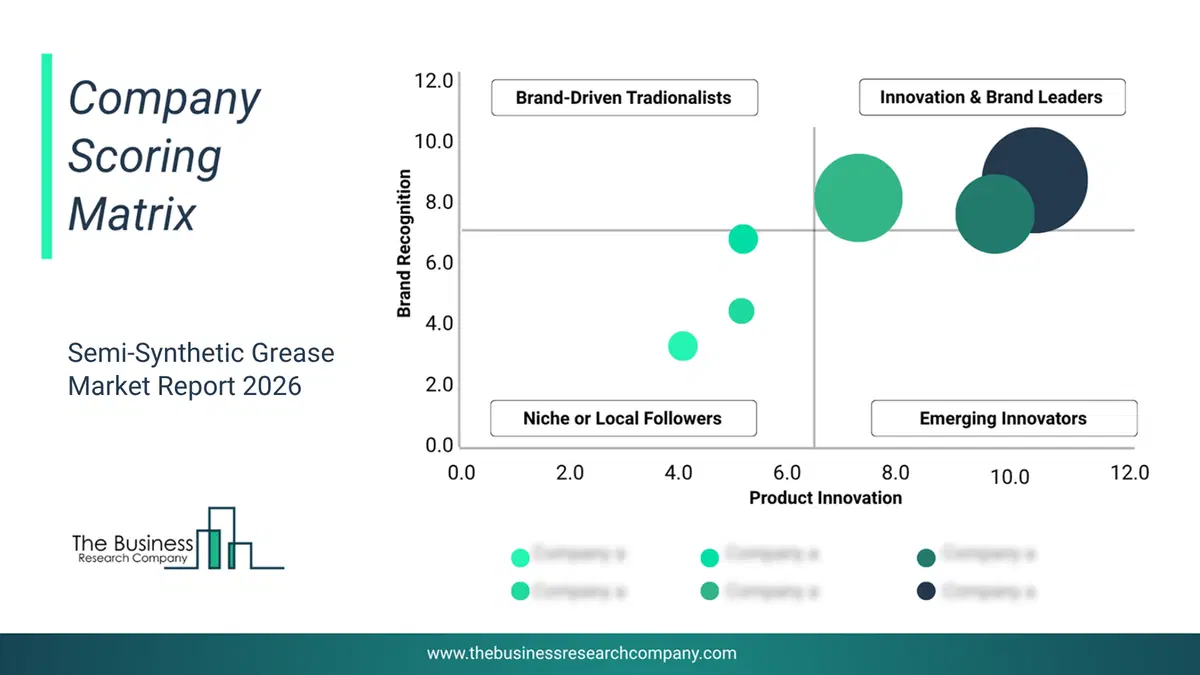
This chart maps companies by product innovation and brand strength, with bubble size indicating relative revenue, helping identify market leaders, challengers, and niche players. This is an illustrative chart; the full report provides a complete and accurate competitive analysis.
Global Semi-Synthetic Grease Market Trends and Insights
Major companies operating in the semi-synthetic grease market are focusing on specialty grease product development and portfolio expansion, such as heavy-duty semi-synthetic greases formulated for high-load and high-temperature applications, to strengthen their offerings for demanding industrial and automotive lubrication requirements. Heavy-duty semi-synthetic greases refer to lubricating greases formulated with a combination of synthetic and mineral base oils and engineered to withstand high loads, elevated temperatures, and demanding operating conditions while providing effective lubrication and component protection. For instance, in October 2025, Rock Oil, a UK-based lubricants manufacturer, launched PRO-GUARD BENTONE-SYN HT 2M, a heavy-duty semi-synthetic grease designed for high-load and high-temperature applications. The product expands Rock Oil’s specialty grease portfolio and provides a lubrication solution for demanding operating conditions. This development aims to strengthen the company’s grease product offerings for high-performance applications.What Are Latest Mergers And Acquisitions In The Semi-Synthetic Grease Market?
In July 2025, Lubrication Engineers Inc., a US-based developer, manufacturer, and marketer of high-performance lubricants and asset-reliability solutions, acquired Southwestern Petroleum Lubricants (SWEPCO) for an undisclosed amount. With this acquisition, Lubrication Engineers aimed to strengthen its in-house grease manufacturing capabilities, expand its specialty lubricant portfolio, and increase its distribution reach through SWEPCO's established customer and distributor network. SWEPCO is a US-based manufacturer of specialty greases and lubricating oils that offers calcium sulfonate greases, gear oils, engine oils, and other mission-critical lubricants.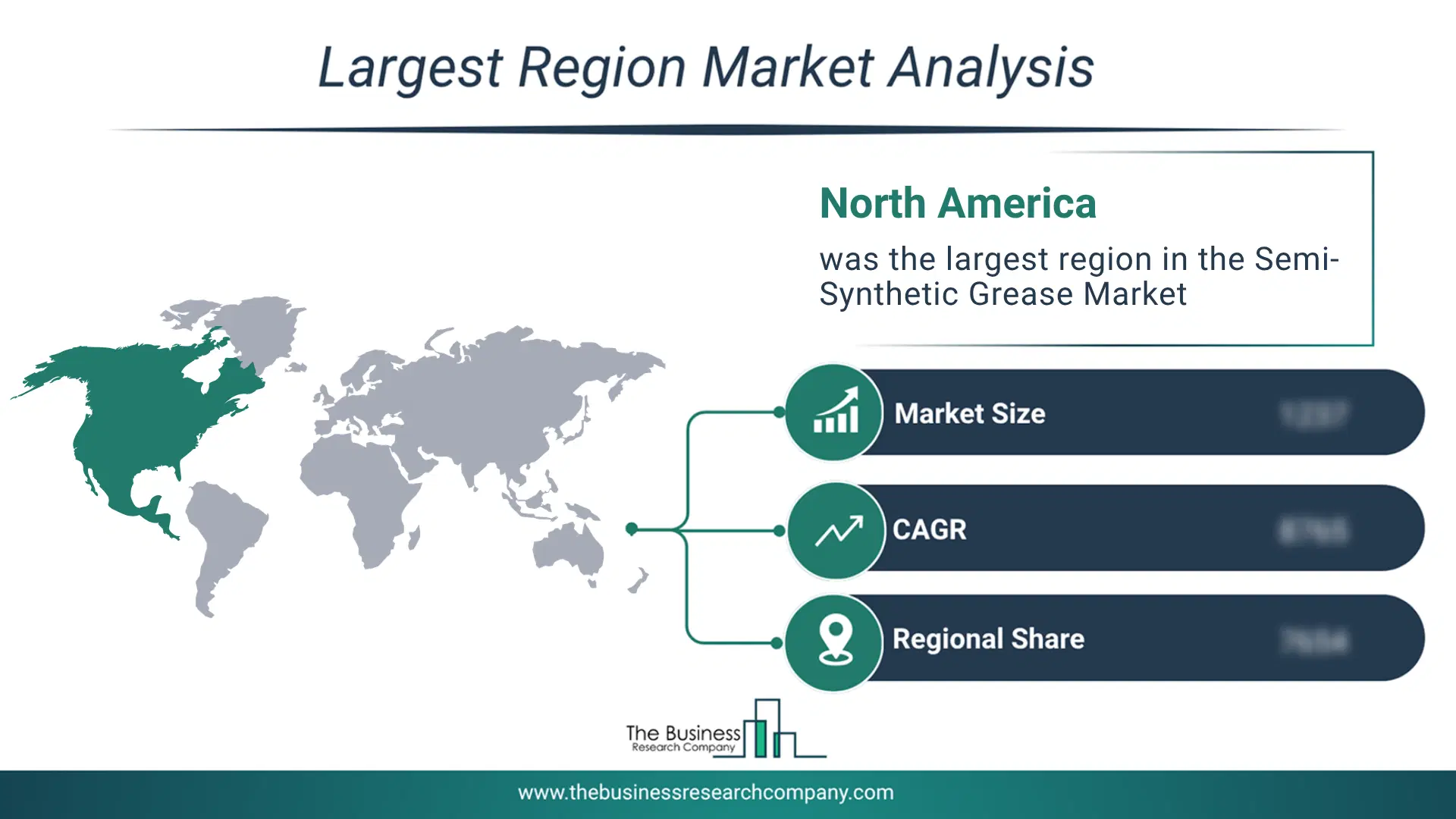
Regional Outlook/Insights
North America was the largest region in the semi-synthetic grease market in 2025. Asia-Pacific is expected to be the fastest-growing region in the forecast period. The regions covered in this market report are Asia-Pacific, South East Asia, Western Europe, Eastern Europe, North America, South America, Middle East, Africa. The countries covered in this market report are Australia, Brazil, China, France, Germany, India, Indonesia, Japan, Taiwan, Russia, South Korea, UK, USA, Canada, Italy, Spain.What Defines the Semi-Synthetic Grease Market?
The semi-synthetic grease market consists of sales of semi-synthetic conveyor bearing grease, semi-synthetic assembly grease, and semi-synthetic universal joint grease. Values in this market are ‘factory gate’ values, that is, the value of goods sold by the manufacturers or creators of the goods, whether to other entities (including downstream manufacturers, wholesalers, distributors, and retailers) or directly to end customers. The value of goods in this market includes related services sold by the creators of the goods.How is Market Value Defined and Measured?
The market value is defined as the revenues that enterprises gain from the sale of goods and/or services within the specified market and geography through sales, grants, or donations in terms of the currency (in USD unless otherwise specified). The revenues for a specified geography are consumption values that are revenues generated by organizations in the specified geography within the market, irrespective of where they are produced. It does not include revenues from resales along the supply chain, either further along the supply chain or as part of other products.
This chart presents market attractiveness based on a quantitative evaluation of growth, competition, strategic alignment, and risk, offering a clear view of opportunity areas for decision-making. This chart is for illustrative purposes; the full report contains the complete analysis.

This chart highlights the Total Addressable Market (TAM) by estimating the maximum revenue opportunity using an assumption-driven approach, supporting strategic planning and opportunity sizing across markets. The chart is illustrative; the full report provides a more comprehensive analysis.
What Key Data and Analysis Are Included in the Semi-Synthetic Grease Market Report 2026?
The semi-synthetic grease market research report is one of a series of new reports from The Business Research Company that provides market statistics, including industry global market size, regional shares, competitors with the market share, detailed market segments, market trends and opportunities, and any further data you may need to thrive in the semi-synthetic grease industry. The market research report delivers a complete perspective of everything you need, with an in-depth analysis of the current and future state of the industry.Semi-Synthetic Grease Market Report Forecast Analysis
| Report Attribute | Details |
|---|---|
| Market Size Value In 2026 | $2.68 billion |
| Revenue Forecast In 2030 | $3.62 billion |
| Growth Rate | CAGR of 7.8% from 2026 to 2035 |
| Base Year For Estimation | 2025 |
| Actual Estimates/Historical Data | 2020-2025 |
| Forecast Period | 2026 - 2030 |
| Market Representation | Revenue in USD Billion and CAGR from 2026 to 2030 |
| Segments Covered | Product Type, Sales Or Distribution Channel, Application, End-User Industry |
| Regional Scope | Asia-Pacific, Western Europe, Eastern Europe, North America, South America, Middle East, Africa |
| Country Scope | The countries covered in the report are Australia, Brazil, China, France, Germany, India, Indonesia, Japan, Taiwan, Russia, South Korea, UK, USA, Canada, Italy, Spain. |
| Customization Scope | Request for Customization |
| Pricing And Purchase Options | Explore Purchase Options |