
Sensor-Based Smart Catheters Market Report 2026
Global Outlook – By Product Type (Temperature Sensing Foley Catheter, Pressure Catheter, Mapping Catheter, Other Product Types), By Catheter Type (Single Lumen, Multi Lumen), By Material (Silicon, Polytetrafluoroethylene, Polyetheretherketone, Other Materials), By Application (Cardiovascular, Urology, Gynecology, Neurovascular, Other Applications) – Market Size, Trends, Strategies, and Forecast to 2035
Sensor-Based Smart Catheters Market Overview
• Sensor-Based Smart Catheters market size has reached to $4.08 billion in 2025 • Expected to grow to $6.11 billion in 2030 at a compound annual growth rate (CAGR) of 8.3% • Growth Driver: Increasing Prevalence Of Cardiovascular Diseases Fuels Growth In The Sensor-Based Smart Catheter Market • Market Trend: Advanced Cardiac Arrhythmia Mapping With High-Density Diagnostic Catheters • North America was the largest region in 2025.What Is Covered Under Sensor-Based Smart Catheters Market?
Sensor-based smart catheters are advanced medical devices equipped with embedded sensors that monitor and transmit real-time data, such as pressure, temperature, pH levels, or flow rates, during catheterization procedures. These catheters are used in various diagnostic and therapeutic applications, providing critical information to healthcare professionals, which can improve patient outcomes, enable precise interventions, and enhance the overall effectiveness of medical treatments. The main product types of sensor-based smart catheters are temperature-sensing foley catheters, pressure catheters, mapping catheters, and others. A temperature-sensing Foley catheter is a specialized type of urinary catheter that drains urine and also measures the body's core temperature. The various catheter types include single-lumen and multi-lumen made from varying materials such as silicon, polytetrafluoroethylene, polyetheretherketone, and others. It is applied for cardiovascular, urology, gynecology, neurovascular, and others.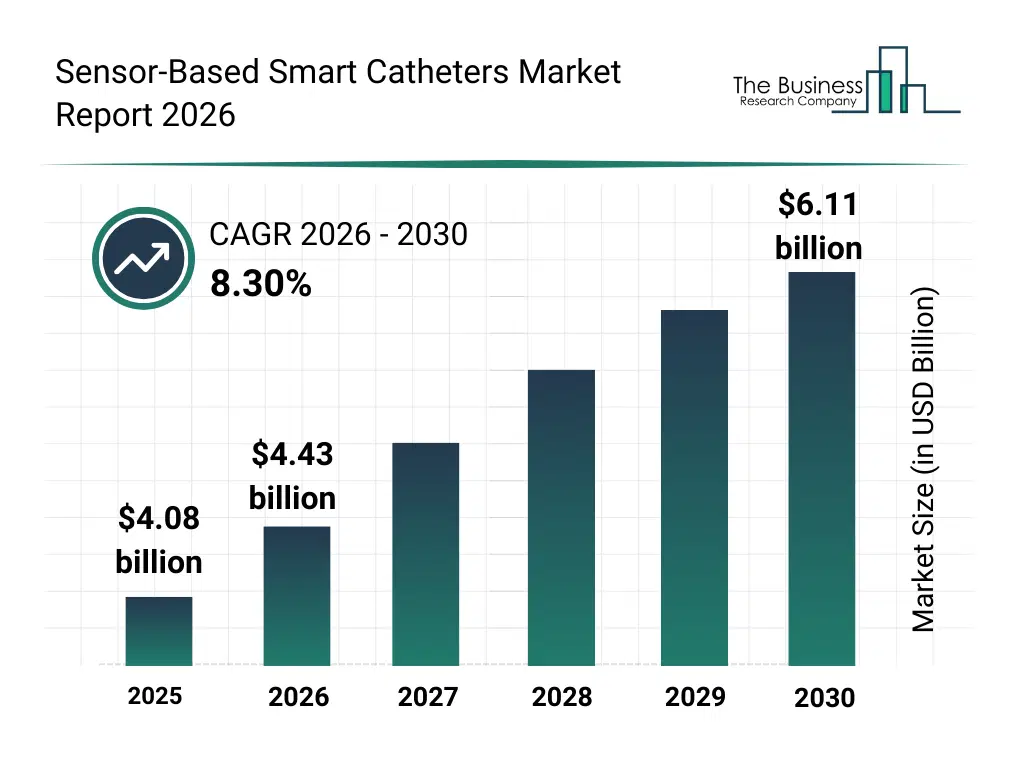
What Is The Sensor-Based Smart Catheters Market Size and Share 2026?
The sensor-based smart catheters market size has grown strongly in recent years. It will grow from $4.08 billion in 2025 to $4.43 billion in 2026 at a compound annual growth rate (CAGR) of 8.7%. The growth in the historic period can be attributed to advancements in catheter materials, increase in cardiovascular diseases, growth in interventional procedures, hospital infrastructure development, demand for patient safety.What Is The Sensor-Based Smart Catheters Market Growth Forecast?
The sensor-based smart catheters market size is expected to see strong growth in the next few years. It will grow to $6.11 billion in 2030 at a compound annual growth rate (CAGR) of 8.3%. The growth in the forecast period can be attributed to rise in chronic diseases, expansion of digital health, demand for precision medicine, growth of smart medical devices, technological integration in healthcare. Major trends in the forecast period include rising adoption of real-time monitoring devices, growth in minimally invasive procedures, increasing demand for multi-sensor catheters, expansion of remote patient monitoring, higher focus on procedural accuracy.
Global Sensor-Based Smart Catheters Market Segmentation
1) By Product Type: Temperature Sensing Foley Catheter, Pressure Catheter, Mapping Catheter, Other Product Types 2) By Catheter Type: Single Lumen, Multi Lumen 3) By Material: Silicon, Polytetrafluoroethylene, Polyetheretherketone, Other Materials 4) By Application: Cardiovascular, Urology, Gynecology, Neurovascular, Other Applications Subsegments: 1) By Temperature Sensing Foley Catheter: Standard Temperature Sensing Foley Catheters, Wireless Temperature Sensing Catheters, High-Precision Temperature Sensing Catheters 2) By Pressure Catheter: Intra-Abdominal Pressure Catheters, Central Venous Pressure Catheters, Intracranial Pressure Catheters 3) By Mapping Catheter: Electrophysiology Mapping Catheters, 3D Mapping Catheters, Contact Force Sensing Mapping Catheters 4) By Other Product Types: Multi-sensor Catheters, Biochemical Sensor Catheters, Optical Sensor CathetersWhat Is The Driver Of The Sensor-Based Smart Catheters Market?
The rise in the prevalence of cardiovascular diseases is expected to drive the growth of the sensor-based smart catheter market moving forward. Cardiovascular disease is a group of conditions affecting the heart and blood vessels. The growing prevalence of cardiovascular diseases is mainly due to more sedentary lifestyles, which contribute to obesity, high blood pressure, and diabetes. Sensor equipped smart catheters aid in treating cardiovascular diseases by providing real-time data on various physiological parameters, such as blood pressure, blood flow, and tissue temperature, directly from within the cardiovascular system. For instance, in April 2023, the World Heart Federation, a Switzerland-based nonprofit organization, reported that cardiovascular diseases number is projected to rise to 22.2 million by 2030 and 32.3 million by 2050. Therefore, the rise in the prevalence of cardiovascular diseases is driving growth in the sensor-based smart catheter market. Therefore, the rise in the prevalence of cardiovascular diseases is driving growth in the sensor-based smart catheter industry.Key Players In The Global Sensor-Based Smart Catheters Market
Major companies operating in the sensor-based smart catheters market are Cardinal Health Inc., Johnson & Johnson, Abbott Laboratories, Medtronic plc, Medline Industries LP, Becton Dickinson and Company, TE Connectivity Corporation, Boston Scientific Corporation, Smiths Group, COOK Medical LLC, ICU Medical Inc., Biotronik SE & Co. KG, Spacelabs Healthcare Inc., MicroPort Scientific Corporation, Freudenberg Medical LLC, Baylis Medical Company Inc., Bactiguard AB, Stereotaxis Inc., Acutus Medical Inc., Osypka AG, CathRx Ltd.Global Sensor-Based Smart Catheters Market Trends and Insights
Major companies operating in the sensor-based smart catheter market are developing advancements in their electrophysiology to improve the accuracy of cardiac mapping, enhance the precision of ablation procedures, and enable real-time monitoring of electrical signals within the heart. Electrophysiology aims to provide better diagnostic capabilities for arrhythmias and other heart conditions, reduce procedural complications, and improve patient outcomes. For instance, in February 2023, Abbott, a US-based healthcare company, launched the TactiFlex ablation catheter- sensor enabled, the world's first ablation catheter designed with a flexible tip and contact force sensing technology, for the treatment of atrial fibrillation (AFib). The tactiFlex catheter has a flexible tip design with a laser-cut pattern that flexes when in contact with the heart wall. This allows for more accurate positioning and up to twice the stability of a beating heart. The catheter's contact force sensor ensures constant therapy, shorter operation times, and improved safety compared to prior generations.What Are Latest Mergers And Acquisitions In The Sensor-Based Smart Catheters Market?
In August 2024, Stereotaxis Inc., a US-based clinical robotic products company, acquired Access Point Technologies (APT) Inc. for an undisclosed amount. With this acquisition, Stereotaxis seeks to strengthen its product offerings by integrating Access Point Technologies' advanced diagnostic catheters, enhancing its market presence in the cardiac ablation and electromedical sectors. Access Point Technologies (APT) Inc. is a US-based medical equipment manufacturer that offers a variety of advanced electrophysiology (EP) diagnostic and ablation catheters, including sensor-enabled smart catheters such as diagnostic mapping catheters.Regional Outlook
North America was the largest region in the sensor-based smart catheters market in 2025. The regions covered in this market report are Asia-Pacific, South East Asia, Western Europe, Eastern Europe, North America, South America, Middle East, Africa. The countries covered in this market report are Australia, Brazil, China, France, Germany, India, Indonesia, Japan, Taiwan, Russia, South Korea, UK, USA, Canada, Italy, SpainWhat Defines the Sensor-Based Smart Catheters Market?
The sensor-based smart catheter market consists of sales of pressure-sensing catheters, temperature-sensing catheters, and thermal monitoring catheters. Values in this market are ‘factory gate’ values, that is, the value of goods sold by the manufacturers or creators of the goods, whether to other entities (including downstream manufacturers, wholesalers, distributors, and retailers) or directly to end customers. The value of goods in this market includes related services sold by the creators of the goods.How is Market Value Defined and Measured?
The market value is defined as the revenues that enterprises gain from the sale of goods and/or services within the specified market and geography through sales, grants, or donations in terms of the currency (in USD unless otherwise specified). The revenues for a specified geography are consumption values that are revenues generated by organizations in the specified geography within the market, irrespective of where they are produced. It does not include revenues from resales along the supply chain, either further along the supply chain or as part of other products.Sensor-Based Smart Catheters Market Report Forecast Analysis
| Report Attribute | Details |
|---|---|
| Market Size Value In 2026 | $4.43 billion |
| Revenue Forecast In 2035 | $6.11 billion |
| Growth Rate | CAGR of 8.7% from 2026 to 2035 |
| Base Year For Estimation | 2025 |
| Actual Estimates/Historical Data | 2020-2025 |
| Forecast Period | 2026 - 2030 - 2035 |
| Market Representation | Revenue in USD Billion and CAGR from 2026 to 2035 |
| Segments Covered | Product Type, Catheter Type, Material, Application |
| Regional Scope | Asia-Pacific, Western Europe, Eastern Europe, North America, South America, Middle East, Africa |
| Country Scope | The countries covered in the report are Australia, Brazil, China, France, Germany, India, ... |
| Key Companies Profiled | Cardinal Health Inc., Johnson & Johnson, Abbott Laboratories, Medtronic plc, Medline Industries LP, Becton Dickinson and Company, TE Connectivity Corporation, Boston Scientific Corporation, Smiths Group, COOK Medical LLC, ICU Medical Inc., Biotronik SE & Co. KG, Spacelabs Healthcare Inc., MicroPort Scientific Corporation, Freudenberg Medical LLC, Baylis Medical Company Inc., Bactiguard AB, Stereotaxis Inc., Acutus Medical Inc., Osypka AG, CathRx Ltd. |
| Customization Scope | Request for Customization |
| Pricing And Purchase Options | Explore Purchase Options |