
Sewing Machine Market Report 2026
Global Outlook – By Type (Mechanical, Electronic, Automated, Embroidery, Overlock, Others), By Distribution Channel (Online, Offline), By Application (Apparel, Shoes, Bags), By End-Users (Household, Commercial, Industrial) – Market Size, Trends, Strategies, and Forecast to 2030
Sewing Machine Market Overview
• Sewing Machine market size has reached to $5.5 billion in 2025 • Expected to grow to $7.45 billion in 2030 at a compound annual growth rate (CAGR) of 6.3% • Growth Driver: Textile Industry Growth Fuels Expansion Of The Sewing Machine Market • Market Trend: Wi-Fi-Connected Sewing Machines Revolutionize The Market • Asia-Pacific was the largest region and fastest growing region.What Is Covered Under Sewing Machine Market?
A sewing machine is a device used to stitch fabric and other materials together using thread. It automates the process of sewing, making it faster and more efficient compared to hand sewing. These machines can be used for a variety of tasks, from basic stitching to more complex techniques such as embroidery, quilting, and garment construction. The main types of sewing machines are mechanical, electronic, automated, embroidery, overlock, and others. Mechanical sewing machines can be operated manually with controls and are mainly used in households and small scale companies. Sewing machines are sold through online and offline distribution channels. Sewing machines are used for applications such as apparel, shoes, and bags. Major end-users of sewing machines include households, commercial and industrial end-users.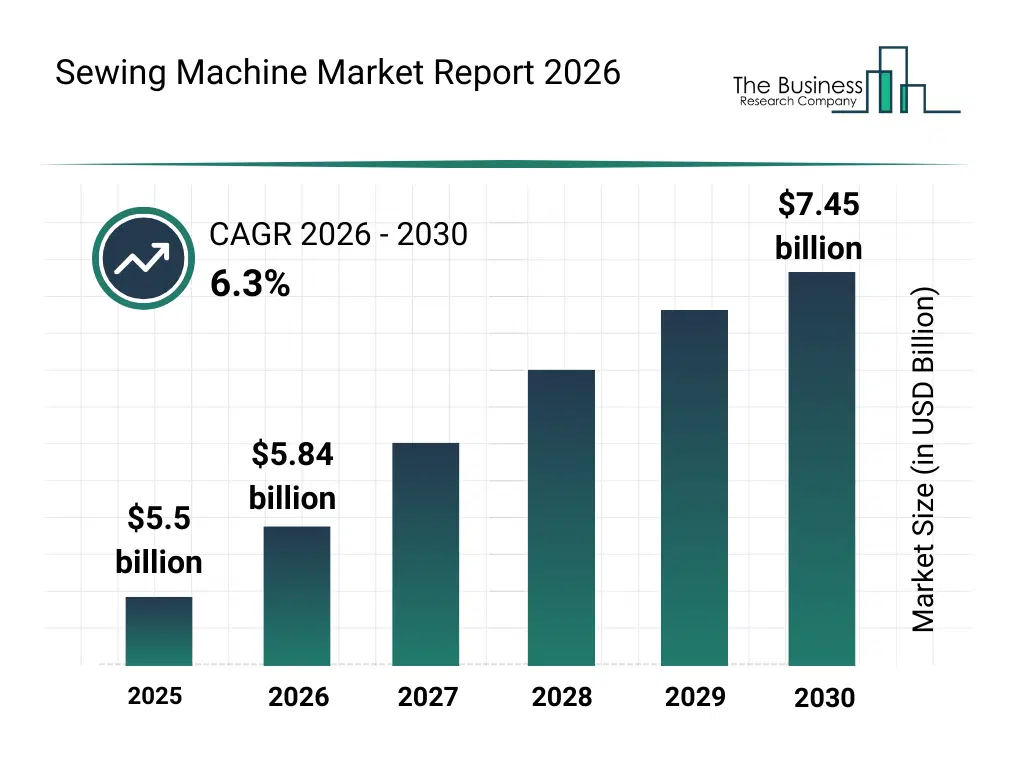
What Is The Sewing Machine Market Size and Share 2026?
The sewing machine market size has grown strongly in recent years. It will grow from $5.5 billion in 2025 to $5.84 billion in 2026 at a compound annual growth rate (CAGR) of 6.3%. The growth in the historic period can be attributed to growth of global apparel manufacturing, expansion of home tailoring and diy sewing, increasing demand for ready-made garments, availability of affordable mechanical sewing machines, growth of textile and footwear industries.What Is The Sewing Machine Market Growth Forecast?
The sewing machine market size is expected to see strong growth in the next few years. It will grow to $7.45 billion in 2030 at a compound annual growth rate (CAGR) of 6.3%. The growth in the forecast period can be attributed to automation of garment production, rising demand for customized apparel, growth of fashion startups and small workshops, technological advancements in embroidery and quilting machines, increasing adoption of sewing machines in emerging economies. Major trends in the forecast period include rising adoption of computerized and automated sewing machines, growing demand for multi-function and embroidery capabilities, expansion of portable and compact sewing machine designs, increasing focus on energy-efficient and durable machines, rising popularity of online sewing machine sales channels.Tariff Impact On Sewing Machine Market
Tariffs have affected the sewing machine market by increasing the cost of imported components such as motors, electronic controllers, precision parts, and steel housings. These impacts are most pronounced in automated, electronic, and embroidery machine segments, particularly across asia-pacific and north america where global sourcing is common. Higher tariffs have raised manufacturing and retail prices, slowing replacement cycles in some markets. At the same time, tariffs have encouraged local assembly, regional manufacturing, and innovation in cost-efficient sewing machine models.
Global Sewing Machine Market Segmentation
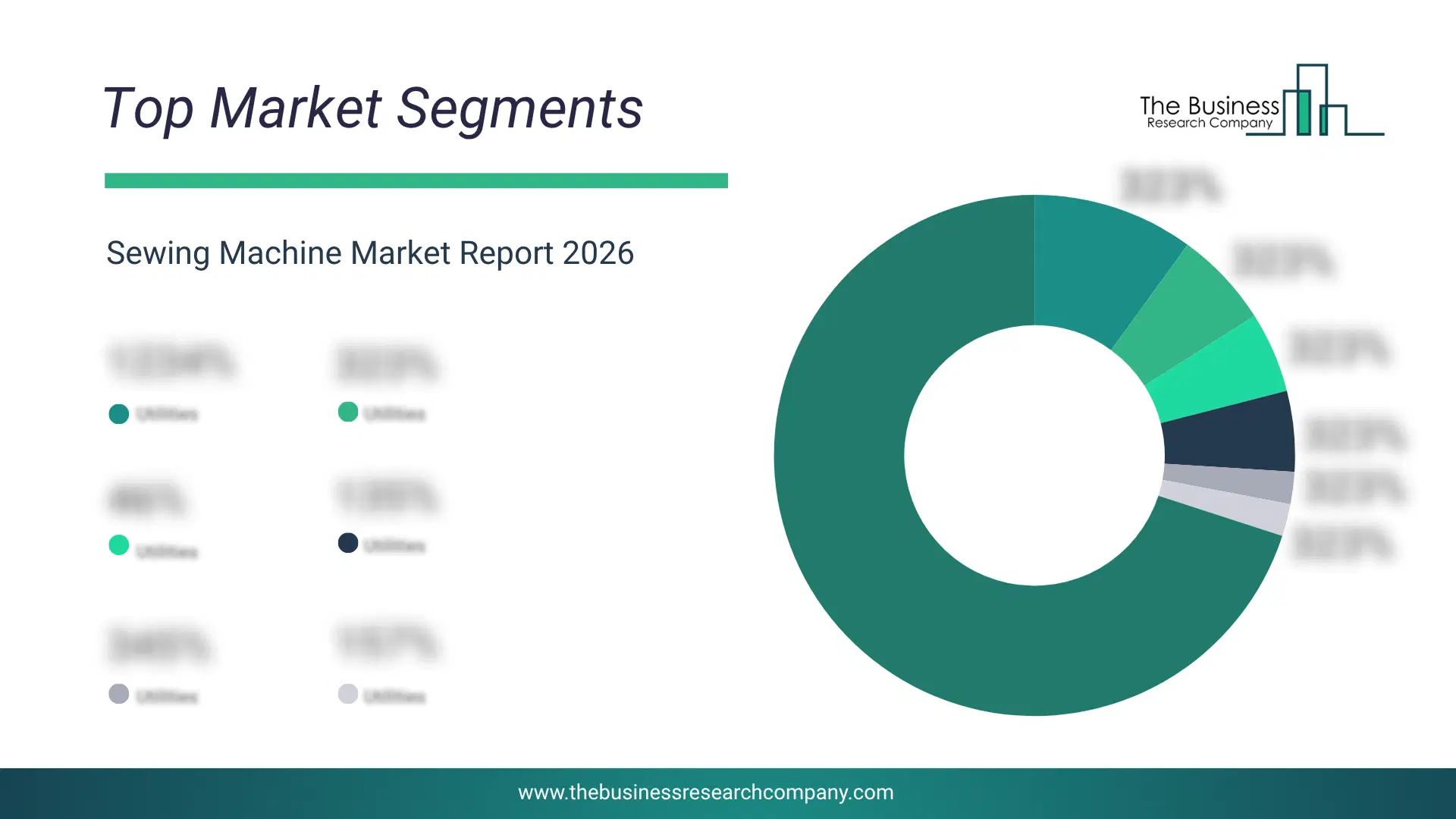
1) By Type: Mechanical, Electronic, Automated, Embroidery, Overlock, Others 2) By Distribution Channel: Online, Offline 3) By Application: Apparel, Shoes, Bags 4) By End-Users: Household, Commercial, Industrial Subsegments: 1) By Mechanical: Basic Mechanical Sewing Machines, Heavy-Duty Mechanical Sewing Machines, Portable Mechanical Sewing Machines 2) By Electronic: Electronic Sewing Machines with LCD Display, Computerized Sewing Machines, Electronic Sewing Machines with Built-in Stitches 3) By Automated: Fully Automated Sewing Machines, Industrial Automated Sewing Machines, Automated Quilting Machines 4) By Embroidery: Computerized Embroidery Machines, Multi-Needle Embroidery Machines, Single-Needle Embroidery Machines 5) By Overlock: Serger Machines, Coverstitch Machines, Combination Overlock and Coverstitch Machines 6) By Others: Walking Foot Sewing Machines, Quilting Machines, Leather Sewing MachinesWhat Are The Drivers Of The Sewing Machine Market?
The rapid growth of the textile industry is contributing to the growth of the sewing machine market. Textile refers to a fabric (woven or knitted) made from yarn. A sewing machine is used to stitch the fabric and other pliable materials together with threads. For instance, according to the 2024 National Textile Industry Workforce Needs Assessment from Advanced Functional Fabrics of America, a US-based company, reported that in 2023, the U.S. textile industry supported more than 334,000 workers across over 17,000 facilities and generated slightly above $28 billion in GDP. The rapid growth of the textile industry will drive the sewing machine industry. The expansion of the e-commerce industry is expected to propel the growth of the sewing machine market going forward. E-commerce refers to the exchange of goods and services or the sending of money or data over an electronic network, primarily the Internet. The sewing machine industry has been transformed by e-commerce, offering consumers a convenient and extensive online marketplace for researching, comparing, and buying machines, thus providing a broader array of choices and easy access. For instance, in August 2024, according to data published by the United States Census Bureau, a US-based government agency, e-commerce sales reached $282.3 billion in this period, marking a 5.3% increase compared to the first quarter of 2023. Moreover, e-commerce sales represented 16% of total retail sales for the second quarter of 2024. Therefore, the expansion of the e-commerce industry is driving the growth of the sewing machine industry.Key Players In The Global Sewing Machine Market
Major companies operating in the sewing machine market are Brother Industries, Janome, Singer Corporation, Bernina, Husqvarna Viking, Pfaff, Juki Corporation, Toyota Industries, Elna, Baby Lock, Bernette, Riccar, Consew, Necchi, Sailrite, Featherweight, Viking Sewing, Gritzner, Auroras Sewing, Sewtec, BERNINA of America, Reliable Corporation, Tjaldor, Sew Easy, Dürkopp Adler, Veritas, Silvercrest, Coats Group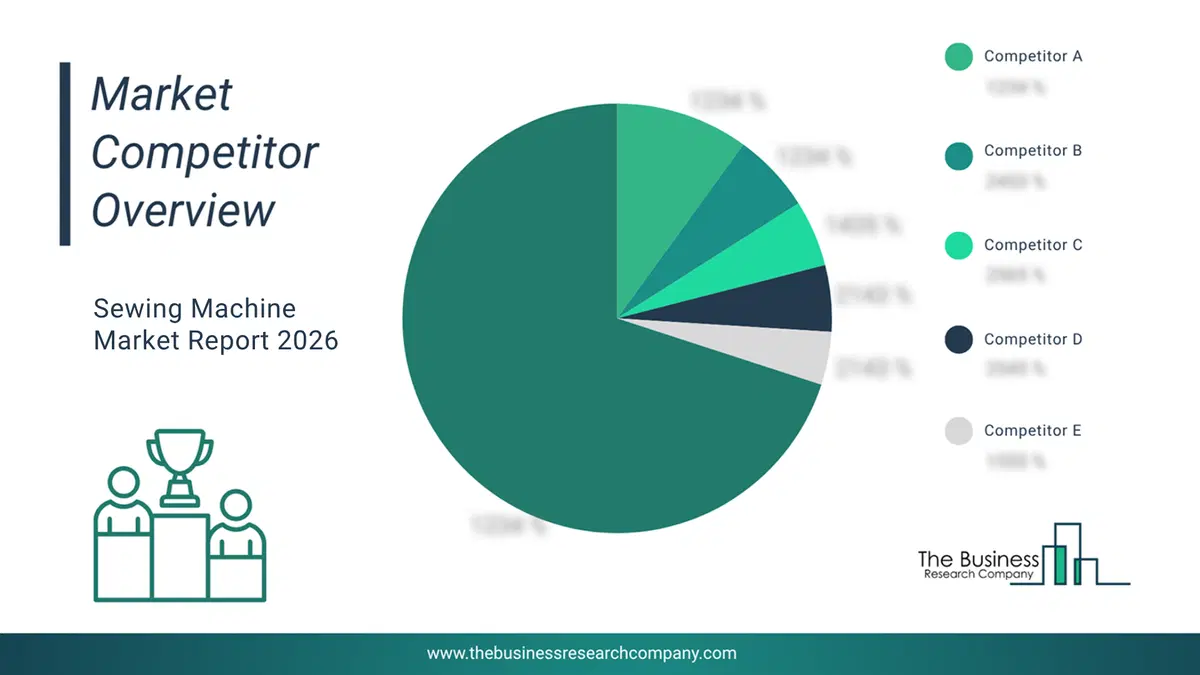
This chart is for illustrative purposes; the full report includes a detailed competitor analysis and comprehensive overview of the top 10 companies in the market.
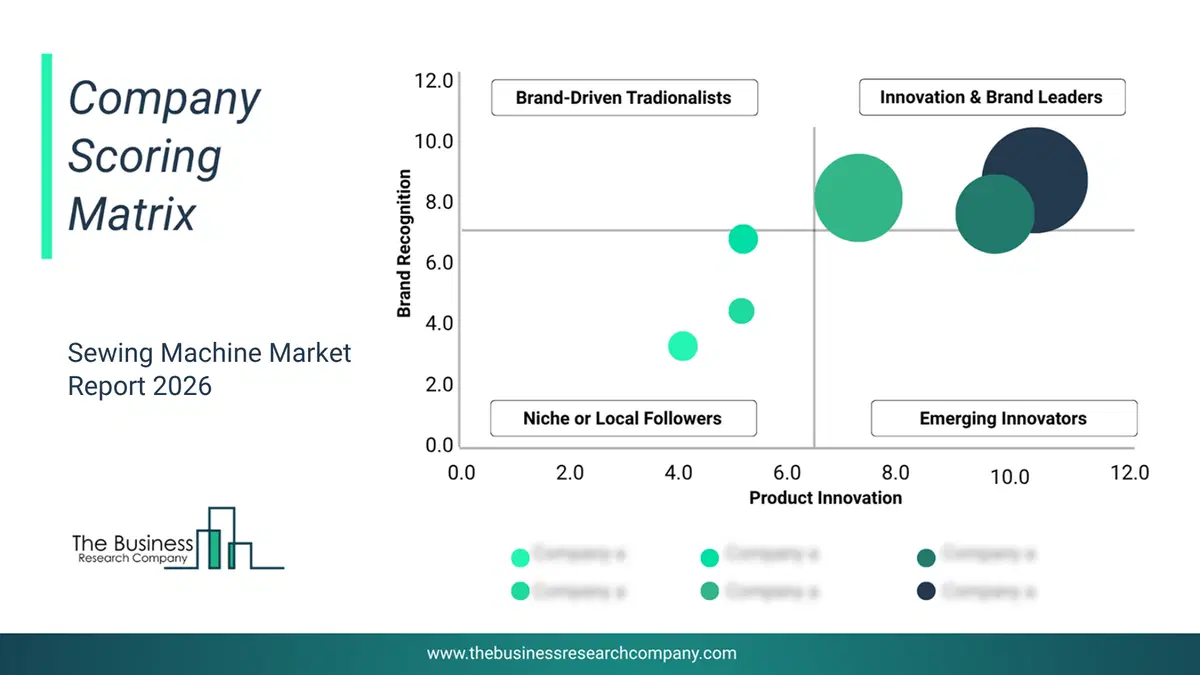
This chart maps companies by product innovation and brand strength, with bubble size indicating relative revenue, helping identify market leaders, challengers, and niche players. This is an illustrative chart; the full report provides a complete and accurate competitive analysis.
Global Sewing Machine Market Trends and Insights
Major companies operating in the sewing machine market are increasing their focus on introducing Wi-Fi-connected sewing machines to gain a competitive edge in the market. Wi-Fi-connected sewing machines are sewing devices equipped with wireless internet connectivity for remote control and access to digital patterns and resources. For instance, in September 2023, Singer Corporation, a US-based manufacturer of consumer sewing machines, launched the SE9180. The SE9180 is a sewing and embroidery machine that offers a range of user-friendly features for sewists of all levels. This machine boasts a large 7 color touch screen, providing users with a clear view of their stitches and easy navigation through its features. With over 250 in-built stitches, including basic, decorative, and stretch stitches, this machine offers a wide range of options for various sewing projects. Additionally, it comes with 150 embroidery designs and 10 embroidery fonts, allowing users to unleash their creativity in their embroidery projects. The automatic needle threader feature makes threading the machine quick and effortless, saving time and effort.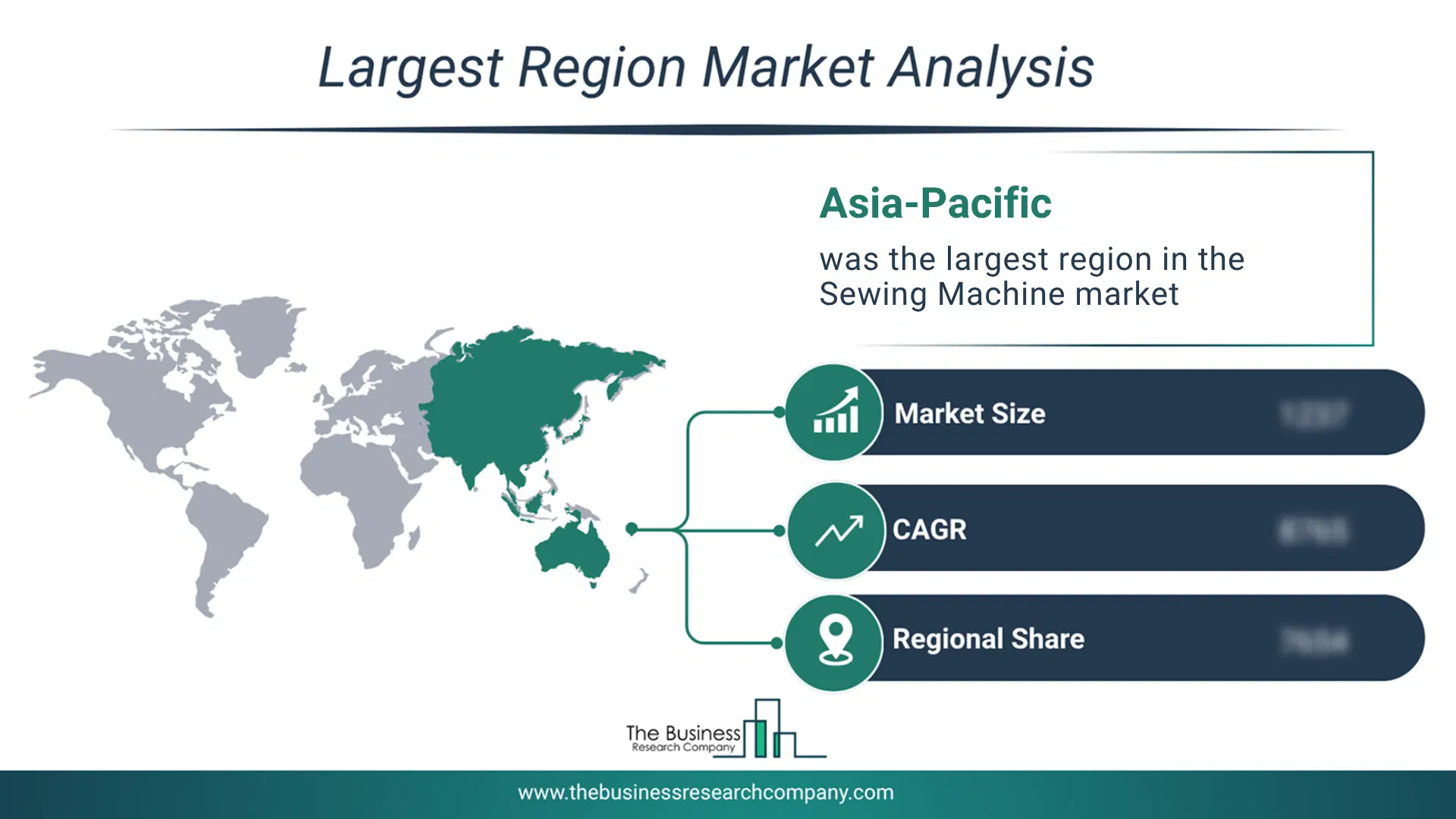
Regional Outlook
Asia-Pacific was the largest region in the sewing machine market in 2025. Asia-Pacific is expected to be the fastest-growing region in the forecast period. The regions covered in this market report are Asia-Pacific, South East Asia, Western Europe, Eastern Europe, North America, South America, Middle East, Africa The countries covered in this market report are Australia, Brazil, China, France, Germany, India, Indonesia, Japan, Taiwan, Russia, South Korea, UK, USA, Canada, Italy, Spain.What Defines the Sewing Machine Market?
The sewing machine market consists of sales of sewing machines domestic sewing machines, manual sewing machines, treadle sewing machines, mechanical domestic sewing machines, embroidery machines, quilting machines, mini/portable sewing machines. Values in this market are ‘factory gate’ values, that is the value of goods sold by the manufacturers or creators of the goods, whether to other entities (including downstream manufacturers, wholesalers, distributors, and retailers) or directly to end customers. The value of goods in this market includes related services sold by the creators of the goods.How is Market Value Defined and Measured?
The market value is defined as the revenues that enterprises gain from the sale of goods and/or services within the specified market and geography through sales, grants, or donations in terms of the currency (in USD unless otherwise specified). The revenues for a specified geography are consumption values that are revenues generated by organizations in the specified geography within the market, irrespective of where they are produced. It does not include revenues from resales along the supply chain, either further along the supply chain or as part of other products.
This chart presents market attractiveness based on a quantitative evaluation of growth, competition, strategic alignment, and risk, offering a clear view of opportunity areas for decision-making. This chart is for illustrative purposes; the full report contains the complete analysis.

This chart highlights the Total Addressable Market (TAM) by estimating the maximum revenue opportunity using an assumption-driven approach, supporting strategic planning and opportunity sizing across markets. The chart is illustrative; the full report provides a more comprehensive analysis.
What Key Data and Analysis Are Included in the Sewing Machine Market Report 2026?
The sewing machine market research report is one of a series of new reports from The Business Research Company that provides market statistics, including industry global market size, regional shares, competitors with the market share, detailed market segments, market trends and opportunities, and any further data you may need to thrive in the sewing machine industry. The market research report delivers a complete perspective of everything you need, with an in-depth analysis of the current and future state of the industry.Sewing Machine Market Report Forecast Analysis
| Report Attribute | Details |
|---|---|
| Market Size Value In 2026 | $5.84 billion |
| Revenue Forecast In 2030 | $7.45 billion |
| Growth Rate | CAGR of 6.3% from 2026 to 2030 |
| Base Year For Estimation | 2025 |
| Actual Estimates/Historical Data | 2020-2025 |
| Forecast Period | 2026 - 2030 |
| Market Representation | Revenue in USD Billion and CAGR from 2026 to 2030 |
| Segments Covered | Type, Distribution Channel, Application, End-Users |
| Regional Scope | Asia-Pacific, Western Europe, Eastern Europe, North America, South America, Middle East, Africa |
| Key Companies Profiled | Brother Industries, Janome, Singer Corporation, Bernina, Husqvarna Viking, Pfaff, Juki Corporation, Toyota Industries, Elna, Baby Lock, Bernette, Riccar, Consew, Necchi, Sailrite, Featherweight, Viking Sewing, Gritzner, Auroras Sewing, Sewtec, BERNINA of America, Reliable Corporation, Tjaldor, Sew Easy, Dürkopp Adler, Veritas, Silvercrest, Coats Group |
| Customization Scope | Request for Customization |
| Pricing And Purchase Options | Explore Purchase Options |