

Shaftless Home Elevator Market Report 2026
Global Outlook – By Type Of Shaftless Home Elevators (Traction Shaftless Elevators, Pneumatic Shaftless Elevators, Vacuum Shaftless Elevators), By Technology Adoption (Smart Elevators, Energy Efficient Elevators, Remote Control Functionality, Internet of Things (IoT) Enabled Elevators), By Installation Type (New Installations, Retrofit Installations), By Application (Double Storey Building, Three Story Building), By End User (Residential Buildings, Retirement Homes, Luxury Villas) – Market Size, Trends, Strategies, and Forecast to 2030
Shaftless Home Elevator Market Overview
• Shaftless Home Elevator market size has reached to $1.53 billion in 2025 • Expected to grow to $2.31 billion in 2030 at a compound annual growth rate (CAGR) of 8.6% • Growth Driver: Rising Demand For Luxury Living Fueling The Growth Of The Market Due To Increasing Preference For Premium Comfort And Accessibility • Market Trend: Advancements And Innovations Driving Enhanced Safety And Performance In Residential Elevators • North America was the largest region in 2025 and Asia-Pacific is the fastest growing region.What Is Covered Under Shaftless Home Elevator Market?
A shaftless home elevator is a compact and space-efficient residential lift system that operates without the need for a traditional elevator shaft, making it easier to install in existing homes with minimal construction work. It typically travels between two floors and is designed for convenience, safety, and accessibility, often featuring a sleek design that blends into home interiors while providing essential mobility support for elderly individuals, people with disabilities, or those planning for aging in place. The main types of shaftless home elevators include traction shaftless elevators, pneumatic shaftless elevators, hydraulic shaftless elevators, and vacuum shaftless elevators. Traction shaftless elevators are elevator systems that use traction drive mechanisms without a traditional elevator shaft, allowing for flexible installation in buildings with limited space. It uses various technologies such as smart elevators, energy-efficient elevators, remote control functionality, and Internet of Things (IoT) enabled elevators and offers both new installations and retrofit installations. It is applied for double-story buildings, three story buildings, and four story and above buildings, and used by several end users, such as residential buildings, commercial buildings, retirement homes, and luxury villas.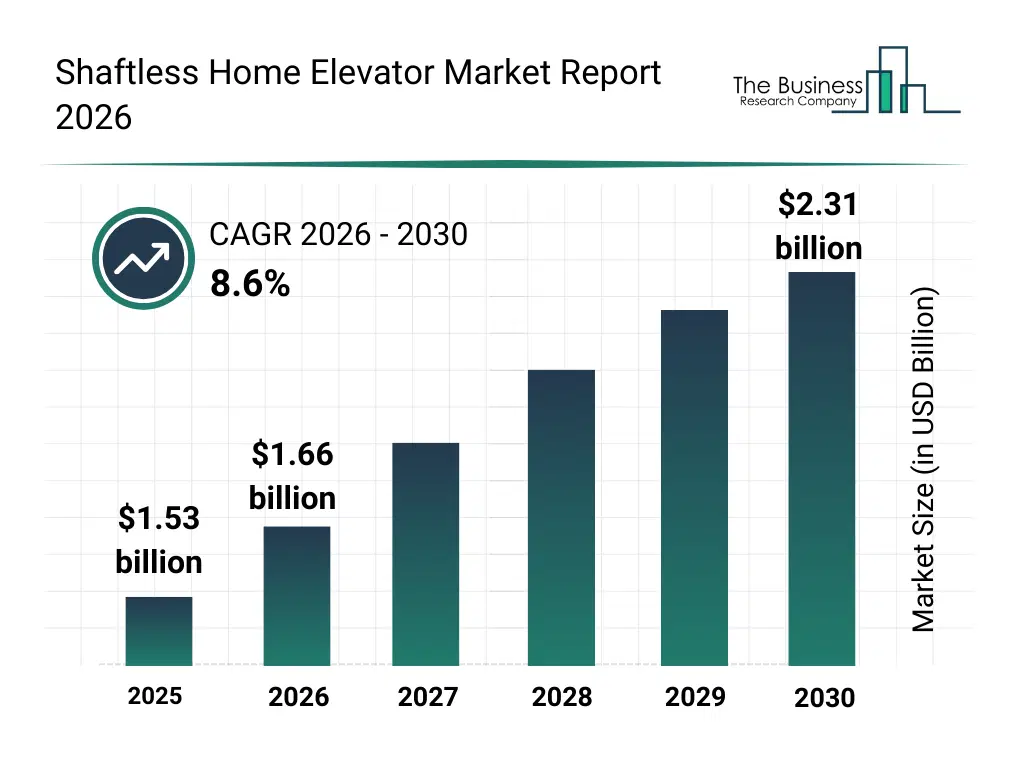
What Is The Shaftless Home Elevator Market Size and Share 2026?
The shaftless home elevator market size has grown strongly in recent years. It will grow from $1.53 billion in 2025 to $1.66 billion in 2026 at a compound annual growth rate (CAGR) of 8.5%. The growth in the historic period can be attributed to aging population growth, home accessibility needs, luxury home upgrades, urban housing constraints, residential safety requirements.What Is The Shaftless Home Elevator Market Growth Forecast?
The shaftless home elevator market size is expected to see strong growth in the next few years. It will grow to $2.31 billion in 2030 at a compound annual growth rate (CAGR) of 8.6%. The growth in the forecast period can be attributed to smart home adoption, growth of multistory homes, elderly care infrastructure expansion, rising disposable incomes, demand for minimal construction solutions. Major trends in the forecast period include rising demand for aging in place solutions, growth of retrofit elevator installations, compact and space saving lift designs, integration of smart home controls, energy efficient residential elevators.Tariff Impact On Shaftless Home Elevator Market
Tariffs have influenced the shaftless home elevator market by increasing costs of imported drive systems, control units, and specialty materials. These impacts are most evident in premium residential elevators in Europe and Asia Pacific. Installation costs have risen. However, tariffs are encouraging regional component sourcing.
Global Shaftless Home Elevator Market Segmentation
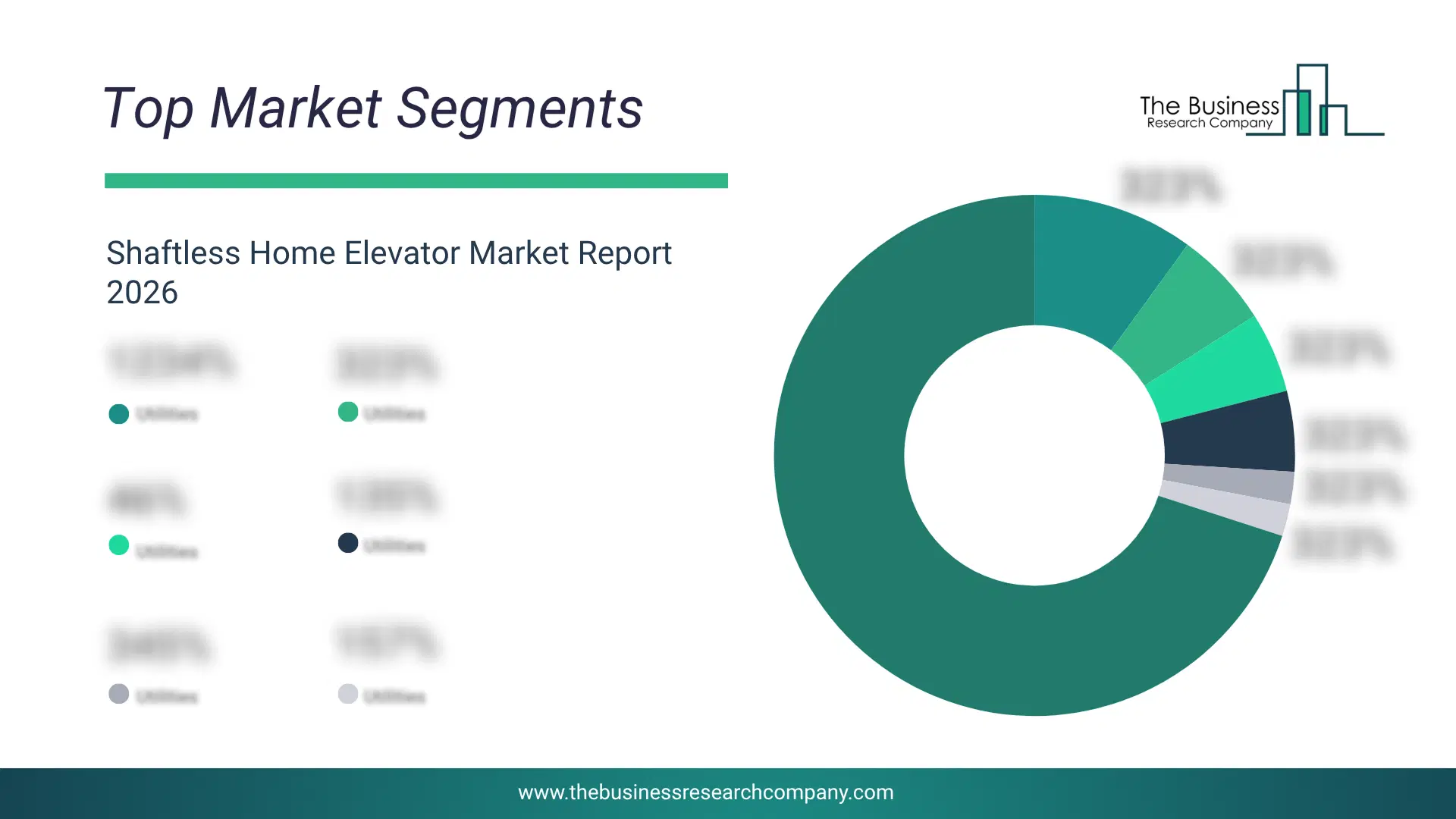
1) By Type Of Shaftless Home Elevators: Traction Shaftless Elevators, Pneumatic Shaftless Elevators, Vacuum Shaftless Elevators 2) By Technology Adoption: Smart Elevators, Energy Efficient Elevators, Remote Control Functionality, Internet of Things (IoT) Enabled Elevators 3) By Installation Type: New Installations, Retrofit Installations 4) By Application: Double Storey Building, Three Story Building 5) By End User: Residential Buildings, Retirement Homes, Luxury Villas Subsegments: 1) By Traction Shaftless Elevators: Counterweight-Based Compact Traction Elevators, Gearless Compact Traction Elevators (Low-Speed Residential), Machine-Room-Less (MRL) Traction Shaftless Elevators 2) By Pneumatic Shaftless Elevators: Single-Tube Pneumatic Elevators, Multi-Tube Pneumatic Elevators, Self-Supporting Pneumatic Elevators 3) By Vacuum Shaftless Elevators: Single-Chamber Vacuum Elevators, Multi-Chamber Vacuum Elevators, Modular Vacuum ElevatorsWhat Is The Driver Of The Shaftless Home Elevator Market?
The increasing demand for luxury homes is expected to propel the growth of the shaftless home elevator market going forward. Luxury homes refer to high-end residential properties that offer premium features, superior construction quality, prime locations, and exclusive amenities designed to provide exceptional comfort, privacy, and lifestyle. The increasing demand for luxury homes is due to affluent homeowners seeking premium amenities that enhance property value, offer seamless vertical mobility, and complement modern interior aesthetics. A shaftless home elevator enhances luxury homes by providing smooth and space-efficient vertical mobility with elegant design, adding both convenience and value to premium living spaces. For instance, in June 2025, according to a report published by Coldwell Banker, a US-based real estate company, the first five months of 2025 saw a 1.7% increase in single-family luxury home sales year over year and a 9.0% increase over 2023. Therefore, the increasing demand for luxury homes is driving growth in the shaftless home elevator industry.Key Players In The Global Shaftless Home Elevator Market
Major companies operating in the shaftless home elevator market are Savaria Corporation, Stiltz Home Lifts Ltd., Cibes Lift AB, Pneumatic Vacuum Elevators, Vacuum Elevators Inc., Nova Vacuum Elevators, Gartec Home Lifts Ltd., Terry Lifts Pvt. Ltd., Vimec S.p.A., Daze Elevator Pvt. Ltd., Nibav Home Elevators India Pvt. Ltd., Arrow Lift Ltd., Stag Elevators Ltd., Elite Elevators Limited, SWIFT Lifts Ltd., VKS Fuji Elevator Co. Ltd., Essaar Elevator India Pvt. Ltd., Fujitec Co. Ltd., Otis, KONE, Schindler, Thyssenkrupp Elevator, Mitsubishi Electric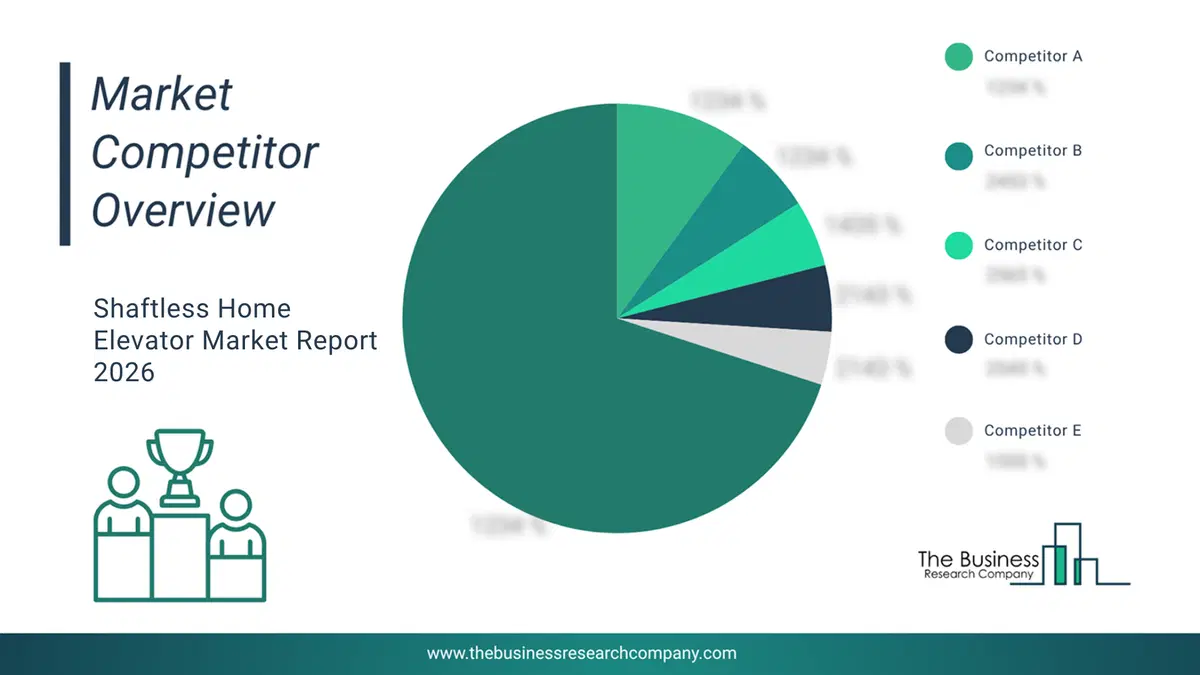
This chart is for illustrative purposes; the full report includes a detailed competitor analysis and comprehensive overview of the top 10 companies in the market.
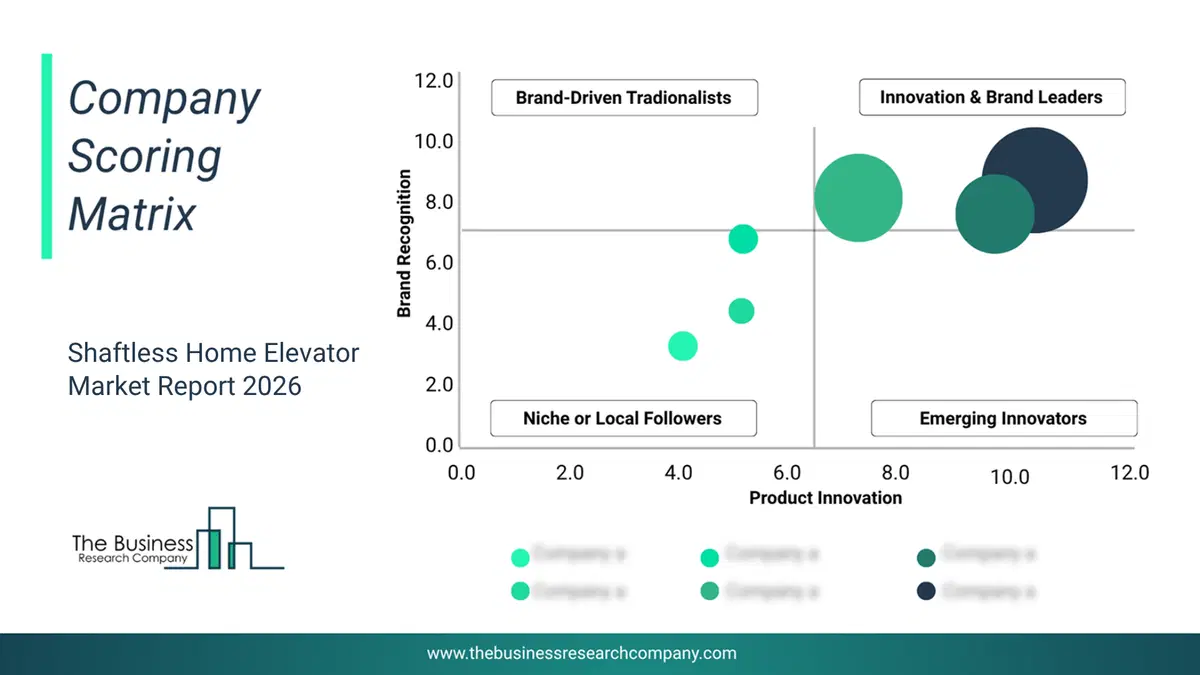
This chart maps companies by product innovation and brand strength, with bubble size indicating relative revenue, helping identify market leaders, challengers, and niche players. This is an illustrative chart; the full report provides a complete and accurate competitive analysis.
Global Shaftless Home Elevator Market Trends and Insights
Major companies operating in the shaftless home elevator market are focusing on developing advanced solutions, such as the carbon seal motor, to deliver durable, low-maintenance, and energy-efficient elevators. The carbon seal motor is a durable, dust- and moisture-resistant motor designed to protect internal elevator components and ensure long-lasting, reliable performance. In June 2024, Nibav Lifts Inc., an India-based elevator manufacturer, launched its Series 4 and Series 4 Max shaftless home elevators featuring advanced safety, customizable designs, and smart technologies such as global system for mobile communications (GSM) connectivity and voice assistants to enhance home mobility. The rapid rescue latch system introduced allows for quick and safe evacuation during emergencies by enabling rescue teams to easily and swiftly remove the polycarbonate glass, significantly reducing rescue time and enhancing overall passenger safety, which demonstrates Nibav’s strong commitment to innovative safety solutions in residential elevators.What Are Latest Mergers And Acquisitions In The Shaftless Home Elevator Market?
In September 2024, Harmar Mobility LLC, a US-based company that manufactures and designs accessibility and mobility solutions, acquired Pollock Lifts for an undisclosed amount. Through this acquisition, Harmar Mobility aims to expand its product portfolio and market reach by leveraging Pollock Lifts’ expertise in wheelchairs and residential elevators to better serve customers across multiple regions. Pollock Lifts Ltd. is a UK-based manufacturer of shaftless home elevators for residential use.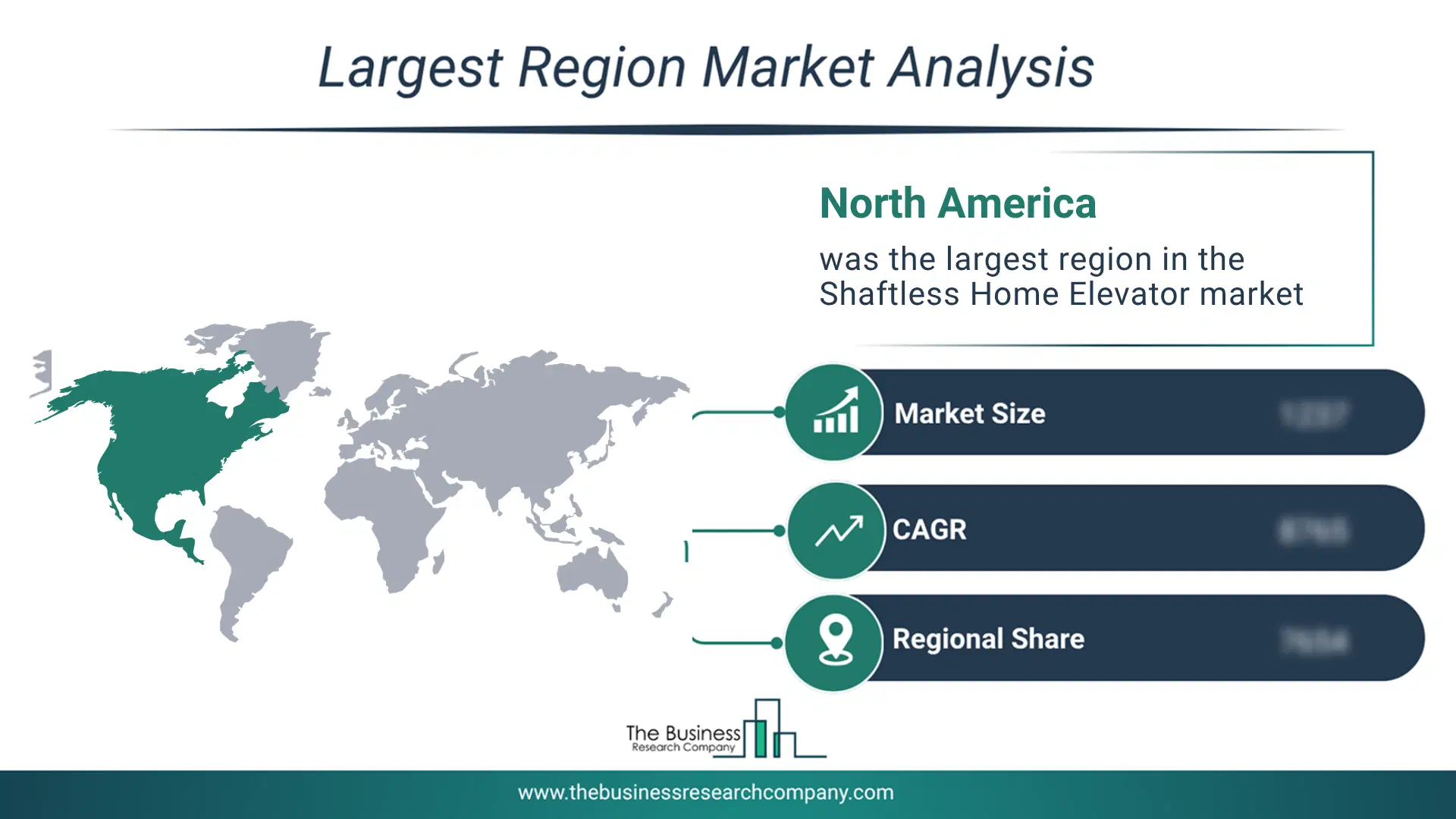
Regional Outlook
North America was the largest region in the shaftless home elevator market in 2025. Asia-Pacific is expected to be the fastest-growing region in the forecast period. The regions covered in this market report are Asia-Pacific, South East Asia, Western Europe, Eastern Europe, North America, South America, Middle East, Africa The countries covered in this market report are Australia, Brazil, China, France, Germany, India, Indonesia, Japan, Taiwan, Russia, South Korea, UK, USA, Canada, Italy, Spain.What Defines the Shaftless Home Elevator Market?
The shaftless home elevator market consists of revenues earned by entities by providing services such as maintenance and repair services, annual service contracts, design and aesthetic customization, and structural adaptation services. The market value includes the value of related goods sold by the service provider or included within the service offering. The shaftless home elevator market also includes sales of gearless drive units, geared drive units, steel cabin structures, aluminum cabin structures, and glass cabins. Values in this market are ‘factory gate’ values, that is the value of goods sold by the manufacturers or creators of the goods, whether to other entities (including downstream manufacturers, wholesalers, distributors and retailers) or directly to end customers. The value of goods in this market includes related services sold by the creators of the goods.How is Market Value Defined and Measured?
The market value is defined as the revenues that enterprises gain from the sale of goods and/or services within the specified market and geography through sales, grants, or donations in terms of the currency (in USD unless otherwise specified). The revenues for a specified geography are consumption values that are revenues generated by organizations in the specified geography within the market, irrespective of where they are produced. It does not include revenues from resales along the supply chain, either further along the supply chain or as part of other products.
This chart presents market attractiveness based on a quantitative evaluation of growth, competition, strategic alignment, and risk, offering a clear view of opportunity areas for decision-making. This chart is for illustrative purposes; the full report contains the complete analysis.

This chart highlights the Total Addressable Market (TAM) by estimating the maximum revenue opportunity using an assumption-driven approach, supporting strategic planning and opportunity sizing across markets. The chart is illustrative; the full report provides a more comprehensive analysis.
What Key Data and Analysis Are Included in the Shaftless Home Elevator Market Report 2026?
The shaftless home elevator market research report is one of a series of new reports from The Business Research Company that provides market statistics, including industry global market size, regional shares, competitors with the market share, detailed market segments, market trends and opportunities, and any further data you may need to thrive in the shaftless home elevator industry. The market research report delivers a complete perspective of everything you need, with an in-depth analysis of the current and future state of the industry.Shaftless Home Elevator Market Report Forecast Analysis
| Report Attribute | Details |
|---|---|
| Market Size Value In 2026 | $1.66 billion |
| Revenue Forecast In 2030 | $2.31 billion |
| Growth Rate | CAGR of 8.6% from 2026 to 2030 |
| Base Year For Estimation | 2025 |
| Actual Estimates/Historical Data | 2020-2025 |
| Forecast Period | 2026 - 2030 |
| Market Representation | Revenue in USD Billion and CAGR from 2026 to 2030 |
| Segments Covered | Type Of Shaftless Home Elevators, Technology Adoption, Installation Type, Application, End User |
| Regional Scope | Asia-Pacific, Western Europe, Eastern Europe, North America, South America, Middle East, Africa |
| Key Companies Profiled | Savaria Corporation, Stiltz Home Lifts Ltd., Cibes Lift AB, Pneumatic Vacuum Elevators, Vacuum Elevators Inc., Nova Vacuum Elevators, Gartec Home Lifts Ltd., Terry Lifts Pvt. Ltd., Vimec S.p.A., Daze Elevator Pvt. Ltd., Nibav Home Elevators India Pvt. Ltd., Arrow Lift Ltd., Stag Elevators Ltd., Elite Elevators Limited, SWIFT Lifts Ltd., VKS Fuji Elevator Co. Ltd., Essaar Elevator India Pvt. Ltd., Fujitec Co. Ltd., Otis, KONE, Schindler, Thyssenkrupp Elevator, Mitsubishi Electric |
| Customization Scope | Request for Customization |
| Pricing And Purchase Options | Explore Purchase Options |