
Shelf Life Testing Market Report 2026
Global Outlook – By Technology (Equipment And Kit-Based, Manual Tests), By Parameter (Microbial Contamination, Rancidity, Nutrient Stability, Organoleptic Properties, Other Parameters), By Method (Real-Time Shelf Life Testing, Accelerated Shelf-Life Testing), By Food Tested (Packaged Food, Beverages, Bakery And Confectionery Products, Meat And Meat Products, Dairy Products And Desserts, Processed Fruits And Vegetables, Other Food Tests) – Market Size, Trends, Strategies, and Forecast to 2030
Shelf Life Testing Market Overview
• Shelf Life Testing market size has reached to $4.9 billion in 2025 • Expected to grow to $7.54 billion in 2030 at a compound annual growth rate (CAGR) of 9% • Growth Driver: Rising Demand For Organic Food Is Anticipated To Fuel Shelf Life Testing Market • Market Trend: Extended-Life Ammonia Testing Solution Enhances Reliability For Diverse Water Applications • Europe was the largest region in 2025 and Asia-Pacific is the fastest growing region.What Is Covered Under Shelf Life Testing Market?
Shelf life testing is the process of testing different parameters and quality factors of food to determine how rapidly microbiological, chemical, and physical changes occur in food during distribution and storage. The main types of shelf life testing technologies include equipment and kit-based and manual tests. Equipment and kit-based use various tools and equipment such as spectrometers, alcohol analyzers, refractometers, titrators, and moisture analyzers to test food substances. The different shelf life testing parameters include microbial contamination, rancidity, nutrient stability, organoleptic properties, and other parameters. The shelf life testing methods include real-time shelf life testing and accelerated shelf life testing. The food tested includes packaged food, beverages, bakery and confectionery products, meat and meat products, dairy products and desserts, processed fruits and vegetables, and others.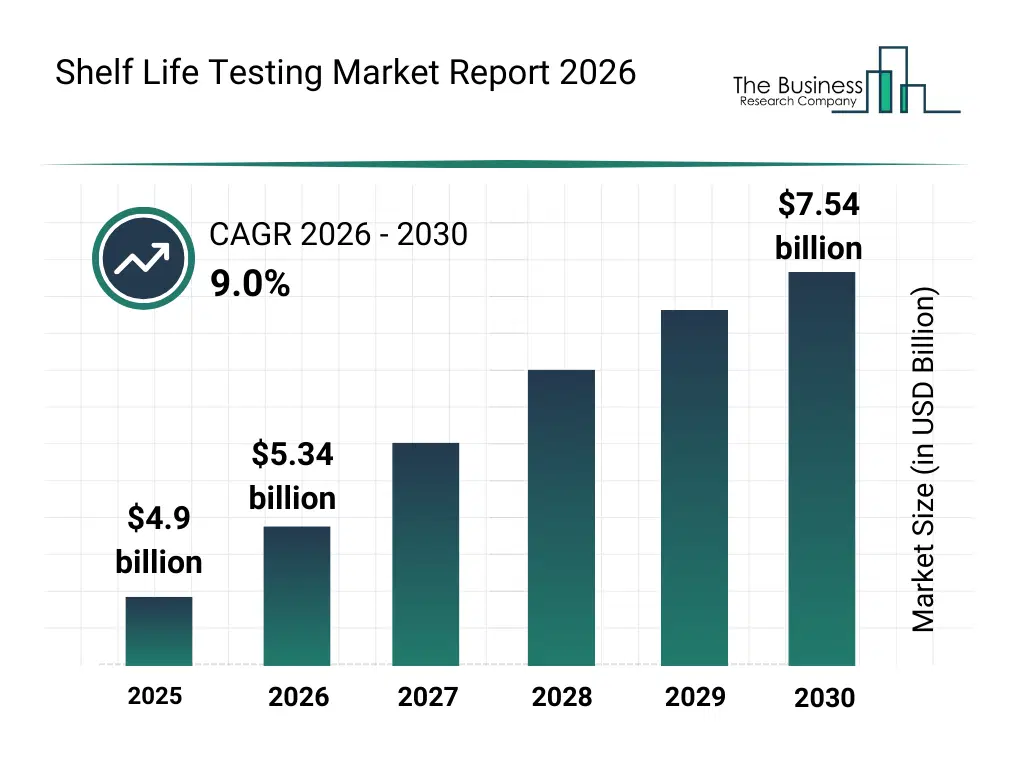
What Is The Shelf Life Testing Market Size and Share 2026?
The shelf life testing market size has grown strongly in recent years. It will grow from $4.9 billion in 2025 to $5.34 billion in 2026 at a compound annual growth rate (CAGR) of 9.0%. The growth in the historic period can be attributed to expansion of packaged food consumption, growth of food safety regulations, increased outsourcing of food testing services, development of laboratory testing infrastructure, rising awareness of food quality standards.What Is The Shelf Life Testing Market Growth Forecast?
The shelf life testing market size is expected to see strong growth in the next few years. It will grow to $7.54 billion in 2030 at a compound annual growth rate (CAGR) of 9.0%. The growth in the forecast period can be attributed to growing demand for rapid testing solutions, increasing integration of digital monitoring tools, expansion of testing for functional foods, rising focus on waste reduction through shelf life optimization, growing investments in food safety compliance. Major trends in the forecast period include increasing adoption of accelerated shelf life testing methods, growing use of advanced analytical equipment, rising demand for regulatory-compliant food testing, expansion of shelf life testing for packaged foods, enhanced focus on quality assurance.
Global Shelf Life Testing Market Segmentation
1) By Technology: Equipment And Kit-Based, Manual Tests 2) By Parameter: Microbial Contamination, Rancidity, Nutrient Stability, Organoleptic Properties, Other Parameters 3) By Method: Real-Time Shelf Life Testing, Accelerated Shelf-Life Testing 4) By Food Tested: Packaged Food, Beverages, Bakery And Confectionery Products, Meat And Meat Products, Dairy Products And Desserts, Processed Fruits And Vegetables, Other Food Tests Subsegments: 1) By Equipment And Kit-Based: Accelerated Shelf Life Testing Equipment, Stability Testing Kits, Analytical Testing Equipment 2) By Manual Tests: Microbial Testing Methods, Sensory Evaluation Techniques, Chemical Stability Tests, Physical Stability AssessmentsWhat Is The Driver Of The Shelf Life Testing Market?
Rising demand for organic food is expected to propel the growth of the shelf life testing market going forward. Organic food refers to produce grown and processed without synthetic pesticides, fertilizers, or genetically modified organisms, adhering to strict organic farming standards. Shelf-life testing ensures the quality and safety of organic food products by assessing their durability, freshness, and adherence to organic standards over time. For instance, in April 2025, according to the statistics published by the Organic Trade Association (OTA), a US-based business association of the organic industry, driven by rising consumer demand, U.S. certified organic product sales climbed 5.2% in 2024-more than double the 2.5% growth of the total market-and reached a record USD 71.6 billion for the year. Therefore, the rising demand for organic food is driving the shelf life testing industry.Key Players In The Global Shelf Life Testing Market
Major companies operating in the shelf life testing market are SGS SA, Bureau Veritas, Eurofins Global, Intertek Group PLC, Mérieux NutriSciences Corp., ALS Limited, AsureQuality Limited, RJ Hill Laboratories, Symbio Laboratories, AES Laboratories Pvt. Ltd., Medallion Labs, Q Laboratories Inc., Microbac Laboratories Inc., Silliker Inc., Food Safety Net Services, Eurofins Scientific SE, Campden BRI, Merieux NutriSciences, Dairy One Cooperative Inc., Microchem Laboratory
This chart is for illustrative purposes; the full report includes a detailed competitor analysis and comprehensive overview of the top 10 companies in the market.
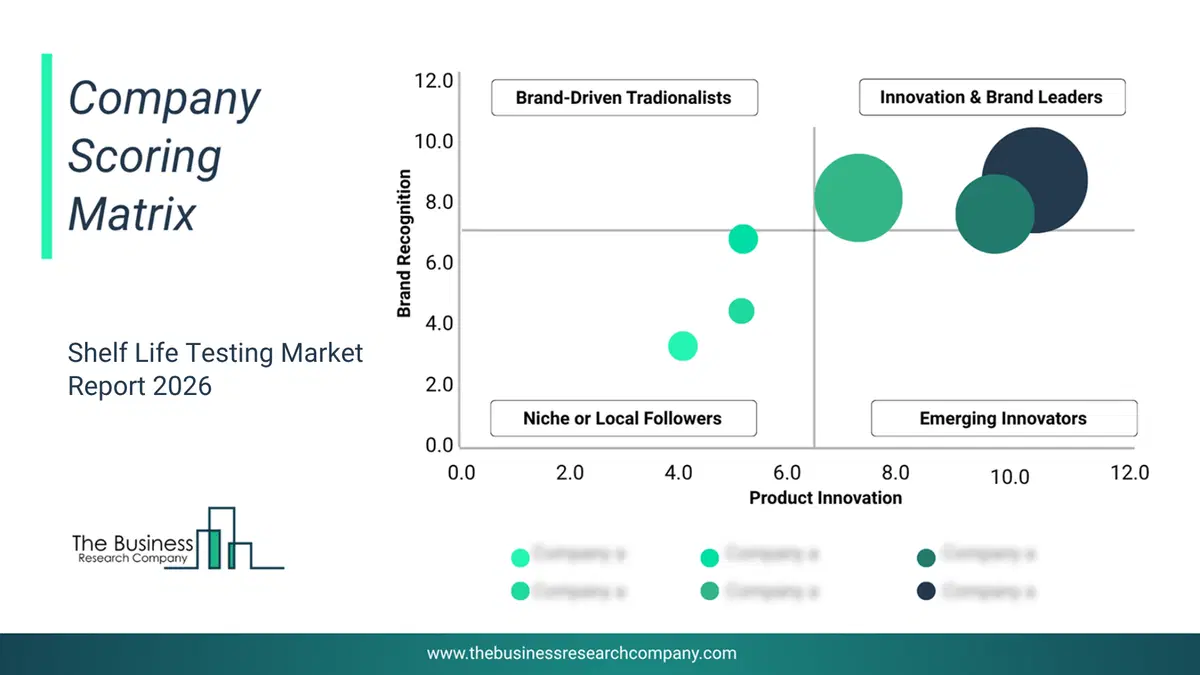
This chart maps companies by product innovation and brand strength, with bubble size indicating relative revenue, helping identify market leaders, challengers, and niche players. This is an illustrative chart; the full report provides a complete and accurate competitive analysis.
Global Shelf Life Testing Market Trends and Insights
Major companies operating in the water quality testing market are focusing on developing innovative solutions such as water testing kits to improve analytical reliability, extend reagent stability, and increase measurement flexibility across diverse field conditions. A water testing kit is a compact analytical device that enables users to assess chemical constituents in water through predefined reagents, sampling tools, and instrument-readable test formats. For instance, in January 2023, CHEMetrics LLC, a US-based manufacturer of water analysis solutions, announced the K-1513 Vacu-vials Ammonia Test Kit. The kit features an extended twelve-month room-temperature shelf life, a significant improvement over prior versions, and supports a wider ammonia measurement range for both routine and seawater testing. Its design increases field practicality by eliminating refrigeration needs and offering compatibility with direct-readout photometers or standard spectrophotometers.What Are Latest Mergers And Acquisitions In The Shelf Life Testing Market?
In October 2024, Mérieux NutriSciences, a US-based food safety company, acquired Bureau Veritas for an undisclosed amount. Through its acquisition of Kineco Kaman Composites India Private Ltd., Mérieux NutriSciences aims to enhance its capabilities in the fields of advanced materials and composites, particularly in sectors like aerospace and defense. Bureau Veritas is a France-based certification company.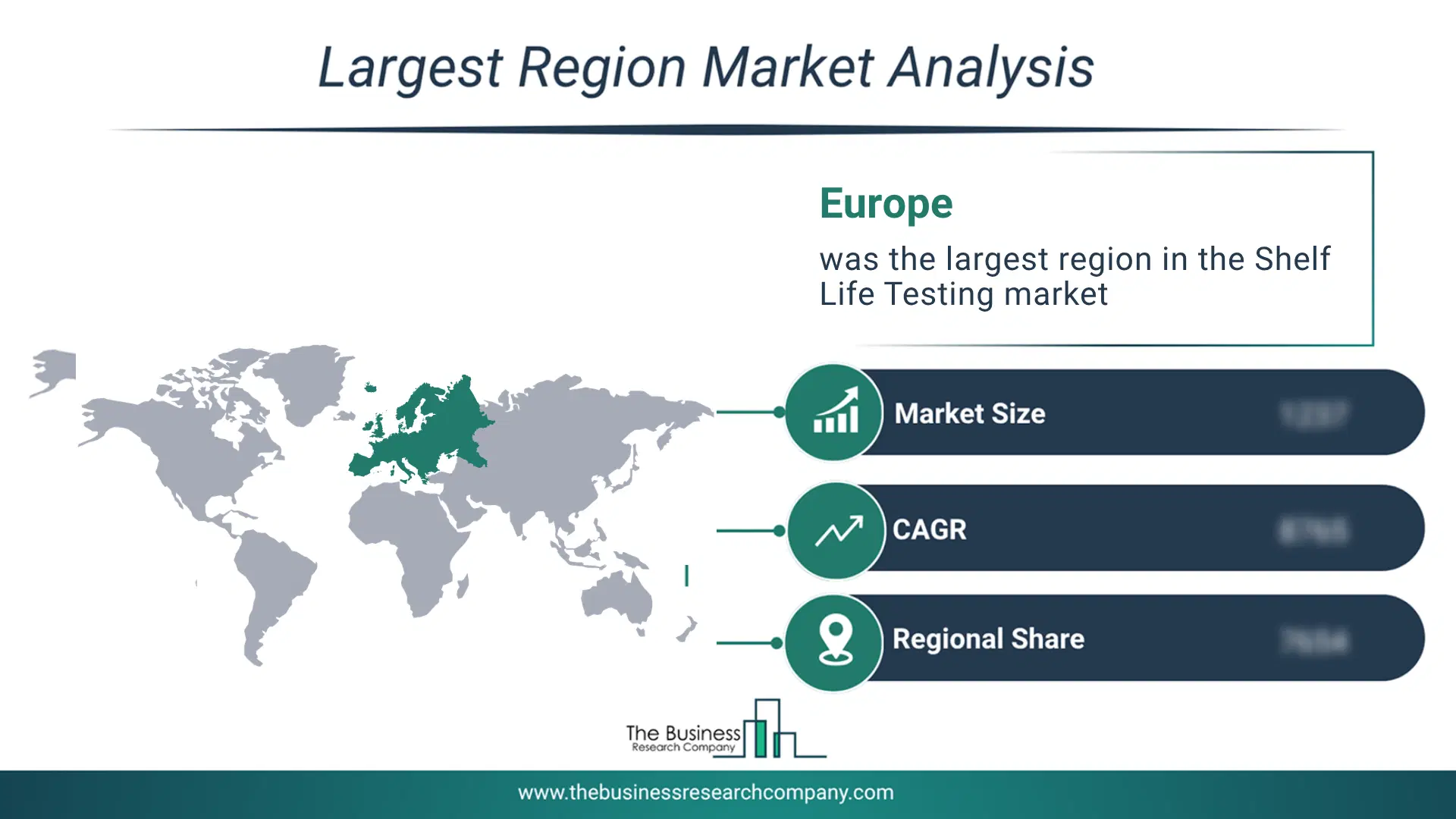
Regional Outlook
Europe was the largest region in the shelf life testing market share in 2025. Asia-Pacific is expected to be the fastest-growing region in the forecast period. The regions covered in this market report are Asia-Pacific, South East Asia, Western Europe, Eastern Europe, North America, South America, Middle East and Africa. The countries covered in this market report are Australia, Brazil, China, France, Germany, India, Indonesia, Japan, Taiwan, Russia, South Korea, UK, USA, Italy, Spain, CanadaWhat Defines the Shelf Life Testing Market?
The shelf life testing market includes revenues earned by entities by testing bacterial contamination, food additives, acidity, and pH value in packed food or beverages using static testing methods. The market value includes the value of related goods sold by the service provider or included within the service offering. Only goods and services traded between entities or sold to end consumers are included.How is Market Value Defined and Measured?
The market value is defined as the revenues that enterprises gain from the sale of goods and/or services within the specified market and geography through sales, grants, or donations in terms of the currency (in USD unless otherwise specified). The revenues for a specified geography are consumption values that are revenues generated by organizations in the specified geography within the market, irrespective of where they are produced. It does not include revenues from resales along the supply chain, either further along the supply chain or as part of other products.
This chart presents market attractiveness based on a quantitative evaluation of growth, competition, strategic alignment, and risk, offering a clear view of opportunity areas for decision-making. This chart is for illustrative purposes; the full report contains the complete analysis.

This chart highlights the Total Addressable Market (TAM) by estimating the maximum revenue opportunity using an assumption-driven approach, supporting strategic planning and opportunity sizing across markets. The chart is illustrative; the full report provides a more comprehensive analysis.
What Key Data and Analysis Are Included in the Shelf Life Testing Market Report 2026?
The shelf life testing market research report is one of a series of new reports from The Business Research Company that provides market statistics, including industry global market size, regional shares, competitors with the market share, detailed market segments, market trends and opportunities, and any further data you may need to thrive in the shelf life testing industry. The market research report delivers a complete perspective of everything you need, with an in-depth analysis of the current and future state of the industry.Shelf Life Testing Market Report Forecast Analysis
| Report Attribute | Details |
|---|---|
| Market Size Value In 2026 | $5.34 billion |
| Revenue Forecast In 2030 | $7.54 billion |
| Growth Rate | CAGR of 9.0% from 2026 to 2030 |
| Base Year For Estimation | 2025 |
| Actual Estimates/Historical Data | 2020-2025 |
| Forecast Period | 2026 - 2030 |
| Market Representation | Revenue in USD Billion and CAGR from 2026 to 2030 |
| Segments Covered | Technology, Parameter, Method, Food Tested |
| Regional Scope | Asia-Pacific, Western Europe, Eastern Europe, North America, South America, Middle East, Africa |
| Country Scope | The countries covered in the report are Australia, Brazil, China, France, Germany, India, Indonesia, Japan, Taiwan, Russia, South Korea, UK, USA, Canada, Italy, Spain. |
| Key Companies Profiled | SGS SA, Bureau Veritas, Eurofins Global, Intertek Group PLC, Mérieux NutriSciences Corp., ALS Limited, AsureQuality Limited, RJ Hill Laboratories, Symbio Laboratories, AES Laboratories Pvt. Ltd., Medallion Labs, Q Laboratories Inc., Microbac Laboratories Inc., Silliker Inc., Food Safety Net Services, Eurofins Scientific SE, Campden BRI, Merieux NutriSciences, Dairy One Cooperative Inc., Microchem Laboratory |
| Customization Scope | Request for Customization |
| Pricing And Purchase Options | Explore Purchase Options |