
Shelf-Stable Ready-To-Drink Beverages Market Report 2026
Global Outlook – By Product Type (Juices, Teas And Coffees, Dairy-Based Beverages, Plant-Based Beverages, Energy And Sports Drinks, Functional Beverages, Other Product Types), By Packaging Type (Bottles, Cans, Cartons, Pouches, Other Packaging Types), By Flavor Type (Fruit Flavors, Chocolate Flavors, Vanilla Flavors, Herbal Flavors, Other Flavor Types), By Distribution Channel (Supermarkets Or Hypermarkets, Convenience Stores, Online Retail, Specialty Stores, Other Distribution Channels), By End-User (Household, Foodservice, Institutional, Other End-Users) – Market Size, Trends, Strategies, and Forecast to 2035
Shelf-Stable Ready-To-Drink Beverages Market Overview
• Shelf-Stable Ready-To-Drink Beverages market size has reached to $323.05 billion in 2025 • Expected to grow to $432.52 billion in 2030 at a compound annual growth rate (CAGR) of 6.1% • Growth Driver: The Increasing Demand For Convenience-Based Beverages The Growth Of The Market Due To Changing Consumer Lifestyles • Market Trend: Long-Life Dairy Innovation Enhancing Convenient On-The-Go Nutrition And Emergency Food Security • North America was the largest region in 2025 and Asia-Pacific is the fastest growing region.What Is Covered Under Shelf-Stable Ready-To-Drink Beverages Market?
Shelf-stable ready-to-drink (RTD) beverages are pre-packaged drinks that are manufactured and processed to remain safe and maintain quality at room temperature for extended periods without the need for refrigeration before opening. They are fully prepared for immediate consumption, requiring no mixing or dilution, and are typically preserved using techniques such as pasteurization or ultra-high temperature processing, along with airtight, protective packaging. The main product types of shelf-stable ready-to-drink beverages include juices, teas and coffees, dairy-based beverages, plant-based beverages, energy and sports drinks, functional beverages, and other product types. Juices refer to ready-to-drink fruit and vegetable-based beverages processed for long shelf life without refrigeration. These beverages are offered in packaging types such as bottles, cans, cartons, pouches, and other packaging types and are available in flavor types including fruit flavors, chocolate flavors, vanilla flavors, herbal flavors, and other flavor types. They are distributed through supermarkets or hypermarkets, convenience stores, online retail, specialty stores, and other distribution channels, and they are used by several end users such as household, foodservice, institutional, and others.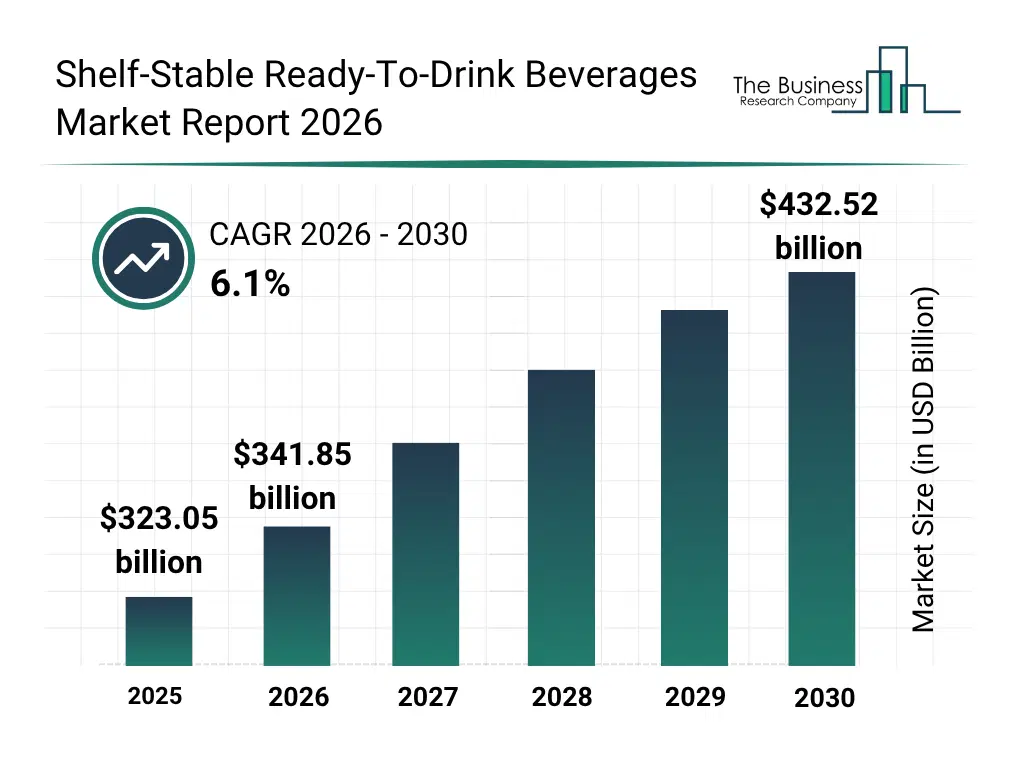
What Is The Shelf-Stable Ready-To-Drink Beverages Market Size and Share 2026?
The shelf-stable ready-to-drink beverages market size has grown strongly in recent years. It will grow from $323.05 billion in 2025 to $341.85 billion in 2026 at a compound annual growth rate (CAGR) of 5.8%. The growth in the historic period can be attributed to limited cold chain infrastructure in emerging markets, high spoilage rates in traditional beverages, increasing demand for convenient packaged drinks, growth of mass retail distribution channels, rising urbanization and on the go consumption habits.What Is The Shelf-Stable Ready-To-Drink Beverages Market Growth Forecast?
The shelf-stable ready-to-drink beverages market size is expected to see strong growth in the next few years. It will grow to $432.52 billion in 2030 at a compound annual growth rate (CAGR) of 6.1%. The growth in the forecast period can be attributed to rising demand for longer shelf life functional beverages, expansion of e commerce driven beverage distribution, increasing adoption of aseptic packaging technologies, growing preference for clean label and natural ingredients, expansion of global ready to drink beverage consumption. Major trends in the forecast period include clean label shelf stable beverage formulations, extended ambient storage packaging innovations, aseptic processing based rtd beverage production, natural preservative adoption in shelf stable drinks, premium functional ambient beverage offerings.
Global Shelf-Stable Ready-To-Drink Beverages Market Segmentation
1) By Product Type: Juices, Teas And Coffees, Dairy-Based Beverages, Plant-Based Beverages, Energy And Sports Drinks, Functional Beverages, Other Product Types 2) By Packaging Type: Bottles, Cans, Cartons, Pouches, Other Packaging Types 3) By Flavor Type: Fruit Flavors, Chocolate Flavors, Vanilla Flavors, Herbal Flavors, Other Flavor Types 4) By Distribution Channel: Supermarkets Or Hypermarkets, Convenience Stores, Online Retail, Specialty Stores, Other Distribution Channels 5) By End-User: Household, Foodservice, Institutional, Other End-Users Subsegments: 1) By Juices: Fruit Juices, Vegetable Juices, Blended Juices, Concentrated Juices 2) By Teas And Coffees: Black Tea, Green Tea, Herbal Tea, Cold Brew Coffee, Iced Coffee 3) By Dairy-Based Beverages: Flavored Milk, Milkshakes, Drinkable Yogurt, Lactose Free Milk Beverages, Protein Enriched Dairy Drinks 4) By Plant-Based Beverages: Almond Based Beverages, Soy Based Beverages, Oat Based Beverages, Coconut Based Beverages, Rice Based Beverages 5) By Energy And Sports Drinks: Caffeinated Energy Drinks, Electrolyte Sports Drinks, Isotonic Drinks, Organic Energy Drinks, Performance Enhancing Drinks 6) By Functional Beverages: Probiotic Drinks, Vitamin Fortified Beverages, Antioxidant Beverages, Detox Beverages, Immunity Boosting Drinks 7) By Other Product Types: Flavored Water, Carbonated Soft Drinks, Ready To Drink Soups, Nutritional Meal Replacement Drinks, Specialty BeveragesWhat Is The Driver Of The Shelf-Stable Ready-To-Drink Beverages Market?
The increasing demand for convenience-based beverages is expected to propel the growth of the shelf-stable ready-to-drink beverages market going forward. A convenience-based beverage refers to a ready-to-consume drink designed for quick consumption with minimal or no preparation, such as energy drinks, sports drinks, bottled water, and ready-to-drink coffee or tea, catering to on-the-go consumer needs. The increasing demand for convenience-based beverages is primarily due to changing consumer lifestyles, where busy schedules, urbanization, and on-the-go consumption habits drive people to prefer quick, ready-to-drink options over time-consuming traditional beverage preparation. Demand for convenience-based beverages is driving the growth of shelf-stable ready-to-drink beverages by encouraging consumers to choose portable, long-shelf-life drinks that require no refrigeration and offer instant consumption on the go. For instance, in February 2024, according to Monster Beverage Corporation, a US-based beverage company that manufactures energy drinks, net sales for the company's Monster Energy Drinks sector increased to $1.60 billion in the fourth quarter of 2023, compared with $1.39 billion in the same quarter of 2022. Therefore, the increasing demand for convenience-based beverages is driving the growth of the shelf-stable ready-to-drink beverages industry.Key Players In The Global Shelf-Stable Ready-To-Drink Beverages Market
Major companies operating in the shelf-stable ready-to-drink beverages market are Nestlé S.A., PepsiCo Inc., Unilever PLC, The Coca-Cola Company, Danone S.A., Keurig Dr Pepper Inc., Royal Friesland Campina N.V., Tingyi (Cayman Islands) Holding Corp., Suntory Holdings Limited, Campbell Soup Company, Monster Beverage Corporation, Red Bull GmbH, Ito En Ltd., Ocean Spray Cranberries Inc., Tata Consumer Products Limited, AJE Group, Dabur India Limited, Parle Agro Private Limited, Hint Inc., Califia Farms LLCGlobal Shelf-Stable Ready-To-Drink Beverages Market Trends and Insights
Major companies operating in the shelf-stable ready-to-drink beverages market are focusing on developing innovative long-life products such as shelf-stable dairy milk to enhance product accessibility, extend shelf life, and meet demand for convenient, on-the-go nutrition in areas with limited refrigeration. Shelf-stable dairy milk is milk that has been processed and packaged in a way that allows it to be stored at room temperature for an extended period without refrigeration until opened. For instance, in July 2024, Chobani LLC, a US-based food company, launched Super Milk, an innovative shelf-stable dairy milk product designed to address emergency nutrition needs and food insecurity challenges. The product is made using high-quality dairy ingredients and processed through UHT technology to ensure microbial safety and extended shelf stability. It is packaged in aseptic cartons that preserve taste, texture, and nutritional value without the need for refrigeration. This milk is designed for versatility and can be consumed directly as a ready-to-drink beverage or included in emergency food kits, disaster relief supplies, and household pantry storage, offering reliable nutrition in situations where fresh milk access is limited.What Are Latest Mergers And Acquisitions In The Shelf-Stable Ready-To-Drink Beverages Market?
In December 2023, Chobani LLC, a US-based food and beverage company, acquired La Colombe Coffee Roasters for $900 million. With this acquisition, Chobani aims to accelerate its expansion into the ready-to-drink coffee segment, diversify its beverage portfolio beyond dairy and yogurt products, and strengthen its position in the premium functional coffee category. La Colombe Coffee Roasters Inc. is a US-based coffee company that provides shelf-stable ready-to-drink (RTD) beverages.Regional Outlook/Insights
North America was the largest region in the shelf-stable ready-to-drink beverages market in 2025. Asia-Pacific is expected to be the fastest-growing region in the forecast period. The regions covered in this market report are Asia-Pacific, South East Asia, Western Europe, Eastern Europe, North America, South America, Middle East, Africa. The countries covered in this market report are Australia, Brazil, China, France, Germany, India, Indonesia, Japan, Taiwan, Russia, South Korea, UK, USA, Canada, Italy, Spain.What Defines the Shelf-Stable Ready-To-Drink Beverages Market?
The shelf-stable ready-to-drink beverages market consists of sales of carbonated soft drinks, bottled water, coconut water, kombucha drinks, and meal replacement beverages. Values in this market are ‘factory gate’ values, that is the value of goods sold by the manufacturers or creators of the goods, whether to other entities (including downstream manufacturers, wholesalers, distributors and retailers) or directly to end customers. The value of goods in this market includes related services sold by the creators of the goods.How is Market Value Defined and Measured?
The market value is defined as the revenues that enterprises gain from the sale of goods and/or services within the specified market and geography through sales, grants, or donations in terms of the currency (in USD unless otherwise specified). The revenues for a specified geography are consumption values that are revenues generated by organizations in the specified geography within the market, irrespective of where they are produced. It does not include revenues from resales along the supply chain, either further along the supply chain or as part of other products.What Key Data and Analysis Are Included in the Shelf-Stable Ready-To-Drink Beverages Market Report 2026?
The shelf-stable ready-to-drink beverages market research report is one of a series of new reports from The Business Research Company that provides market statistics, including industry global market size, regional shares, competitors with the market share, detailed market segments, market trends and opportunities, and any further data you may need to thrive in the shelf-stable ready-to-drink beverages industry. The market research report delivers a complete perspective of everything you need, with an in-depth analysis of the current and future state of the industry.Shelf-Stable Ready-To-Drink Beverages Market Report Forecast Analysis
| Report Attribute | Details |
|---|---|
| Market Size Value In 2026 | $341.85 billion |
| Revenue Forecast In 2035 | $432.52 billion |
| Growth Rate | CAGR of 6.1% from 2026 to 2035 |
| Base Year For Estimation | 2025 |
| Actual Estimates/Historical Data | 2020-2025 |
| Forecast Period | 2026 - 2030 - 2035 |
| Market Representation | Revenue in USD Billion and CAGR from 2026 to 2035 |
| Segments Covered | Product Type, Packaging Type, Flavor Type, Distribution Channel, End-User |
| Regional Scope | Asia-Pacific, Western Europe, Eastern Europe, North America, South America, Middle East, Africa |
| Country Scope | The countries covered in the report are Australia, Brazil, China, France, Germany, India, Indonesia, Japan, Taiwan, Russia, South Korea, UK, USA, Canada, Italy, Spain. |
| Key Companies Profiled | Nestlé S.A., PepsiCo Inc., Unilever PLC, The Coca-Cola Company, Danone S.A., Keurig Dr Pepper Inc., Royal Friesland Campina N.V., Tingyi (Cayman Islands) Holding Corp., Suntory Holdings Limited, Campbell Soup Company, Monster Beverage Corporation, Red Bull GmbH, Ito En Ltd., Ocean Spray Cranberries Inc., Tata Consumer Products Limited, AJE Group, Dabur India Limited, Parle Agro Private Limited, Hint Inc., Califia Farms LLC |
| Customization Scope | Request for Customization |
| Pricing And Purchase Options | Explore Purchase Options |