
Contact Us
  Search
The Business Research Company Logo
Ship Building Global Market Opportunities And Strategies To 2035
Published :June 2026
Pages :370
Format :PDF
Delivery Time :2-3 Business Days
ⓘ
Why 2-3 days? We update the report with the latest data and news before delivery. Let us know if you need us to expedite.
Report Price :$4,490.00

Ship Building Global Market Opportunities And Strategies To 2035

By Product (Bulkers, Tankers, Containers, Cruise And Ferry, Other Products), By Application (Passenger Transportation, Goods Transportation), By End-User Industry (Logistics Companies, Cruise Operators, Other End-Users), And By Region, Opportunities And Strategies – Global Forecast To 2035

Ship Building Market Definition

Ship building is the process of designing, constructing and assembling ships and other floating vessels such as cargo ships, tankers, naval ships, offshore platforms and passenger vessels. It involves multiple stages including conceptual design, engineering, material procurement, fabrication of hull structures, installation of machinery and systems and final testing. The primary purpose of ship building is to support global transportation, trade and maritime operations. The ship building market consists of revenues generated by entities (organizations, sole proprietors and partnerships) that design, construct, repair and retrofit ships and other marine vessels. The market includes both commercial and specialized vessels used for transporting goods and passengers across waterways. It also includes associated services such as ship conversion and modernization. However, the market does not include revenues generated from maritime transportation services, ship leasing, or standalone marine equipment manufacturing that is not integrated into ship building activities.
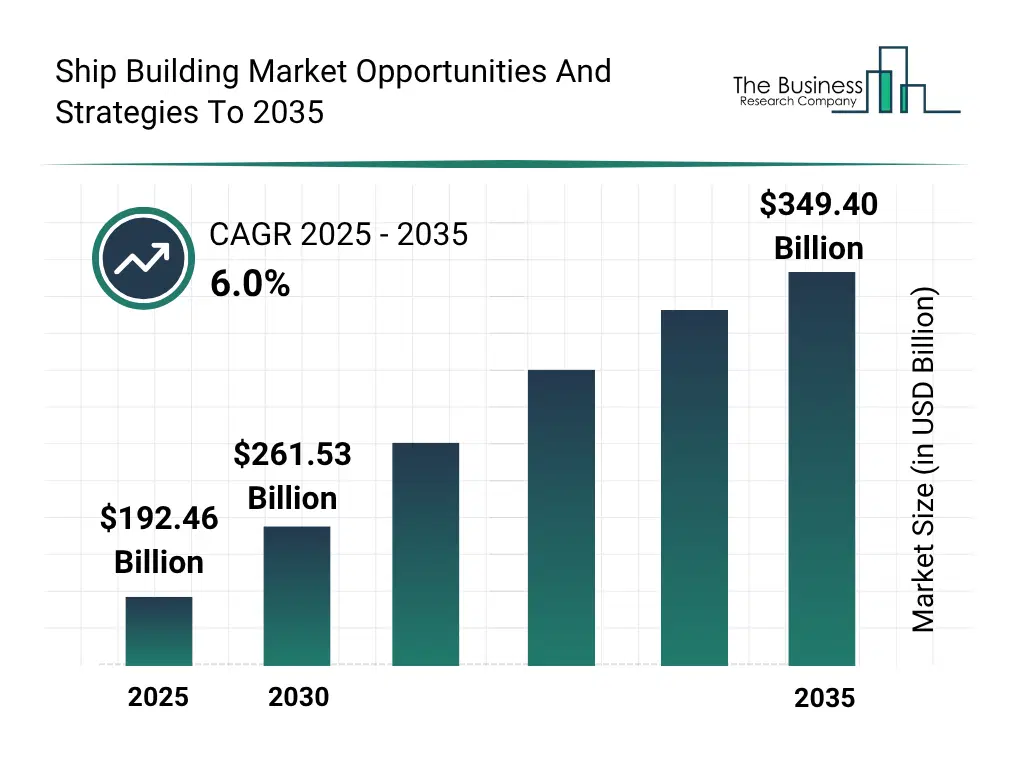
Ship Building Global Market Opportunities And Strategies To 2035 Market Size and growth rate 2026 to 2030: Graph

Ship Building Market Size

The global ship building market reached a value of nearly $192,461.7 million in 2025, having grown at a compound annual growth rate (CAGR) of 7.5% since 2020. The market is expected to grow from $192,461.7 million in 2025 to $261,529.9 million in 2030 at a rate of 6.3%. The market is then expected to grow at a CAGR of 6.0% from 2030 and reach $349,404.1 million in 2035. Growth in the historic period resulted from rising global seaborne trade, rising maritime tourism and cruise industry growth, growing import–export activities and rising demand for LNG carriers and gas transport vessels. Factors that negatively affected growth in the historic period were rising volatility in global maritime trade cycles and increasing high capital investment requirements. Going forward, increasing aging fleet replacement, government support for domestic ship building industries, growing offshore oil and gas exploration activities and increasing naval defense procurement and fleet expansion will drive the growth. Factors that could hinder the growth of the ship building market in the future include rising competition for skilled industrial workforce, increasing maritime emission compliance pressure and impact of trade wars and tariffs.
Research Expert

Book your 30 minutes free consultation with our research experts

Ship Building Market Segmentation

The ship building market is segmented by product, by application and by end-user industry.

By Product –
The ship building market is segmented by product into:
    • a) Bulkers
    • b) Tankers
    • c) Containers
    • d) Cruise And Ferry
    • e) Other Products
The bulkers market was the largest segment of the ship building market segmented by product, accounting for 34.7% or $66,833.5 million of the total in 2025. Going forward, the bulkers segment is expected to be the fastest growing segment in the ship building market segmented by product, at a CAGR of 6.4% during 2025-2030.

By Application –
The Ship Building market is segmented by application into:
    • a) Passenger Transportation
    • b) Goods Transportation
The goods transportation market was the largest segment of the ship building market segmented by application, accounting for 93.1% or $179,163.6 million of the total in 2025. Going forward, the goods transportation segment is expected to be the fastest growing segment in the ship building market segmented by application, at a CAGR of 6.3% during 2025-2030.

By End-User Industry –
The Ship Building market is segmented by end-user industry into:
    • a) Logistics Companies
    • b) Cruise Operators
    • c) Other End-Users
The logistics companies market was the largest segment of the ship building market segmented by end-user, accounting for 91.7% or $176,514.6 million of the total in 2025. Going forward, the logistics companies segment is expected to be the fastest growing segment in the ship building market segmented by end-user, at a CAGR of 6.3% during 2025-2030.

By Geography - The ship building market is segmented by geography into:
      o Asia Pacific
      • China
      • India
      • Japan
      • Australia
      • Indonesia
      • South Korea
      o North America
      • USA
      • Canada
      o South America
      • Brazil
      o Western Europe
      • France
      • Germany
      • UK
      • Italy
      • Spain
      o Eastern Europe
      • Russia
      o Middle East
      o Africa
Asia Pacific was the largest region in the ship building market, accounting for 48.9% or $94,100.7 million of the total in 2025. It was followed by Western Europe, North America and then the other regions. Going forward, the fastest-growing regions in the ship building market will be Middle East and Africa where growth will be at CAGRs of 11.8% and 11.0% respectively. These will be followed by Western Europe and Asia Pacific where the markets are expected to grow at CAGRs of 7.1% and 6.9% respectively.

Ship Building Market Drivers

The key drivers of the ship building market include: Increasing Aging Fleet Replacement During the forecast period, increasing aging fleet replacement is expected to be a key driver propelling growth in the ship building market. As global maritime fleets continue to age, shipowners and operators are increasingly facing higher maintenance costs, operational inefficiencies and safety risks associated with older vessels. Aging fleets typically refer to ships that have been in service for extended periods, often exceeding 20–25 years and are more prone to mechanical failures, structural deterioration and compliance challenges with modern safety and environmental regulations. The growing number of vessels approaching the later stages of their operational lifecycle is increasing pressure on fleet operators to modernize their fleets; maritime industry stakeholders are continuously evaluating fleet renewal strategies and adopting newly built vessels that align with evolving regulatory standards and operational requirements, reflecting the broader transition toward safer and more efficient maritime transportation. This increasing emphasis on replacing aging vessels is supporting demand for new ship construction. The increasing aging fleet replacement growth contribution during the forecast period in 2025 is 1.5%.

Ship Building Market Restraints

The key restraints on the ship building market include: Increasing Maritime Emission Compliance Pressure During the forecast period, increasing maritime emission compliance pressure is expected to restrict the growth of the ship building market. As the maritime sector faces stricter environmental regulations, including limits on greenhouse gas (GHG) emissions, sulfur oxides (SOx) and nitrogen oxides (NOx), shipbuilders are required to adopt cleaner fuels, energy-efficient designs and advanced emission control technologies. The growing emphasis on reducing carbon footprints and meeting international maritime emission standards increases the complexity and cost of ship construction and retrofitting. Concerns related to regulatory compliance, environmental penalties and the need for sustainable ship design practices can create challenges for ship manufacturers and operators. The rising need to adhere to emission reduction frameworks and environmental sustainability mandates may slow the expansion of the ship building market. Growth affected by the increasing maritime emission compliance pressure during the forecast period in 2025 is -1.5%.

Ship Building Market Competitive Landscape

Major Competitors are:

  • HD Hyundai Heavy Industries (HHI)
  • Fincantieri S.p.A.
  • Yangzijiang Shipbuilding Ltd.
  • Cochin Shipyard Limited
  • China State Shipbuilding Corporation (CSSC)
  • Other Competitors Include:

  • Hanwha Ocean (formerly Daewoo Shipbuilding & Marine Engineering / DSME)
  • Mitsubishi Heavy Industries Ltd.
  • Meyer Turku Oy
  • Thyssenkrupp AG
  • Damen Shipyards Group
  • Shanghai Waigaoqiao Shipbuilding Co., Ltd.
  • Western India Shipyard
  • Imabari Shipbuilding Co., Ltd.
  • Tsuneishi Shipbuilding Co., Ltd.
  • Korea Shipbuilding & Offshore Engineering Co., Ltd.
  • Japan Marine United Corporation
  • Samsung Heavy Industries Co., Ltd.
  • CSBC Corporation Taiwan
  • Monterey Boats
  • Ellicott Dredges
  • Bertram Yachts
  • Master Boat Builders, Inc.
  • Crestliner Boats
  • Back Cove Yachts
  • Fabrication, LLC
  • Irving Shipbuilding Inc.
  • Seaspan Shipyards
  • Ontario Shipyards
  • Allied Shipbuilders Ltd.
  • Naval Group
  • Chantiers de l’Atlantique
  • Cantiere Navale Vittoria
  • Navantia
  • BAE Systems Maritime
  • Babcock International Group
  • Cammell Laird
  • VEKA Shipyard
  • Loděnice Chvaletice
  • LOKO Trans Shipyard
  • Remontowa Shipbuilding
  • Crist Shipyard
  • Constanța Shipyard
  • United Shipbuilding Corporation
  • Yantar Shipyard
  • Israel Shipyards
  • International Maritime Industries
  • Sedef Shipyard
  • ARES Shipyard
  • Abu Dhabi Ship Building
  • Abu Dhabi MAR
  • Alexandria Shipyard
  • Sandock Austral Shipyards
  • Need data on a specific region in this market?

    Opportunities And Recommendations In The Ship Building Market

    Opportunities – The top opportunities in the ship building market segmented by product will arise in the bulkers segment, which will gain $24,299.9 million of global annual sales by 2030. The top opportunities in the ship building market segmented by application will arise in the goods transportation segment, which will gain $64,302.9 million of global annual sales by 2030. The top opportunities in the ship building market segmented by end-user will arise in the logistics companies segment, which will gain $63,481.2 million of global annual sales by 2030. The ship building market size will gain the most in the China at $20,014.2 million. Recommendations- To take advantage of the opportunities, the business research company recommends the ship building companies to focus on scalable electric vessel innovation and sustainable design, focus on indigenous multi-role naval platforms and defense integration, focus on advanced combat-ready naval vessel design and integrated defense systems, focus on high-efficiency ro-ro vessel design and sustainable cargo operations, focus on bulk carrier segment expansion and efficient dry cargo solutions, expand in emerging markets, continue to focus on developed markets, focus on strategic global shipyard partnerships and regional market expansion, focus on value based pricing and long term contract structuring, focus on strategic industry positioning through technical proof and reference projects, focus on digital ecosystem promotion and stakeholder collaboration networks, focus on clean fuel enabled goods transportation vessel innovation focus on green logistics fleet expansion and large capacity cargo vessel development.
    Chat with us