
Ship Desalination Machine Market Report 2026
Global Outlook – By Product Type (Containerized Desalination Units, Modular Desalination Systems, Fixed Installation Desalination Equipment), By Technology Type (Reverse Osmosis, Multistage Flash Distillation, Multi Effect Distillation, Electrodialysis, Solar Desalination), By Vessel Type (Cargo Ships, Oil and Gas Tankers, Passenger Vessels, Naval Vessels, Research and Exploration Vessels), By Desalination Capacity (Low Capacity, Medium Capacity, High Capacity), By Application (Freshwater Supply for Crew and Passengers, Water Supply for Machinery and Equipment, Water Treatment for Sanitation Purposes, Industrial Applications) – Market Size, Trends, Strategies, and Forecast to 2030
Ship Desalination Machine Market Overview
• Ship Desalination Machine market size has reached to $1.38 billion in 2025 • Expected to grow to $1.96 billion in 2030 at a compound annual growth rate (CAGR) of 7.3% • Growth Driver: Rise In Global Shipping And Maritime Trade Activities Fueled The Growth Of The Market Due To Increased Demand For Sustainable Onboard Freshwater Supply • Market Trend: Innovative Maritime Solutions For Efficient And Reliable Freshwater Production At Sea • North America was the largest region in 2025 and Asia-Pacific is the fastest growing region.Market Gains By 2030 – Top Opportunities By Segment
Market Gain identifies the most promising market opportunities by highlighting the segments or products expected to generate the highest incremental revenue growth over the next five years.
What Is Covered Under Ship Desalination Machine Market?
Ship desalination machine refers to a device installed on ships to convert seawater into fresh, potable water using processes such as reverse osmosis or distillation. Its purpose is to provide a continuous and reliable supply of drinking water and freshwater for onboard operations, ensuring the safety and comfort of crew and passengers during voyages. The main types of products in the ship desalination machine market are containerized desalination units, modular desalination systems, and fixed installation desalination equipment. Containerized desalination units refer to compact, self-contained water desalination systems that are housed within standard shipping containers. The key technologies comprise reverse osmosis, multistage flash distillation, multi-effect distillation, electrodialysis, and solar desalination. The types of vessels include cargo ships, oil and gas tankers, passenger vessels, naval vessels, and research and exploration vessels. The desalination capacities are classified as low capacity, medium capacity, and high capacity. The applications cover freshwater supply for crew and passengers, water supply for machinery and equipment, water treatment for sanitation purposes, and industrial applications.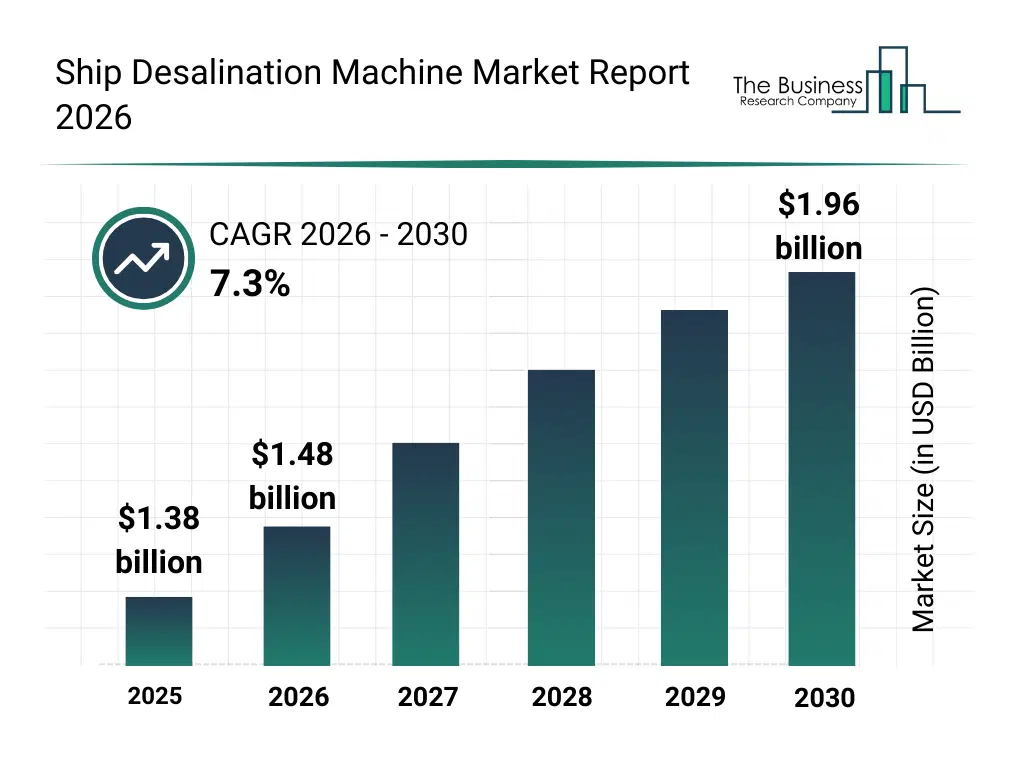
What Is The Ship Desalination Machine Market Size and Share 2026?
The ship desalination machine market size has grown strongly in recent years. It will grow from $1.38 billion in 2025 to $1.48 billion in 2026 at a compound annual growth rate (CAGR) of 7.0%. The growth in the historic period can be attributed to growth in global maritime trade, expansion of long-distance shipping routes, increasing crew welfare standards, rising demand for onboard freshwater independence, adoption of desalination in naval vessels.What Is The Ship Desalination Machine Market Growth Forecast?
The ship desalination machine market size is expected to see strong growth in the next few years. It will grow to $1.96 billion in 2030 at a compound annual growth rate (CAGR) of 7.3%. The growth in the forecast period can be attributed to increasing deployment of energy-efficient ship systems, rising demand for sustainable maritime operations, expansion of passenger and cruise shipping, growing integration of smart ship technologies, increasing focus on reducing freshwater logistics dependency. Major trends in the forecast period include increasing adoption of reverse osmosis systems onboard, rising demand for modular desalination units, growing integration of energy-efficient desalination technologies, expansion of compact and space-saving designs, enhanced focus on water quality monitoring.
Global Ship Desalination Machine Market Segmentation
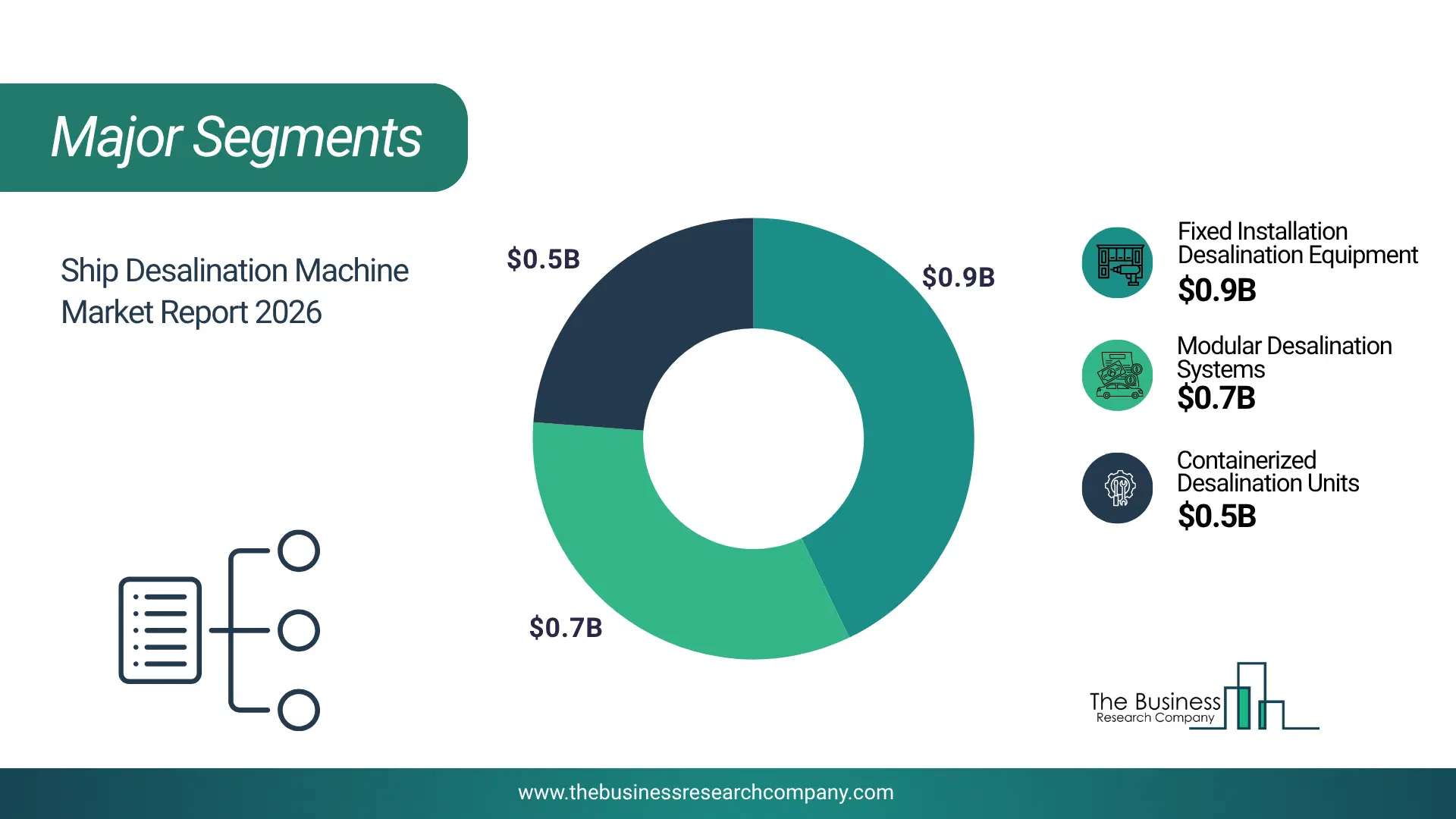
1) By Product Type: Containerized Desalination Units, Modular Desalination Systems, Fixed Installation Desalination Equipment 2) By Technology Type: Reverse Osmosis, Multistage Flash Distillation, Multi Effect Distillation, Electrodialysis, Solar Desalination 3) By Vessel Type: Cargo Ships, Oil and Gas Tankers, Passenger Vessels, Naval Vessels, Research and Exploration Vessels 4) By Desalination Capacity: Low Capacity, Medium Capacity, High Capacity 5) By Application: Freshwater Supply for Crew and Passengers, Water Supply for Machinery and Equipment, Water Treatment for Sanitation Purposes, Industrial Applications Subsegments: 1) By Containerized Desalination Units: Small Capacity Containerized Units, Medium Capacity Containerized Units, Large Capacity Containerized Units 2) By Modular Desalination Systems: Skid Mounted Modular Systems, Portable Modular Systems, Expandable Modular Systems 3) By Fixed Installation Desalination Equipment: Reverse Osmosis Fixed Installations, Multi Stage Flash Fixed Installations, Vapor Compression Fixed Installations The top segments in the ship desalination machine market will be: • Fixed Installation Desalination Equipment will reach $0.89 billion by 2030. • Modular Desalination Systems will reach $0.65 billion by 2030. • Containerized Desalination Units will reach $0.42 billion by 2030.What Is The Driver Of The Ship Desalination Machine Market?
The rise in shipping and maritime trade activities is expected to propel the growth of the ship desalination machine market going forward. Shipping and maritime trade activities are increasing due to growing global demand for consumer goods and energy resources. This rise in trade drives the deployment of more cargo ships, tankers, and offshore vessels, which in turn escalates the need for onboard freshwater supply. Ship desalination machines meet this demand by providing a continuous and reliable source of freshwater for crew consumption, cleaning, and operational processes, enabling vessels to undertake long-distance voyages without depending on port-based water supplies and ensuring smooth, uninterrupted global trade operations. For instance, in August 2025, according to the Bureau of Transportation Statistics, a US-based federal agency, cross-border freight shipments between the United States, Canada and Mexico reached over $144.8 billion in 2025, representing an 8.4% increase compared to 2024. Therefore, the rise in shipping and maritime trade activities is driving the growth of the ship desalination machine industry.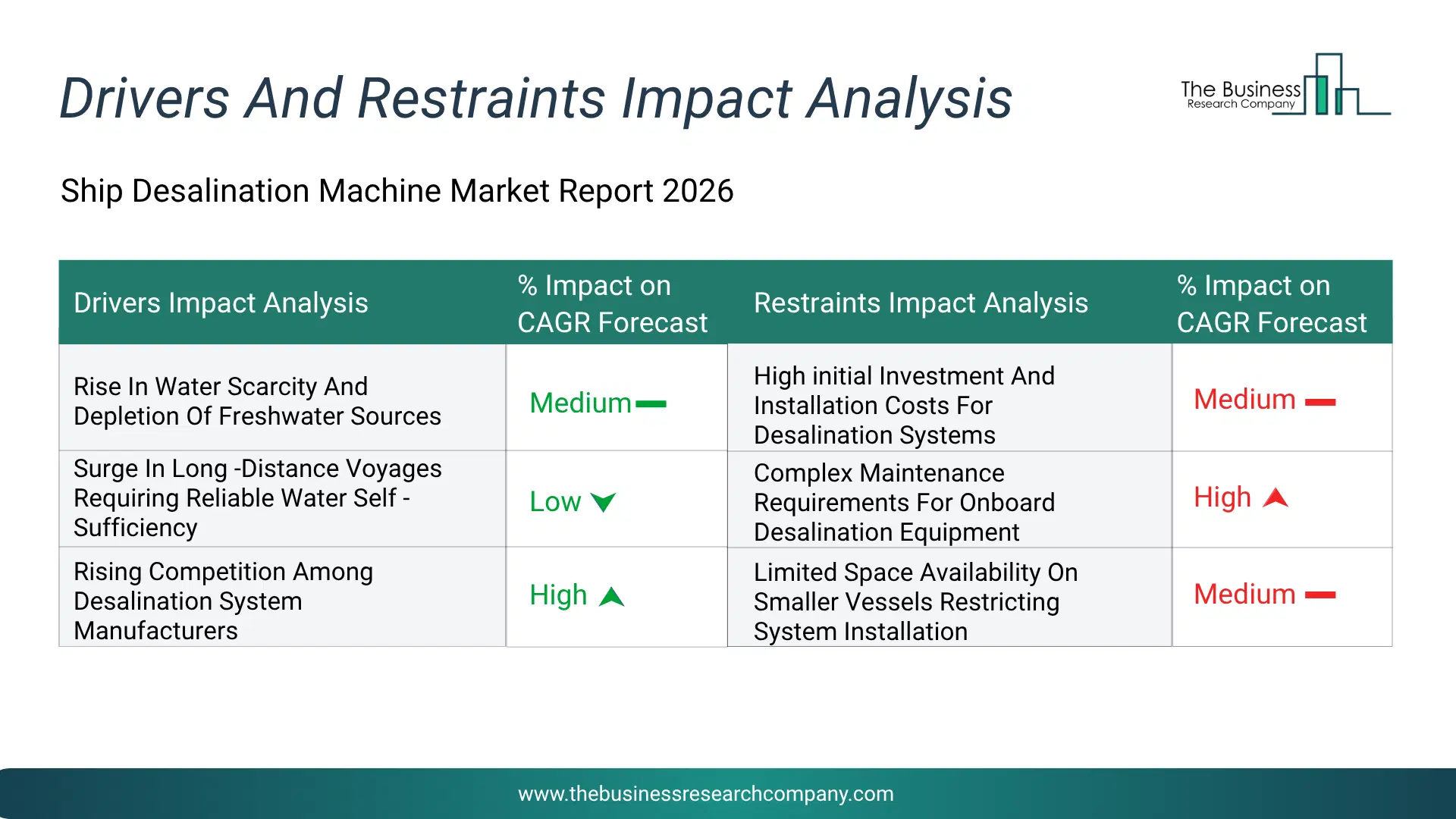
Infographic Chart Showing Key Market Drivers Analysis And Restraints For Ship Desalination Machine Market
The chart presents an impact analysis of key drivers and restraints, quantifying their relative influence on the market's growth rate and helping assess the balance between growth enablers and limiting factors. This chart offers a high-level perspective; the full report contains more detailed insights.
How Will The Drivers Impact Growth In The Global Ship Desalination Machine Market?
• Rise In Water Scarcity And Depletion Of Freshwater Sources (Medium) – During the forecast period, the rising water scarcity and the depletion of freshwater sources is expected to become a key growth driver for the ship desalination machine market by 2030. Rising water scarcity and the depletion of freshwater sources are creating strong demand for ship desalination machines. Ships require a consistent supply of potable water, but relying on ports or coastal facilities is becoming costly and unreliable. Onboard desalination systems enable vessels to be self-sufficient, reducing operational risks and expenses. They also ensure continuous availability of fresh water for crew, passengers, and essential operations during long voyages. As global water stress intensifies, the adoption of ship desalination machines is accelerating across commercial, naval, and leisure fleets. • Surge In Long -Distance Voyages Requiring Reliable Water Self -Sufficiency (Low) – During the forecast period, the surge in long -distance voyages is expected to emerge as a major factor driving the expansion of the ship desalination machine market by 2030. Onboard desalination ensures a steady supply of potable water, supporting both operational needs and passenger comfort. By providing self -sufficiency, these systems reduce reliance on coastal facilities and mitigate the risks of supply disruptions. They also enhance crew safety and efficiency by guaranteeing water availability in remote waters. As global maritime trade and cruise tourism expand, the adoption of ship desalination machines is accelerating. • Rising Competition Among Desalination System Manufacturers (High) – During the forecast period, the growing prevalence of rising competition among desalination system manufacturers is expected to act as a key growth catalyst for the ship desalination machine market by 2030. Rising competition among desalination system manufacturers is acting as a key driver for the ship desalination machines market. Companies are investing in advanced technologies such as energy -efficient membranes and hybrid systems to deliver better performance at lower operating costs. These innovations make shipboard desalination more attractive to operators by reducing fuel consumption and maintenance expenses. Competitive pricing also expands adoption across commercial, naval, and leisure vessels that previously relied on costly port -supplied water. As manufacturers race to differentiate through efficiency and affordability, market growth for ship desalination machines is accelerating.How Will The Restraints Impact Growth In The Global Ship Desalination Machine Market?
• High initial Investment And Installation Costs For Desalination Systems (Medium) – During the forecast period, the high initial investment and installation costs act as a major restraint for the ship desalination machines market. Setting up these systems requires significant capital for advanced membranes, pumps, and supporting infrastructure. Smaller ship operators and fleets with limited budgets often find it difficult to justify the upfront expense compared to sourcing water from ports. The added costs of integration, maintenance, and crew training further discourage adoption. As a result, high entry costs slow down market penetration, especially in developing regions and among mid-sized vessels. • Complex Maintenance Requirements For Onboard Desalination Equipment (High) – During the forecast period, the complex maintenance requirements pose a significant restraint for the adoption of ship desalination machines. These systems involve sensitive membranes, high-pressure pumps, and filtration units that demand regular monitoring and skilled handling. Frequent maintenance not only increases operational costs but also requires trained crew members, which many vessels lack. Any malfunction or improper servicing can disrupt water supply during voyages, creating operational risks. This technical complexity discourages some operators from investing in desalination systems, especially smaller shipping companies with limited resources • Limited Space Availability On Smaller Vessels Restricting System Installation (Medium) – During the forecast period, the limited space availability on smaller vessels acts as a key restraint for the ship desalination machines market. These systems require dedicated room for pumps, filters, and storage tanks, which many fishing boats, yachts, and coastal vessels cannot easily accommodate. Space constraints force operators to prioritize other critical equipment over watermaking systems. Even compact models often demand structural modifications, adding to installation challenges and costs. As a result, limited onboard space restricts the widespread adoption of desalination machines among smaller fleets.Key Players In The Global Ship Desalination Machine Market
Major companies operating in the ship desalination machine market are Hamworthy (Wärtsilä), Alfa Laval AB, MECO, ENWA Sandnes, KYSEARO, IDE Technologies, SLCE Watermakers, Spectra Watermakers (Katadyn Group), Devise Engineering S.A., Pomar Water, AMPAC USA, Schenker Watermakers, DongHwa Entec, SeaWater Pro LLC, Blue Water Desalination, Cathelco (Evac Group), Osmosea Srl, PWT Wassertechnik GmbH, Desalination Systems Inc., Hatenboer‑Water, Rochem Group, Pure Aqua Inc., Watertec, Norwater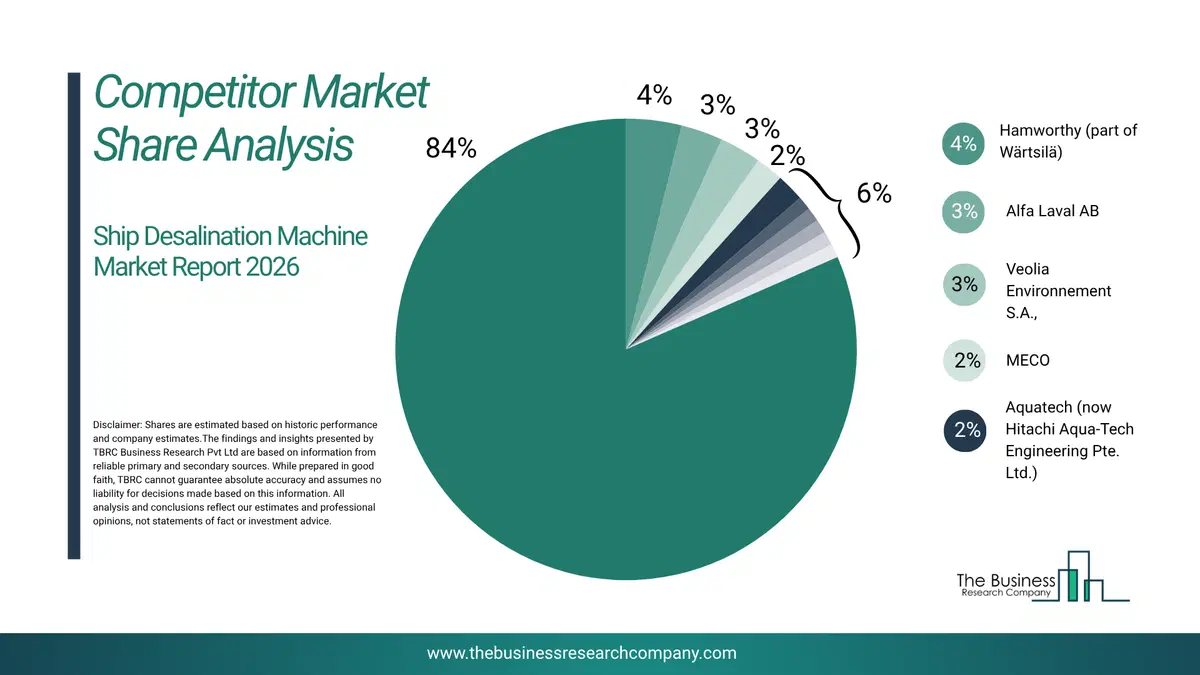
This chart is for illustrative purposes; the full report includes a detailed competitor analysis and comprehensive overview of the top 10 companies in the market.
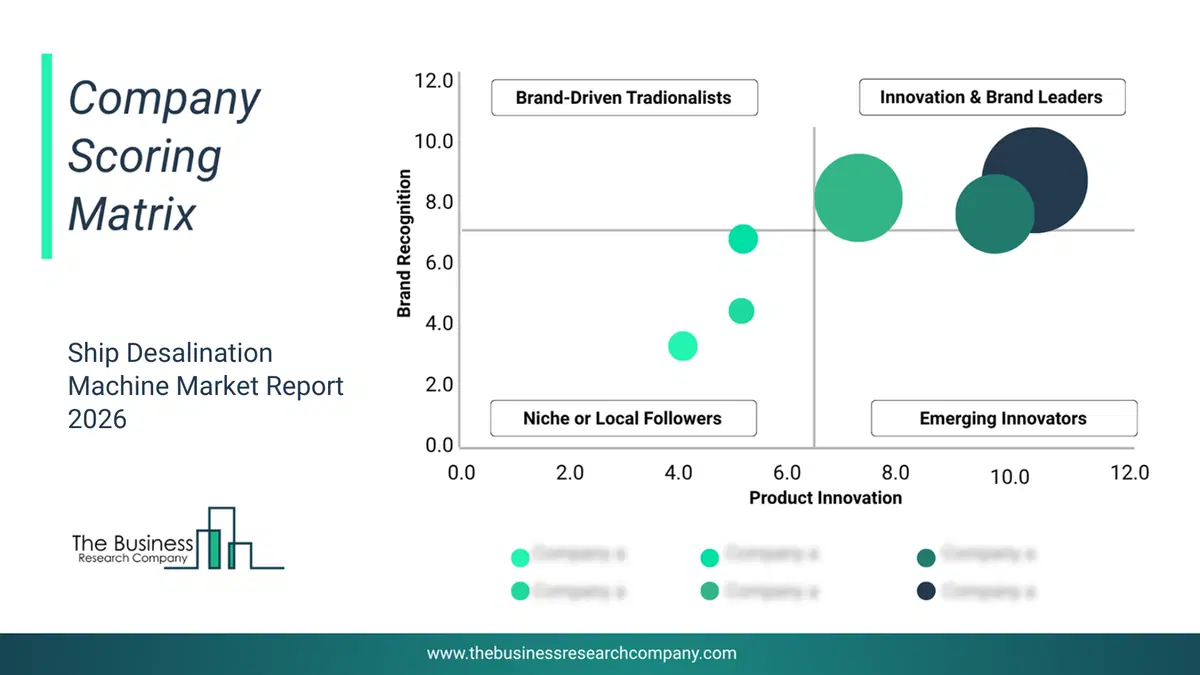
This chart maps companies by product innovation and brand strength, with bubble size indicating relative revenue, helping identify market leaders, challengers, and niche players. This is an illustrative chart; the full report provides a complete and accurate competitive analysis.
Global Ship Desalination Machine Market Trends and Insights
Major companies operating in the ship desalination machine market are focusing on advanced material engineering, such as nanoporous polymeric membranes, to provide vessels with high-efficiency, durable, and reliable desalination solutions that enhance freshwater production, ensure operational stability in harsh marine environments, and support maritime operations in addressing water scarcity challenges at sea. A nanoporous polymeric membrane is a multilayered polymer material with nanoscale pores that selectively allow water to pass through while blocking salts and other impurities, enabling efficient seawater desalination. For instance, in May 2025, the Defence Research & Development Organisation, an India-based government agency, launched an indigenous seawater desalination technology for Coast Guard ships. This high-pressure ship-based desalination system is designed to produce reliable freshwater directly from seawater while addressing operational challenges such as ship stability and chloride exposure, enabling efficient, scalable, and safe water supply for maritime operations and coastal missions.What Are Latest Mergers And Acquisitions In The Ship Desalination Machine Market?
In April 2023, SKion Water GmbH, a Germany-based water technology investment company, acquired Enwa AS for an undisclosed amount. With this acquisition, SKion Water aims to strengthen its presence in the Nordic water treatment market and expand its sustainable and energy-efficient water and environmental solutions globally. Enwa AS is a Norway-based company that provides ship desalination machines.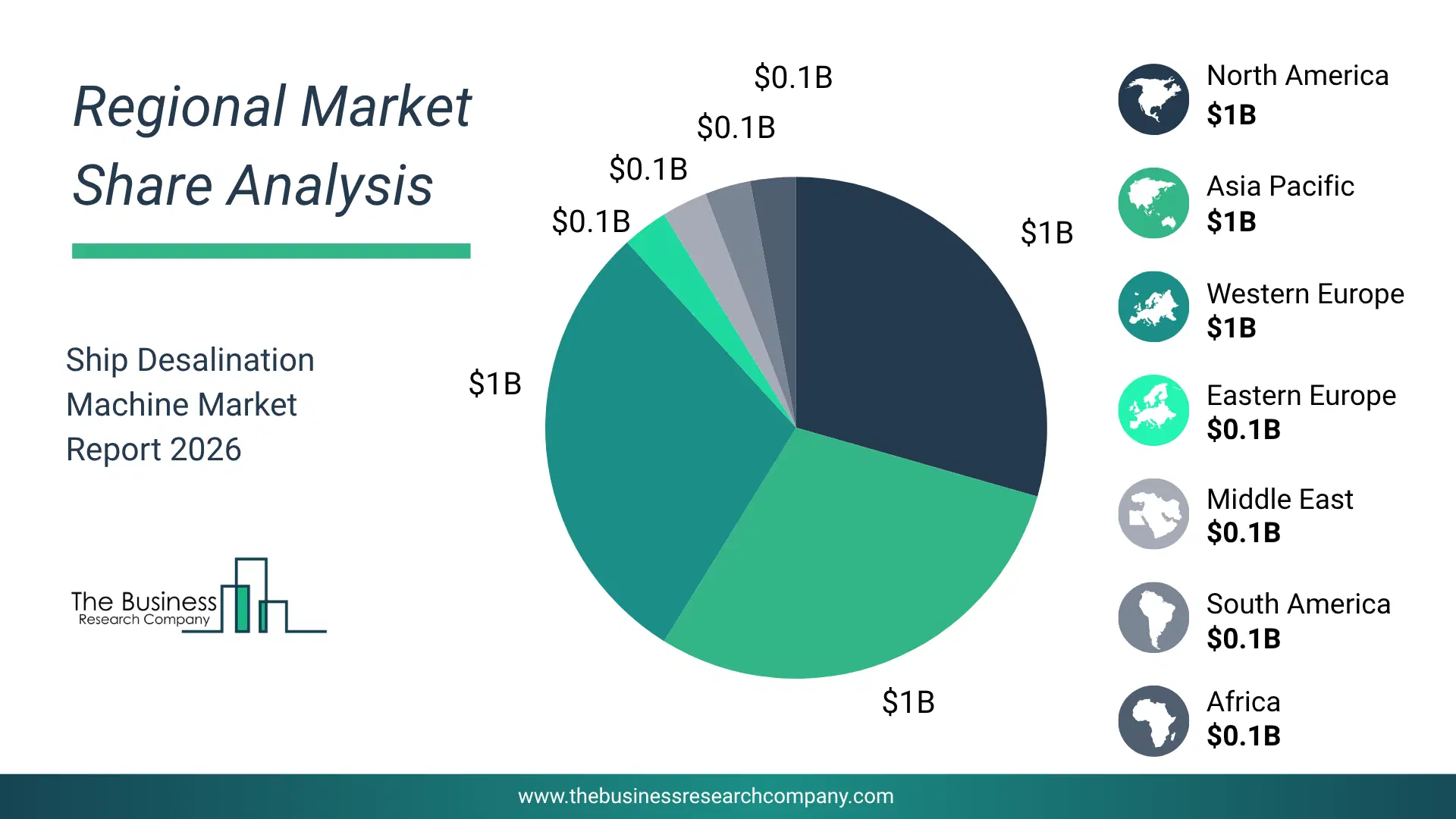
Regional Outlook
North America was the largest region in the ship desalination machine market in 2025. Asia-Pacific is expected to be the fastest-growing region in the forecast period. The regions covered in this market report are Asia-Pacific, South East Asia, Western Europe, Eastern Europe, North America, South America, Middle East, Africa. The countries covered in this market report are Australia, Brazil, China, France, Germany, India, Indonesia, Japan, Taiwan, Russia, South Korea, UK, USA, Canada, Italy, SpainWhat Defines the Ship Desalination Machine Market?
The ship desalination machine market consists of sales of vapor compression distillation units, membrane distillation units, hybrid desalination systems, brine concentrators and electrode ionization units. Values in this market are ‘factory gate’ values, that is the value of goods sold by the manufacturers or creators of the goods, whether to other entities (including downstream manufacturers, wholesalers, distributors and retailers) or directly to end customers. The value of goods in this market includes related services sold by the creators of the goods.How is Market Value Defined and Measured?
The market value is defined as the revenues that enterprises gain from the sale of goods and/or services within the specified market and geography through sales, grants, or donations in terms of the currency (in USD unless otherwise specified). The revenues for a specified geography are consumption values that are revenues generated by organizations in the specified geography within the market, irrespective of where they are produced. It does not include revenues from resales along the supply chain, either further along the supply chain or as part of other products.
This chart presents market attractiveness based on a quantitative evaluation of growth, competition, strategic alignment, and risk, offering a clear view of opportunity areas for decision-making. This chart is for illustrative purposes; the full report contains the complete analysis.

This chart highlights the Total Addressable Market (TAM) by estimating the maximum revenue opportunity using an assumption-driven approach, supporting strategic planning and opportunity sizing across markets. The chart is illustrative; the full report provides a more comprehensive analysis.
What Key Data and Analysis Are Included in the Ship Desalination Machine Market Report 2026?
The ship desalination machine market research report is one of a series of new reports from The Business Research Company that provides market statistics, including Market Report 2026?global market size, regional shares, competitors with the market share, detailed market segments, market trends and opportunities, and any further data you may need to thrive in the ship desalination machine Market Report 2026? The market research report delivers a complete perspective of everything you need, with an in-depth analysis of the current and future state of the Market Report 2026?Ship Desalination Machine Market Report Forecast Analysis
| Report Attribute | Details |
|---|---|
| Market Size Value In 2026 | $1.48 billion |
| Revenue Forecast In 2030 | $1.96 billion |
| Growth Rate | CAGR of 7.3% from 2026 to 2030 |
| Base Year For Estimation | 2025 |
| Actual Estimates/Historical Data | 2020-2025 |
| Forecast Period | 2026 - 2030 |
| Market Representation | Revenue in USD Billion and CAGR from 2026 to 2030 |
| Segments Covered | Product Type, Technology Type, Vessel Type, Desalination Capacity, Application |
| Regional Scope | Asia-Pacific, Western Europe, Eastern Europe, North America, South America, Middle East, Africa |
| Country Scope | The countries covered in the report are Australia, Brazil, China, France, Germany, India, ... |
| Key Companies Profiled | Hamworthy (Wärtsilä), Alfa Laval AB, MECO, ENWA Sandnes, KYSEARO, IDE Technologies, SLCE Watermakers, Spectra Watermakers (Katadyn Group), Devise Engineering S.A., Pomar Water, AMPAC USA, Schenker Watermakers, DongHwa Entec, SeaWater Pro LLC, Blue Water Desalination, Cathelco (Evac Group), Osmosea Srl, PWT Wassertechnik GmbH, Desalination Systems Inc., Hatenboer‑Water, Rochem Group, Pure Aqua Inc., Watertec, Norwater |
| Customization Scope | Request for Customization |
| Pricing And Purchase Options | Explore Purchase Options |