

Signals Of Opportunity (SoOp) Market Report 2026
Global Outlook – By Component (Hardware, Software, Services), By Signal Type (Communication Signals Of Opportunity, Broadcast Signals Of Opportunity, Global Navigation Satellite System Signals Of Opportunity, Satellite Signals Of Opportunity, Terrestrial Signals Of Opportunity), By Technology Type (Communication Signal Based Sensing, Broadcast Signal Based Sensing, Navigation Signal Based Sensing, Multi Signal Fusion Based Sensing, Quantum Enabled Sensing), By Application (Positioning And Navigation, Geolocation And Tracking, Environmental Monitoring, Surveillance And Reconnaissance, Autonomous Systems), By End User Industry (Defense And Military, Aerospace, Telecommunications, Transportation And Logistics, Government And Public Safety, Research And Academic Institutions) – Market Size, Trends, Strategies, and Forecast to 2030
Signals Of Opportunity (SoOp) Market Overview
• Signals Of Opportunity (SoOp) market size has reached to $0.72 billion in 2025 • Expected to grow to $0.84 billion in 2030 at a compound annual growth rate (CAGR) of 17.2% • Growth Driver: Increasing Defense And Military Investments Fueling The Growth Of The Market Due To Rising Demand For Resilient Navigation In Gps-denied And Contested Environments • Market Trend: Advanced PNTaaS Launch Enhances GPS-Denied Navigation Capabilities • North America was the largest region in 2025 and Asia-Pacific is the fastest growing region.What Is Covered Under Signals Of Opportunity (SoOp) Market?
Signals of opportunity (SoOp) refers to a passive sensing and positioning approach that leverages existing ambient electromagnetic signals from non-cooperative transmitters such as communication, broadcast, and navigation signals for detection, localization, and environmental monitoring. It enables high-accuracy sensing and navigation by analyzing reflections or distortions of these signals without requiring dedicated transmitters, often integrating advanced electronic, photonic, and quantum-enabled sensing technologies. The main components of signals of opportunity include hardware, software, and services. Hardware refers to the physical sensing and processing devices used in signals of opportunity systems to detect and utilize ambient radio, communication, or environmental signals for positioning and navigation. The signal types include communication signals of opportunity, broadcast signals of opportunity, global navigation satellite system signals of opportunity, satellite signals of opportunity, and terrestrial signals of opportunity, and the technology types include communication signal-based sensing, broadcast signal-based sensing, navigation signal-based sensing, multi signal fusion based sensing, and quantum enabled sensing, and the application areas include positioning and navigation, geolocation and tracking, environmental monitoring, surveillance and reconnaissance, and autonomous systems, and the key end user industries include defence and military, aerospace, telecommunications, transportation and logistics, government and public safety, research and academic institutions.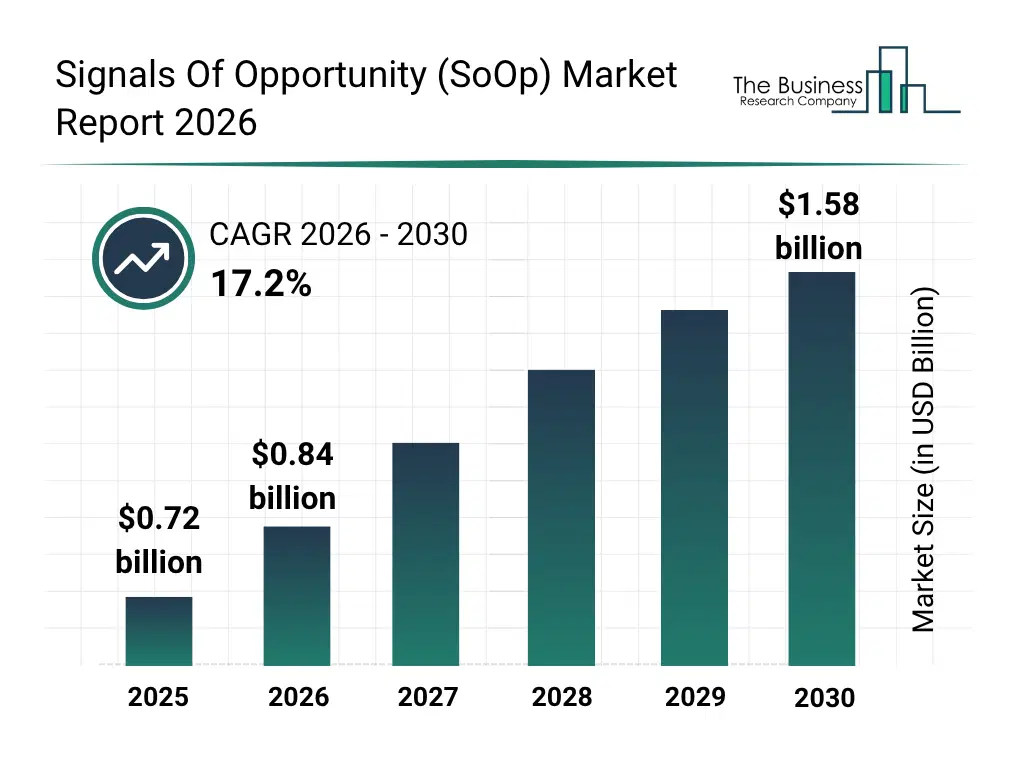
What Is The Signals Of Opportunity (SoOp) Market Size and Share 2026?
The signals of opportunity (soop) market size has grown rapidly in recent years. It will grow from $0.72 billion in 2025 to $0.84 billion in 2026 at a compound annual growth rate (CAGR) of 17.0%. The growth in the historic period can be attributed to dependence on gps based navigation systems, expansion of wireless communication infrastructure, growth of defense surveillance modernization, increasing demand for maritime and aviation tracking, early adoption of radio signal processing techniques.What Is The Signals Of Opportunity (SoOp) Market Growth Forecast?
The signals of opportunity (soop) market size is expected to see rapid growth in the next few years. It will grow to $1.58 billion by 2030 at a compound annual growth rate (CAGR) of 17.2%. The growth in the forecast period can be attributed to rising demand for gps denied navigation solutions, growth of autonomous vehicle and drone ecosystems, increasing investment in quantum sensing technologies, expansion of smart city monitoring systems, need for resilient positioning in contested environments. Major trends in the forecast period include passive radar and ambient sensing advancement, multi signal fusion based positioning systems, quantum enhanced navigation and sensing development, AI driven signal processing and interpretation, gnss denied navigation solutions expansion.
Global Signals Of Opportunity (SoOp) Market Segmentation
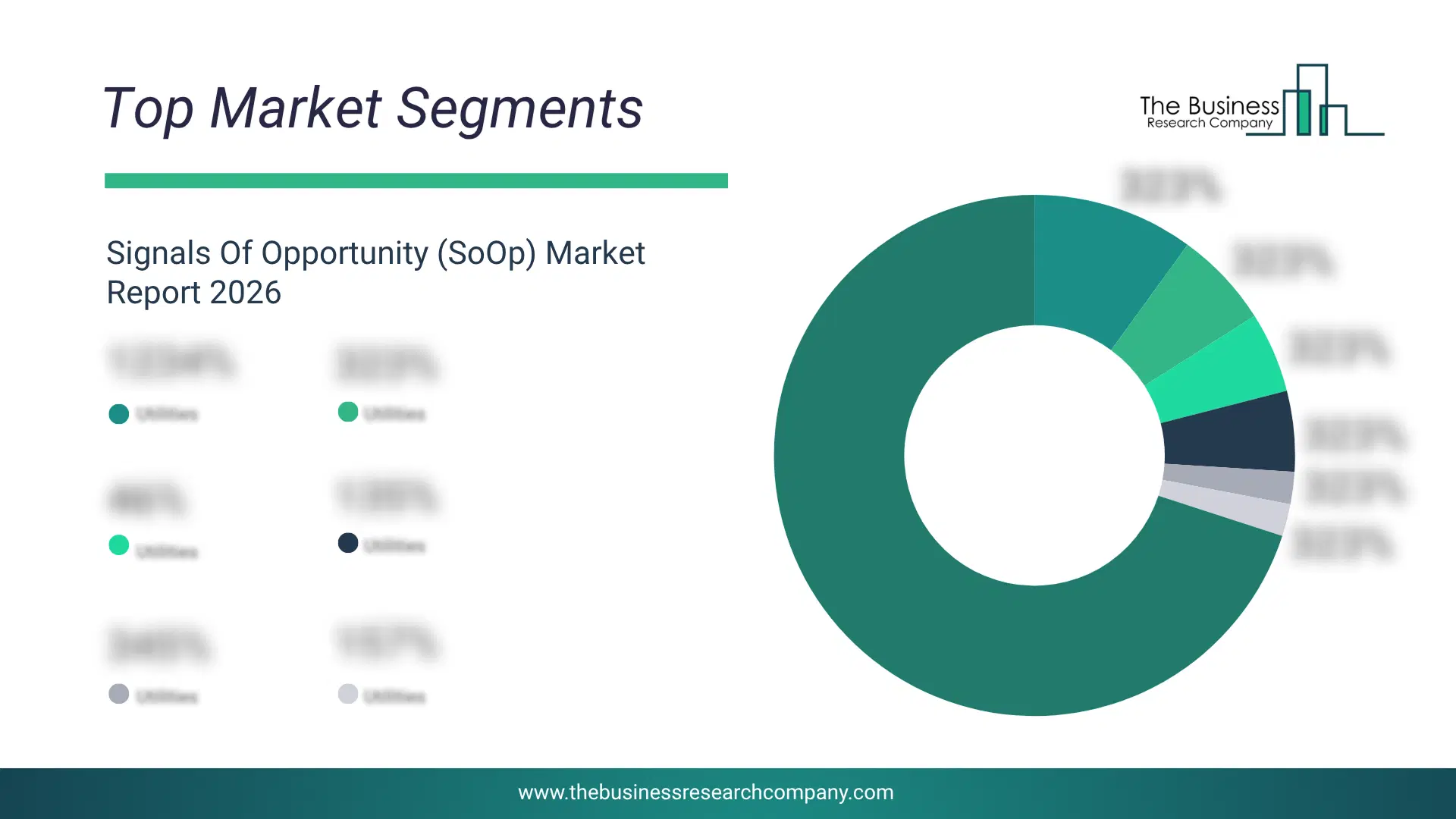
1) By Component: Hardware, Software, Services 2) By Signal Type: Communication Signals Of Opportunity, Broadcast Signals Of Opportunity, Global Navigation Satellite System Signals Of Opportunity, Satellite Signals Of Opportunity, Terrestrial Signals Of Opportunity 3) By Technology Type: Communication Signal Based Sensing, Broadcast Signal Based Sensing, Navigation Signal Based Sensing, Multi Signal Fusion Based Sensing, Quantum Enabled Sensing 4) By Application: Positioning And Navigation, Geolocation And Tracking, Environmental Monitoring, Surveillance And Reconnaissance, Autonomous Systems 5) By End User Industry: Defense And Military, Aerospace, Telecommunications, Transportation And Logistics, Government And Public Safety, Research And Academic Institutions Subsegments: 1) By Hardware: Signal Reception Units, Antenna Systems, Radio Frequency Front End Modules, Processing Units, Timing And Synchronization Units 2) By Software: Signal Processing Algorithms, Positioning And Navigation Software, Interference Detection Software, Data Fusion Software, Simulation And Modeling Software 3) By Services: System Integration Services, Consulting Services, Deployment And Implementation Services, Maintenance And Support Services, Testing And Validation ServicesWhat Is The Driver Of The Signals Of Opportunity (SoOp) Market?
The increasing defense and military investments are expected to propel the growth of the signals of opportunity (SoOp) going forward. Defense and military investments refer to the allocation of financial resources by governments toward building, maintaining, and advancing armed forces capabilities, including personnel, equipment, infrastructure, technology, and operations. The rise in defense and military investments is increasing due to escalating geopolitical tensions, which are prompting governments to strengthen national security, modernize military capabilities, and enhance preparedness against potential threats. Defense and military investments help signals of opportunity (SoOp) by funding resilient PNT technologies that exploit existing radiofrequency signals such as cellular, satellite, and communication transmissions for navigation and positioning in GPS-denied or contested environments. For instance, in January 2026, according to the government of the United Kingdom, a UK-based central governing authority responsible for administering the country, implementing laws, managing public services, and overseeing national defense, economic policy, and international relations, indicates that the United Kingdom’s defense spending reached £60.2 billion ($76.5 billion) in 2024/25, marking a £6.3 billion ($8.0 billion) year-on-year increase, which translates to a 7.7% real growth after adjusting for inflation, reflecting a significant expansion in military investment. Therefore, increasing defense and military investments is driving the growth of the signals of opportunity (SoOp) industry.Key Players In The Global Signals Of Opportunity (SoOp) Market
Major companies operating in the signals of opportunity (soop) market are Qualcomm Incorporated; BAE Systems plc; Safran SA; L3Harris Technologies Inc.; Hexagon AB; Parsons Corporation; Rohde & Schwarz GmbH & Co. KG; Kratos Defense & Security Solutions Inc.; Globalstar Inc.; HawkEye 360 Inc.; Kymeta Corporation; Nokomis Inc.; Telespazio UK Limited; Xona Space Systems Inc.; Unseenlabs SAS; Q-CTRL Pty Ltd; Novocomms Limited; AST SpaceMobile Inc.; AnySignal Inc.; Mayflower Communications Company Inc.; PNI Sensor Corporation; Locata Corporation Pty Ltd; Silentium Defence Pty Ltd; SpacePNT LLC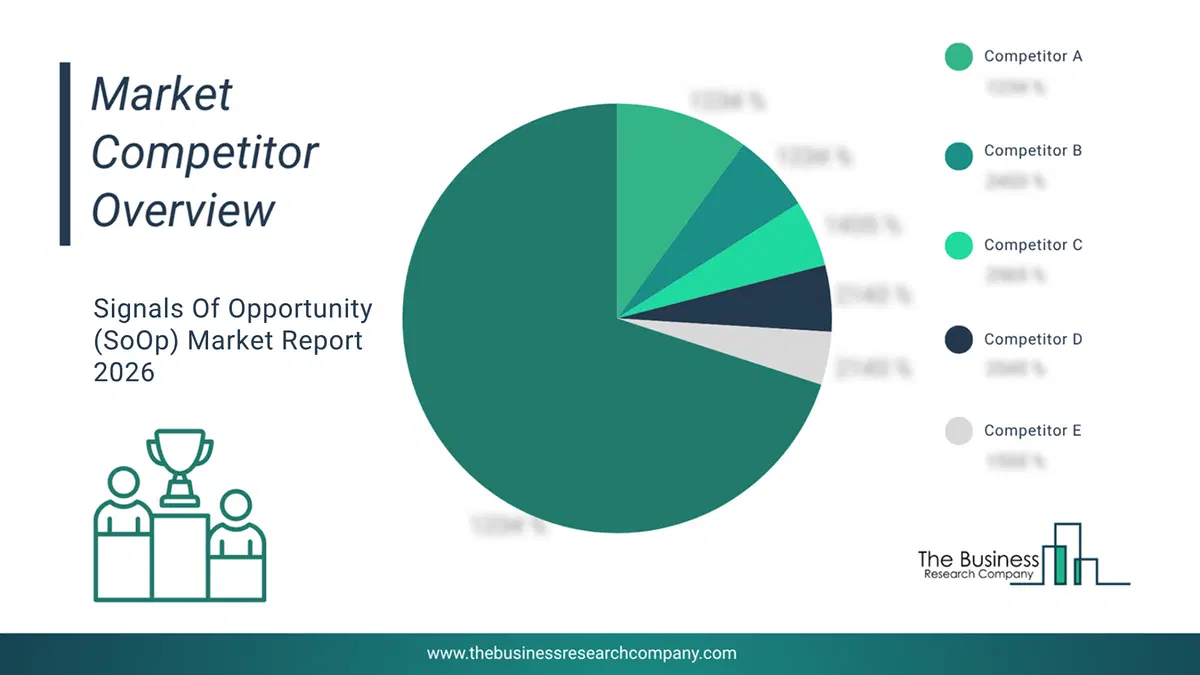
This chart is for illustrative purposes; the full report includes a detailed competitor analysis and comprehensive overview of the top 10 companies in the market.
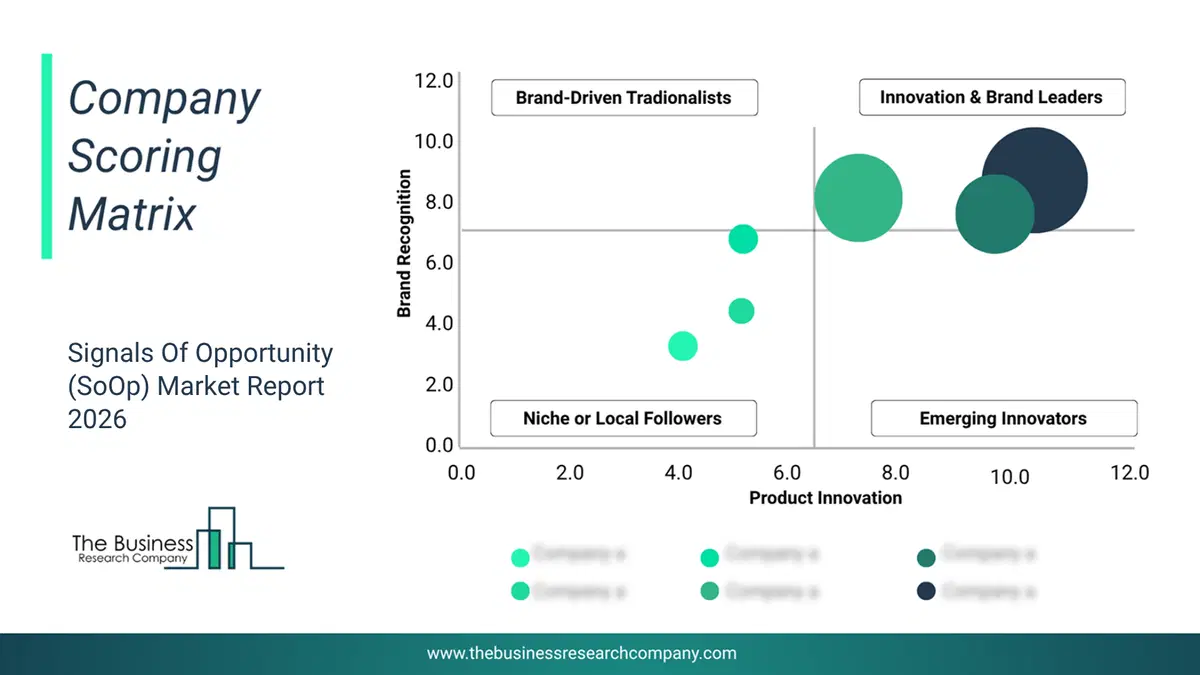
This chart maps companies by product innovation and brand strength, with bubble size indicating relative revenue, helping identify market leaders, challengers, and niche players. This is an illustrative chart; the full report provides a complete and accurate competitive analysis.
Global Signals Of Opportunity (SoOp) Market Trends and Insights
Major companies operating in the signals of opportunity (SoOp) market are focusing on launching advanced alternative positioning, navigation, and timing solutions, such as PNT as a Service (PNTaaS) platforms, to ensure resilient navigation capabilities in GPS-denied environments while expanding global service coverage. PNTaaS is a service-based navigation solution that delivers accurate positioning, navigation, and timing data using terrestrial and non-traditional signals when satellite GPS is unavailable or disrupted. For instance, in March 2026, NAVSYS Corporation, a US-based navigation technology company, announced the expansion of its PNTaaS infrastructure with CONUS-wide coverage and deployment across Europe, alongside plans to extend services into Asia, South America, and Africa, strengthening assured navigation resilience through signals of opportunity technologies.What Are Latest Mergers And Acquisitions In The Signals Of Opportunity (SoOp) Market?
In March 2025, the European Space Agency, a France-based space agency, partnered with Telespazio UK Ltd and subcontractors to develop next-generation resilient navigation technologies under its NAVISP program. With this collaboration, ESA and its industrial partners aim to develop and demonstrate a proof-of-concept for Signals of Opportunity Positioning using broadband satellite communication signals, advancing resilient positioning, navigation, and timing solutions by leveraging signals not originally designed for navigation purposes. Telespazio UK Ltd is a UK-based space and defense engineering company actively implementing the SoOp proof-of-concept under ESA’s NAVISP program.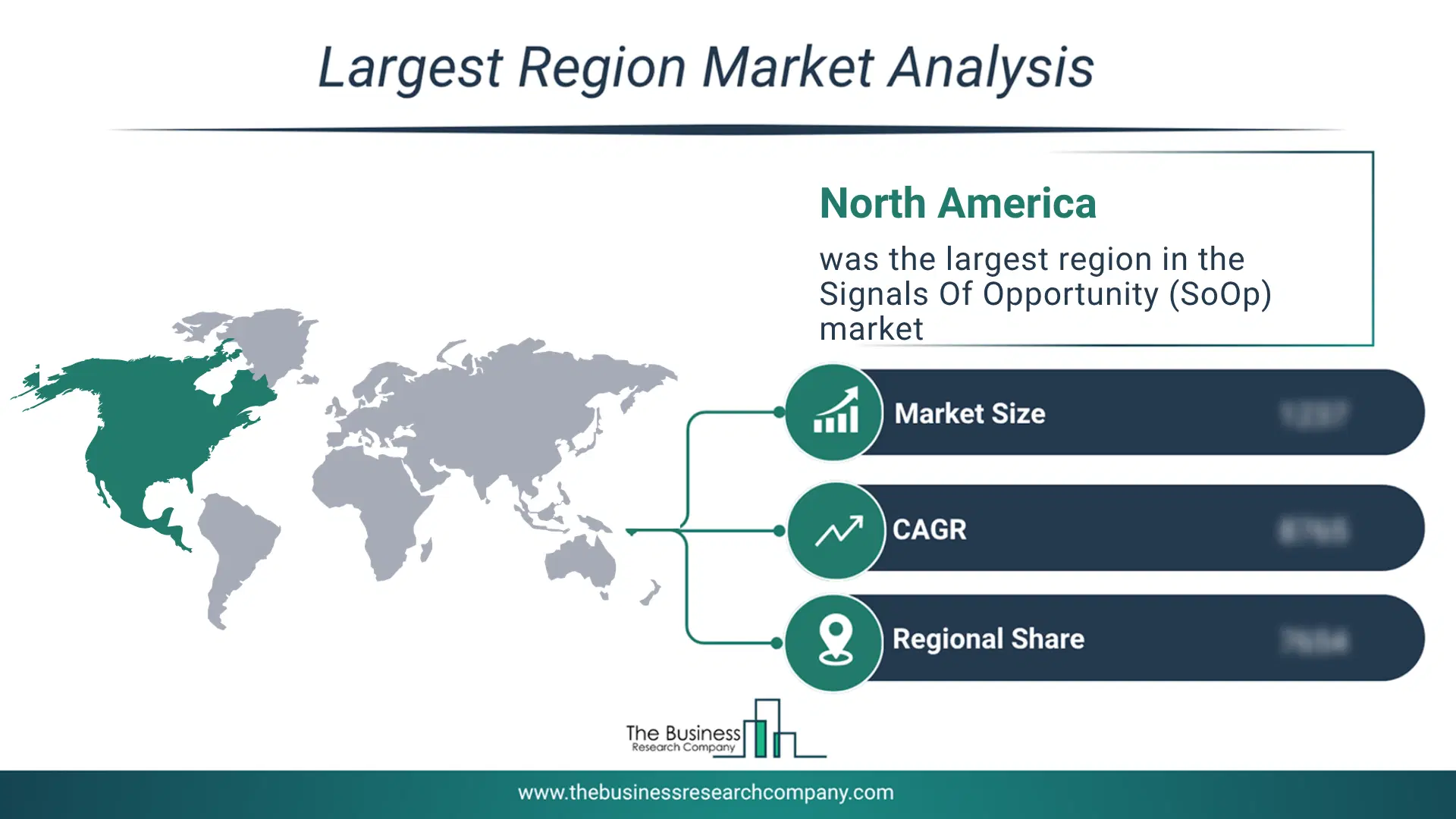
Regional Insights
North America was the largest region in the signals of opportunity (SoOp) market in 2025. Asia-Pacific is expected to be the fastest-growing region in the forecast period. The regions covered in this market report are Asia-Pacific, South East Asia, Western Europe, Eastern Europe, North America, South America, Middle East, Africa. The countries covered in this market report are Australia, Brazil, China, France, Germany, India, Indonesia, Japan, Taiwan, Russia, South Korea, UK, USA, Canada, Italy, Spain.What Defines the Signals Of Opportunity (SoOp) Market?
The signals of opportunity market consists of revenues earned by entities by providing services such as passive signal-based navigation services, signal processing and interpretation services, and integrated sensor fusion services. The market value includes the value of related goods sold by the service provider or included within the service offering. The signals of opportunity market also include sales of software-defined radios (SDRs), antennas, photonic sensing components, quantum sensors, timing modules, and edge processing units. Values in this market are ‘factory gate’ values, that is, the value of goods sold by the manufacturers or creators of the goods, whether to other entities (including downstream manufacturers, wholesalers, distributors, and retailers) or directly to end customers. The value of goods in this market includes related services sold by the creators of the goods.How is Market Value Defined and Measured?
The market value is defined as the revenues that enterprises gain from the sale of goods and/or services within the specified market and geography through sales, grants, or donations in terms of the currency (in USD unless otherwise specified). The revenues for a specified geography are consumption values that are revenues generated by organizations in the specified geography within the market, irrespective of where they are produced. It does not include revenues from resales along the supply chain, either further along the supply chain or as part of other products.
This chart presents market attractiveness based on a quantitative evaluation of growth, competition, strategic alignment, and risk, offering a clear view of opportunity areas for decision-making. This chart is for illustrative purposes; the full report contains the complete analysis.

This chart highlights the Total Addressable Market (TAM) by estimating the maximum revenue opportunity using an assumption-driven approach, supporting strategic planning and opportunity sizing across markets. The chart is illustrative; the full report provides a more comprehensive analysis.
What Key Data and Analysis Are Included in the Signals Of Opportunity (SoOp) Market Report 2026?
The signals of opportunity (soop) market research report is one of a series of new reports from The Business Research Company that provides market statistics, including industry global market size, regional shares, competitors with the market share, detailed market segments, market trends and opportunities, and any further data you may need to thrive in the signals of opportunity (soop) industry. The market research report delivers a complete perspective of everything you need, with an in-depth analysis of the current and future state of the industry.Signals Of Opportunity (SoOp) Market Report Forecast Analysis
| Report Attribute | Details |
|---|---|
| Market Size Value In 2026 | $0.84 billion |
| Revenue Forecast In 2030 | $1.58 billion |
| Growth Rate | CAGR of 17.2% from 2026 to 2030 |
| Base Year For Estimation | 2025 |
| Actual Estimates/Historical Data | 2020-2025 |
| Forecast Period | 2026 - 2030 |
| Market Representation | Revenue in USD Billion and CAGR from 2026 to 2030 |
| Segments Covered | Component, Signal Type, Technology Type, Application, End User Industry |
| Regional Scope | Asia-Pacific, Western Europe, Eastern Europe, North America, South America, Middle East, Africa |
| Country Scope | The Countries Covered In This Market Report Are Australia, Brazil, China, France, Germany, India, Indonesia, Japan, Taiwan, Russia, South Korea, Uk, Usa, Canada, Italy, Spain. |
| Key Companies Profiled | Qualcomm Incorporated, BAE Systems plc, Safran SA, L3Harris Technologies Inc., Hexagon AB, Parsons Corporation, Rohde & Schwarz GmbH & Co. KG, Kratos Defense & Security Solutions Inc., Globalstar Inc., HawkEye 360 Inc., Kymeta Corporation, Nokomis Inc., Telespazio UK Limited, Xona Space Systems Inc., Unseenlabs SAS, Q-CTRL Pty Ltd, Novocomms Limited, AST SpaceMobile Inc., AnySignal Inc., Mayflower Communications Company Inc., PNI Sensor Corporation, Locata Corporation Pty Ltd, Silentium Defence Pty Ltd, SpacePNT LLC |
| Customization Scope | Request for Customization |
| Pricing And Purchase Options | Explore Purchase Options |