
Simulation As A Service Market Report 2026
Global Outlook – By Component (Software, Services), By Deployment Mode (Public Cloud, Private Cloud, Hybrid Cloud), By Organization Size (Large Enterprises, Small And Medium Enterprises (SMEs)), By Application (Product Engineering, Research And Development, Training And Education, Process Optimization, Other Applications), By End-User (Automotive, Aerospace And Defense, Healthcare, Manufacturing, Information Technology And Telecommunications, Other End Users) – Market Size, Trends, Strategies, and Forecast to 2035
Simulation As A Service Market Overview
• Simulation As A Service market size has reached to $3.51 billion in 2025 • Expected to grow to $7.4 billion in 2030 at a compound annual growth rate (CAGR) of 16.1% • Growth Driver: Surge In Digital Transformation Fueling The Growth Of The Market Due To Increasing Cloud Adoption And Virtual Testing Capabilities • Market Trend: Siemens Advances Digital Engineering With Next-generation Cloud Simulation Platform • North America was the largest region in 2025 and Asia-Pacific is the fastest growing region.What Is Covered Under Simulation As A Service Market?
Simulation as a service is a cloud-based solution that allows users to perform complex simulations without needing to install or maintain software locally. It provides access to high-performance computing resources and advanced simulation tools over the internet. This service enables faster analysis, improved decision-making, and efficient testing of designs and processes in a virtual environment. The main components of simulation as a service include software and services. Software refers to platforms that enable organizations to perform virtual modeling, testing, and optimization of products, processes, and training programs through cloud-based environments. These solutions are deployed through public cloud, private cloud, and hybrid cloud models and are adopted by large enterprises and small and medium enterprises (SMEs). The key applications of product engineering, research and development, training and education, process optimization, and other applications, while the end-users include automotive, aerospace and defense, healthcare, manufacturing, information technology and telecommunications, and other end users.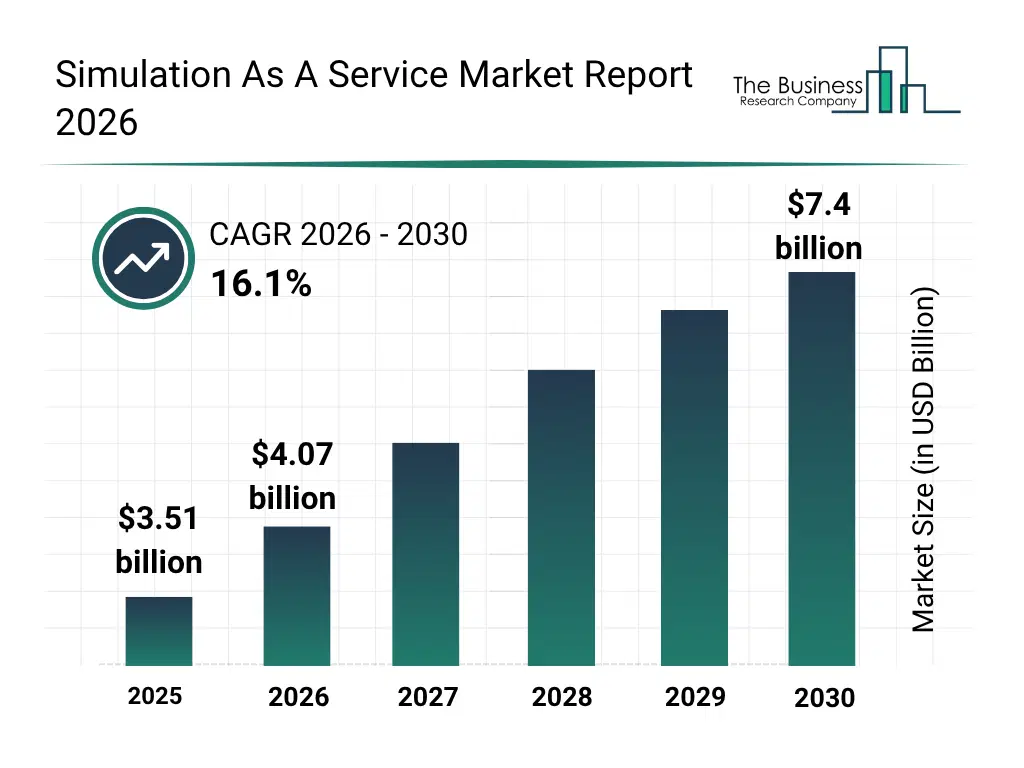
What Is The Simulation As A Service Market Size and Share 2026?
The simulation as a service market size has grown rapidly in recent years. It will grow from $3.51 billion in 2025 to $4.07 billion in 2026 at a compound annual growth rate (CAGR) of 15.9%. The growth in the historic period can be attributed to increasing r&d investments, adoption of on-premise simulation software, rising demand for product engineering, growth of manufacturing sector, need for faster design validation.What Is The Simulation As A Service Market Growth Forecast?
The simulation as a service market size is expected to see rapid growth in the next few years. It will grow to $7.4 billion in 2030 at a compound annual growth rate (CAGR) of 16.1%. The growth in the forecast period can be attributed to expansion of cloud infrastructure, ai-enabled simulation tools, integration with digital twins, demand for real-time simulation analytics, adoption in training and education programs. Major trends in the forecast period include cloud-based high-performance simulation, physics-based simulation adoption, multi-domain simulation integration, virtual training and education platforms, simulation-driven process optimization.
Global Simulation As A Service Market Segmentation
1) By Component: Software, Services 2) By Deployment Mode: Public Cloud, Private Cloud, Hybrid Cloud 3) By Organization Size: Large Enterprises, Small And Medium Enterprises (SMEs) 4) By Application: Product Engineering, Research And Development, Training And Education, Process Optimization, Other Applications 5) By End-User: Automotive, Aerospace And Defense, Healthcare, Manufacturing, Information Technology And Telecommunications, Other End Users Subsegments: 1) By Software: Simulation Modeling Software, Physics Based Simulation Software, Multi Domain Simulation Software, Process And System Simulation Software, High Performance Computing Enabled Simulation Software 2) By Services: Cloud Based Simulation Services, Simulation Consulting And Advisory Services, Model Development And Customization Services, Integration And Deployment Services, Training, Support, And Maintenance ServicesWhat Is The Driver Of The Simulation As A Service Market?
The increasing digital transformation is expected to propel the growth of the Simulation as a Service market going forward. Digital transformation refers to the integration of digital technologies into all areas of a business to improve processes, efficiency, and value delivery. The rise in digital transformation is driven by cloud computing adoption, as it enables enterprises to access scalable IT resources, improve efficiency, and accelerate business innovation. Simulation as a service accelerates digital transformation by allowing enterprises to perform complex virtual testing and modeling in the cloud, reducing development time, lowering costs, and enabling data-driven decision-making. For instance, in January 2026, according to the Eurostat, a Luxembourg-based statistical office of the European Union (EU), around 52.74% of EU enterprises used paid cloud computing services in 2025, marking a 7.42 percentage point increase since 2023. Therefore, the increasing digital transformation is driving the growth of the simulation-as-a-service market.Key Players In The Global Simulation As A Service Market
Major companies operating in the simulation as a service market are Siemens, Rockwell Automation, Dassault Systèmes SE, Synopsys Inc, Autodesk Inc, MSC Software Corporation, CAE Inc, PTC Inc, The MathWorks Inc, Rescale Inc, SimScale GmbH, Lanner Group Ltd, Mak Technologies Inc, Aras Corporation, Cybernet Systems Corporation, COMSOL AB, OnScale Inc, Simul8 Corporation, FlexSim Software Products Inc, Cloudalize NV, AnyLogic Company, CPFD Software, and Design Simulation Technologies Inc.Global Simulation As A Service Market Trends and Insights
Major companies operating in the simulation-as-a-service (SIMaaS) market are increasingly focused on developing advanced cloud-based high-performance simulation platforms to improve engineering efficiency, accelerate product development, and reduce reliance on on-premises infrastructure. These platforms provide scalable, on-demand access to computational resources that allow engineers to run complex multiphysics simulations and advanced analyses without the cost and complexity of maintaining dedicated hardware, supporting subscription- or usage-based service delivery models. For instance, in December 2025, Siemens Digital Industries Software, a US-based industrial software company, expanded its cloud simulation portfolio with the introduction of Simcenter X Advanced. The solution enhances Siemens’ SIMaaS offerings by providing cloud-native access to advanced computational fluid dynamics (CFD), structural analysis, and electromagnetic simulation capabilities. By leveraging scalable cloud computing and integrated digital workflows, Simcenter X Advanced is designed to enable faster model processing, improved collaboration among distributed engineering teams, and streamlined access to high-performance computing resources with reduced IT overhead.What Are Latest Mergers And Acquisitions In The Simulation As A Service Market?
In July 2024, Altair Engineering, a US-based technology company providing software and cloud solutions in simulation, acquired Metrics Design Automation Inc. for an undisclosed amount. Through this acquisition, Altair Engineering aims to expand its cloud-native electronic design automation capabilities by delivering scalable, flexible, and cost-efficient simulation environments for semiconductor design and verification. Metrics Design Automation Inc. is a Canada-based company specialized in cloud-native electronic design automation platforms delivering simulation as a service for digital circuit simulation and verification.Regional Insights
North America was the largest region in the simulation as a service market in 2025. Asia-Pacific is expected to be the fastest-growing region in the forecast period. The regions covered in this market report are Asia-Pacific, South East Asia, Western Europe, Eastern Europe, North America, South America, Middle East, Africa. The countries covered in this market report are Australia, Brazil, China, France, Germany, India, Indonesia, Japan, Taiwan, Russia, South Korea, UK, USA, Canada, Italy, Spain.What Defines the Simulation As A Service Market?
The simulation as a service market consists of revenues earned by entities by providing services such as process modeling, data visualization, real-time simulation, workflow automation. The market value includes the value of related goods sold by the service provider or included within the service offering. Only goods and services traded between entities or sold to end consumers are included.How is Market Value Defined and Measured?
The market value is defined as the revenues that enterprises gain from the sale of goods and/or services within the specified market and geography through sales, grants, or donations in terms of the currency (in USD unless otherwise specified). The revenues for a specified geography are consumption values that are revenues generated by organizations in the specified geography within the market, irrespective of where they are produced. It does not include revenues from resales along the supply chain, either further along the supply chain or as part of other products.What Key Data And Analysis Are Included In The Simulation As A Service Market Report 2026?
The simulation as a service market research report is one of a series of new reports from The Business Research Company that provides market statistics, including industry global market size, regional shares, competitors with the market share, detailed market segments, market trends and opportunities, and any further data you may need to thrive in the simulation as a service industry. The market research report delivers a complete perspective of everything you need, with an in-depth analysis of the current and future state of the industry.Simulation As A Service Market Report Forecast Analysis
| Report Attribute | Details |
|---|---|
| Market Size Value In 2026 | $4.07 billion |
| Revenue Forecast In 2035 | $7.4 billion |
| Growth Rate | CAGR of 15.9% from 2026 to 2035 |
| Base Year For Estimation | 2025 |
| Actual Estimates/Historical Data | 2020-2025 |
| Forecast Period | 2026 - 2030 - 2035 |
| Market Representation | Revenue in USD Billion and CAGR from 2026 to 2035 |
| Segments Covered | Component, Deployment Mode, Organization Size, Application, End-User |
| Regional Scope | Asia-Pacific, Western Europe, Eastern Europe, North America, South America, Middle East, Africa |
| Country Scope | The countries covered in the report are Australia, Brazil, China, France, Germany, India, Indonesia, Japan, Taiwan, Russia, South Korea, UK, USA, Canada, Italy, Spain. |
| Key Companies Profiled | Siemens, Rockwell Automation, Dassault Systèmes SE, Synopsys Inc, Autodesk Inc, MSC Software Corporation, CAE Inc, PTC Inc, The MathWorks Inc, Rescale Inc, SimScale GmbH, Lanner Group Ltd, Mak Technologies Inc, Aras Corporation, Cybernet Systems Corporation, COMSOL AB, OnScale Inc, Simul8 Corporation, FlexSim Software Products Inc, Cloudalize NV, AnyLogic Company, CPFD Software, and Design Simulation Technologies Inc. |
| Customization Scope | Request for Customization |
| Pricing And Purchase Options | Explore Purchase Options |