
Simulation Table Market Report 2026
Global Outlook – By Component (Software, Services, Platform And Integration), By Payload Capacity (Small, Standard, High Frequency), By Application (Financial Forecasting, Risk Management, Strategic Planning, Supply Chain Optimization, Research And Development), By End-User (Banking, Financial Services And Insurance, Information Technology And Telecom, Manufacturing, Healthcare And Life Sciences, Energy And Utilities, Government And Defense, Education And Research, Retail And Consumer Goods) – Market Size, Trends, Strategies, and Forecast to 2035
Simulation Table Market Overview
• Simulation Table market size has reached to $1.93 billion in 2025 • Expected to grow to $2.99 billion in 2030 at a compound annual growth rate (CAGR) of 9.2% • Growth Driver: Surge In Demand For Minimally Invasive Surgery (Mis) Fueling The Growth Of The Market Due To Rising Adoption Of Advanced Surgical Technologies And Need For Hands-on Skill Development • Market Trend: Mixed Reality (MR) Innovations Transform Military And Tactical Training Through Advanced Sand Table Simulations • North America was the largest region in 2025 and Asia-Pacific is the fastest growing region.What Is Covered Under Simulation Table Market?
A simulation table is an interactive platform that combines physical and digital components to replicate real-world environments and scenarios. It enables users to visualize, manipulate, and analyze complex systems in a controlled, virtual setting. A simulation table provides accurate and immersive simulations for planning, training, and decision-making purposes. The main components of simulation table include software, services, and platform and integration. Software refers to solutions that enable modeling, analysis, and scenario simulation to support decision-making and operational optimization. These solutions are available with payload capacities such as small, standard, and high frequency. They are applied in financial forecasting, risk management, strategic planning, supply chain optimization, and research and development, serving end users including banking, financial services and insurance, information technology and telecom, manufacturing, healthcare and life sciences, energy and utilities, government and defense, education and research, and retail and consumer goods.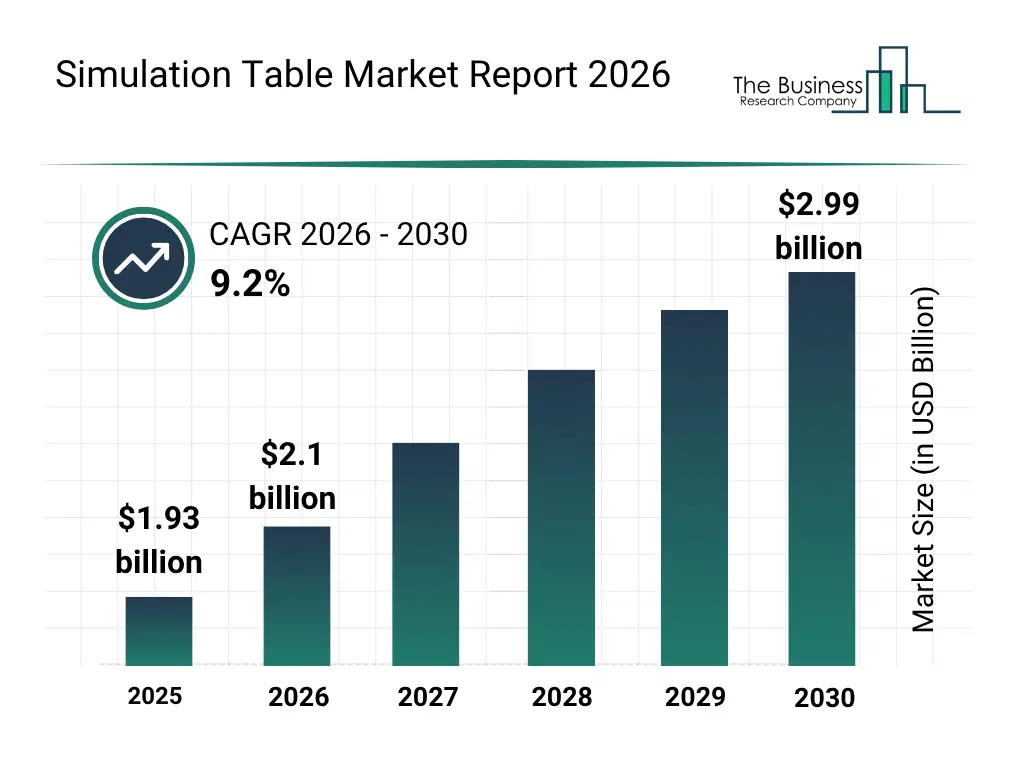
What Is The Simulation Table Market Size and Share 2026?
The simulation table market size has grown strongly in recent years. It will grow from $1.93 billion in 2025 to $2.1 billion in 2026 at a compound annual growth rate (CAGR) of 8.9%. The growth in the historic period can be attributed to rising adoption of on-premise simulation software, increasing demand for strategic planning tools, integration of vr/ar in training programs, growth in r&d activities across industries, early adoption of hybrid simulation platforms.What Is The Simulation Table Market Growth Forecast?
The simulation table market size is expected to see strong growth in the next few years. It will grow to $2.99 billion in 2030 at a compound annual growth rate (CAGR) of 9.2%. The growth in the forecast period can be attributed to adoption of cloud-based and ai-enabled simulation platforms, expansion in financial forecasting and risk management applications, demand for customized consulting and advisory services, integration with iot-enabled systems, focus on scenario-based predictive analytics. Major trends in the forecast period include real-time data visualization, scenario modeling and analytics, cloud-based simulation deployment, ai-enabled simulation insights, customized training and capacity development.
Global Simulation Table Market Segmentation
1) By Component: Software, Services, Platform And Integration 2) By Payload Capacity: Small, Standard, High Frequency 3) By Application: Financial Forecasting, Risk Management, Strategic Planning, Supply Chain Optimization, Research And Development 4) By End-User: Banking, Financial Services And Insurance, Information Technology And Telecom, Manufacturing, Healthcare And Life Sciences, Energy And Utilities, Government And Defense, Education And Research, Retail And Consumer Goods Subsegments: 1) By Software: On Premise Simulation Software, Cloud Based Simulation Software, Hybrid Deployment Simulation Software, Real Time Data Visualization Software, Scenario Modeling And Analytics Software 2) By Services: Consulting And Advisory Services, System Design And Customization Services, Deployment And Installation Services, Maintenance And Technical Support Services, Training And Capacity Development Services 3) By Platform And Integration: Hardware Integrated Simulation Platforms, Software Integrated Simulation Platforms, Augmented Reality Integrated Platforms, Virtual Reality Integrated Platforms, Artificial Intelligence Enabled Simulation PlatformsWhat Is The Driver Of The Simulation Table Market?
The growing demand for minimally invasive surgery (MIS) is expected to propel the growth of the simulation table market going forward. Minimally invasive surgery (MIS) refers to the practice of surgical techniques that use small incisions and specialized instruments to perform procedures with minimal tissue damage. The growing demand for minimally invasive surgery (MIS) is driven by the increasing adoption of advanced surgical technologies, as more surgeons need specialized skills to perform less invasive procedures safely and effectively. Simulation tables help minimally invasive surgery (MIS) by providing a realistic, hands-on environment where surgeons can practice complex procedures, refine their skills, and improve precision without risk to patients. For instance, in April 2025, according to the British Association of Aesthetic Plastic Surgeons, a UK-based surgical organization, between 2023 and 2024, cosmetic surgical procedures increased by 5%, reaching a total of 27,462 procedures performed in 2024. Therefore, the growing demand for minimally invasive surgery (MIS) is driving the growth of the simulation table industry.Key Players In The Global Simulation Table Market
Major companies operating in the simulation table market are Siemens AG, Schneider Electric SE, Rockwell Automation Inc., Bosch Rexroth AG, Synopsys Inc., Autodesk Inc., PTC Inc., The MathWorks Inc., Bentley Systems Incorporated, Instron, COMSOL AB, Dongling Technologies Co. Ltd., Lanner Electronics Inc., Weiss Technik GmbH, CFM Schiller GmbH, Simio LLC, Flow Science Inc., Team Corporation, SIMUL8 Corporation, and CPFD Software LLC.Global Simulation Table Market Trends and Insights
Major companies operating in the simulation table market are focusing on developing advanced solutions, such as mixed reality-enabled planning platforms, to enhance mission rehearsal capabilities, improve situational awareness, and support immersive operational training. A mixed reality sand table refers to an interactive simulation system that combines physical terrain models with digital overlays and real-time 3D visualization to create realistic and dynamic operational environments for strategic planning and training purposes. For instance, in November 2023, MVRsimulation, a US-based simulation technology company, launched its mixed-reality Sand Table at the I/ITSEC event, introducing a collaborative 3D visualization tool for military mission planning, rehearsal, and after-action reviews. Powered by the company's Virtual Reality Scene Generator (VRSG) with geospecific terrain and integrated with Varjo mixed-reality headsets and Valve Index controllers, it enables commanders, instructors, and trainees to interactively explore scenarios, manipulate views, and network with simulators like the Deployable Joint Fires Trainer (DJFT) in JTAC call-for-fire exercises.What Are Latest Mergers And Acquisitions In The Simulation Table Market?
In July 2025, Synopsys Inc., a US-based electronic design automation software company, acquired Ansys Inc. for $35 billion. Through this acquisition, Synopsys aims to expand its capabilities beyond chip design by integrating Ansys’s advanced simulation and analysis technologies, enabling a comprehensive silicon-to-systems engineering platform that supports virtual testing and validation of complex products. Ansys Inc. is a US-based software company that offers testing and simulation systems.Regional Insights
North America was the largest region in the simulation table market in 2025. Asia-Pacific is expected to be the fastest-growing region in the forecast period. The regions covered in this market report are Asia-Pacific, South East Asia, Western Europe, Eastern Europe, North America, South America, Middle East, Africa. The countries covered in this market report are Australia, Brazil, China, France, Germany, India, Indonesia, Japan, Taiwan, Russia, South Korea, UK, USA, Canada, Italy, Spain.What Defines the Simulation Table Market?
The simulation table market consists of revenues earned by entities by providing services such as scenario modeling services, interactive training simulation setup, system integration services, performance analytics, and reporting. The market value includes the value of related goods sold by the service provider or included within the service offering. Only goods and services traded between entities or sold to end consumers are included.How is Market Value Defined and Measured?
The market value is defined as the revenues that enterprises gain from the sale of goods and/or services within the specified market and geography through sales, grants, or donations in terms of the currency (in USD unless otherwise specified). The revenues for a specified geography are consumption values that are revenues generated by organizations in the specified geography within the market, irrespective of where they are produced. It does not include revenues from resales along the supply chain, either further along the supply chain or as part of other products.What Key Data And Analysis Are Included In The Simulation Table Market Report 2026?
The simulation table market research report is one of a series of new reports from The Business Research Company that provides market statistics, including industry global market size, regional shares, competitors with the market share, detailed market segments, market trends and opportunities, and any further data you may need to thrive in the simulation table industry. The market research report delivers a complete perspective of everything you need, with an in-depth analysis of the current and future state of the industry.Simulation Table Market Report Forecast Analysis
| Report Attribute | Details |
|---|---|
| Market Size Value In 2026 | $2.1 billion |
| Revenue Forecast In 2035 | $2.99 billion |
| Growth Rate | CAGR of 8.9% from 2026 to 2035 |
| Base Year For Estimation | 2025 |
| Actual Estimates/Historical Data | 2020-2025 |
| Forecast Period | 2026 - 2030 - 2035 |
| Market Representation | Revenue in USD Billion and CAGR from 2026 to 2035 |
| Segments Covered | Component, Payload Capacity, Application, End-User |
| Regional Scope | Asia-Pacific, Western Europe, Eastern Europe, North America, South America, Middle East, Africa |
| Country Scope | The countries covered in the report are Australia, Brazil, China, France, Germany, India, Indonesia, Japan, Taiwan, Russia, South Korea, UK, USA, Canada, Italy, Spain. |
| Key Companies Profiled | Siemens AG, Schneider Electric SE, Rockwell Automation Inc., Bosch Rexroth AG, Synopsys Inc., Autodesk Inc., PTC Inc., The MathWorks Inc., Bentley Systems Incorporated, Instron, COMSOL AB, Dongling Technologies Co. Ltd., Lanner Electronics Inc., Weiss Technik GmbH, CFM Schiller GmbH, Simio LLC, Flow Science Inc., Team Corporation, SIMUL8 Corporation, and CPFD Software LLC. |
| Customization Scope | Request for Customization |
| Pricing And Purchase Options | Explore Purchase Options |