
Single-Cell Genome Sequencing Market Report 2026
Global Outlook – By Type (Instruments, Reagents), By Technology (Next-Generation Sequencing (NGS), Polymerase Chain Reaction (PCR), Quantitative Polymerase Chain Reaction (qPCR), Microarray, Multiple Displacement Amplification (MDA)), By Disease Area (Cancer, Immunology, Prenatal Diagnosis, Neurobiology, Microbiology, Other Disease Areas), By Application (Circulating Cells, Cell Differentiation Or Reprogramming, Genomic Variation, Subpopulation Characterization, Other Applications), By End User (Academic Research Laboratories, Biotechnology Biopharmaceutical Companies, Clinics, Other End Users) - Market Size, Trends, Strategies, and Forecast to 2030
Single-Cell Genome Sequencing Market Overview
• Single-Cell Genome Sequencing market size has reached to $2.83 billion in 2025 • Expected to grow to $5.84 billion in 2030 at a compound annual growth rate (CAGR) of 15.7% • Growth Driver: Rising Cancer Prevalence Drives Growth In Single-Cell Genome Sequencing Market • Market Trend: Advancing Single-Cell Proteomics For Personalized Medicine • North America was the largest region in 2025 and Asia-Pacific is the fastest growing region.What Is Covered Under Single-Cell Genome Sequencing Market?
Single-cell genome sequencing is a potent method for detecting genomic changes like copy number variations (CNVs) and point mutations and revealing cell-to-cell heterogeneity in biological materials. They are employed to investigate both healthy and diseased physiology. The main types of single-cell genome sequencing are instruments and reagents. An instrument refers to the specialized equipment or device used to perform the various steps involved in the sequencing process. The various technologies are next-generation sequencing (NGS), polymerase chain reaction (PCR), quantitative polymerase chain reaction (qPCR), microarray, and multiple displacement amplification (MDA) used in disease areas such as cancer, immunology, prenatal diagnosis, neurobiology, microbiology, and others. The various applications are circulating cells, cell differentiation or reprogramming, genomic variation, subpopulation characterization, and others used by academic research laboratories, biotechnology biopharmaceutical companies, clinics, and others.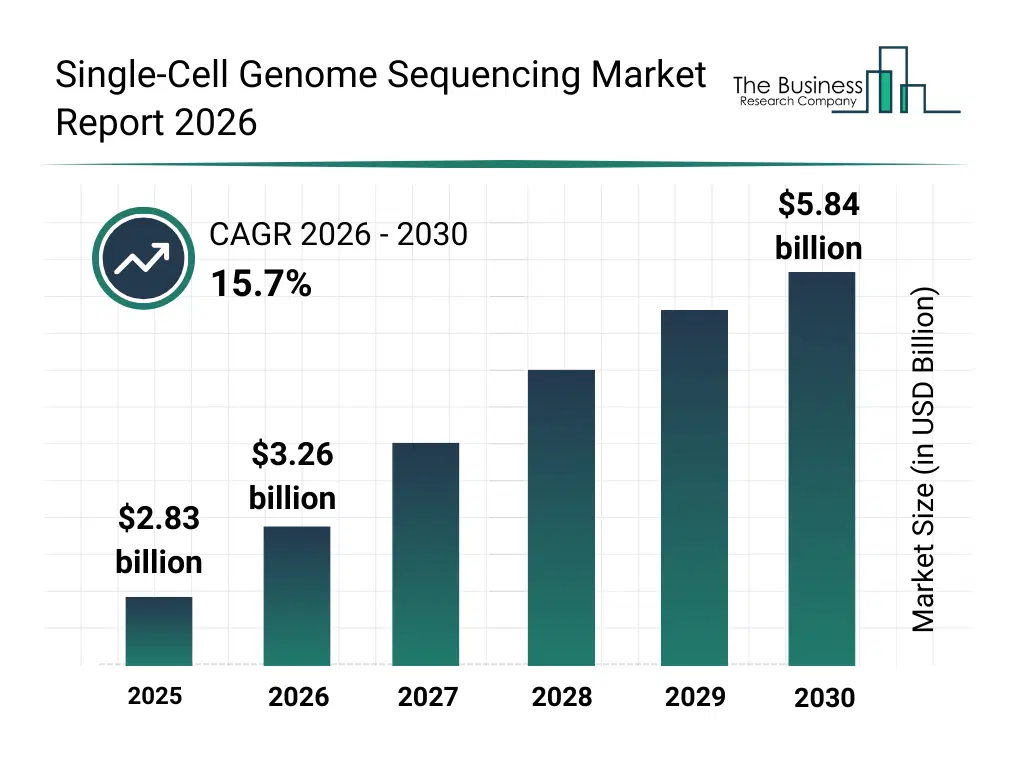
What Is The Single-Cell Genome Sequencing Market Size and Share 2026?
The single-cell genome sequencing market size has grown rapidly in recent years. It will grow from $2.83 billion in 2025 to $3.26 billion in 2026 at a compound annual growth rate (CAGR) of 15.2%. The growth in the historic period can be attributed to early adoption in research, limited sequencing resolution, high cost of single-cell analysis, growing demand for personalized medicine research, increasing collaborations in genomics.What Is The Single-Cell Genome Sequencing Market Growth Forecast?
The single-cell genome sequencing market size is expected to see rapid growth in the next few years. It will grow to $5.84 billion in 2030 at a compound annual growth rate (CAGR) of 15.7%. The growth in the forecast period can be attributed to development of high-throughput single-cell platforms, expansion in clinical diagnostic use, integration with AI and bioinformatics, adoption in multi-omics studies, growth in drug discovery applications. Major trends in the forecast period include increasing use in cancer research, integration with multi-omics studies, adoption in drug discovery, development of automated sequencing platforms, growth in clinical diagnostics applications.
Global Single-Cell Genome Sequencing Market Segmentation
1) By Type: Instruments, Reagents 2) By Technology: Next-Generation Sequencing (NGS), Polymerase Chain Reaction (PCR), Quantitative Polymerase Chain Reaction (qPCR), Microarray, Multiple Displacement Amplification (MDA) 3) By Disease Area: Cancer, Immunology, Prenatal Diagnosis, Neurobiology, Microbiology, Other Disease Areas 4) By Application: Circulating Cells, Cell Differentiation Or Reprogramming, Genomic Variation, Subpopulation Characterization, Other Applications 5) By End User: Academic Research Laboratories, Biotechnology Biopharmaceutical Companies, Clinics, Other End Users Subsegments: 1) By Instruments: Single-Cell Isolation Systems, Sequencing Platforms, Automation And Robotic Systems 2) By Reagents: Library Preparation Kits, Amplification Reagents, DNA Extraction Kits, Quality Control ReagentsWhat Is The Driver Of The Single-Cell Genome Sequencing Market?
Increasing the prevalence of cancer is expected to propel the growth of the single-cell genome sequencing market going forward. Cancer is a broad category of illnesses where aberrant cells develop and divide out of control. It results from changes in the genes that regulate cell division and control the normal functioning of cells. Cancer is a disease characterized by genetic alterations, and single-cell genome sequencing can help uncover the genetic changes that occur in individual cancer cells. For instance, in January 2023, according to the American Cancer Society, a US-based cancer-fighting organization, there were around 1.9 million new cancer cases and 609,360 cancer deaths in the US in 2022. Further, approximately 27.5 million new cancer cases and 16.3 million cancer deaths are estimated to occur by 2040. Therefore, the increasing prevalence of cancer is expected to propel the growth of the single-cell genome sequencing industry.Key Players In The Global Single-Cell Genome Sequencing Market
Major companies operating in the single-cell genome sequencing market are F Hoffmann-La Roche Ltd., Thermo Fisher Scientific Inc., DH Life Sciences LLC., Becton Dickinson And Company (BD), Agilent Technologies Inc., Illumina Inc., Bio-Rad Laboratories Inc., QIAGEN GmbH, Bio-Techne Corporation, BGI Genomics Co. Ltd., Fulgent Genetics Inc., 10x Genomics Inc., Promega Corporation, Takara Bio Inc., Oxford Nanopore Technologies PLC, Pacific Biosciences of California Inc., Standard BioTools Inc., Singleron Biotechnologies, MGI Tech Co. Ltd, GENEWIZ Inc., Mission Bio Inc., Zymo Research Corporation, Menarini Silicon Biosystems SpA, Novogene Co. Ltd., RareCyte Inc., Fluxion Biosciences Inc., Single Cell Discoveries B.V., Parse Biosciences Inc., BioSpyder Technologies Inc., SeqWell Inc.
This chart is for illustrative purposes; the full report includes a detailed competitor analysis and comprehensive overview of the top 10 companies in the market.
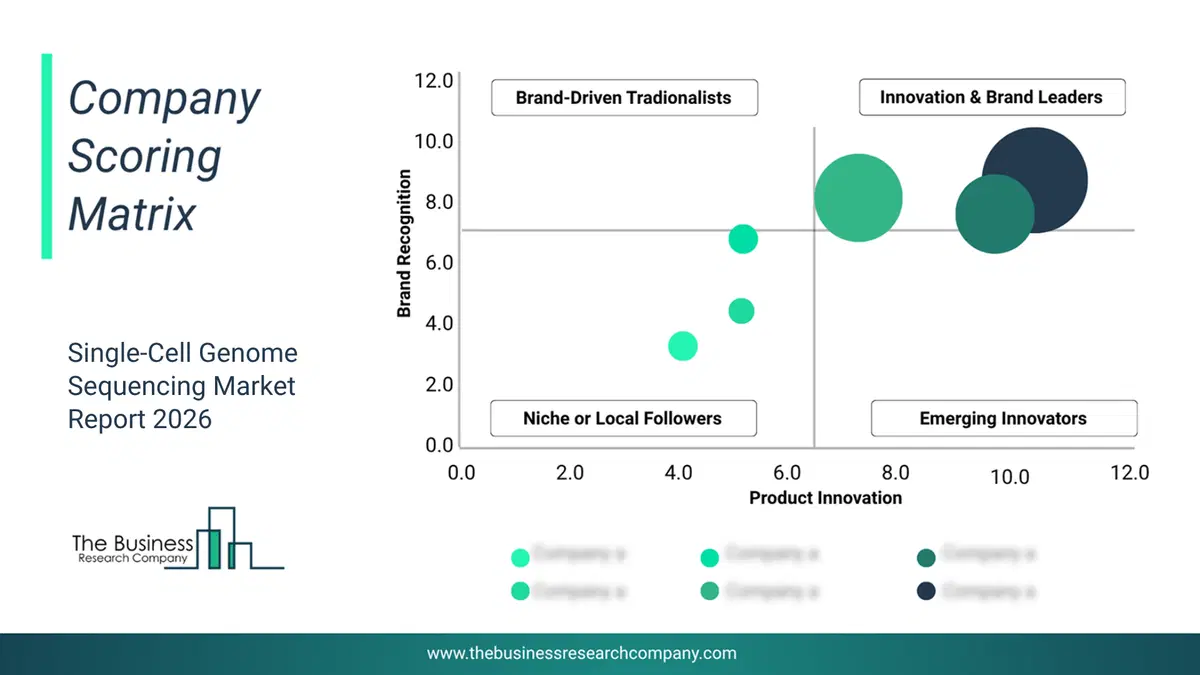
This chart maps companies by product innovation and brand strength, with bubble size indicating relative revenue, helping identify market leaders, challengers, and niche players. This is an illustrative chart; the full report provides a complete and accurate competitive analysis.
Global Single-Cell Genome Sequencing Market Trends and Insights
Major companies operating in the single-cell genome sequencing market are focusing on developing single cell proteomics. Single cell proteomics refer to a young discipline that seeks to comprehend the variety of protein expression that occurs within individual cells. Integration of single-cell genomics with proteomics techniques to study the relationship between genomic information and protein expression at the single-cell level. For instance, in October 2023, Proteome Sciences plc a UK-based biotechnology company launched SysQuant SCP the single-cell proteomics commercial service that leverages the capabilities of its TMTproTM isobaric labelling reagents. Quantitative mass spectrometry data is generated and analyzed by the SysQuant SCP pipeline to uncover minute variations in individual cells as well as within subpopulations of the same primary cell type. By providing new therapeutic and diagnostic targets for personalized medicine, this data will significantly advance our understanding of the biological drivers of heterogeneity and evolution in the contexts of disease and response to therapy.What Are Latest Mergers And Acquisitions In The Single-Cell Genome Sequencing Market?
In January 2023, Qiagen, a Germany-based pharmaceutical research company, acquired Verogen for an undisclosed amount. The aim of the acquisition is to enhance Qiagen's position in the field of human identification and forensic testing by integrating Verogen's NGS technology and expertise. Verogen is a US-based biotechnology company.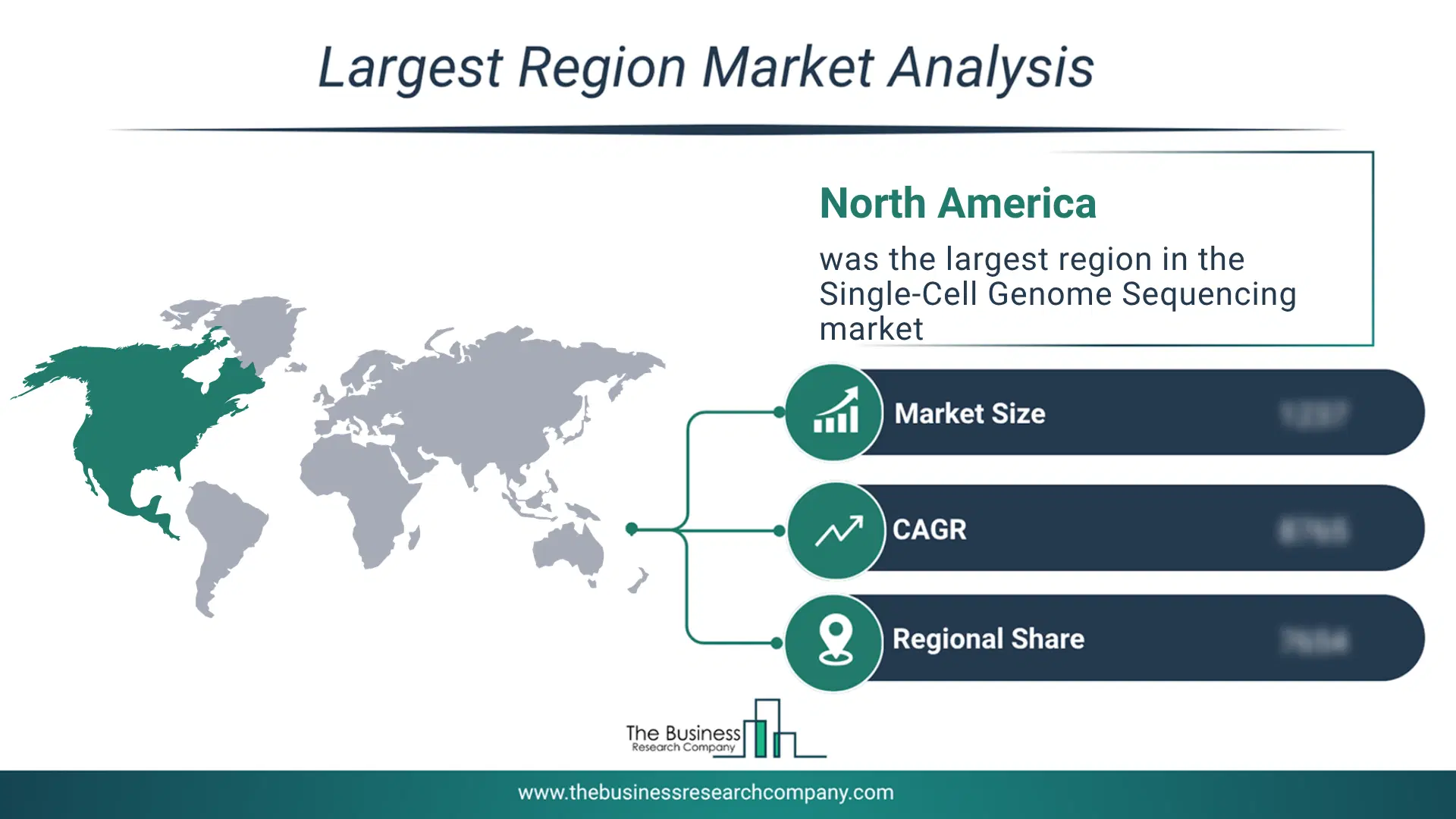
Regional Outlook
North America was the largest region in the single-cell genome sequencing market in 2025. Asia-Pacific is expected to be the fastest-growing region in the forecast period. The regions covered in this market report are Asia-Pacific, South East Asia, Western Europe, Eastern Europe, North America, South America, Middle East, Africa. The countries covered in this market report are Australia, Brazil, China, France, Germany, India, Indonesia, Japan, Taiwan, Russia, South Korea, UK, USA, Canada, Italy, Spain.What Defines the Single-Cell Genome Sequencing Market?
The single-cell genome sequencing market consists of revenues earned by entities by providing single-cell analysis, genetic heterogeneity study, identification of genomes of individual cells, and microbiomes and cancer study. The market value includes the value of related goods sold by the service provider or included within the service offering. The single-cell genome sequencing market also includes sales of single cell kit, DNA sequencing instruments and single-cell sequencing kits. Values in this market are ‘factory gate’ values, that is the value of goods sold by the manufacturers or creators of the goods, whether to other entities (including downstream manufacturers, wholesalers, distributors and retailers) or directly to end customers. The value of goods in this market includes related services sold by the creators of the goods.How is Market Value Defined and Measured?
The market value is defined as the revenues that enterprises gain from the sale of goods and/or services within the specified market and geography through sales, grants, or donations in terms of the currency (in USD unless otherwise specified). The revenues for a specified geography are consumption values that are revenues generated by organizations in the specified geography within the market, irrespective of where they are produced. It does not include revenues from resales along the supply chain, either further along the supply chain or as part of other products.
This chart presents market attractiveness based on a quantitative evaluation of growth, competition, strategic alignment, and risk, offering a clear view of opportunity areas for decision-making. This chart is for illustrative purposes; the full report contains the complete analysis.

This chart highlights the Total Addressable Market (TAM) by estimating the maximum revenue opportunity using an assumption-driven approach, supporting strategic planning and opportunity sizing across markets. The chart is illustrative; the full report provides a more comprehensive analysis.
What Key Data and Analysis Are Included in the Single-Cell Genome Sequencing Market Report 2026?
The single-cell genome sequencing market research report is one of a series of new reports from The Business Research Company that provides market statistics, including industry global market size, regional shares, competitors with the market share, detailed market segments, market trends and opportunities, and any further data you may need to thrive in the single-cell genome sequencing industry. The market research report delivers a complete perspective of everything you need, with an in-depth analysis of the current and future state of the industry.Single-Cell Genome Sequencing Market Report Forecast Analysis
| Report Attribute | Details |
|---|---|
| Market Size Value In 2026 | $3.26 billion |
| Revenue Forecast In 2030 | $5.84 billion |
| Growth Rate | CAGR of 15.7% from 2026 to 2030 |
| Base Year For Estimation | 2025 |
| Actual Estimates/Historical Data | 2020-2025 |
| Forecast Period | 2026 - 2030 |
| Market Representation | Revenue in USD Billion and CAGR from 2026 to 2030 |
| Segments Covered | Type, Technology, Disease Area, Application, End User |
| Regional Scope | Asia-Pacific, Western Europe, Eastern Europe, North America, South America, Middle East, Africa |
| Country Scope | The countries covered in the report are Australia, Brazil, China, France, Germany, India, Indonesia, Japan, Taiwan, Russia, South Korea, UK, USA, Canada, Italy, Spain |
| Key Companies Profiled | F Hoffmann-La Roche Ltd., Thermo Fisher Scientific Inc., DH Life Sciences LLC., Becton Dickinson And Company (BD), Agilent Technologies Inc., Illumina Inc., Bio-Rad Laboratories Inc., QIAGEN GmbH, Bio-Techne Corporation, BGI Genomics Co. Ltd., Fulgent Genetics Inc., 10x Genomics Inc., Promega Corporation, Takara Bio Inc., Oxford Nanopore Technologies PLC, Pacific Biosciences of California Inc., Standard BioTools Inc., Singleron Biotechnologies, MGI Tech Co. Ltd, GENEWIZ Inc., Mission Bio Inc., Zymo Research Corporation, Menarini Silicon Biosystems SpA, Novogene Co. Ltd., RareCyte Inc., Fluxion Biosciences Inc., Single Cell Discoveries B.V., Parse Biosciences Inc., BioSpyder Technologies Inc., SeqWell Inc. |
| Customization Scope | Request for Customization |
| Pricing And Purchase Options | Explore Purchase Options |