
Single Vision Lenses Market Report 2026
Global Outlook – By Type (Spherical, Aspherical, Freeform), By Material (Glass, Polycarbonate, Other Material Types), By Age Group (Less Than 18 Years, Greater Than Or Equal To 18 Years And Less Than 40 Years, Greater Than Or Equal To 40 Years), By Application (Hyperopia (Farsightedness), Myopia (Nearsightedness), Astigmatism, Presbyopia) – Market Size, Trends, Strategies, and Forecast to 2030
Single Vision Lenses Market Overview
• Single Vision Lenses market size has reached to $7.31 billion in 2025 • Expected to grow to $8.91 billion in 2030 at a compound annual growth rate (CAGR) of 3.9% • Growth Driver: Rising Prevalence Of Myopia Fuels The Single-Vision Lenses Market • Market Trend: Advancements In Personalized Lens Technology Enhance Visual Clarity And Comfort • North America was the largest region in 2025.What Is Covered Under Single Vision Lenses Market?
Single vision lenses are corrective lenses designed to correct vision at a single distance, either for nearsightedness (myopia) or farsightedness (hyperopia). Unlike multifocal lenses, they have uniform optical power throughout, offering clear vision either for close-up tasks or distance vision, depending on the prescription. These lenses are commonly used in eyeglasses for everyday wear and can be made from various materials, including plastic and glass, to accommodate different needs for durability, weight, and optical clarity. The main types of single vision lenses are spherical, aspherical, and freeform. Spherical lenses have a uniform curvature across their surface, correcting common vision problems such as nearsightedness or farsightedness. The materials used in single-vision lenses are glass, polycarbonate, and others, and they are useful for various age groups, such as those less than 18 years, those greater than or equal to 18 years, those less than 40 years, and those greater than or equal to 40 years. It is used in various applications, such as hyperopia (farsightedness), myopia (nearsightedness), astigmatism, and presbyopia.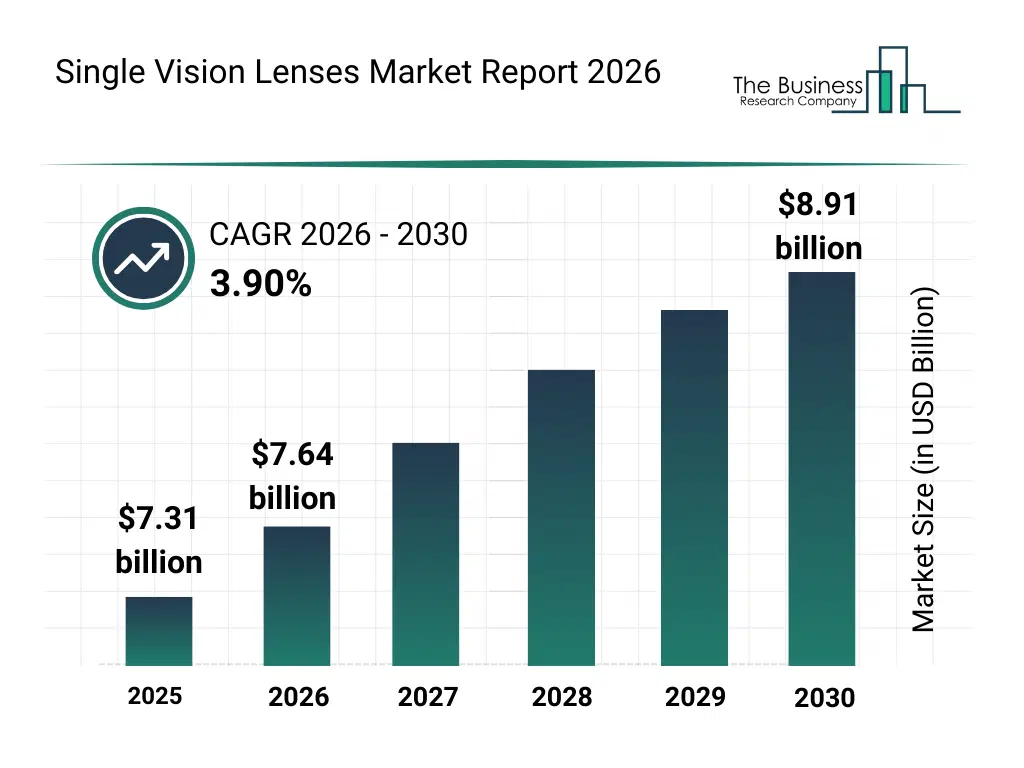
What Is The Single Vision Lenses Market Size and Share 2026?
The single vision lenses market size has grown steadily in recent years. It will grow from $7.31 billion in 2025 to $7.64 billion in 2026 at a compound annual growth rate (CAGR) of 4.4%. The growth in the historic period can be attributed to increasing prevalence of refractive vision disorders, widespread use of corrective eyewear, growth of optometry services, availability of mass-produced lens materials, rising demand for prescription eyewear.What Is The Single Vision Lenses Market Growth Forecast?
The single vision lenses market size is expected to see steady growth in the next few years. It will grow to $8.91 billion in 2030 at a compound annual growth rate (CAGR) of 3.9%. The growth in the forecast period can be attributed to increasing adoption of personalized eyewear solutions, rising demand for premium optical lenses, expansion of digital eye testing technologies, growing focus on visual comfort and eye health, increasing penetration of online eyewear retail. Major trends in the forecast period include increasing adoption of freeform lens manufacturing, rising demand for lightweight and high-index materials, growing preference for customized vision correction, expansion of digital lens surfacing technologies, enhanced focus on optical clarity and comfort.
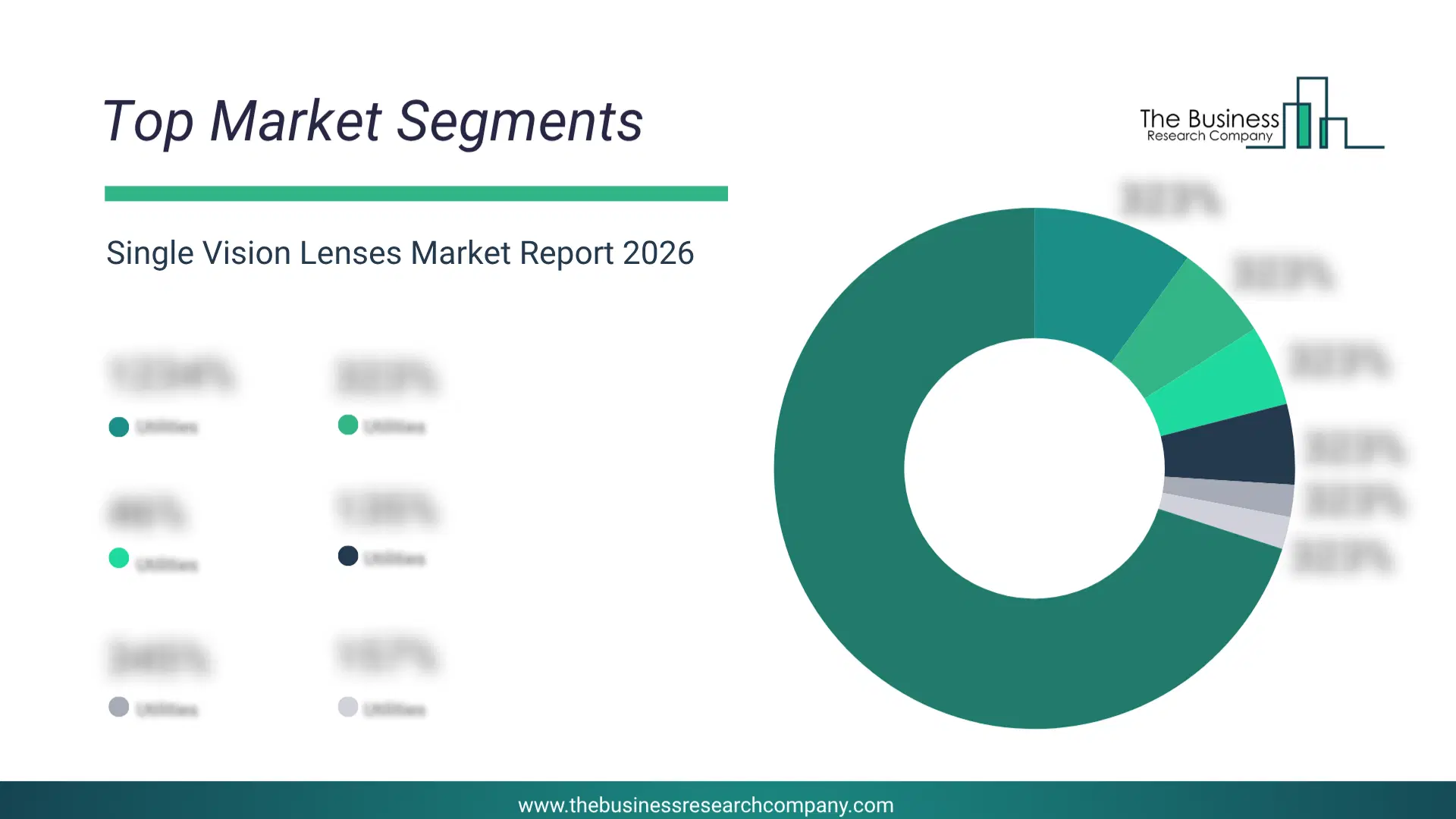
Global Single Vision Lenses Market Segmentation
1) By Type: Spherical, Aspherical, Freeform 2) By Material: Glass, Polycarbonate, Other Material Types 3) By Age Group: Less Than 18 Years, Greater Than Or Equal To 18 Years And Less Than 40 Years, Greater Than Or Equal To 40 Years 4) By Application: Hyperopia (Farsightedness), Myopia (Nearsightedness), Astigmatism, Presbyopia Subsegments: 1) By Spherical: Standard Spherical Lenses, High-Index Spherical Lenses 2) By Aspherical: High-Index Aspherical Lenses, Polycarbonate Aspherical Lenses 3) By Freeform: Customized Freeform Lenses, Digital Freeform LensesWhat Is The Driver Of The Single Vision Lenses Market?
The increasing prevalence of myopia is expected to propel the growth of the single vision lenses market going forward. Myopia, commonly known as nearsightedness, is a refractive error of the eye where distant objects appear blurry while close objects can be seen clearly. The prevalence of myopia is rising due to increased screen time, prolonged work, and aging populations. Single vision lenses correct myopia by focusing light directly on the retina, improving distance vision. For instance, in September 2024, according to BMJ Publishing Group, a UK-based published by a health organization, over 36% of children and adolescents worldwide are affected by myopia. This marks a significant increase from earlier decades, with projections indicating that the number of myopic individuals could exceed 740 million by 2050. Therefore, the increasing prevalence of myopia is driving the growth of the single vision lenses industry.Key Players In The Global Single Vision Lenses Market
Major companies operating in the single vision lenses market are Essilor Luxottica, Hoya Corporation, Nikon Corporation, Carl Zeiss AG, Rodenstock GmbH, Shamir Optical Industry Ltd., Norville, Vision-Ease Lens, Younger Optics Asia Pacific Ltd., iCoat Company LLC, Seiko Optical Products Co. Ltd., GKB Optic Technologies Pvt. Ltd., Optiswiss AG, KODAK Lens, Augen Optics, Opticote Inc., Tokai Optical Co. Ltd., Shanghai Conant Optics Co. Ltd., Jiangsu Aogang Optical Glasses Co. Ltd., Central Optical Co. Ltd.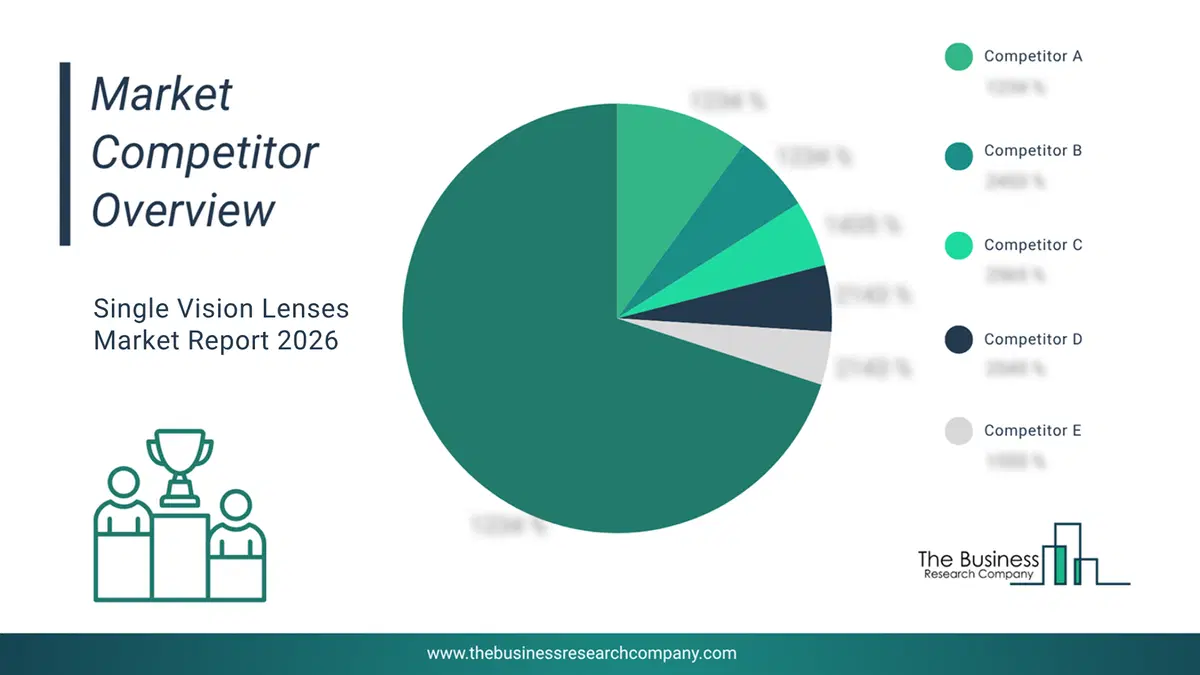
This chart is for illustrative purposes; the full report includes a detailed competitor analysis and comprehensive overview of the top 10 companies in the market.
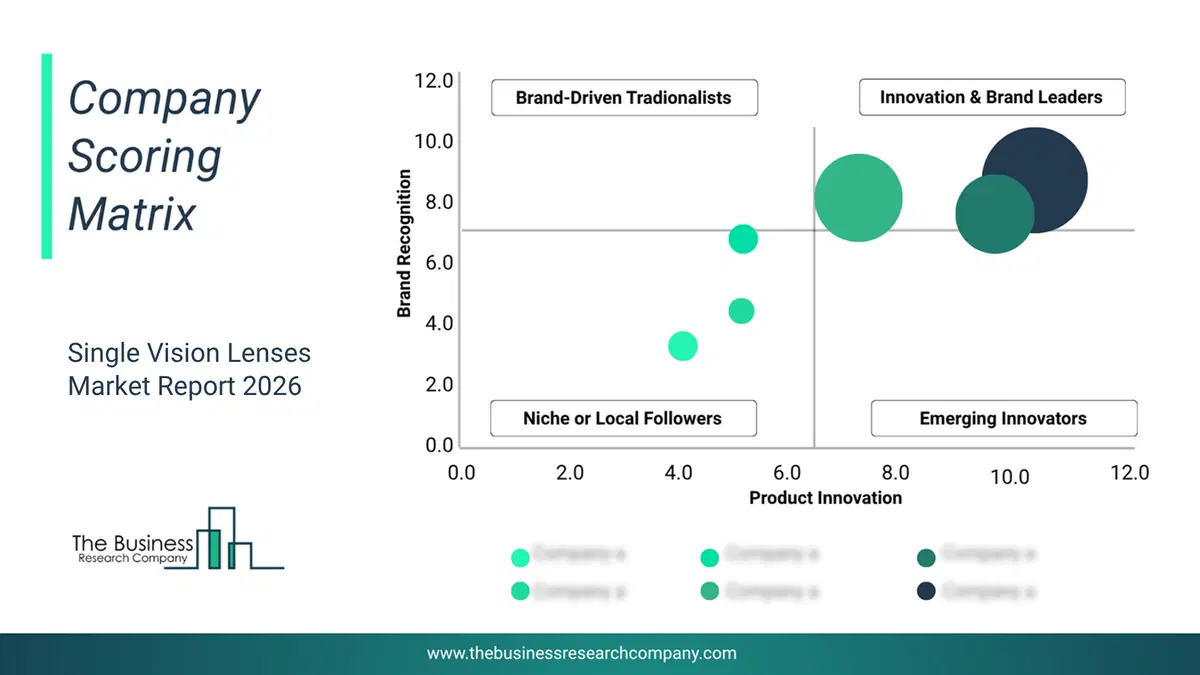
This chart maps companies by product innovation and brand strength, with bubble size indicating relative revenue, helping identify market leaders, challengers, and niche players. This is an illustrative chart; the full report provides a complete and accurate competitive analysis.
Global Single Vision Lenses Market Trends and Insights
Major companies operating in the single vision lens market are focusing on developing advanced, personalized lens solutions, such as individually optimized free-form designs, to enhance visual precision, expand peripheral clarity, and improve overall wearer comfort. These technologies aim to deliver distortion-free vision in all gaze directions by leveraging precise patient measurements and sophisticated surface optimization techniques. For instance, in April 2023, Hoya Lens Australia Pty Ltd a Australia-based Technology company launched Nulux iDentity V+ single vision lenses, which utilize Backside Surface Precision Technology to provide 360 visual comfort and seamless peripheral performance. Designed to support daily visual tasks with greater ease and accuracy, this innovation highlights the market’s shift toward tailored single vision eyewear that improves clarity, comfort, and real-world visual functionality.What Are Latest Mergers And Acquisitions In The Single Vision Lenses Market?
In June 2025, Carl Zeiss Vision International GmbH, a Germany‑based optoelectronics company acquired Brighten Optix for an undisclosed amount. With this acquisition, Zeiss aims to strengthen its myopia-management portfolio and integrate specialty contact‑lens capabilities to reinforce its global leadership in vision care. Brighten Optix Corporation is a Taiwan‑based company specializing in orthokeratology and advanced rigid contact lenses, with a strong presence in Greater China and Southeast Asia.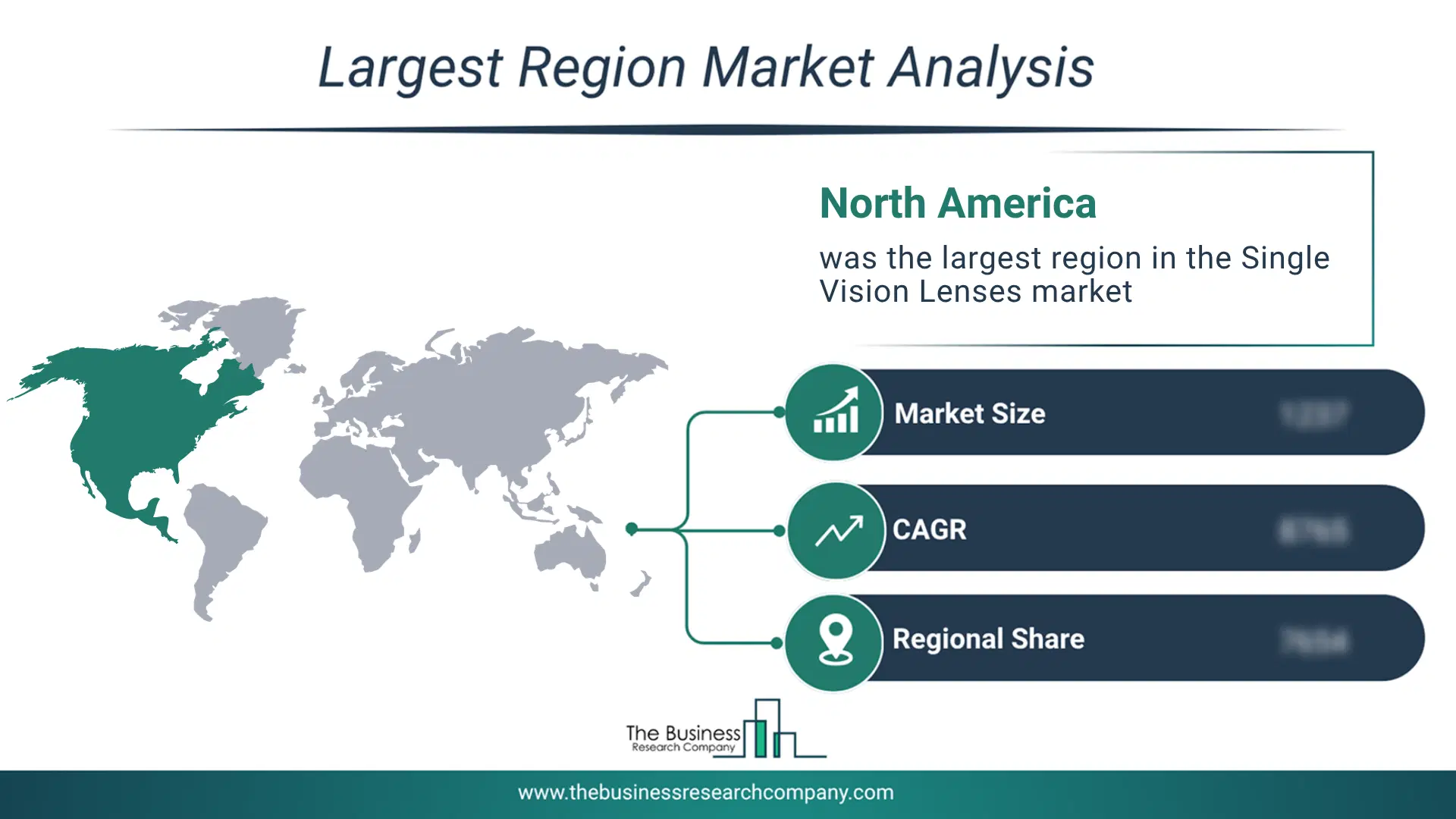
Regional Outlook
North America was the largest region in the single vision lenses market in 2025. The regions covered in this market report are Asia-Pacific, South East Asia, Western Europe, Eastern Europe, North America, South America, Middle East, Africa. The countries covered in this market report are Australia, Brazil, China, France, Germany, India, Indonesia, Japan, Taiwan, Russia, South Korea, UK, USA, Canada, Italy, SpainWhat Defines the Single Vision Lenses Market?
The single vision lenses market consists of sales of standard plastic lenses, high-index lenses, trivex lenses, and blue light blocking lenses. Values in this market are ‘factory gate’ values, that is the value of goods sold by the manufacturers or creators of the goods, whether to other entities (including downstream manufacturers, wholesalers, distributors and retailers) or directly to end customers. The value of goods in this market includes related services sold, by the creators of the goods.How is Market Value Defined and Measured?
The market value is defined as the revenues that enterprises gain from the sale of goods and/or services within the specified market and geography through sales, grants, or donations in terms of the currency (in USD unless otherwise specified). The revenues for a specified geography are consumption values that are revenues generated by organizations in the specified geography within the market, irrespective of where they are produced. It does not include revenues from resales along the supply chain, either further along the supply chain or as part of other products.
This chart presents market attractiveness based on a quantitative evaluation of growth, competition, strategic alignment, and risk, offering a clear view of opportunity areas for decision-making. This chart is for illustrative purposes; the full report contains the complete analysis.

This chart highlights the Total Addressable Market (TAM) by estimating the maximum revenue opportunity using an assumption-driven approach, supporting strategic planning and opportunity sizing across markets. The chart is illustrative; the full report provides a more comprehensive analysis.
What Key Data and Analysis Are Included in the Single Vision Lenses Market Report 2026?
The single vision lenses market research report is one of a series of new reports from The Business Research Company that provides market statistics, including industry global market size, regional shares, competitors with the market share, detailed market segments, market trends and opportunities, and any further data you may need to thrive in the single vision lenses industry. The market research report delivers a complete perspective of everything you need, with an in-depth analysis of the current and future state of the industry.Single Vision Lenses Market Report Forecast Analysis
| Report Attribute | Details |
|---|---|
| Market Size Value In 2026 | $7.64 billion |
| Revenue Forecast In 2030 | $8.91 billion |
| Growth Rate | CAGR of 3.9% from 2026 to 2030 |
| Base Year For Estimation | 2025 |
| Actual Estimates/Historical Data | 2020-2025 |
| Forecast Period | 2026 - 2030 |
| Market Representation | Revenue in USD Billion and CAGR from 2026 to 2030 |
| Segments Covered | Type, Material, Age Group, Application |
| Regional Scope | Asia-Pacific, Western Europe, Eastern Europe, North America, South America, Middle East, Africa |
| Country Scope | The countries covered in the report are Australia, Brazil, China, France, Germany, India, Indonesia, Japan, Taiwan, Russia, South Korea, UK, USA, Canada, Italy, Spain. |
| Key Companies Profiled | Essilor Luxottica, Hoya Corporation, Nikon Corporation, Carl Zeiss AG, Rodenstock GmbH, Shamir Optical Industry Ltd., Norville, Vision-Ease Lens, Younger Optics Asia Pacific Ltd., iCoat Company LLC, Seiko Optical Products Co. Ltd., GKB Optic Technologies Pvt. Ltd., Optiswiss AG, KODAK Lens, Augen Optics, Opticote Inc., Tokai Optical Co. Ltd., Shanghai Conant Optics Co. Ltd., Jiangsu Aogang Optical Glasses Co. Ltd., Central Optical Co. Ltd. |
| Customization Scope | Request for Customization |
| Pricing And Purchase Options | Explore Purchase Options |