
Skin Repair Market Report 2026
Global Outlook – By Type (Collagen-based Skin Repair Products, Hyaluronic Acid-based Skin Repair Products, Growth Factor-based Skin Repair Products, Stem Cell-based Skin Repair Products, Peptides-based Skin Repair Products), By Product Form (Creams, Ointments, Gels, Pads And Dressings, Other Product Form), By Distribution Channel (Retail Pharmacies, Online Retail, Hospital Pharmacies, Specialty Stores, Other Distribution Channel), By Application (Burns, Diabetic Foot Ulcers, Surgical Wounds, Traumatic Wounds, Pressure Sores, Other Applications), By End-user (Hospitals And Clinics, Home Care Settings, Skincare And Aesthetic Centers, Other End-Users) - Market Size, Trends, Strategies, and Forecast to 2030
Skin Repair Market Overview
• Skin Repair market size has reached to $84.69 billion in 2025 • Expected to grow to $121.21 billion in 2030 at a compound annual growth rate (CAGR) of 7.4% • Growth Driver: Rising Prevalence of Skin Conditions Fuels Surge in Dermatology Treatments and Skincare Market Growth • Market Trend: Skin Repair Enters A New Era With Game-Changing Technological Advances • North America was the largest region in 2025 and Asia-Pacific is the fastest growing region.What Is Covered Under Skin Repair Market?
Skin repair is the biological process by which the skin restores its structure and function after injury, such as cuts, burns, or abrasions. It involves a coordinated sequence of events, including hemostasis, inflammation, cell proliferation, and tissue remodeling, resulting in wound closure and the restoration of the skin’s protective barrier. The main types of skin repair are collagen-based skin repair products, hyaluronic acid-based skin repair products, growth factor-based skin repair products, stem cell-based skin repair products, and peptide-based skin repair products. Collagen-based skin repair products refer to skin repair products formulated using collagen to promote wound healing, improve skin elasticity, restore damaged skin, support tissue regeneration, maintain the skin’s natural barrier, and reduce the risk of scarring or delayed recovery. The various product form involved are creams, ointments, gels, pads and dressings, and others which are distributed through retail pharmacies, online retail, hospital pharmacies, specialty stores, others. The various applications involved are burns, diabetic foot ulcers, surgical wounds, traumatic wounds, pressure sores, others by hospitals and clinics, home care settings, skincare and aesthetic centers, and other end-users.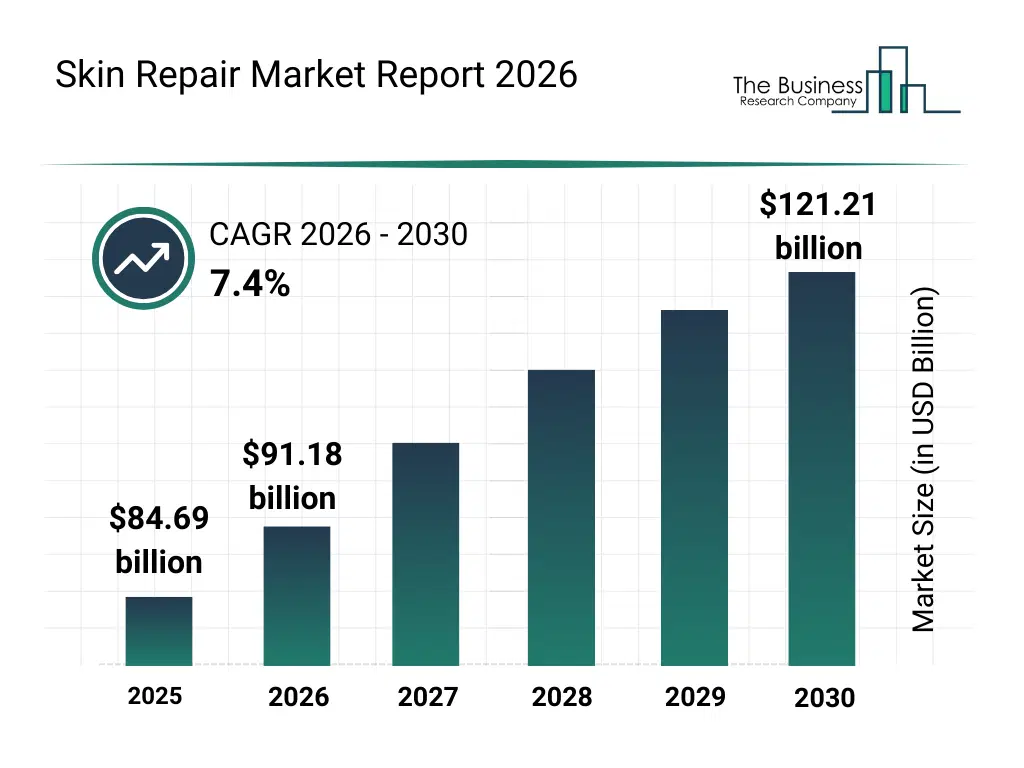
What Is The Skin Repair Market Size and Share 2026?
The skin repair market size has grown strongly in recent years. It will grow from $84.69 billion in 2025 to $91.18 billion in 2026 at a compound annual growth rate (CAGR) of 7.7%. The growth in the historic period can be attributed to increasing incidence of chronic wounds, rising prevalence of diabetes-related ulcers, expansion of surgical procedures, growth in burn injury treatments, availability of advanced topical formulations.What Is The Skin Repair Market Growth Forecast?
The skin repair market size is expected to see strong growth in the next few years. It will grow to $121.21 billion in 2030 at a compound annual growth rate (CAGR) of 7.4%. The growth in the forecast period can be attributed to increasing adoption of regenerative medicine approaches, rising demand for home-based wound care, expansion of aesthetic skin repair treatments, growing focus on personalized skincare solutions, advancements in biomaterial-based dressings. Major trends in the forecast period include increasing demand for advanced wound healing formulations, rising adoption of growth factor and stem cell-based products, expansion of chronic wound care solutions, growing focus on scar reduction and tissue regeneration, enhanced product innovation in skin repair therapies.
Global Skin Repair Market Segmentation
1) By Type: Collagen-based Skin Repair Products, Hyaluronic Acid-based Skin Repair Products, Growth Factor-based Skin Repair Products, Stem Cell-based Skin Repair Products, Peptides-based Skin Repair Products 2) By Product Form: Creams, Ointments, Gels, Pads And Dressings, Other Product Form 3) By Distribution Channel: Retail Pharmacies, Online Retail, Hospital Pharmacies, Specialty Stores, Other Distribution Channel 4) By Application: Burns, Diabetic Foot Ulcers, Surgical Wounds, Traumatic Wounds, Pressure Sores, Other Applications 5) By End-user: Hospitals And Clinics, Home Care Settings, Skincare And Aesthetic Centers, Other End-Users Subsegments: 1) By Collagen-Based Skin Repair Products: Collagen Creams, Collagen Serums, Collagen Gels, Collagen Dressings, Collagen Patches 2) By Hyaluronic Acid-Based Skin Repair Products: Hyaluronic Acid Creams, Hyaluronic Acid Serums, Hyaluronic Acid Lotions, Hyaluronic Acid Injections, Hyaluronic Acid Masks 3) By Growth Factor-Based Skin Repair Products: Epidermal Growth Factor Serums, Fibroblast Growth Factor Creams, Platelet-Derived Growth Factor Gels, Vascular Endothelial Growth Factor Solutions, Combination Growth Factor Formulations 4) By Stem Cell-Based Skin Repair Products: Plant Stem Cell Creams, Human Stem Cell Serums, Stem Cell Patches, Stem Cell Infused Masks, Stem Cell Lotions 5) By Peptides-Based Skin Repair Products: Peptide Creams, Peptide Serums, Peptide Gels, Peptide Masks, Peptide LotionsWhat Is The Driver Of The Skin Repair Market?
The rising prevalence of skin conditions is expected to propel the growth of the skin repair market going forward. Skin conditions refer to a wide range of issues that affect the skin’s health, such as acne, eczema, psoriasis, and infections, often requiring medical or cosmetic treatment. The rising prevalence of skin conditions is due to environmental pollution, as constant exposure to pollutants can damage the skin barrier, trigger inflammation, and worsen existing skin issues. Skin repair supports the rising prevalence of skin conditions by providing effective solutions for treatment and recovery. For instance, in November 2025, according to the Cancer Australia, an Australia-based government agency, in 2025, melanoma deaths in Australia are estimated at 1,455 (990 males and 465 females), with a 1 in 253 lifetime risk of death by age 85 (1 in 181 for males and 1 in 422 for females). Therefore, the rising prevalence of skin conditions is driving the growth of the skin repair industry.Key Players In The Global Skin Repair Market
Major companies operating in the skin repair market are Beiersdorf AG, Kao Corporation, Shiseido, Obagi Medical, Dermalogica, Revision Skincare, SkinCeuticals, PCA Skin, Lucas Meyer Cosmetics, Derma Made, OneSkin, Rubedo Life Sciences, Smith & Nephew plc, Mölnlycke Health Care AB, Coloplast A/S, ConvaTec Group plc, Integra LifeSciences Holdings Corporation, MiMedx Group Inc., Organogenesis Holdings Inc., Acelity L.P. Inc., Medline Industries Inc., Paul Hartmann AG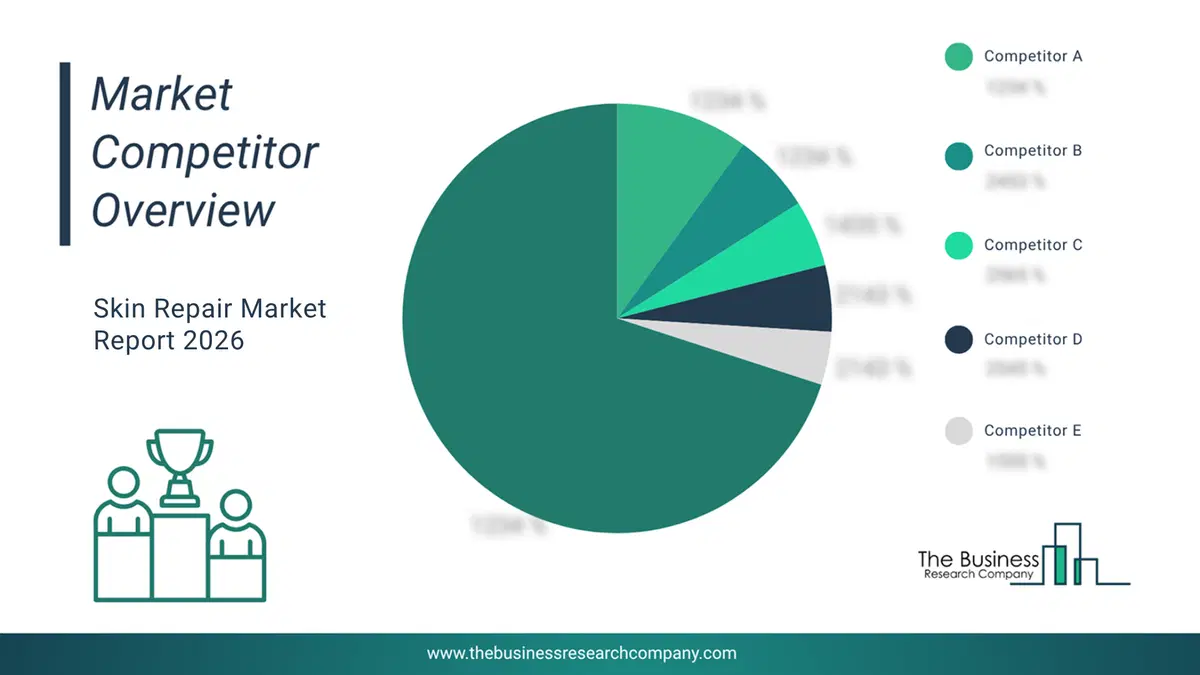
This chart is for illustrative purposes; the full report includes a detailed competitor analysis and comprehensive overview of the top 10 companies in the market.
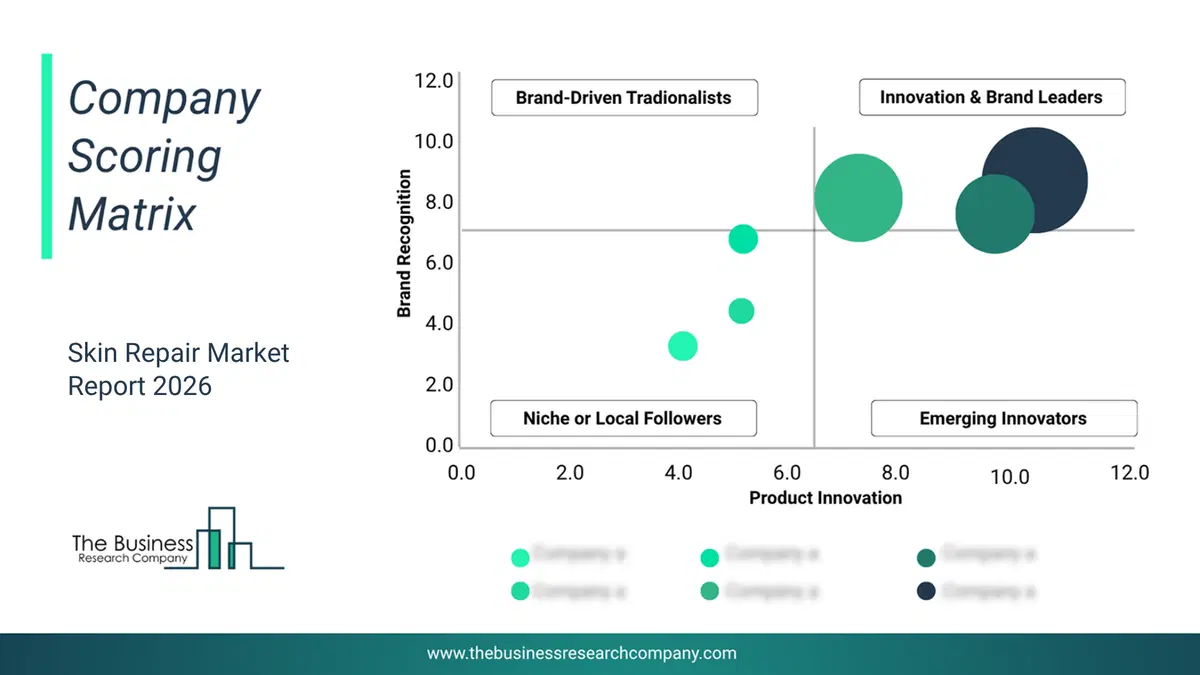
This chart maps companies by product innovation and brand strength, with bubble size indicating relative revenue, helping identify market leaders, challengers, and niche players. This is an illustrative chart; the full report provides a complete and accurate competitive analysis.
Global Skin Repair Market Trends and Insights
Major companies operating in the skin repair market are focusing on technological advancements in therapeutic approaches, such as cell-based gene therapy (CBGT). Cell-based gene therapy (CBGT) is a treatment that uses a patient’s own genetically modified cells to repair damaged skin tissue, correct underlying genetic defects, and promote long-term regeneration. For instance, in April 2025, Abeona Therapeutics, a U.S.-based biopharmaceutical company, received U.S. FDA approval for Zevaskyn, the first cell-based gene therapy for recessive dystrophic epidermolysis bullosa (RDEB), a rare genetic skin disorder. Zevaskyn represents a pioneering approach in dermatology by using autologous cell-based gene therapy to repair skin tissue, potentially transforming the standard of care for patients suffering from recessive dystrophic epidermolysis bullosa.What Are Latest Mergers And Acquisitions In The Skin Repair Market?
In September 2023, Church & Dwight Co., Inc., a US-based consumer goods company, acquired the Hero Mighty Patch brand and other acne treatment products of Hero Cosmetics for $0.6 billion. With this acquisition, Church & Dwight aims to expand Mighty Patch’s distribution by leveraging its U.S. retailer relationships and global footprint, while maintaining the brand’s operations in New York City and retaining its employees. Hero Cosmetics is a United States-based skincare company focused on skin repair solutions.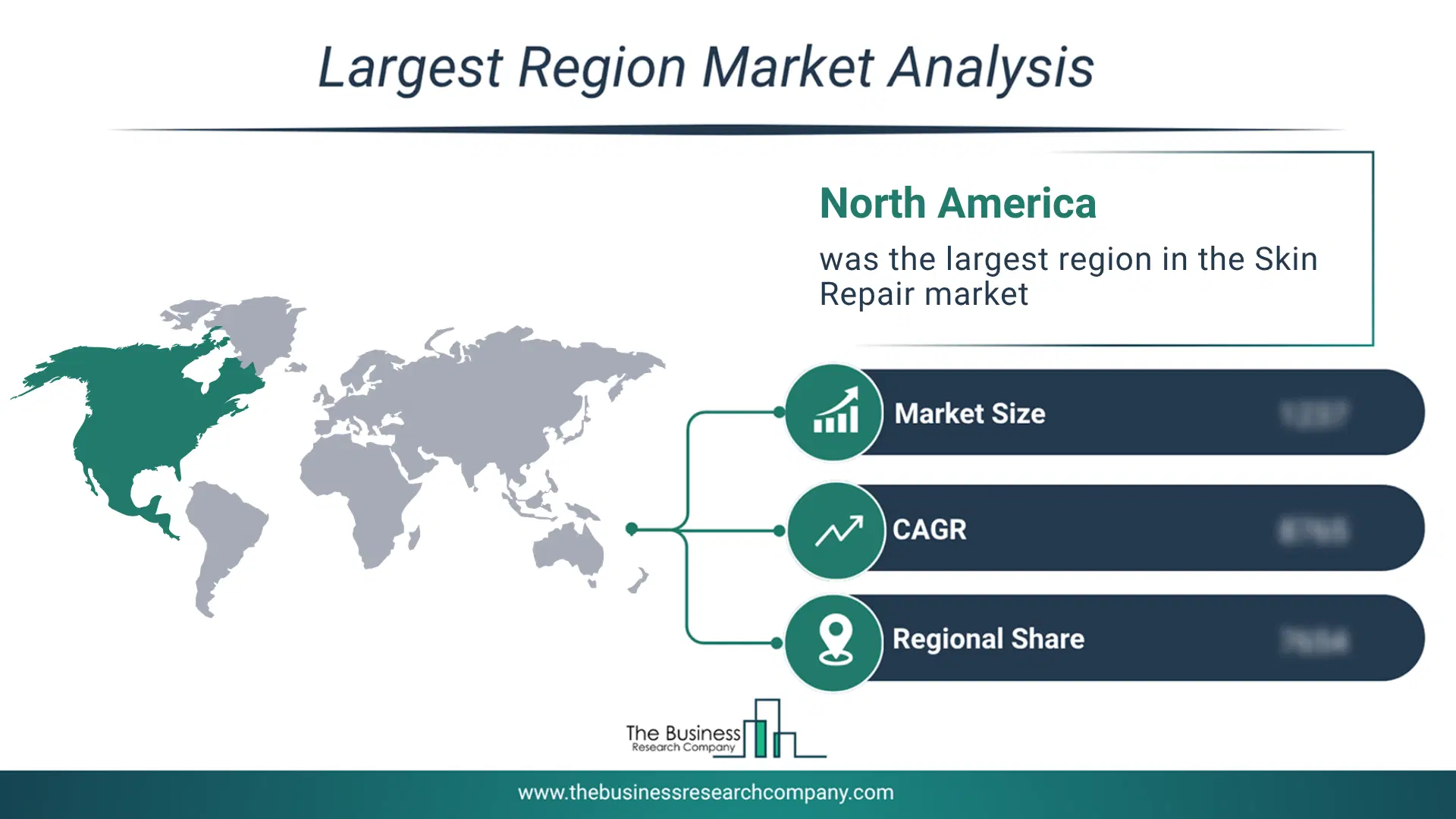
Regional Outlook
North America was the largest region in the skin repair market in 2025. Asia-Pacific is expected to be the fastest-growing region in the forecast period. The regions covered in this market report are Asia-Pacific, South East Asia, Western Europe, Eastern Europe, North America, South America, Middle East, Africa. The countries covered in this market report are Australia, Brazil, China, France, Germany, India, Indonesia, Japan, Taiwan, Russia, South Korea, UK, USA, Canada, Italy, Spain.What Defines the Skin Repair Market?
The skin repair market includes revenues earned by entities by providing services such as microneedling, laser skin resurfacing, chemical peels, hydrafacial MD and oxygen infusion facial. The market value includes the value of related goods sold by the service provider or included within the service offering. Only goods and services traded between entities or sold to end consumers are included.How is Market Value Defined and Measured?
The market value is defined as the revenues that enterprises gain from the sale of goods and/or services within the specified market and geography through sales, grants, or donations in terms of the currency (in USD unless otherwise specified). The revenues for a specified geography are consumption values that are revenues generated by organizations in the specified geography within the market, irrespective of where they are produced. It does not include revenues from resales along the supply chain, either further along the supply chain or as part of other products.
This chart presents market attractiveness based on a quantitative evaluation of growth, competition, strategic alignment, and risk, offering a clear view of opportunity areas for decision-making. This chart is for illustrative purposes; the full report contains the complete analysis.

This chart highlights the Total Addressable Market (TAM) by estimating the maximum revenue opportunity using an assumption-driven approach, supporting strategic planning and opportunity sizing across markets. The chart is illustrative; the full report provides a more comprehensive analysis.
What Key Data and Analysis Are Included in the Skin Repair Market Report 2026?
The skin repair market research report is one of a series of new reports from The Business Research Company that provides market statistics, including industry global market size, regional shares, competitors with the market share, detailed market segments, market trends and opportunities, and any further data you may need to thrive in the skin repair industry. The market research report delivers a complete perspective of everything you need, with an in-depth analysis of the current and future state of the industry.Skin Repair Market Report Forecast Analysis
| Report Attribute | Details |
|---|---|
| Market Size Value In 2026 | $91.18 billion |
| Revenue Forecast In 2030 | $121.21 billion |
| Growth Rate | CAGR of 7.4% from 2026 to 2030 |
| Base Year For Estimation | 2025 |
| Actual Estimates/Historical Data | 2020-2025 |
| Forecast Period | 2026 - 2030 |
| Market Representation | Revenue in USD Billion and CAGR from 2026 to 2030 |
| Segments Covered | Type, Product Form, Distribution Channel, Application, End-user |
| Regional Scope | Asia-Pacific, Western Europe, Eastern Europe, North America, South America, Middle East, Africa |
| Country Scope | The countries covered in the report are Australia, Brazil, China, France, Germany, India, Indonesia, Japan, Taiwan, Russia, South Korea, UK, USA, Canada, Italy, Spain |
| Key Companies Profiled | Beiersdorf AG, Kao Corporation, Shiseido, Obagi Medical, Dermalogica, Revision Skincare, SkinCeuticals, PCA Skin, Lucas Meyer Cosmetics, Derma Made, OneSkin, Rubedo Life Sciences, Smith & Nephew plc, Mölnlycke Health Care AB, Coloplast A/S, ConvaTec Group plc, Integra LifeSciences Holdings Corporation, MiMedx Group Inc., Organogenesis Holdings Inc., Acelity L.P. Inc., Medline Industries Inc., Paul Hartmann AG |
| Customization Scope | Request for Customization |
| Pricing And Purchase Options | Explore Purchase Options |