
Skin Tightening Devices Market Report 2026
Global Outlook – By Product Type (Radiofrequency Devices, Ultrasound Devices, Laser Based Devices, Infrared Devices, Other Product Types), By Treatment Type (Non Invasive, Minimally Invasive), By Distribution Channel (Direct Sales, Retail Pharmacies, Online Stores, Other Distribution Channels), By Application (Facial Skin Tightening, Body Skin Tightening, Other Applications), By End User (Hospitals And Clinics, Medical Spas, Home Care Settings, Other End Users) – Market Size, Trends, Strategies, and Forecast to 2030
Skin Tightening Devices Market Overview
• Skin Tightening Devices market size has reached to $2.16 billion in 2025 • Expected to grow to $3.7 billion in 2030 at a compound annual growth rate (CAGR) of 11.4% • Growth Driver: Increasing Demand For Non-Invasive Cosmetic Procedures Fueling The Growth Of The Market Due To Growing Preference For Low-Downtime Aesthetic Treatments • Market Trend: Innovation In Radiofrequency Skin Tightening Technologies Supporting Advanced Facial Rejuvenation Treatments • North America was the largest region in 2025 and Asia-Pacific is the fastest growing region.What Is Covered Under Skin Tightening Devices Market?
Skin tightening devices are aesthetic medical devices that use energy-based technologies to improve skin firmness, elasticity, and collagen production. Their primary use is to reduce skin laxity, minimize wrinkles, and enhance facial and body contour through non-invasive or minimally invasive cosmetic procedures. The main product types of skin tightening devices include radiofrequency devices, ultrasound devices, laser based devices, infrared devices, and other product types. Radiofrequency devices refer to aesthetic equipment that uses controlled radiofrequency energy to stimulate collagen production and improve skin elasticity. These systems are categorized by treatment type including non invasive and minimally invasive, and are distributed through direct sales, retail pharmacies, online stores, and other distribution channels. The various applications involved are facial skin tightening, body skin tightening, and others, and they are used by several end users such as hospitals and clinics, medical spas, home care settings, and others.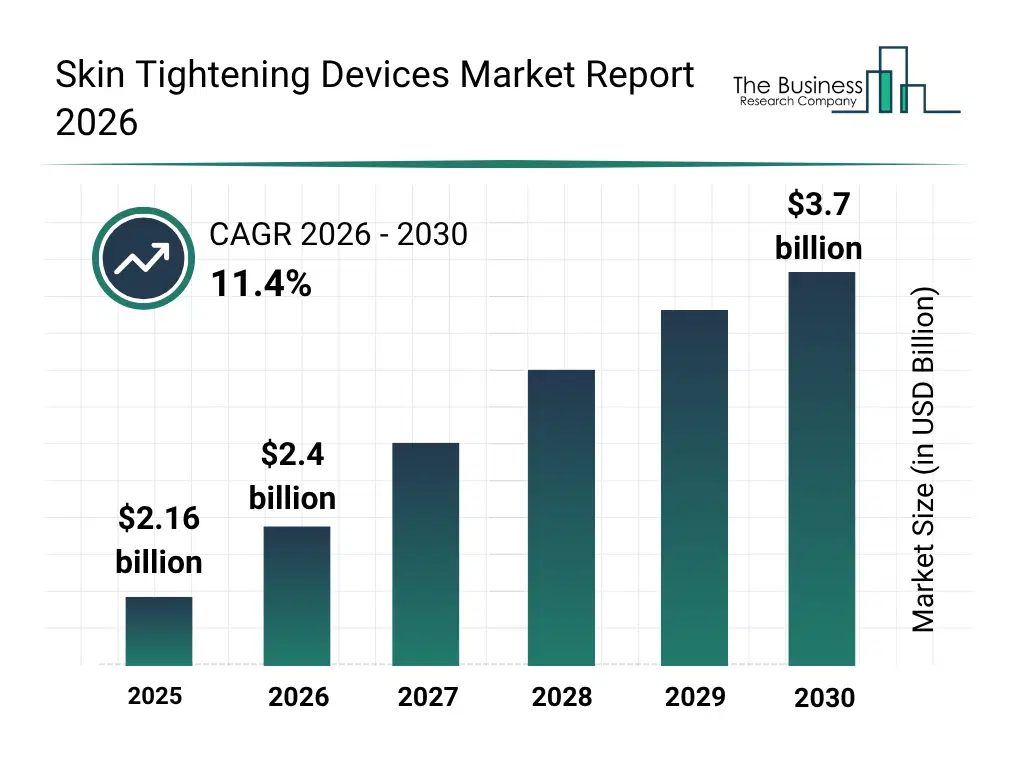
What Is The Skin Tightening Devices Market Size and Share 2026?
The skin tightening devices market size has grown rapidly in recent years. It will grow from $2.16 billion in 2025 to $2.4 billion in 2026 at a compound annual growth rate (CAGR) of 11.1%. The growth in the historic period can be attributed to rising demand for non-invasive cosmetic procedures, increasing awareness of aesthetic dermatology treatments, growth in medical spa and cosmetic clinic infrastructure, expansion of laser and rf-based dermatology devices, increasing prevalence of skin aging concerns.What Is The Skin Tightening Devices Market Growth Forecast?
The skin tightening devices market size is expected to see rapid growth in the next few years. It will grow to $3.7 billion in 2030 at a compound annual growth rate (CAGR) of 11.4%. The growth in the forecast period can be attributed to advancements in ai-assisted aesthetic treatment planning, growing adoption of personalized skin rejuvenation therapies, expansion of minimally invasive cosmetic technology adoption, increasing integration of digital platforms in aesthetic clinics, rising demand for combination energy-based skin tightening systems. Major trends in the forecast period include increasing adoption of energy-based aesthetic devices for non-invasive skin rejuvenation treatments, rising demand for radiofrequency and ultrasound-based skin tightening procedures in medical spas, growing preference for minimally invasive cosmetic procedures with reduced recovery time, expansion of combination therapy devices integrating laser and RF technologies for improved outcomes, increasing consumer focus on anti-aging treatments and body contouring solutions.
Global Skin Tightening Devices Market Segmentation
1) By Product Type: Radiofrequency Devices; Ultrasound Devices; Laser Based Devices; Infrared Devices; Other Product Types 2) By Treatment Type: Non Invasive; Minimally Invasive 3) By Distribution Channel: Direct Sales; Retail Pharmacies; Online Stores; Other Distribution Channels 4) By Application: Facial Skin Tightening; Body Skin Tightening; Other Applications 5) By End User: Hospitals And Clinics; Medical Spas; Home Care Settings; Other End Users Subsegments: 1) By Radiofrequency Devices: Bipolar Radiofrequency Devices; Multipolar Radiofrequency Devices; Fractional Radiofrequency Devices; Microneedling Radiofrequency Devices; Monopolar Radiofrequency Devices 2) By Ultrasound Devices: Microfocused Ultrasound Devices; Portable Ultrasound Skin Tightening Devices; Ultrasound Facial Tightening Systems; Ultrasound Body Contouring Devices; High Intensity Focused Ultrasound Devices 3) By Laser Based Devices: Carbon Dioxide Laser Devices; Erbium Laser Devices; Non Ablative Laser Devices; Ablative Laser Skin Tightening Devices; Fractional Laser Devices 4) By Infrared Devices: Near Infrared Skin Tightening Devices; Far Infrared Therapy Devices; Infrared Facial Rejuvenation Devices; Infrared Body Tightening Devices; Portable Infrared Skin Tightening Devices 5) By Other Product Types: Light Emitting Diode Skin Tightening Devices; Plasma Skin Tightening Devices; Combination Energy Based Devices; Cryotherapy Skin Tightening Devices; Electromagnetic Skin Tightening DevicesWhat Is The Driver Of The Skin Tightening Devices Market?
The increasing demand for non-invasive cosmetic procedures is expected to propel the growth of the skin tightening devices market going forward. Non-invasive cosmetic procedures refer to aesthetic treatments that improve appearance without surgery, incisions, or penetration of the skin, typically using external technologies such as laser, ultrasound, radiofrequency, or light-based systems. The increasing demand for non-invasive cosmetic procedures is due to growing aesthetic awareness, as consumers seek safer skin rejuvenation treatments with minimal pain, reduced recovery time, and lower risk of complications. Skin tightening devices are used in non-invasive cosmetic procedures to improve skin firmness, stimulate collagen production, reduce wrinkles, and enhance facial and body contours without surgery or significant recovery time. For instance, in June 2024, according to the American Society of Plastic Surgeons, a US-based plastic surgery specialty organization, non-invasive cosmetic treatments accounted for 15.6 million procedures in 2023, marking a 7% increase compared to 2022. Therefore, the increasing demand for non-invasive cosmetic procedures is driving the growth of the skin tightening devices industry.Key Players In The Global Skin Tightening Devices Market
Major companies operating in the skin tightening devices market are Merz Aesthetics; InMode Ltd.; BTL Industries; Candela Corporation; Cutera Inc.; Lumenis Ltd.; Alma Lasers; Sciton Inc.; Apyx Medical Corporation; Zimmer MedizinSysteme GmbH; DEKA M.E.L.A. S.r.l.; WONTECH Co. Ltd.; Aerolase Corporation; SharpLight Technologies Ltd.; Union Medical Co. Ltd.; Eunsung Global Corp.; BISON Medical Co. Ltd.; Asterasys Co. Ltd.; Tentech Inc.; Cartessa Aesthetics LLC; Beijing HONKON Technologies Co. Ltd.; Shanghai Apolo Medical Technology Co. Ltd.; DermaJEM Co. Ltd.Global Skin Tightening Devices Market Trends and Insights
Major companies operating in the skin tightening devices market are focusing on developing advanced solutions, such as radiofrequency skin rejuvenation platforms, to improve facial wrinkle reduction, enhance skin remodeling, and support non-invasive aesthetic treatments. Radiofrequency skin rejuvenation platforms are aesthetic treatment systems that use controlled radiofrequency energy to stimulate collagen production, tighten skin tissue, and improve skin texture and elasticity. For instance, in August 2024, Candela Corporation, a US-based aesthetic medical technology company, received U.S. Food and Drug Administration clearance for its Matrix radiofrequency platform for the treatment of facial wrinkles. The platform combines Matrix Pro and Sublative radiofrequency technologies to deliver customizable skin resurfacing and collagen stimulation treatments with minimal downtime and enhanced treatment precision. It features interchangeable applicators and adjustable energy settings, enabling practitioners to tailor treatments according to different skin types, treatment depths, and patient-specific aesthetic concerns. In addition to wrinkle reduction, the system is designed to improve skin texture, tone, and overall skin rejuvenation by promoting natural collagen remodeling through fractional radiofrequency energy delivery.What Are Latest Mergers And Acquisitions In The Skin Tightening Devices Market?
In September 2024, ArchiMed, a France-based private equity investment firm, acquired Jeisys Medical Inc. for $742 million. Through this acquisition, ArchiMed strengthened its presence in the global aesthetic medical device industry by expanding its portfolio of energy-based skin tightening, facial rejuvenation, and non-invasive cosmetic treatment technologies. Jeisys Medical Inc. is a South Korea-based manufacturer of energy-based medical aesthetic devices used for skin tightening, facial rejuvenation, wrinkle reduction, and non-invasive cosmetic procedures.Regional Outlook
North America was the largest region in the skin tightening devices market in 2025. Asia-Pacific is expected to be the fastest-growing region in the forecast period. The regions covered in this market report are Asia-Pacific, South East Asia, Western Europe, Eastern Europe, North America, South America, Middle East, Africa. The countries covered in this market report are Australia, Brazil, China, France, Germany, India, Indonesia, Japan, Taiwan, Russia, South Korea, UK, USA, Canada, Italy, Spain.What Defines the Skin Tightening Devices Market?
The skin tightening devices market consists of sales of portable skin tightening devices, body contouring devices, and multi-energy aesthetic treatment devices. Values in this market are ‘factory gate’ values, that is the value of goods sold by the manufacturers or creators of the goods, whether to other entities (including downstream manufacturers, wholesalers, distributors and retailers) or directly to end customers. The value of goods in this market includes related services sold by the creators of the goods.How is Market Value Defined and Measured?
The market value is defined as the revenues that enterprises gain from the sale of goods and/or services within the specified market and geography through sales, grants, or donations in terms of the currency (in USD unless otherwise specified). The revenues for a specified geography are consumption values that are revenues generated by organizations in the specified geography within the market, irrespective of where they are produced. It does not include revenues from resales along the supply chain, either further along the supply chain or as part of other products.What Key Data and Analysis Are Included in the Skin Tightening Devices Market Report 2026?
The skin tightening devices market research report is one of a series of new reports from The Business Research Company that provides market statistics, including industry global market size, regional shares, competitors with the market share, detailed market segments, market trends and opportunities, and any further data you may need to thrive in the skin tightening devices industry. The market research report delivers a complete perspective of everything you need, with an in-depth analysis of the current and future state of the industry.Skin Tightening Devices Market Report Forecast Analysis
| Report Attribute | Details |
|---|---|
| Market Size Value In 2026 | $2.4 billion |
| Revenue Forecast In 2030 | $3.7 billion |
| Growth Rate | CAGR of 11.4% from 2026 to 2030 |
| Base Year For Estimation | 2025 |
| Actual Estimates/Historical Data | 2020-2025 |
| Forecast Period | 2026 - 2030 |
| Market Representation | Revenue in USD Billion and CAGR from 2026 to 2030 |
| Segments Covered | Product Type, Treatment Type, Distribution Channel, Application, End User |
| Regional Scope | Asia-Pacific, Western Europe, Eastern Europe, North America, South America, Middle East, Africa |
| Country Scope | The countries covered in the report are Australia, Brazil, China, France, Germany, India, ... |
| Key Companies Profiled | Merz Aesthetics; InMode Ltd.; BTL Industries; Candela Corporation; Cutera Inc.; Lumenis Ltd.; Alma Lasers; Sciton Inc.; Apyx Medical Corporation; Zimmer MedizinSysteme GmbH; DEKA M.E.L.A. S.r.l.; WONTECH Co. Ltd.; Aerolase Corporation; SharpLight Technologies Ltd.; Union Medical Co. Ltd.; Eunsung Global Corp.; BISON Medical Co. Ltd.; Asterasys Co. Ltd.; Tentech Inc.; Cartessa Aesthetics LLC; Beijing HONKON Technologies Co. Ltd.; Shanghai Apolo Medical Technology Co. Ltd.; DermaJEM Co. Ltd. |
| Customization Scope | Request for Customization |
| Pricing And Purchase Options | Explore Purchase Options |