
Sleep Fragmentation Analytics Market Report 2026
Global Outlook – By Type (Wearable Sleep Trackers, Electroencephalogram Sleep Scoring Software, Artificial Intelligence Sleep Fragmentation Algorithms), By Diagnostic Technology Type (Polysomnography, Actigraphy Motion Sensors, Electroencephalogram Based Systems), By Distribution Channel Type (Direct Sales Tenders, Retail Pharmacies And Medical Stores, Online Electronic Commerce Channels), By Application (Sleep Apnea Evaluation, Insomnia Pattern Analysis, Shift Worker Sleep Studies, Cognitive Impact Research), By End User (Hospitals And Clinics, Sleep Diagnostic Centers, Consumer Wellness Platforms, Corporate Wellness Programs) – Market Size, Trends, Strategies, and Forecast to 2035
Sleep Fragmentation Analytics Market Overview
• Sleep Fragmentation Analytics market size has reached to $0.52 billion in 2025 • Expected to grow to $0.93 billion in 2030 at a compound annual growth rate (CAGR) of 12.4% • Growth Driver: Rising Stress Levels Driving The Growth Of The Market Due To Increasing Prevalence Of Sleep Disorders And Demand For Sleep Monitoring Solutions • Market Trend: AI-Enhanced Sleep Staging Improves Because Accurate Fragmentation Monitoring Supports Better Care • North America was the largest region in 2025 and Asia-Pacific is the fastest growing region.What Is Covered Under Sleep Fragmentation Analytics Market?
Sleep fragmentation analytics refers to the measurement and analysis of interruptions in sleep such as awakenings, arousals, and frequent stage shifts to evaluate sleep continuity and quality. Its purpose is to identify underlying sleep disorders, assess overall sleep health, and support clinical or consumer interventions that improve restorative sleep and daytime functioning. The main types of sleep fragmentation analytics include wearable sleep trackers, electroencephalogram sleep scoring software, and artificial intelligence sleep fragmentation algorithms. Wearable sleep trackers refer to devices worn on the body to monitor sleep patterns and detect interruptions throughout the sleep cycle. The different diagnostic technology types include polysomnography, actigraphy motion sensors, and electroencephalogram based systems and distribution channel types are categorized into direct sales tenders, retail pharmacies and medical stores, and online electronic commerce channels. The various applications involved are sleep apnea evaluation, insomnia pattern analysis, shift worker sleep studies, and cognitive impact research, and they are utilized by end users including hospitals and clinics, sleep diagnostic centers, consumer wellness platforms, and corporate wellness programs.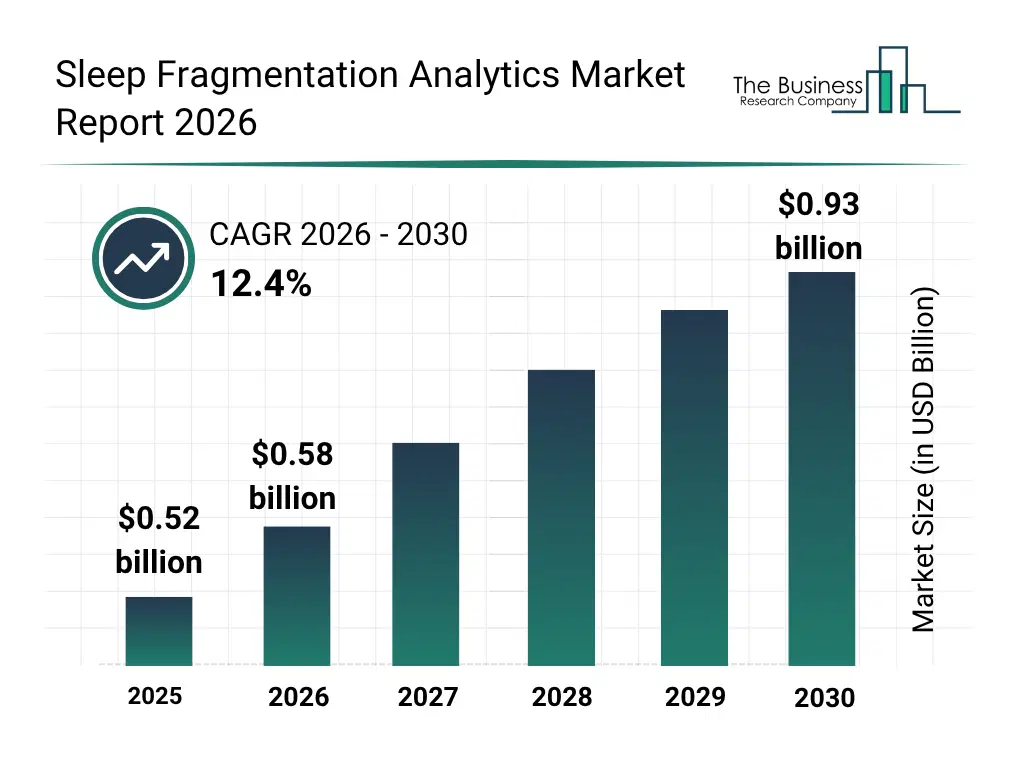
What Is The Sleep Fragmentation Analytics Market Size and Share 2026?
The sleep fragmentation analytics market size has grown rapidly in recent years.It will grow from $0.52 billion in 2025 to $0.58 billion in 2026 at a compound annual growth rate (CAGR) of 12.1%. The growth in the historic period can be attributed to increasing prevalence of insomnia and sleep related disorders, growth of traditional sleep laboratories and diagnostic centers, rising awareness of sleep health importance, expansion of wearable fitness tracking adoption, increasing clinical use of polysomnography systems.What Is The Sleep Fragmentation Analytics Market Growth Forecast?
The sleep fragmentation analytics market size is expected to see rapid growth in the next few years.It will grow to $0.93 billion by 2030 at a compound annual growth rate (CAGR) of 12.4%. The growth in the forecast period can be attributed to growing adoption of ai based sleep analytics platforms, expansion of home based sleep monitoring devices, increasing integration of cloud based health data ecosystems, rising demand for personalized sleep optimization solutions, growth of preventive healthcare and wellness focused diagnostics.Major trends in the forecast period include ai driven sleep fragmentation detection and predictive sleep quality scoring, wearable based continuous sleep monitoring using smart rings and headband sensors, cloud connected polysomnography platforms enabling remote sleep disorder diagnostics, integration of eeg based sleep stage classification with automated clinical reporting systems, rising adoption of consumer sleep wellness apps for personalized sleep optimization insights.
Global Sleep Fragmentation Analytics Market Segmentation
1) By Type: Wearable Sleep Trackers, Electroencephalogram Sleep Scoring Software, Artificial Intelligence Sleep Fragmentation Algorithms 2) By Diagnostic Technology Type: Polysomnography, Actigraphy Motion Sensors, Electroencephalogram Based Systems 3) By Distribution Channel Type: Direct Sales Tenders, Retail Pharmacies And Medical Stores, Online Electronic Commerce Channels 4) By Application: Sleep Apnea Evaluation, Insomnia Pattern Analysis, Shift Worker Sleep Studies, Cognitive Impact Research 5) By End User: Hospitals And Clinics, Sleep Diagnostic Centers, Consumer Wellness Platforms, Corporate Wellness Programs Subsegments: 1) By Wearable Sleep Trackers: Wrist Worn Trackers, Headband Sleep Monitors, Clip On Sleep Sensors, Smart Ring Sleep Devices 2) By Electroencephalogram Sleep Scoring Software: Automated Sleep Scoring Platforms, Signal Processing Software, Sleep Stage Classification Tools, Data Visualization Software 3) By Artificial Intelligence Sleep Fragmentation Algorithms: Sleep Pattern Recognition Algorithms, Sleep Disruption Detection Tools, Predictive Sleep Analysis Platforms, Machine Learning Sleep Optimization SystemsWhat Is The Driver Of The Sleep Fragmentation Analytics Market?
The rising stress levels are expected to propel the growth of the sleep fragmentation analytics industry going forward.Stress refers to a state of mental or emotional strain resulting from demanding circumstances, lifestyle pressures, or physiological factors that disrupt the body’s normal functioning.Stress levels are increasing globally due to factors such as work-related pressure and economic uncertainties, all of which contribute to heightened psychological burden and reduced sleep quality.Sleep fragmentation analytics solutions help in identifying disrupted sleep patterns, monitoring nocturnal awakenings, and providing actionable insights for managing stress-induced sleep disturbances, thereby improving overall sleep health and well-being.For instance, in May 2024, according to the American Psychiatric Association, a US-based professional organization, representing psychiatrists and advancing mental health research, 43% of adults reported feeling more anxious in 2024 compared to 37% in 2023 and 32% in 2022.Therefore, the rising stress levels are driving the growth of the sleep fragmentation analytics industry.Key Players In The Global Sleep Fragmentation Analytics Market
Major companies operating in the sleep fragmentation analytics market are Apple Inc., Google LLC, Samsung Electronics Co. Ltd., Garmin Ltd., ResMed Inc., Masimo Corporation, Sleep Number Corporation, NIHON KOHDEN Corporation, Thryve Health GmbH, ŌURA Health Oy, Natus Medical Incorporated, Zepp Health Corporation, WHOOP Inc., Withings S. A., Cadwell Industries Inc., Eight Sleep Inc., Compumedics Limited, Fullpower Technologies Inc., Emfit Ltd., Belun Technology Company LimitedGlobal Sleep Fragmentation Analytics Market Trends and Insights
Major companies operating in the sleep fragmentation analytics market are focusing on innovating technologies such as machine‑learning‑based sleep staging algorithms to gain a competitive advantage by automating precise identification of sleep stages and micro‑arousals that reflect fragmentation patterns closely tied to health outcomes and prescription delivery decisions in clinical care. Machine‑learning‑based sleep staging algorithms refer to advanced software that interprets physiological signals such as EEG and movement patterns using trained models to classify sleep architecture with higher consistency and reduced human error compared with manual scoring. For instance, in March 2024, Beacon Biosignals, a US‑based health technology company, received FDA 510(k) clearance for SleepStageML software, which automatically stages sleep from polysomnography recordings, standardizes classification across settings, and enables more consistent, efficient, and precise sleep analysis to detect fragmentation and other diagnostic markers.What Are Latest Mergers And Acquisitions In The Sleep Fragmentation Analytics Market?
In July 2023, Beacon Biosignals Inc., a US‑based provider of computational neurodiagnostics and EEG analytics platforms that deliver advanced sleep physiology insights, acquired the research and development business of Dreem for an undisclosed amount. With this acquisition, Beacon Biosignals aimed to enhance its sleep analytics capabilities, integrating Dreem’s clinically validated at‑home sleep monitoring hardware with its next‑generation EEG analytics to support scalable sleep fragmentation analysis and clinical trial endpoints for sleep disorders and neurological conditions. Dreem is a France‑based developer of at‑home sleep monitoring devices and technologies, including the Dreem 3 sleep headband, which collects sleep EEG and related physiological data used to assess sleep quality and architecture.Regional Insights
North America was the largest region in the sleep fragmentation analytics market in 2025. Asia-Pacific is expected to be the fastest-growing region in the forecast period. The regions covered in this market report are Asia-Pacific, South East Asia, Western Europe, Eastern Europe, North America, South America, Middle East and Africa. The countries covered in this market report are Australia, Brazil, China, France, Germany, India, Indonesia, Japan, Taiwan, Russia, South Korea, UK, USA, Canada, Italy, Spain.What Defines the Sleep Fragmentation Analytics Market?
The sleep fragmentation analytics market consists of revenues earned by entities by providing services such as sleep monitoring and tracking services, wearable-based sleep data analytics, sleep coaching and personalized therapy recommendations, and data integration. The market value includes the value of related goods sold by the service provider or included within the service offering. The sleep fragmentation analytics market also includes sales of actigraphy devices, biosensors, and neurodiagnostic monitoring equipment. Values in this market are ‘factory gate’ values, that is the value of goods sold by the manufacturers or creators of the goods, whether to other entities (including downstream manufacturers, wholesalers, distributors and retailers) or directly to end customers. The value of goods in this market includes related services sold by the creators of the goods.What is the Market Assessment and Strategic Outlook for the Sleep Fragmentation Analytics Industry?
The sleep fragmentation analytics market research report is one of a series of new reports from The Business Research Company that provides market statistics, including industry global market size, regional shares, competitors with the market share, detailed market segments, market trends and opportunities, and any further data you may need to thrive in the sleep fragmentation analytics industry. The market research report delivers a complete perspective of everything you need, with an in-depth analysis of the current and future state of the industry.What is the Market Assessment and Strategic Outlook for the Sleep Fragmentation Analytics Market Report 2026?
The sleep fragmentation analytics market research report is one of a series of new reports from The Business Research Company that provides sleep fragmentation analytics market statistics, including sleep fragmentation analytics industry global market size, regional shares, competitors with a sleep fragmentation analytics market share, detailed sleep fragmentation analytics market segments, market trends and opportunities, and any further data you may need to thrive in the sleep fragmentation analytics industry. This sleep fragmentation analytics market research report delivers a complete perspective of everything you need, with an in-depth analysis of the current and future scenario of the industry.Sleep Fragmentation Analytics Market Report Forecast Analysis
| Report Attribute | Details |
|---|---|
| Market Size Value In 2026 | $0.58 billion |
| Revenue Forecast In 2035 | $0.93 billion |
| Growth Rate | CAGR of 12.4% from 2026 to 2035 |
| Base Year For Estimation | 2025 |
| Actual Estimates/Historical Data | 2020-2025 |
| Forecast Period | 2026 - 2030 - 2035 |
| Market Representation | Revenue in USD Billion and CAGR from 2026 to 2035 |
| Segments Covered | Type, Diagnostic Technology Type, Distribution Channel Type, Application, End User |
| Regional Scope | Asia-Pacific, Western Europe, Eastern Europe, North America, South America, Middle East, Africa |
| Country Scope | The countries covered in the report are Australia, Brazil, China, France, Germany, India, Indonesia, Japan, Taiwan, Russia, South Korea, UK, USA, Canada, Italy, Spain. |
| Key Companies Profiled | Apple Inc., Google LLC, Samsung Electronics Co. Ltd., Garmin Ltd., ResMed Inc., Masimo Corporation, Sleep Number Corporation, NIHON KOHDEN Corporation, Thryve Health GmbH, ŌURA Health Oy, Natus Medical Incorporated, Zepp Health Corporation, WHOOP Inc., Withings S. A., Cadwell Industries Inc., Eight Sleep Inc., Compumedics Limited, Fullpower Technologies Inc., Emfit Ltd., Belun Technology Company Limited |
| Customization Scope | Request for Customization |
| Pricing And Purchase Options | Explore Purchase Options |