

Small Cell Backhaul Market Report 2026
Global Outlook – By Service (Network Services, Integration Services, Professional Services), By Transmission Medium (Wired, Wireless), By Backhaul Technology (Fiber, Millimeter Wave, Microwave, Sub-6 GHz), By Application (For In-Building Use, For Outdoor Use) – Market Size, Trends, Strategies, and Forecast to 2030
Small Cell Backhaul Market Overview
• Small Cell Backhaul market size has reached to $2.55 billion in 2025 • Expected to grow to $7.74 billion in 2030 at a compound annual growth rate (CAGR) of 24.9% • Growth Driver: Explosive Growth Forecasted For The Small Cell Backhaul Market Driven By Soaring Demand For High-Speed And Reliable Wireless Connectivity • Market Trend: Adoption Of Software-Defined Small Cells To Enhance 4G And 5G Network Flexibility • North America was the largest region in 2025.Market Gains By 2030 – Top Opportunities By Segment
Market Gain identifies the most promising market opportunities by highlighting the segments or products expected to generate the highest incremental revenue growth over the next five years.
What Is Covered Under Small Cell Backhaul Market?
Small cell backhaul refers to the technology and infrastructure used to connect small cell base stations to a telecommunications provider's core network. Small cell base stations are low-power cellular radio access nodes that improve wireless coverage and capacity in densely populated areas or where typical macrocell towers are unfeasible. It is used to facilitate the transmission of data, voice, and multimedia traffic between small cell base stations and the core network. The main services of small cell backhaul are network services, integration services, and professional services. Network services refer to the various functions and capabilities provided by computer networks to facilitate communication, data exchange, resource sharing, and access to information among connected devices and users. The access technology generations include 2G (second generation), 3G (third generation), and 4G or LTE (fourth generation or long-term evolution), along with wired and wireless transmission mediums. Several technologies include copper, fiber, millimeter wave, microwave, sub-6 GHz, and satellite for in-building use and outdoor use applications.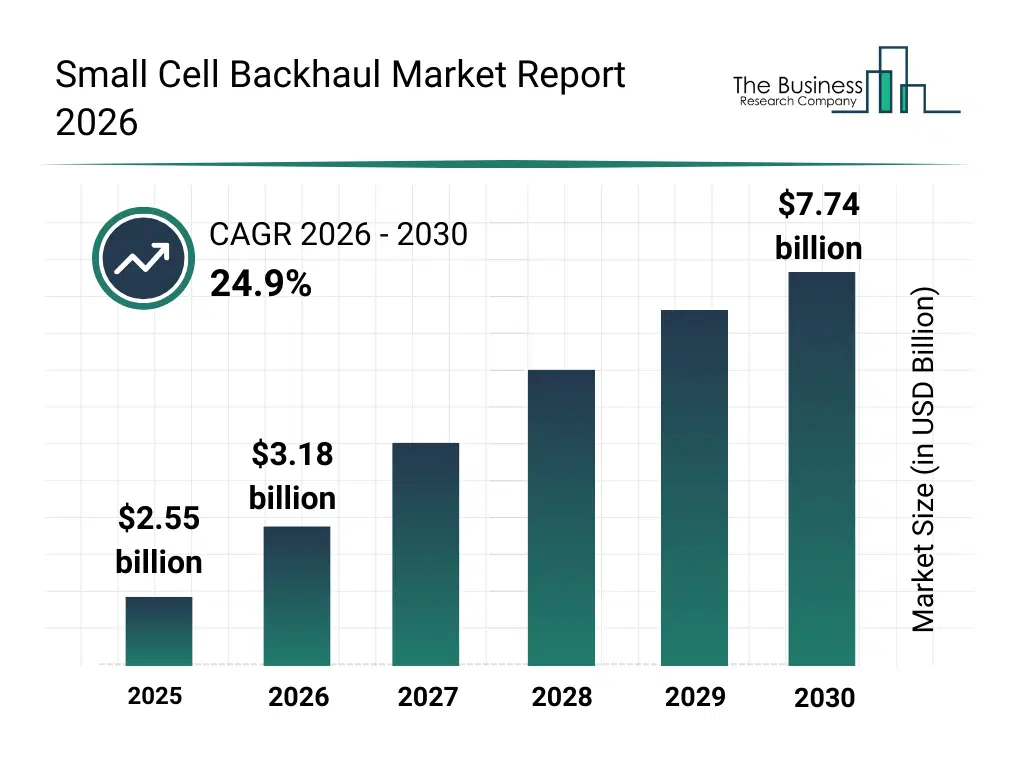
What Is The Small Cell Backhaul Market Size and Share 2026?
The small cell backhaul market size has grown exponentially in recent years. It will grow from $2.55 billion in 2025 to $3.18 billion in 2026 at a compound annual growth rate (CAGR) of 24.9%. The growth in the historic period can be attributed to expansion of small cell deployments, increased reliance on microwave backhaul, growth of dense urban telecom networks, rising mobile data usage, improvements in wireless transmission technologies.What Is The Small Cell Backhaul Market Growth Forecast?
The small cell backhaul market size is expected to see exponential growth in the next few years. It will grow to $7.74 billion in 2030 at a compound annual growth rate (CAGR) of 24.9%. The growth in the forecast period can be attributed to increasing demand for high-throughput 5G backhaul, expansion of smart city connectivity, growing adoption of cloud-native network architectures, rising investments in fiber infrastructure, increasing use of hybrid backhaul models. Major trends in the forecast period include increasing deployment of fiber-based backhaul solutions, rising adoption of wireless backhaul technologies, growing integration of millimeter wave backhaul, expansion of high-capacity backhaul for urban networks, enhanced focus on network reliability and scalability.
Global Small Cell Backhaul Market Segmentation
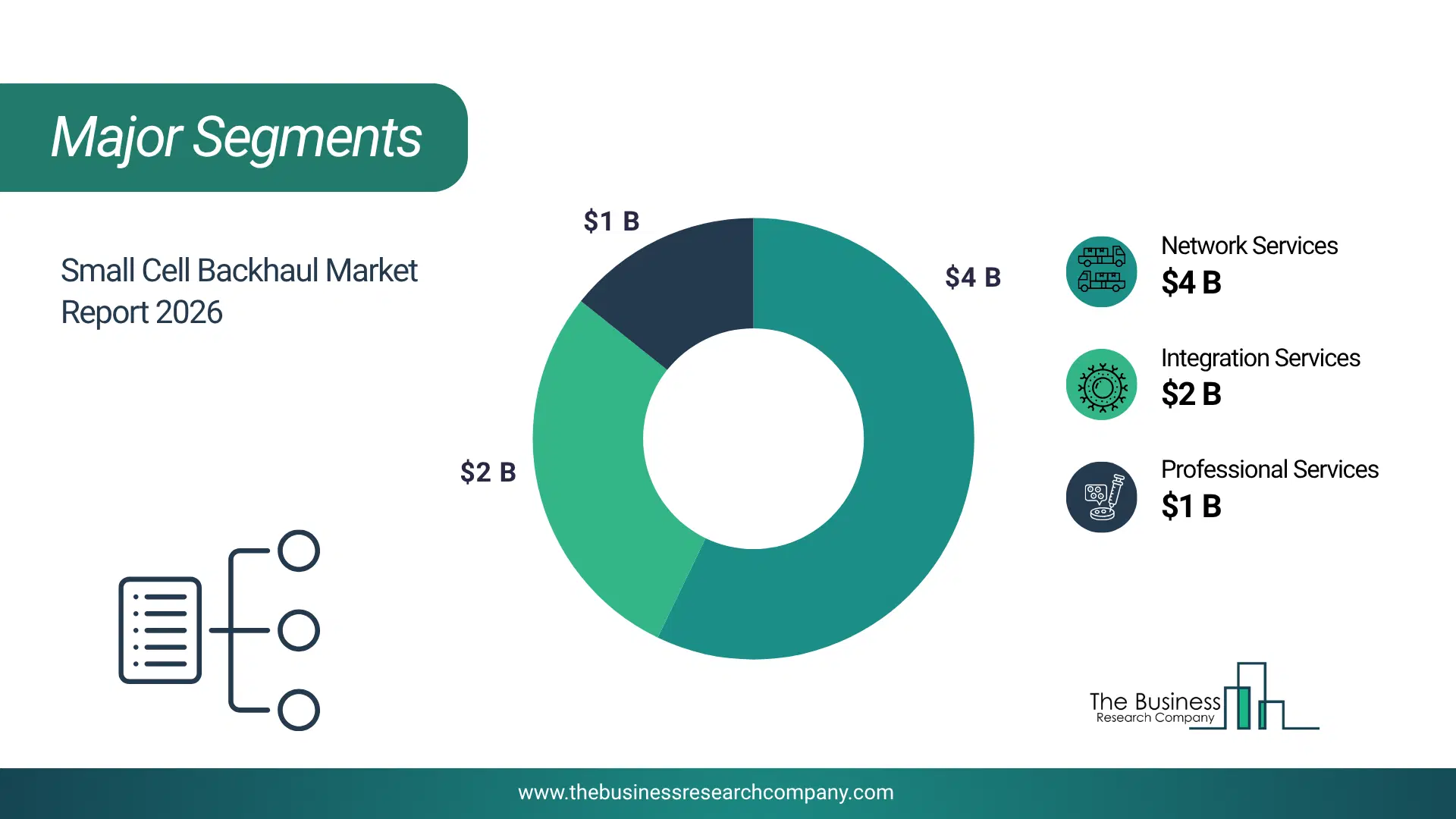
1) By Service: Network Services, Integration Services, Professional Services 2) By Transmission Medium: Wired, Wireless 3) By Backhaul Technology: Fiber, Millimeter Wave, Microwave, Sub-6 GHz 4) By Application: For In-Building Use, For Outdoor Use Subsegments: 1) By Network Services: Backhaul Network Operation And Management, Traffic Monitoring And Performance Optimization, Network Maintenance And Fault Management, Capacity Planning And Bandwidth Management, Network Security And Reliability Services 2) By Integration Services: Backhaul Network Design And Architecture, Integration with Core Network And RAN, Multi-Technology Integration, Interoperability And Compatibility Testing, System Configuration And Commissioning 3) By Professional Services: Consulting And Network Planning Services, Site Survey And Feasibility Assessment, Deployment And Installation Services, Training And Knowledge Transfer, Technical Support And Lifecycle Support The top segments in the small cell backhaul market will be: • Network Services will reach $4.07 Billion by 2030. • Integration Services will reach $2.29 Billion by 2030. • Professional Services will reach $1.34 Billion by 2030.What Is The Driver Of The Small Cell Backhaul Market?
The increasing demand for high-speed wireless connectivity is expected to propel the growth of the small cell backhaul market going forward. High-speed connectivity refers to the capability of a wireless communication system to consistently deliver fast data transmission rates while maintaining a dependable and consistent connection. The demand for high-speed wireless connectivity is driven by factors such as growing reliance on digital technologies, the proliferation of connected devices, and the rise of data-intensive applications. Small cell backhaul plays an important role in enhancing network capacity, extending coverage, and enabling seamless connectivity, all of which are essential for delivering high-speed wireless connectivity to users in both urban and indoor environments, as well as supporting the transition to advanced technologies like 5G. For instance, in November 2023, according to HighSpeedInternet.com, a US-based platform that assists users in optimizing their internet experience, the national average internet speed in 2023 was 171.30 Mbps, which is 44% greater than the 2022 average speed of 119.03 Mbps. Therefore, the increasing demand for high-speed connectivity is driving the growth of the small cell backhaul industry.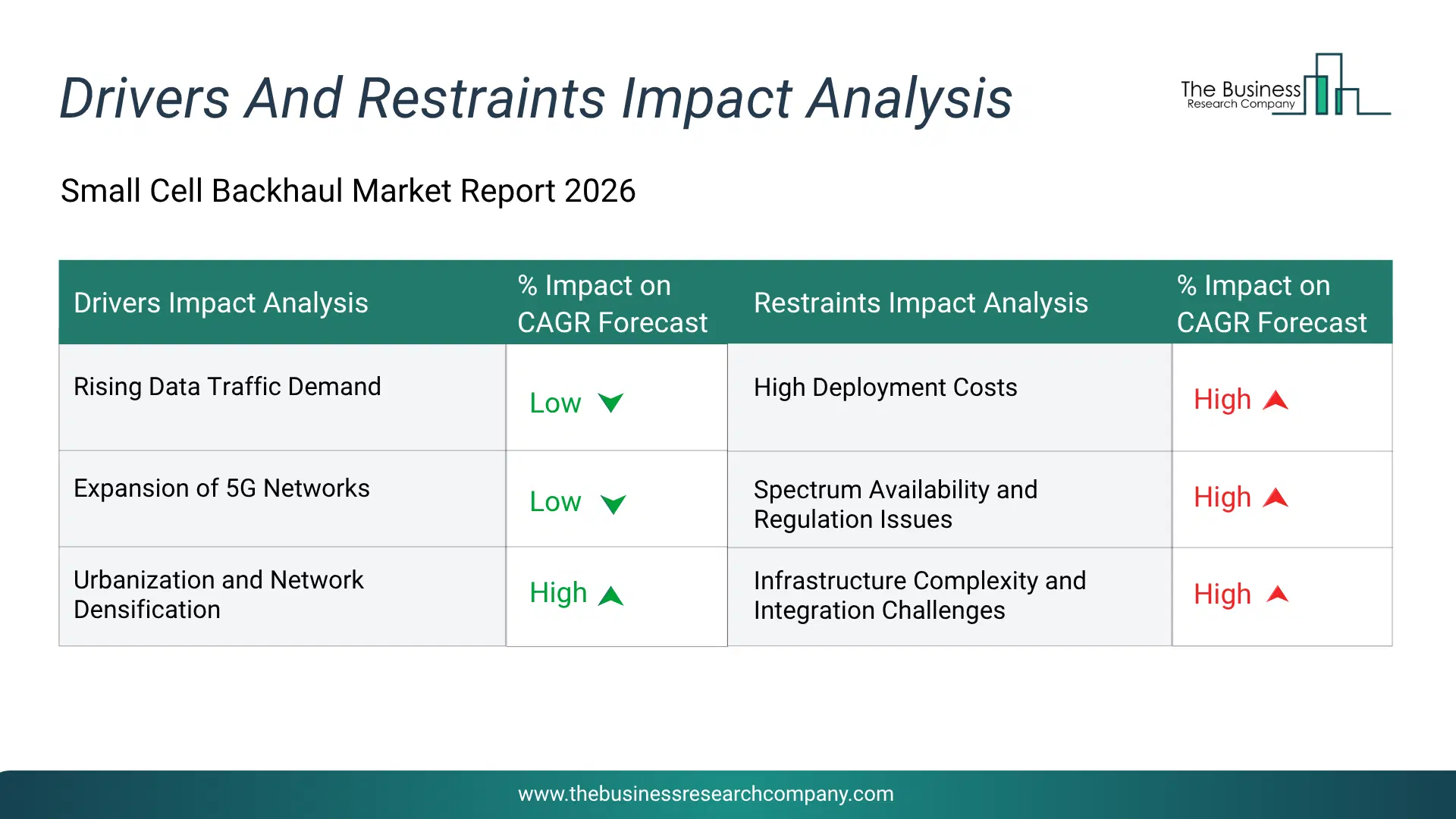
Infographic Chart Showing Key Market Drivers Analysis And Restraints For Small Cell Backhaul Market
The chart presents an impact analysis of key drivers and restraints, quantifying their relative influence on the market's growth rate and helping assess the balance between growth enablers and limiting factors. This chart offers a high-level perspective; the full report contains more detailed insights.
How Will The Drivers Impact Growth In The Global Small Cell Backhaul Market?
• Rising Data Traffic Demand (Low) – During the forecast period, the rising data traffic demand is expected to become a key growth driver for the small cell backhaul market by 2030. The exponential increase in mobile data consumption driven by video streaming, cloud-based applications, and real-time digital services is placing significant pressure on existing network infrastructure. Telecom operators are therefore accelerating the deployment of efficient backhaul solutions to support higher throughput and seamless connectivity. Small cell backhaul plays a critical role in managing this surge by enabling faster data transfer between distributed network nodes. This growing reliance on high-capacity data transmission is strengthening market expansion. • Expansion of 5G Networks (Low) – During the forecast period, the expansion of 5G networks is expected to emerge as a major factor driving the growth of the small cell backhaul market by 2030. The rollout of next-generation wireless networks requires extensive deployment of small cells to deliver ultra-fast speeds and low latency connectivity. This transition is increasing the need for robust and scalable backhaul infrastructure capable of supporting dense network architectures. Telecom providers are investing heavily in advanced backhaul technologies to ensure consistent performance across 5G networks. The continuous expansion of 5G coverage across urban and semi-urban areas is further accelerating demand for efficient backhaul solutions. • Urbanization and Network Densification (High) – During the forecast period, the urbanization and network densification are expected to act as key growth catalysts for the small cell backhaul market by 2030. The rapid expansion of urban populations is driving increased demand for reliable and high-speed connectivity in densely populated areas. To address coverage gaps and capacity constraints, telecom operators are deploying a higher number of small cells, leading to more complex and dense network environments. This trend is significantly increasing the requirement for efficient backhaul systems to interconnect these nodes and maintain network performance. The ongoing development of smart cities and digital infrastructure is further supporting this shift.How Will The Restraints Impact Growth In The Global Small Cell Backhaul Market?
• High Deployment Costs (Low) – During the forecast period, high deployment costs are significantly restricting the growth of the small cell backhaul market. Substantial investments required for fiber rollout, equipment installation, site acquisition, and ongoing maintenance are increasing financial burdens on telecom operators, thereby slowing large-scale deployment. • Spectrum Availability and Regulation Issues (Low) – During the forecast period, spectrum availability and regulation issues are significantly restricting the growth of the small cell backhaul market. Limited spectrum allocation, fragmented licensing frameworks, and strict regulatory compliance requirements are constraining network expansion and increasing operational complexities for service providers. • Infrastructure Complexity and Integration Challenges (High) – During the forecast period, infrastructure complexity and integration challenges are significantly restricting the growth of the small cell backhaul market. The need to integrate small cells with existing macro networks, manage heterogeneous technologies, and ensure seamless connectivity is increasing technical difficulties and deployment timelines for operators.Key Players In The Global Small Cell Backhaul Market
Major companies operating in the small cell backhaul market are Huawei Technologies Co. Ltd, Cisco Systems Inc, Fujitsu Limited, Telefonaktiebolaget LM Ericsson, Nokia Corporation, NEC Corporation, Zte Corporation, Corning Incorporated, CommScope Holding Company Inc, Ceragon Networks Ltd, Alcatel-Lucent Enterprise, Altobridge Limited, Aviat Networks Inc, BLiNQ Networks, Bluwan S.A, DragonWave-X, Intracom Holdings, JDS Uniphase Corporation, Proxim Wireless Corporation, Siae Microelettronica S.p.a, Siklu Communication Ltd, SOLiD Technologies lnc, Sub10 Systems Ltd, Tellabs Inc, VT iDirect Inc, Vubiq Networks Incorporated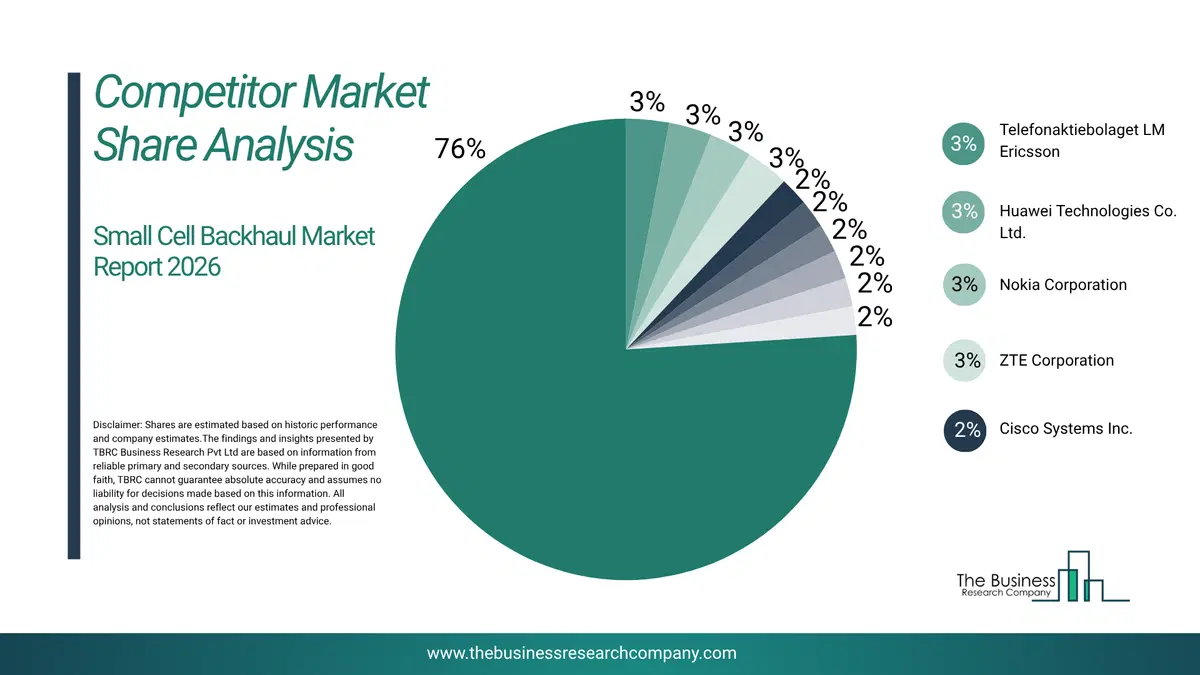
This chart is for illustrative purposes; the full report includes a detailed competitor analysis and comprehensive overview of the top 10 companies in the market.
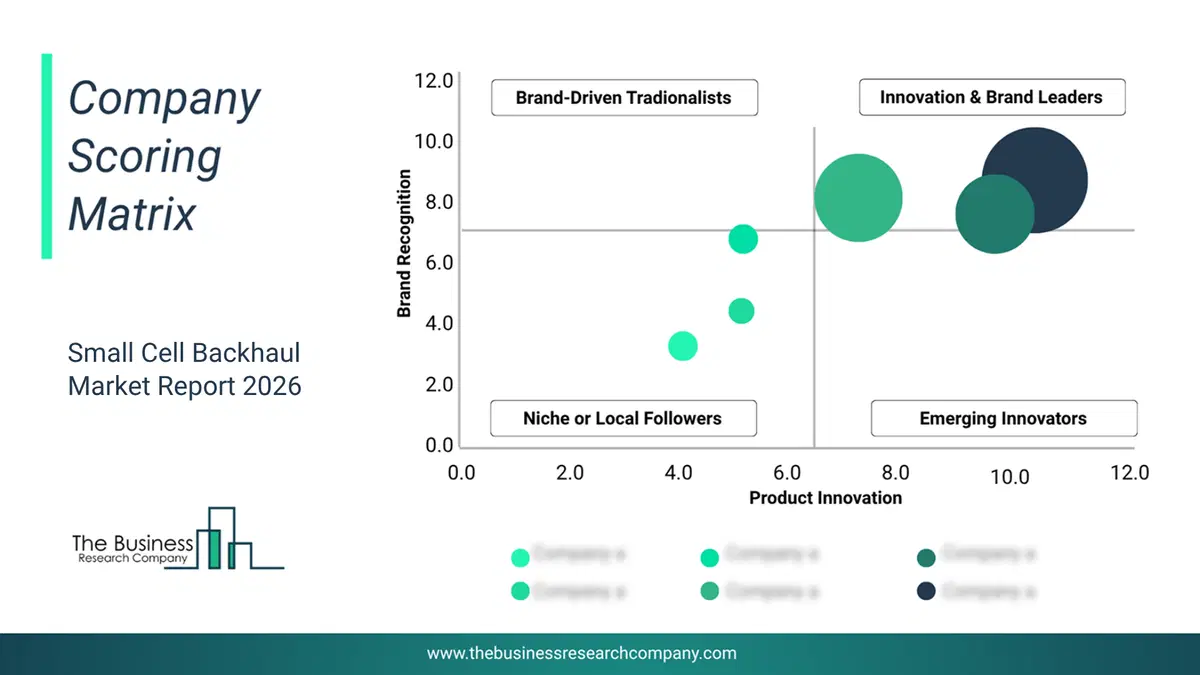
This chart maps companies by product innovation and brand strength, with bubble size indicating relative revenue, helping identify market leaders, challengers, and niche players. This is an illustrative chart; the full report provides a complete and accurate competitive analysis.
Global Small Cell Backhaul Market Trends and Insights
Major companies are operating in the small cell market, focusing on developing technological advancements such as software-defined, cloud-native small cells to meet the rising demand for flexible, scalable, and high-capacity 4G/5G deployments. A software-defined small cell is a compact base station whose radio and control functions are managed via software, allowing dynamic reconfiguration, multi-band support, and seamless scaling from 4G to 5G without hardware replacement unlike traditional fixed small cells that rely on static configurations and manual upgrades. For instance, in February 2025, Mavenir Systems, Inc., a U.S.-based telecommunications software company, launched its next-generation software-defined small cell solution in collaboration with EdgeQ. The product delivers 4G and 5G on a single chip, supports flexible single-band to multi-band configurations, features low power consumption, and is optimized for rapid deployment in urban densification and neutral-host scenarios. It empowers operators to address increasing data traffic demands while reducing infrastructure costs and simplifying network management.What Are Latest Mergers And Acquisitions In The Small Cell Backhaul Market?
In November 2023, Aviat Networks Inc., a US-based telecommunications company, acquired NEC Corporation for $70 million. The acquisition aims to enhance Aviat Networks' position as a leading wireless transport specialist and expand its product portfolio, creating a more diversified business with increased scale and innovation capabilities. NEC Corporation is a Japan-based information technology and electronics corporation that offers a solution portfolio for small cell backhaul, including compact products with high-performance, integrated management.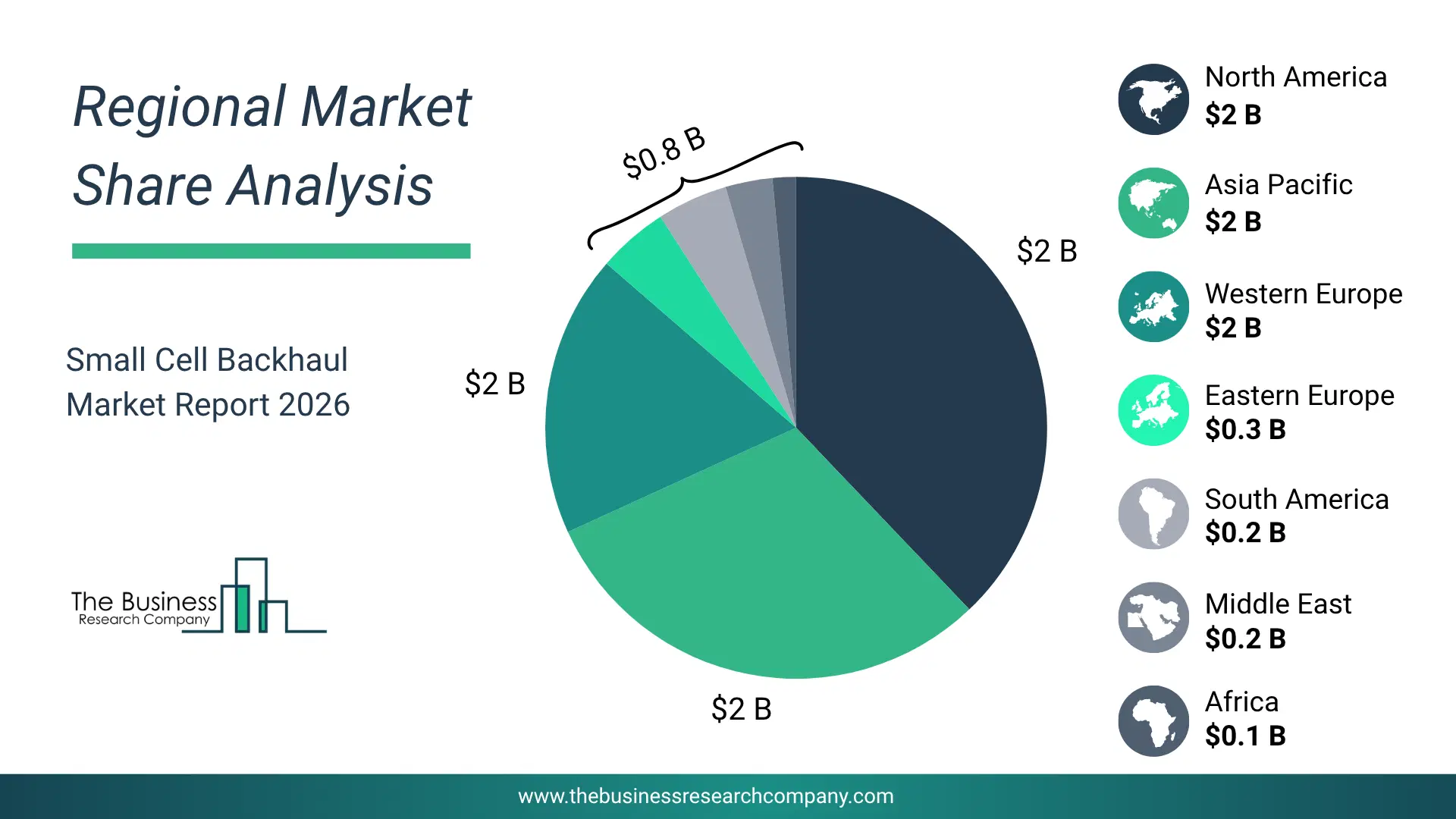
Regional Insights
North America was the largest region in the small cell backhaul market in 2025. The regions covered in this market report are Asia-Pacific, South East Asia, Western Europe, Eastern Europe, North America, South America, Middle East, Africa. The countries covered in this market report are Australia, Brazil, China, France, Germany, India, Indonesia, Japan, Taiwan, Russia, South Korea, UK, USA, Canada, Italy, Spain.What Defines the Small Cell Backhaul Market?
The small cell backhaul market consists of revenues earned by entities by providing services, such as backhaul connectivity solutions, performance optimization, security solutions, consulting and support services. The market value includes the value of related goods sold by the service provider or included within the service offering. The small cell backhaul market also includes sales of small cells, backhaul links, aggregation nodes, Ethernet switches, routers, power supply units, and a network management system. Values in this market are ‘factory gate’ values, that is, the value of goods sold by the manufacturers or creators of the goods, whether to other entities (including downstream manufacturers, wholesalers, distributors, and retailers) or directly to end customers. The value of goods in this market includes related services sold by the creators of the goods.How is Market Value Defined and Measured?
The market value is defined as the revenues that enterprises gain from the sale of goods and/or services within the specified market and geography through sales, grants, or donations in terms of the currency (in USD unless otherwise specified). The revenues for a specified geography are consumption values that are revenues generated by organizations in the specified geography within the market, irrespective of where they are produced. It does not include revenues from resales along the supply chain, either further along the supply chain or as part of other products.
This chart presents market attractiveness based on a quantitative evaluation of growth, competition, strategic alignment, and risk, offering a clear view of opportunity areas for decision-making. This chart is for illustrative purposes; the full report contains the complete analysis.

This chart highlights the Total Addressable Market (TAM) by estimating the maximum revenue opportunity using an assumption-driven approach, supporting strategic planning and opportunity sizing across markets. The chart is illustrative; the full report provides a more comprehensive analysis.
What Key Data and Analysis Are Included in the Small Cell Backhaul Market Report 2026?
The small cell backhaul market research report is one of a series of new reports from The Business Research Company that provides market statistics, including industry global market size, regional shares, competitors with the market share, detailed market segments, market trends and opportunities, and any further data you may need to thrive in the small cell backhaul industry. The market research report delivers a complete perspective of everything you need, with an in-depth analysis of the current and future state of the industry.Small Cell Backhaul Market Report Forecast Analysis
| Report Attribute | Details |
|---|---|
| Market Size Value In 2026 | $3.18 billion |
| Revenue Forecast In 2030 | $7.74 billion |
| Growth Rate | CAGR of 24.9% from 2026 to 2030 |
| Base Year For Estimation | 2025 |
| Actual Estimates/Historical Data | 2020-2025 |
| Forecast Period | 2026 - 2030 |
| Market Representation | Revenue in USD Billion and CAGR from 2026 to 2030 |
| Segments Covered | Service, Transmission Medium, Backhaul Technology, Application |
| Regional Scope | Asia-Pacific, Western Europe, Eastern Europe, North America, South America, Middle East, Africa |
| Country Scope | The countries covered in the report are Australia, Brazil, China, France, Germany, India, Indonesia, Japan, Taiwan, Russia, South Korea, UK, USA, Canada, Italy, Spain. |
| Key Companies Profiled | Huawei Technologies Co. Ltd, Cisco Systems Inc, Fujitsu Limited, Telefonaktiebolaget LM Ericsson, Nokia Corporation, NEC Corporation, Zte Corporation, Corning Incorporated, CommScope Holding Company Inc, Ceragon Networks Ltd, Alcatel-Lucent Enterprise, Altobridge Limited, Aviat Networks Inc, BLiNQ Networks, Bluwan S.A, DragonWave-X, Intracom Holdings, JDS Uniphase Corporation, Proxim Wireless Corporation, Siae Microelettronica S.p.a, Siklu Communication Ltd, SOLiD Technologies lnc, Sub10 Systems Ltd, Tellabs Inc, VT iDirect Inc, Vubiq Networks Incorporated |
| Customization Scope | Request for Customization |
| Pricing And Purchase Options | Explore Purchase Options |