

Small Cells Market Report 2026
Global Outlook – By Type (Femtocells, Picocells, Metrocells, Femto Hybrid Cells, Microcells), By Technology (Fourth Generation Long Term Evolution Small Cells, Fifth Generation Small Cells, Wireless Fidelity Small Cells, Long Term Evolution Unlicensed Small Cells, Citizens Broadband Radio Service Small Cells), By Deployment Mode (Managed Service, On Premise Solutions, Cloud Based Solutions, Distributed Antenna Systems, Self Deployable Units), By Application (Residential And Small Office Home Office, Enterprises, Other Applications), By End User Industry (Telecommunications, Healthcare, Retail, Hospitality, Transportation) – Market Size, Trends, Strategies, and Forecast to 2030
Small Cells Market Overview
• Small Cells market size has reached to $4.24 billion in 2025 • Expected to grow to $4.79 billion in 2030 at a compound annual growth rate (CAGR) of 13.1% • Growth Driver: Rising Demand For Broadband Services Fueling The Growth Of The Market Due To Increasing Consumption Of High Bandwidth Applications • Market Trend: Advancements In Software-Defined Multi-RAT Small Cell Platforms For 4G–5G Evolution • North America was the largest region in 2025 and Asia-Pacific is the fastest growing region.What Is Covered Under Small Cells Market?
Small cells are low-powered, short-range wireless communication nodes that are deployed to enhance cellular network coverage, capacity, and performance in dense or hard-to-reach areas. They operate as part of heterogeneous network architectures and support advanced technologies such as fourth generation and fifth generation networks by enabling high-speed data transmission, low latency, and efficient spectrum utilization. By bringing network access closer to end users, small cells improve connectivity, support massive device density, and enable seamless communication across urban, indoor, and enterprise environments. The main type of small cells includes femtocells, picocells, metrocells, femto hybrid cells and microcells. Femtocells refer to low-power cellular base stations that provide localized indoor wireless coverage and capacity enhancement by connecting to the mobile operator’s core network through broadband backhaul, enabling improved voice quality, data speeds, and network offloading in residential and small enterprise environments. The technology includes fourth generation long term evolution (4G LTE) small cells, fifth generation (5G) small cells, wireless fidelity (Wi-Fi) small cells, long term evolution unlicensed (LTE-U) small cells, and citizens broadband radio service (CBRS) small cells, and the deployment mode includes managed services, on-premise solutions, cloud-based solutions, distributed antenna systems (DAS), and self-deployable units, with applications spanning residential and small office/home office (SOHO), enterprises, and other applications, and the key end-user industries including telecommunications, healthcare, retail, hospitality, and transportation.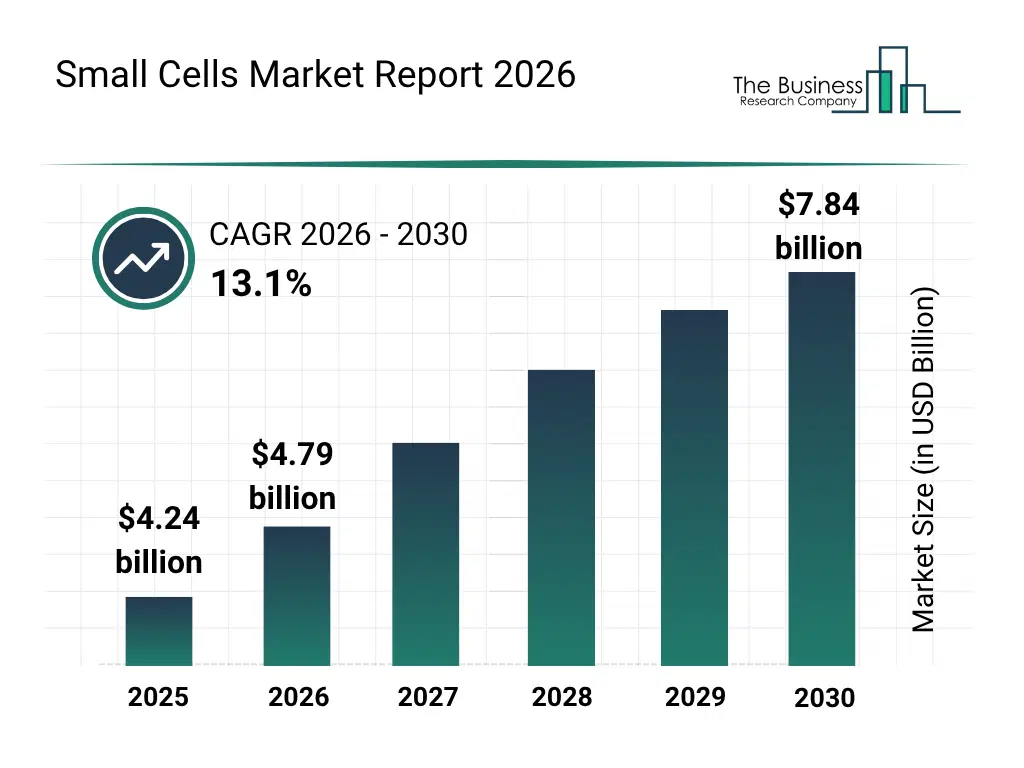
What Is The Small Cells Market Size and Share 2026?
The small cells market size has grown rapidly in recent years. It will grow from $4.24 billion in 2025 to $4.79 billion in 2026 at a compound annual growth rate (CAGR) of 12.9%. The growth in the historic period can be attributed to increasing mobile data consumption, expansion of urban population density, rising demand for indoor connectivity, early adoption of 4g lte networks, telecom infrastructure modernization initiatives.What Is The Small Cells Market Growth Forecast?
The small cells market size is expected to see rapid growth in the next few years. It will grow to $7.84 billion by 2030 at a compound annual growth rate (CAGR) of 13.1%. The growth in the forecast period can be attributed to rapid 5g rollout and network densification, growth of iot and connected devices ecosystem, rising demand for ultra low latency applications, expansion of smart cities and connected infrastructure, increasing enterprise private network deployments. Major trends in the forecast period include dense urban network densification, edge based small cell deployment expansion, 5g and 4g heterogeneous network integration, indoor connectivity optimization for enterprises, private network and campus small cell adoption.
Global Small Cells Market Segmentation
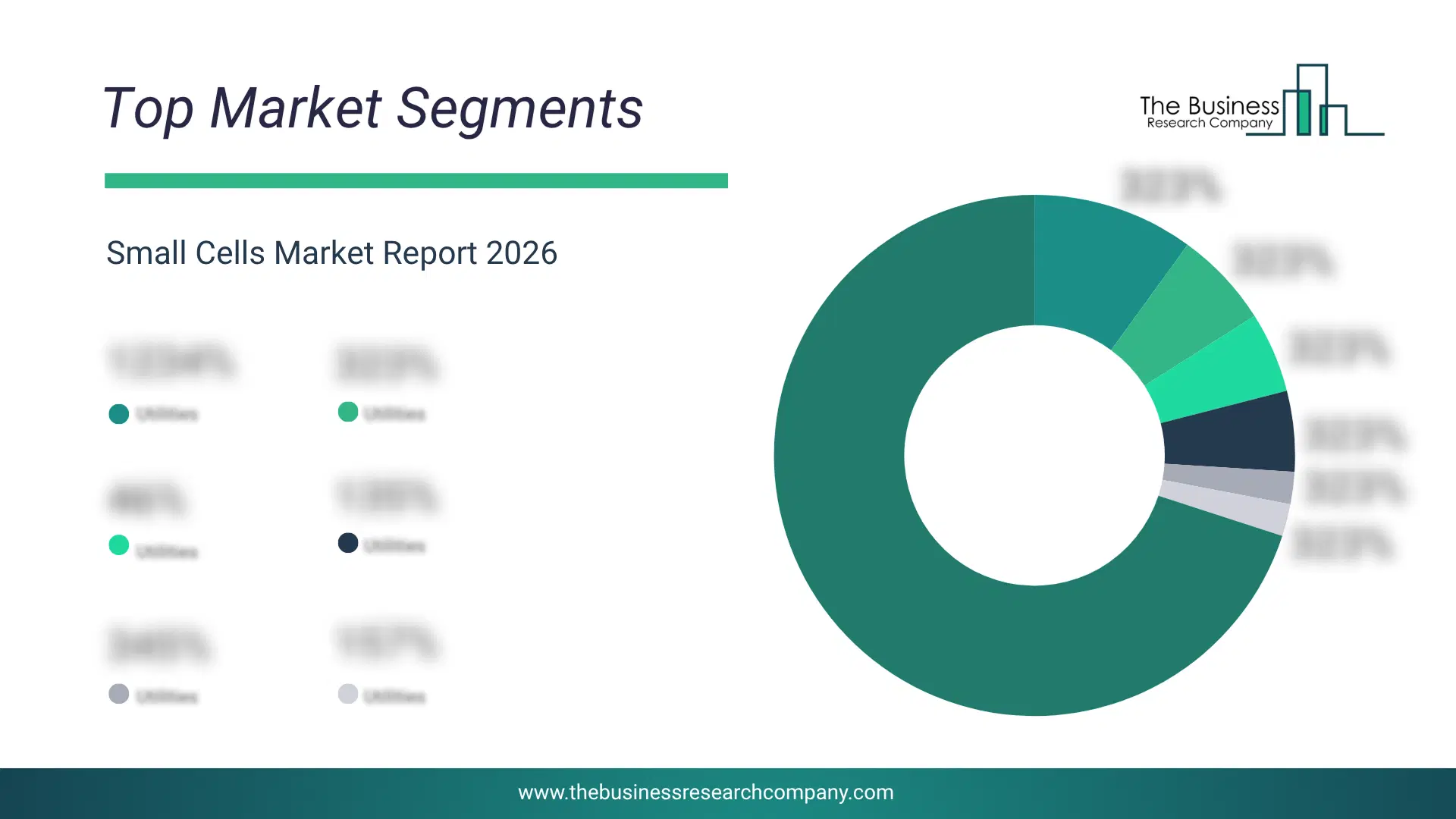
1) By Type: Femtocells, Picocells, Metrocells, Femto Hybrid Cells, Microcells 2) By Technology: Fourth Generation Long Term Evolution Small Cells, Fifth Generation Small Cells, Wireless Fidelity Small Cells, Long Term Evolution Unlicensed Small Cells, Citizens Broadband Radio Service Small Cells 3) By Deployment Mode: Managed Service, On Premise Solutions, Cloud Based Solutions, Distributed Antenna Systems, Self Deployable Units 4) By Application: Residential And Small Office Home Office, Enterprises, Other Applications 5) By End User Industry: Telecommunications, Healthcare, Retail, Hospitality, Transportation Subsegments: 1) By Femtocells: Residential Femtocells, Enterprise Femtocells, Plug And Play Femtocells, Integrated Gateway Femtocells, Standalone Femtocells 2) By Picocells: Enterprise Picocells, Indoor Venue Picocells, Carrier Grade Picocells, High Capacity Picocells, Multi User Picocells 3) By Metrocells: Urban Street Metrocells, Dense Urban Metrocells, Outdoor Public Space Metrocells, High Traffic Area Metrocells, Pole Mounted Metrocells 4) By Femto Hybrid Cells: Hybrid Residential Cells, Hybrid Enterprise Cells, Dual Mode Hybrid Cells, Integrated Hybrid Cells, Multi Technology Hybrid Cells 5) By Microcells: Urban Microcells, Suburban Microcells, Outdoor Coverage Microcells, High Capacity Microcells, Wide Area MicrocellsWhat Is The Driver Of The Small Cells Market?
The rising demand for broadband services is expected to propel the growth of the small cells market going forward. Broadband services represent high-speed internet access that is continuously available and significantly faster than traditional dial-up connections, enabling efficient data transmission for digital communication, streaming, and cloud-based applications. The increasing demand for broadband services is primarily driven by the growing consumption of high-bandwidth applications, including video streaming, online gaming, and cloud computing. Small cells support broadband services by enhancing network capacity, improving coverage, and enabling high-speed connectivity in densely populated and high-traffic areas. For instance, in May 2025, according to Ofcom, a UK-based communications regulator, the number of homes able to access gigabit-capable broadband increased to 25.9 million (86% of the United Kingdom’s 30.2 million homes), up from 25.0 million (83%) in July 2024, reflecting strong growth in broadband availability. Therefore, the rising demand for broadband services is driving the growth of the small cellsKey Players In The Global Small Cells Market
Major companies operating in the small cells market are Samsung Electronics Co. Ltd.; Huawei Technologies Co. Ltd.; Cisco Systems Inc.; Broadcom Inc.; Qualcomm Incorporated; Fujitsu Limited; Telefonaktiebolaget LM Ericsson; NEC Corporation; Nokia Corporation; ZTE Corporation; Texas Instruments Incorporated; Corning Incorporated; Amphenol Corporation; American Tower Corporation; Comba Telecom Systems Holdings Limited; Ubiquiti Inc.; Mavenir Systems Inc.; Gemtek Technology Co. Ltd.; Parallel Wireless Inc.; Baicells Technologies Co. Ltd.; Octasic Inc.; Contela Inc.; Acceleran NV; Accuver Co. Ltd.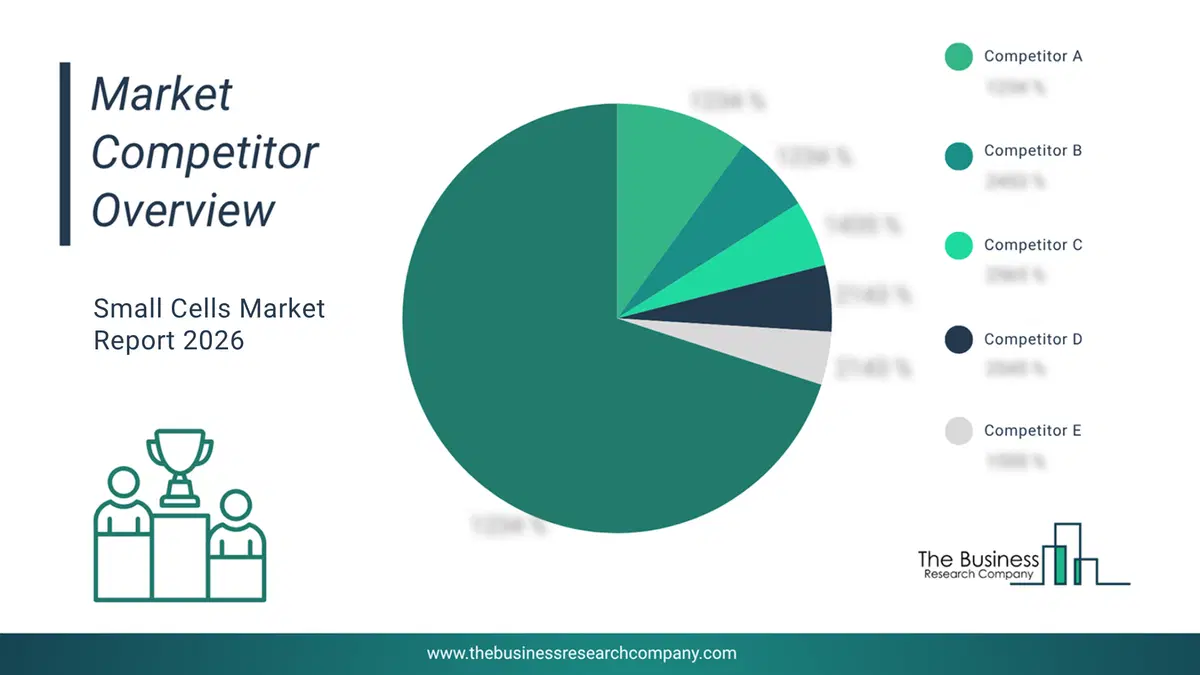
This chart is for illustrative purposes; the full report includes a detailed competitor analysis and comprehensive overview of the top 10 companies in the market.
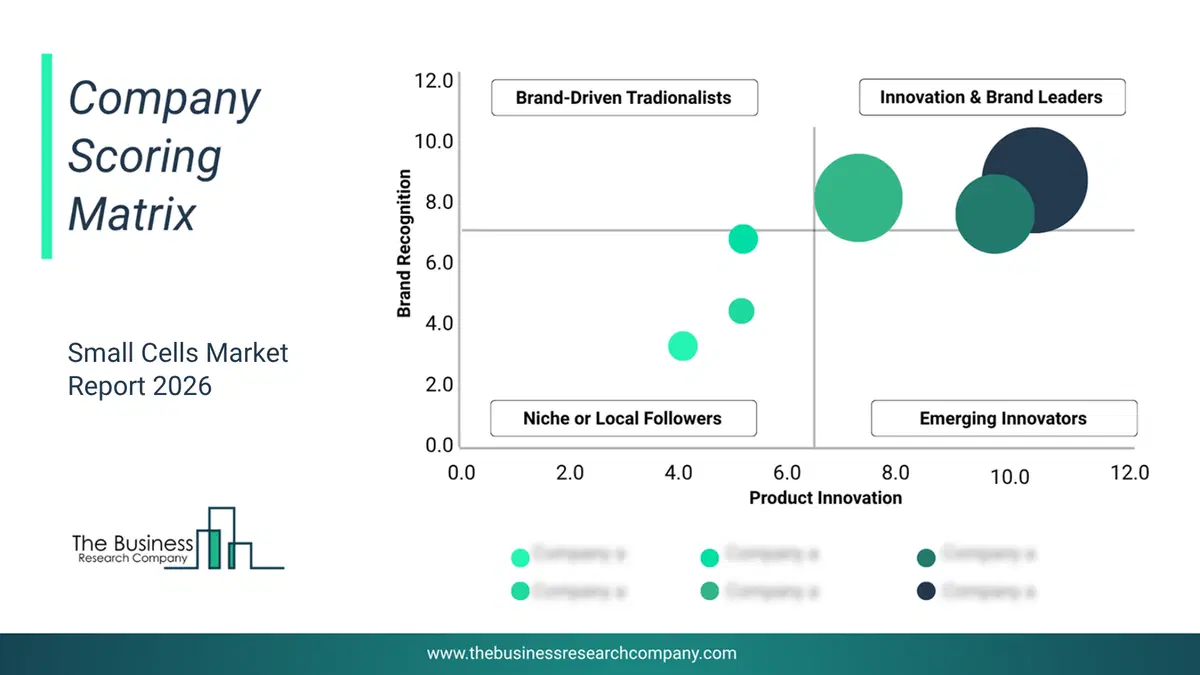
This chart maps companies by product innovation and brand strength, with bubble size indicating relative revenue, helping identify market leaders, challengers, and niche players. This is an illustrative chart; the full report provides a complete and accurate competitive analysis.
Global Small Cells Market Trends and Insights
Major companies operating in the small cells market are focusing on developing advanced technologies, such as software-defined multi-RAT small-cell platforms, to enhance network flexibility, scalability, and seamless evolution from 4G to 5G. Software-defined multi-RAT small-cell platforms are integrated solutions that support multiple radio access technologies, including 4G LTE and 5G NR, within a single architecture, enabling operators to optimize deployments and transition networks efficiently. For instance, in February 2026, Airspan Networks Holdings Inc., a US-based provider of wireless network solutions, launched AirUnity Small Cells, a software-defined small-cell portfolio designed for both carrier and enterprise deployments. The platform supports 4G LTE and 5G NR, including standalone and non-standalone modes, within a single integrated baseband. It provides flexible deployment options across indoor and outdoor environments and supports both Split 2 and all-in-one architectures, enabling operators to adapt to diverse spectrum and network requirements while facilitating a software-upgradable transition from LTE to 5G.What Are Latest Mergers And Acquisitions In The Small Cells Market?
In April 2025, Airspan Networks, a US-based provider of wireless network solutions, small cells, and Open Radio Access Network technologies, acquired the wireless business of Corning Incorporated for an undisclosed amount. Through this acquisition, Airspan aims to expand its in-building wireless coverage portfolio and strengthen its capabilities in small cells and distributed antenna systems to support advanced fifth-generation network deployments. Corning Incorporated is a US-based provider of wireless communication solutions, including distributed antenna systems and SpiderCloud small cell radio access network products designed for enterprise and indoor connectivity.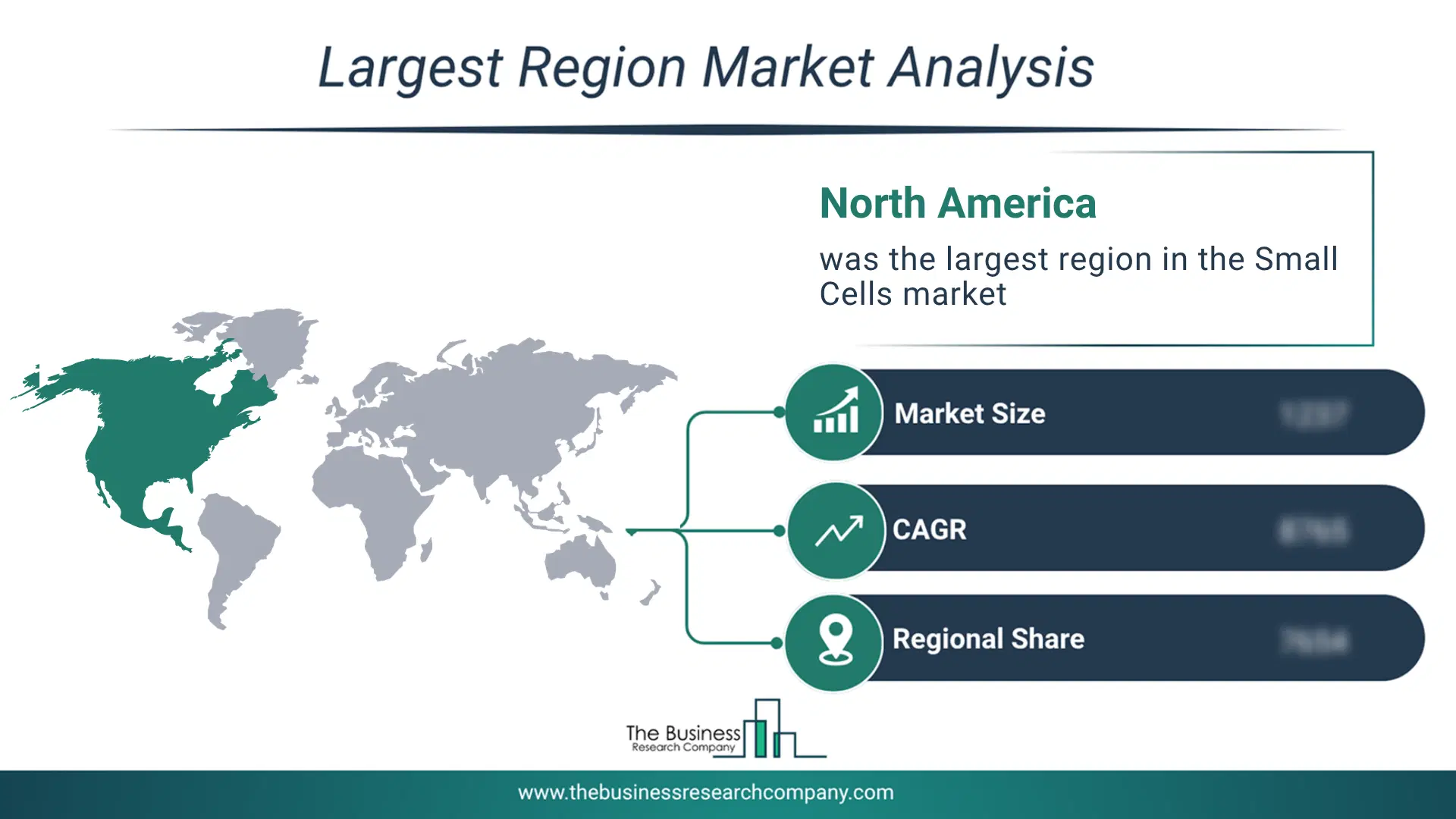
Regional Insights
North America was the largest region in the small cells market in 2025. Asia-Pacific is expected to be the fastest-growing region in the forecast period. The regions covered in this market report are Asia-Pacific, South East Asia, Western Europe, Eastern Europe, North America, South America, Middle East, Africa. The countries covered in this market report are Australia, Brazil, China, France, Germany, India, Indonesia, Japan, Taiwan, Russia, South Korea, UK, USA, Canada, Italy, Spain.What Defines the Small Cells Market?
The small cells market consists of revenues earned by entities by providing services such as network planning and design services, installation and deployment services, network optimization services, managed services, maintenance and support services, and integration services. The market value includes the value of related goods sold by the service provider or included within the service offering. The small cells market also includes sales of femtocells, picocells, microcells, metro cells, radio access network equipment, small cell base stations, antennas, power supply units, backhaul equipment, network controllers, and edge computing devices. Values in this market are ‘factory gate’ values, that is the value of goods sold by the manufacturers or creators of the goods, whether to other entities (including downstream manufacturers, wholesalers, distributors and retailers) or directly to end customers. The value of goods in this market includes related services sold by the creators of the goods.How is Market Value Defined and Measured?
The market value is defined as the revenues that enterprises gain from the sale of goods and/or services within the specified market and geography through sales, grants, or donations in terms of the currency (in USD unless otherwise specified). The revenues for a specified geography are consumption values that are revenues generated by organizations in the specified geography within the market, irrespective of where they are produced. It does not include revenues from resales along the supply chain, either further along the supply chain or as part of other products.
This chart presents market attractiveness based on a quantitative evaluation of growth, competition, strategic alignment, and risk, offering a clear view of opportunity areas for decision-making. This chart is for illustrative purposes; the full report contains the complete analysis.

This chart highlights the Total Addressable Market (TAM) by estimating the maximum revenue opportunity using an assumption-driven approach, supporting strategic planning and opportunity sizing across markets. The chart is illustrative; the full report provides a more comprehensive analysis.
What Key Data and Analysis Are Included in the Small Cells Market Report 2026?
The small cells market research report is one of a series of new reports from The Business Research Company that provides market statistics, including industry global market size, regional shares, competitors with the market share, detailed market segments, market trends and opportunities, and any further data you may need to thrive in the small cells industry. The market research report delivers a complete perspective of everything you need, with an in-depth analysis of the current and future state of the industry.Small Cells Market Report Forecast Analysis
| Report Attribute | Details |
|---|---|
| Market Size Value In 2026 | $4.79 billion |
| Revenue Forecast In 2030 | $7.84 billion |
| Growth Rate | CAGR of 13.1% from 2026 to 2030 |
| Base Year For Estimation | 2025 |
| Actual Estimates/Historical Data | 2020-2025 |
| Forecast Period | 2026 - 2030 |
| Market Representation | Revenue in USD Billion and CAGR from 2026 to 2030 |
| Segments Covered | Type, Technology, Deployment Mode, Application, End User Industry |
| Regional Scope | Asia-Pacific, Western Europe, Eastern Europe, North America, South America, Middle East, Africa |
| Country Scope | The Countries Covered In This Market Report Are Australia, Brazil, China, France, Germany, India, Indonesia, Japan, Taiwan, Russia, South Korea, Uk, Usa, Canada, Italy, Spain. |
| Key Companies Profiled | Samsung Electronics Co. Ltd., Huawei Technologies Co. Ltd., Cisco Systems Inc., Broadcom Inc., Qualcomm Incorporated, Fujitsu Limited, Telefonaktiebolaget LM Ericsson, NEC Corporation, Nokia Corporation, ZTE Corporation, Texas Instruments Incorporated, Corning Incorporated, Amphenol Corporation, American Tower Corporation, Comba Telecom Systems Holdings Limited, Ubiquiti Inc., Mavenir Systems Inc., Gemtek Technology Co. Ltd., Parallel Wireless Inc., Baicells Technologies Co. Ltd., Octasic Inc., Contela Inc., Acceleran NV, Accuver Co. Ltd. |
| Customization Scope | Request for Customization |
| Pricing And Purchase Options | Explore Purchase Options |