

Small Hydropower Market 2025
By Type (Micro Hydropower, Mini Hydropower), By Capacity (Up To 1 MW, 1–10 MW), By Application (Civil Construction, Power Infrastructure, Other Applications), By End-User (Commercial, Utility-Scale), And By Region, Opportunities And Strategies – Global Forecast To 2035
Small Hydropower Market Definition
Small hydropower refers to hydroelectric power generation systems with a capacity that generate between 100 kilowatts and 10 megawatts (MW) and used to convert the energy of flowing or falling water into electricity. These systems are typically smaller in scale compared to large hydropower plants and are commonly used in rural, off-grid, or regional settings where large-scale infrastructure is not feasible or economical. The small hydropower market consists of sales by entities (organizations, sole traders and partnerships) of small hydropower system that are used by private commercial entities, small-scale utilities, local governments, industrial operators and rural communities, particularly in developing regions where energy access remains limited. These systems are commonly used when a reliable, clean and cost-effective source of electricity is needed, especially in areas near flowing rivers or canals.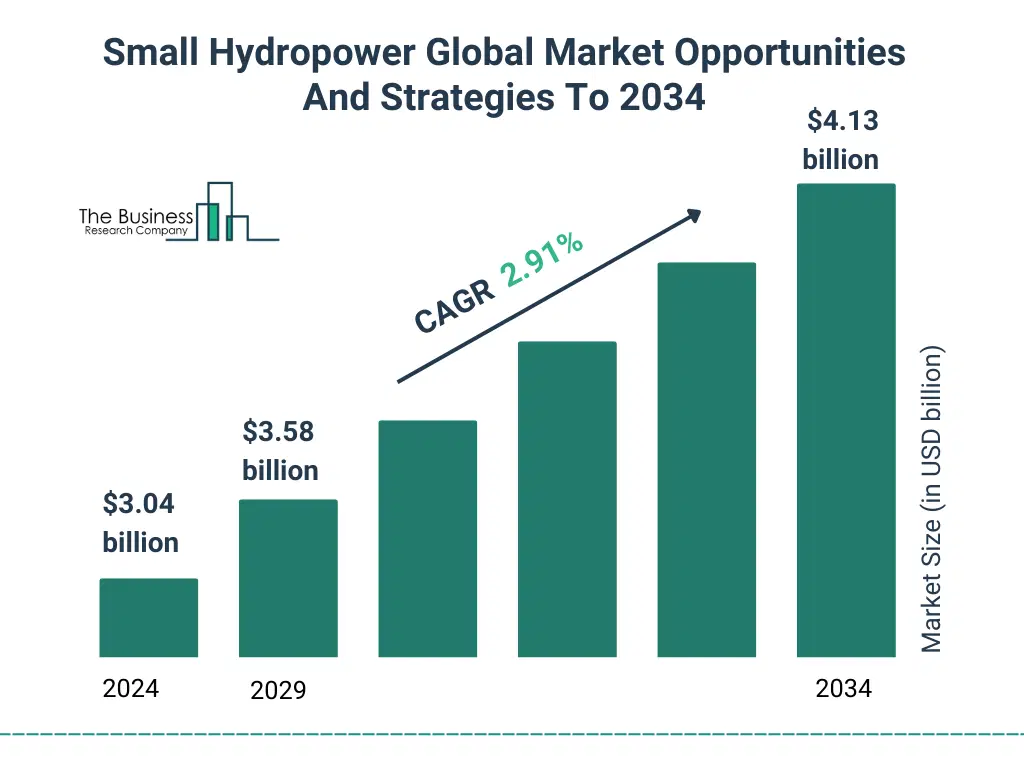
Small Hydropower Market Size
The global small hydropower market reached a value of nearly $3,037.50 million in 2024, having grown at a compound annual growth rate (CAGR) of 3.11% since 2019. The market is expected to grow from $3,037.50 million in 2024 to $3,577.75 million in 2029 at a rate of 3.33%. The market is then expected to grow at a CAGR of 2.91% from 2029 and reach $4,129.21 million in 2034. Growth in the historic period resulted from subsidies and financial incentives for small hydro, increasing electrification, global investments in sustainable energy projects and rise in water resource management and multipurpose use. Factors that negatively affected growth in the historic period were the high upfront capital costs and competition from cheaper renewables such as solar and wind. Going forward, growing cross-border green energy trade initiatives, focus on reducing carbon emissions, rising demand for renewable energy and favorable government initiative will drive growth. Factors that could hinder the growth of the small hydropower market in the future include long payback periods, seasonal flow variability and droughts reducing generation reliability and impact of trade war and tariff.Small Hydropower Market Drivers
The key drivers of the Small hydropower market include: Rising Demand for Renewable Energy During the forecast period, the rising demand for renewable energy will significantly propel the growth of the small hydropower market. As countries strive to meet increasing electricity needs, driven by industrial expansion, electrification of transport, higher cooling demand and growth in data centers, they are turning more and more toward clean, reliable sources of power. Small hydropower plants, with their ability to supply continuous and low-emission electricity in mountainous and rural regions, offer an ideal match for this shift. Small hydropower stands to benefit from policies and investment flows favoring renewable generation options. The steady increase in renewables’ share in electricity mix encourages investment in small and medium scale projects, modernization of existing plants and integration of small hydropower into regional power systems. The rising demand for renewable energy growth during the forecast period in 2024 is 2.00%.Small Hydropower Market Restraints
The key restraints on the Small hydropower market include: Long Payback Periods During the forecast period, the long payback periods will restrain the growth of the small hydropower market. The capital-intensive nature of hydropower projects, coupled with extended construction timelines, results in delayed returns on investment. This financial challenge is further exacerbated by high interest rates and the necessity for developers to secure substantial upfront capital. Additionally, the integration of hydropower plants into remote or mountainous regions often necessitates significant investments in transmission infrastructure, further increasing costs. These financial constraints can deter potential investors and developers, particularly in a competitive energy market where alternative renewable sources may offer quicker returns. Consequently, the long payback periods associated with small hydropower projects may limit their attractiveness and impede market growth. Growth affected by long payback periods during the forecast period in 2024 is -2.00%.Small Hydropower Market Trends
Major trends shaping the Small hydropower market include: Digitalization and Modular Innovation Transforming Small Hydropower Major companies in the small hydropower market are increasingly focusing on digital & modular innovation, efficiency in low-flow / low-head settings, hybrid deployments and stronger environmental compliance. These trends aim to reduce downtime, lower costs and expand deployment into more challenging or remote locations. For example, in July 2025, Voith, a Germany-based technology company specializing in hydropower, paper, raw materials, and transport & automotive sectors, has commissioned its first Hydro Pocket solution in Japan at the Ohsawagawa hydropower station in Yamagata Prefecture, marking a major step in unlocking the digital potential for the region's hydropower fleet. The Hydro Pocket platform is a cloud-based, digital monitoring and analytics solution that enables real-time remote access to operational data, replacing the previous closed-circuit monitoring system. The deployment was completed in close cooperation with Fuji Electric, which provided technical and customer interface support throughout the project. Canal-Based Mini-Hydro Turbines Revolutionizing Small-Scale Hydropower Companies in the small hydropower market are increasingly focusing on the development of canal-based mini-hydro turbines designed to harness energy from existing water infrastructure without the need for traditional dams or weirs. These innovations aim to provide a sustainable and cost-effective solution for small-scale hydropower generation, particularly in areas where conventional infrastructure is impractical. For instance, in April 2023, Emrgy, a U.S.-based startup specializing in mini-hydro technology, raised $18.4 million to scale up its canal-based turbine systems. These small turbines are designed to be installed in irrigation canals, utilizing the existing water flow to generate electricity. The system operates silently and requires minimal infrastructure, making it an ideal solution for decentralized renewable energy generation in agricultural regions. By employing such innovative technologies, companies are not only enhancing the efficiency and environmental compatibility of mini-hydro systems but also expanding the potential applications of hydropower in regions with limited infrastructure.Opportunities And Recommendations In The Small hydropower Market
Opportunities – The top opportunities in the small hydropower market segmented by type will arise in the mini hydropower segment, which will gain $467.97 million of global annual sales by 2029. The top opportunities in the small hydropower market segmented by capacity will arise in the Up to 1 MW segment, which will gain $291.69 million of global annual sales by 2029. The top opportunities in the small hydropower market segmented by application will arise in the power infrastructure segment, which will gain $297.88 million of global annual sales by 2029. The top opportunities in the small hydropower market segmented by end user will arise in the utility-scale segment, which will gain $350.16 million of global annual sales by 2029. The small hydropower market size will gain the most in China at $110.69 million. Recommendations- To take advantage of the opportunities, the business research company recommends the small hydropower companies to focus on digital innovation and efficiency in challenging deployments, focus on canal-based mini-hydro solutions for decentralized energy, focus on mini hydropower expansion, focus on 1–10 mw small hydropower projects, expand in emerging markets, focus on expanding distribution networks and strategic partnerships, focus on competitive and value-based pricing strategies, focus on targeted awareness campaigns and stakeholder engagement, focus on digital and local marketing integration, focus on power infrastructure investments, focus on commercial small hydropower projects.
Small hydropower Market Segmentation
The Small hydropower market is segmented by type, by application, by capacity type and by end user .By Type –
The Small hydropower market is segmented by type into:
- a) Micro Hydropower
- b) Mini Hydropower
By Capacity Type –
The Small hydropower market is segmented by capacity type into:
- a) up to 1 MW
- b) 1–10 MW
By Application –
The Small hydropower market is segmented by application into:
- a) Civil Construction
- b) Power Infrastructure
- c) Other applications
By End-User –
The Small hydropower market is segmented by end-user into:
- a) Commercial
- b) Utility-Scale
By Geography - The Small hydropower market is segmented by geography into:
- • China
- • India
- • Japan
- • Australia
- • Indonesia
- • South Korea
- • USA
- • Canada
- • Brazil
- • France
- • Germany
- • UK
- • Italy
- • Spain
- • Russia
-
o Asia Pacific
o Africa