
Small Molecule Targeted Cancer Therapy Market Report 2026
Global Outlook – By Therapy Type (Tyrosine Kinase Inhibitors, Proteasome Inhibitors, Histone Deacetylase Inhibitors, PARP Inhibitors, CDK Inhibitors, BCL-2 Inhibitors, mTOR Inhibitors, Other Small Molecule Inhibitors), By Cancer Type (Lung Cancer, Breast Cancer, Colorectal Cancer, Leukemia, Prostate Cancer, Other Cancer Types), By Mode Of Administration (Oral, Intravenous, Other Modes), By Distribution Channel (Hospital Pharmacy, Retail Pharmacy, Online Pharmacy, Direct Sales), By End User (Hospitals, Specialty Clinics, Research Institutes, Other End Users) – Market Size, Trends, Strategies, and Forecast to 2035
Small Molecule Targeted Cancer Therapy Market Overview
• Small Molecule Targeted Cancer Therapy market size has reached to $85.35 billion in 2025 • Expected to grow to $130.9 billion in 2030 at a compound annual growth rate (CAGR) of 8.9% • Growth Driver: Growing Demand For Personalized Medicine Fueling The Growth Of The Market Due To Need For Tailored And Effective Treatments • Market Trend: Next-Generation Targeted Treatments Improve Outcomes for Hormone Receptor-Positive Cancer • North America was the largest region in 2025 and Asia-Pacific is the fastest growing region.What Is Covered Under Small Molecule Targeted Cancer Therapy Market?
Small molecule targeted cancer therapy is a type of cancer treatment that uses low-molecular-weight compounds to specifically target cancer cell proteins or pathways, inhibiting tumor growth while minimizing damage to healthy cells. Its purpose is to provide precise, effective, and personalized treatment options that improve patient outcomes and reduce the side effects associated with conventional chemotherapy. The main therapy types of small molecule targeted cancer therapy include tyrosine kinase inhibitors, proteasome inhibitors, histone deacetylase inhibitors, PARP inhibitors, CDK inhibitors, BCL-2 inhibitors, mTOR inhibitors, and others. Tyrosine kinase inhibitors refer to targeted compounds designed to block specific enzymes involved in cancer cell growth and proliferation, providing precise therapeutic effects with reduced systemic toxicity. These therapies are used across cancer types such as lung cancer, breast cancer, colorectal cancer, leukemia, prostate cancer, and others. They are administered via oral, intravenous, and others, distributed through hospital pharmacies, retail pharmacies, online pharmacies, and direct sales, with key end-users including hospitals, specialty clinics, research institutes, and others.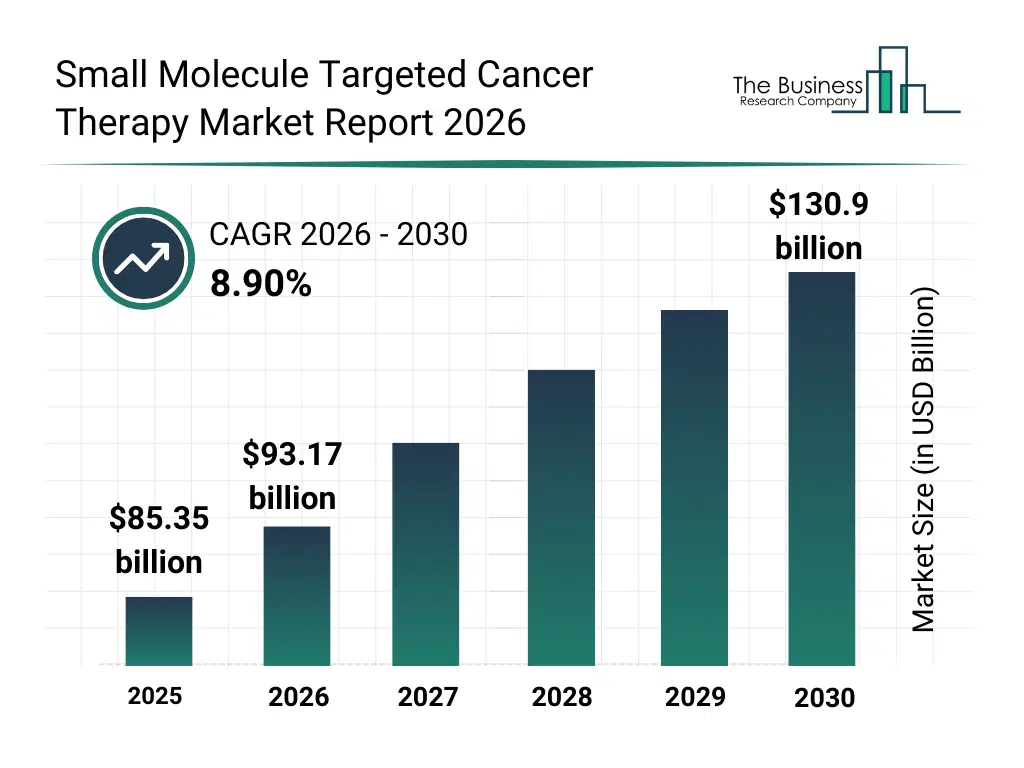
What Is The Small Molecule Targeted Cancer Therapy Market Size and Share 2026?
The small molecule targeted cancer therapy market size has grown strongly in recent years. It will grow from $85.35 billion in 2025 to $93.17 billion in 2026 at a compound annual growth rate (CAGR) of 9.2%. The growth in the historic period can be attributed to rising cancer incidence rates, increased understanding of molecular oncology pathways, expansion of targeted drug discovery programs, regulatory approvals of first-generation targeted inhibitors, growing investment in oncology research.What Is The Small Molecule Targeted Cancer Therapy Market Growth Forecast?
The small molecule targeted cancer therapy market size is expected to see strong growth in the next few years. It will grow to $130.9 billion in 2030 at a compound annual growth rate (CAGR) of 8.9%. The growth in the forecast period can be attributed to increasing adoption of personalized cancer medicine, rising development of next-generation inhibitors, expansion of companion diagnostics usage, growing focus on resistance management strategies, increasing oncology drug pipeline activity. Major trends in the forecast period include increasing development of mutation-specific inhibitors, rising adoption of precision oncology therapies, growing focus on oral small molecule drugs, expansion of combination targeted therapy regimens, enhanced emphasis on biomarker-driven treatment selection.
Global Small Molecule Targeted Cancer Therapy Market Segmentation
1) By Therapy Type: Tyrosine Kinase Inhibitors, Proteasome Inhibitors, Histone Deacetylase Inhibitors, PARP Inhibitors, CDK Inhibitors, BCL-2 Inhibitors, mTOR Inhibitors, Other Small Molecule Inhibitors 2) By Cancer Type: Lung Cancer, Breast Cancer, Colorectal Cancer, Leukemia, Prostate Cancer, Other Cancer Types 3) By Mode Of Administration: Oral, Intravenous, Other Modes 4) By Distribution Channel: Hospital Pharmacy, Retail Pharmacy, Online Pharmacy, Direct Sales 5) By End User: Hospitals, Specialty Clinics, Research Institutes, Other End Users Subsegments: 1) By Tyrosine Kinase Inhibitors: EGFR Inhibitors, VEGFR Inhibitors, ALK Inhibitors, BCR-ABL Inhibitors, HER2 Inhibitors 2) By Proteasome Inhibitors: Bortezomib, Carfilzomib, Ixazomib 3) By Histone Deacetylase Inhibitors: Pan-Histone Deacetylase Inhibitors, Class-specific Histone Deacetylase Inhibitors 4) By PARP Inhibitors: Olaparib, Niraparib, Rucaparib, Talazoparib 5) By CDK Inhibitors: CDK4/6 Inhibitors, CDK1/2 Inhibitors, Pan-CDK Inhibitors 6) By BCL-2 Inhibitors: Venetoclax, Navitoclax 7) By mTOR Inhibitors: Rapamycin Analogs (Rapalogs), ATP-competitive mTOR Inhibitors, Dual mTOR/PI3K Inhibitors 8) By Other Small Molecule Inhibitors: MEK Inhibitors, PI3K Inhibitors, RAF InhibitorsWhat Is The Driver Of The Small Molecule Targeted Cancer Therapy Market?
The growing demand for personalized medicine is expected to propel the growth of the small molecule targeted therapy market going forward. Personalized medicine refers to a medical approach that tailors the prevention, diagnosis, and treatment of diseases to the individual characteristics of each patient. The demand for personalized medicine is rising due to the growing need for targeted treatments that improve efficacy and reduce adverse effects. Small molecule targeted therapy helps address the demand for personalized medicine by enhancing treatment specificity, improving patient response, minimizing side effects, and enabling therapies tailored to individual genetic and molecular profiles. For instance, in February 2024, the Personalized Medicine Coalition, a US-based non-profit organization, in 2023, the US Food and Drug Administration (FDA) granted approval for 16 new personalized treatments for rare disease patients, marking a substantial increase from the six approvals in 2022. Therefore, the growing demand for personalized medicine is driving the growth of the small molecule targeted therapy market.Key Players In The Global Small Molecule Targeted Cancer Therapy Market
Major companies operating in the small molecule targeted cancer therapy market are Johnson & Johnson Services Inc., F. Hoffmann-La Roche Ltd., Merck & Co. Inc., Pfizer Inc., AbbVie Inc., Bayer AG, Sanofi S.A., Novartis International AG, AstraZeneca plc, Bristol-Myers Squibb Company, GlaxoSmithKline plc (GSK), Eli Lilly and Company, Takeda Pharmaceutical Company Limited, Amgen Inc., Gilead Sciences Inc., Boehringer Ingelheim International GmbH, Astellas Pharma Inc., Daiichi Sankyo Company Limited, Eisai Co. Ltd., Ipsen Biopharmaceuticals Inc.Global Small Molecule Targeted Cancer Therapy Market Trends and Insights
Major companies operating in the breast cancer small-molecule targeted therapy market are focusing on developing innovative therapies such as PI3K inhibitors and CDK4/6 inhibitor combinations to enhance treatment efficacy and target specific cancer cell signalling pathways more effectively. PI3K inhibitors are targeted cancer therapies that block the phosphatidylinositol-3-kinase pathway involved in tumor growth and survival, while CDK4/6 inhibitor combinations are designed to specifically halt cell cycle progression in hormone receptor-positive cancer cells. For instance, in October 2024, Genentech, Inc., a US-based biotechnology company, received approval from the U.S. Food and Drug Administration (FDA) for inavolisib (Itovebi) in combination with palbociclib (Ibrance) and fulvestrant (Faslodex) for the treatment of adults with endocrine-resistant, PIK3CA-mutated, hormone receptor-positive, HER2-negative, locally advanced, or metastatic breast cancer. The approval was based on the results of the INAVO120 trial, which demonstrated a significant improvement in progression-free survival and objective response rate compared to palbociclib and fulvestrant alone. This marks a major advancement in personalized therapy for HR-positive, HER2-negative breast cancer, offering a targeted option for patients with PIK3CA mutations.What Are Latest Mergers And Acquisitions In The Small Molecule Targeted Cancer Therapy Market?
In May 2023, Gilead Sciences, Inc., a US-based biopharmaceutical company, acquired XinThera Inc. for an undisclosed amount. With this acquisition, Gilead Sciences aims to strengthen its oncology and inflammation pipeline by adding XinThera’s small molecule inhibitors targeting PARP1 and MK2, expanding its portfolio of precision medicines. XinThera Inc. is a US-based biotechnology company specializing in developing small molecule therapies for oncology and immunology.Regional Insights
North America was the largest region in the small molecule targeted cancer therapy market in 2025. Asia-Pacific is expected to be the fastest-growing region in the forecast period. The regions covered in this market report are Asia-Pacific, South East Asia, Western Europe, Eastern Europe, North America, South America, Middle East, Africa. The countries covered in this market report are Australia, Brazil, China, France, Germany, India, Indonesia, Japan, Taiwan, Russia, South Korea, UK, USA, Canada, Italy, Spain.What Defines the Small Molecule Targeted Cancer Therapy Market?
The small molecule targeted cancer therapy market consists of sales of novel agents, venetoclax, imatinib, olaparib, niraparib. Values in this market are ‘factory gate’ values, meaning the value of goods sold by the manufacturers or creators of the drugs, whether to other entities (including downstream manufacturers, wholesalers, distributors, and retailers) or directly to end customers. The value of goods in this market also includes related services provided by the creators of these therapies.How is Market Value Defined and Measured?
The market value is defined as the revenues that enterprises gain from the sale of goods and/or services within the specified market and geography through sales, grants, or donations in terms of the currency (in USD unless otherwise specified). The revenues for a specified geography are consumption values that are revenues generated by organizations in the specified geography within the market, irrespective of where they are produced. It does not include revenues from resales along the supply chain, either further along the supply chain or as part of other products.What Key Data and Analysis Are Included in the Small Molecule Targeted Cancer Therapy Market Report 2026?
The small molecule targeted cancer therapy market research report is one of a series of new reports from The Business Research Company that provides market statistics, including industry global market size, regional shares, competitors with the market share, detailed market segments, market trends and opportunities, and any further data you may need to thrive in the small molecule targeted cancer therapy industry. The market research report delivers a complete perspective of everything you need, with an in-depth analysis of the current and future state of the industry.Small Molecule Targeted Cancer Therapy Market Report Forecast Analysis
| Report Attribute | Details |
|---|---|
| Market Size Value In 2026 | $93.17 billion |
| Revenue Forecast In 2035 | $130.9 billion |
| Growth Rate | CAGR of 9.2% from 2026 to 2035 |
| Base Year For Estimation | 2025 |
| Actual Estimates/Historical Data | 2020-2025 |
| Forecast Period | 2026 - 2030 - 2035 |
| Market Representation | Revenue in USD Billion and CAGR from 2026 to 2035 |
| Segments Covered | Therapy Type, Cancer Type, Mode Of Administration, Distribution Channel, End User |
| Regional Scope | Asia-Pacific, Western Europe, Eastern Europe, North America, South America, Middle East, Africa |
| Country Scope | The countries covered in the report are Australia, Brazil, China, France, Germany, India, ... |
| Key Companies Profiled | Johnson & Johnson Services Inc., F. Hoffmann-La Roche Ltd., Merck & Co. Inc., Pfizer Inc., AbbVie Inc., Bayer AG, Sanofi S.A., Novartis International AG, AstraZeneca plc, Bristol-Myers Squibb Company, GlaxoSmithKline plc (GSK), Eli Lilly and Company, Takeda Pharmaceutical Company Limited, Amgen Inc., Gilead Sciences Inc., Boehringer Ingelheim International GmbH, Astellas Pharma Inc., Daiichi Sankyo Company Limited, Eisai Co. Ltd., Ipsen Biopharmaceuticals Inc. |
| Customization Scope | Request for Customization |
| Pricing And Purchase Options | Explore Purchase Options |