
Small-Satellite Launch Service Market Report 2026
Global Outlook – By Launch Service Type (Dedicated Launch Services, Rideshare Launch Services, Hosted Payload Services, On-Demand Launch Services), By Satellite Type (CubeSats, Nanosatellites, Microsatellites, Picosatellites, Other Satellite Types), By Orbit Type (Low Earth Orbit, Sun-Synchronous Orbit, Medium Earth Orbit, Geostationary Transfer Orbit), By Satellite Weight (Up To 50 Kilograms, 51 Kilograms To 150 Kilograms, 151 Kilograms To 500 Kilograms), By End User (Commercial Satellite Operators, Government And Defense Organizations, Research And Academic Institutions, Space Agencies) – Market Size, Trends, Strategies, and Forecast to 2035
Small-Satellite Launch Service Market Overview
• Small-Satellite Launch Service market size has reached to $11.88 billion in 2025 • Expected to grow to $25.08 billion in 2030 at a compound annual growth rate (CAGR) of 16% • Growth Driver: Expansion Of Commercial Space Industry Driving The Market Growth Due To Increasing Demand For Cost-Effective Satellite Deployment Solutions • Market Trend: Advancements In Private Orbital Launch Vehicles Accelerate Commercial Space Access And Enable Next-Generation Satellite Deployment • North America was the largest region in 2025 and Asia-Pacific is the fastest growing region.What Is Covered Under Small-Satellite Launch Service Market?
Small-satellite launch services refer to specialized space transportation services designed to deploy small satellites into designated orbits using launch vehicles and related space infrastructure. These services enable the efficient placement of compact spacecraft into space by providing launch planning, mission integration, payload accommodation, and orbital deployment capabilities. They support reliable and cost-effective access to space through advanced launch technologies and mission management solutions. The main launch service types of small-satellite launch services include dedicated launch services, rideshare launch services, hosted payload services, and on-demand launch services. Dedicated launch services refer to launch arrangements in which a launch vehicle is assigned specifically to carry one or more small satellites to their intended orbit. These services support CubeSats, nanosatellites, microsatellites, picosatellites, and other satellite types, and are available for low Earth orbit, sun-synchronous orbit, medium Earth orbit, and geostationary transfer orbit. They support satellite weights ranging from up to 50 kilograms, 51 kilograms to 150 kilograms, and 151 kilograms to 500 kilograms, and are used end users by commercial satellite operators, government and defense organizations, research and academic institutions, and space agencies.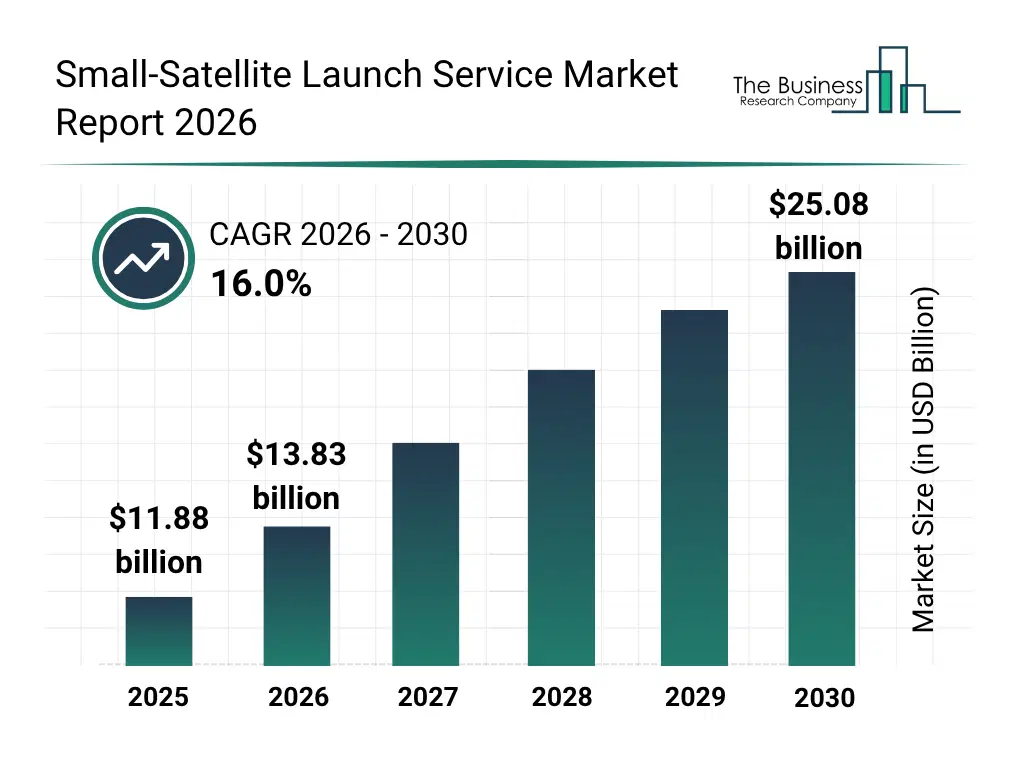
What Is The Small-Satellite Launch Service Market Size and Share 2026?
The small-satellite launch service market size has grown rapidly in recent years. It will grow from $11.88 billion in 2025 to $13.83 billion in 2026 at a compound annual growth rate (CAGR) of 16.5%. The growth in the historic period can be attributed to increasing deployment of small satellites, growing demand for low-cost access to space, expansion of commercial satellite constellations, rising adoption of rideshare launch services, increasing government investment in small-satellite missions.What Is The Small-Satellite Launch Service Market Growth Forecast?
The small-satellite launch service market size is expected to see rapid growth in the next few years. It will grow to $25.08 billion in 2030 at a compound annual growth rate (CAGR) of 16.0%. The growth in the forecast period can be attributed to growing demand for high-frequency satellite launches, expansion of small-satellite constellations, increasing need for responsive launch capabilities, rising demand for customized orbital deployment, growing commercialization of small-satellite applications. Major trends in the forecast period include rideshare launch optimization, rapid responsive launch services, dedicated small-satellite launch vehicles, flexible orbit deployment solutions, mission-specific payload integration.Tariff Impact On Small-Satellite Launch Service Market
Tariffs are impacting the small-satellite launch services market by increasing the cost of imported launch vehicle components, satellite electronics, propulsion systems, and specialized aerospace equipment used for mission integration and deployment. Dedicated launch services and launch vehicle manufacturing are likely to experience greater cost pressures, particularly in North America, Europe, and Asia-Pacific due to globally distributed aerospace supply chains. However, tariffs may encourage domestic production of critical components, supplier diversification, and greater investment in regional launch infrastructure, potentially strengthening local aerospace manufacturing capabilities and supply-chain resilience.
Global Small-Satellite Launch Service Market Segmentation
2) By Satellite Type: CubeSats, Nanosatellites, Microsatellites, Picosatellites, Other Satellite Types 3) By Orbit Type: Low Earth Orbit, Sun-Synchronous Orbit, Medium Earth Orbit, Geostationary Transfer Orbit 4) By Satellite Weight: Up To 50 Kilograms, 51 Kilograms To 150 Kilograms, 151 Kilograms To 500 Kilograms 5) By End User: Commercial Satellite Operators, Government And Defense Organizations, Research And Academic Institutions, Space Agencies Subsegments: 1) By Dedicated Launch Services: Small Satellite Dedicated Launch Vehicles, Single Mission Launch Services, Custom Orbit Launch Services, Priority Launch Services, Customized Deployment Launch Services 2) By Rideshare Launch Services: Multiple Satellite Rideshare Launch Services, Secondary Payload Launch Services, Small Satellite Cluster Launch Services, Shared Orbit Deployment Services, Cost Efficient Rideshare Launch Services 3) By Hosted Payload Services: Commercial Hosted Payload Services, Government Hosted Payload Services, Communication Hosted Payload Services, Earth Observation Hosted Payload Services, Technology Demonstration Hosted Payload Services 4) By On-Demand Launch Services: Rapid Response Launch Services, Flexible Scheduling Launch Services, Short Notice Launch Services, Responsive Space Launch Services, Mission Specific Launch ServicesWhat Is The Driver Of The Small-Satellite Launch Service Market?
The expansion of the commercial space industry is expected to propel the growth of the small-satellite launch service market going forward. The commercial space industry refers to privately funded space activities and services, including satellite deployment, space-based communication, Earth observation, and other commercial applications enabled by private companies rather than only government agencies. The commercial space industry is expanding due to the growing demand for satellite-based communication, as businesses, governments, and consumers increasingly rely on satellites to provide high-speed internet connectivity. The expansion of the commercial space industry drives demand for small-satellite launches services by increasing the need for cost-effective, flexible, and frequent launch solutions that enable faster satellite deployment and support the growing number of small satellite constellations. For instance, in July 2025, according to the Space Foundation, a US-based nonprofit organization, global launch activity reached a record pace in the first half of 2025, with 149 launches conducted between January and June, averaging one launch every 28 hours. SpaceX accounted for 81 of these launches, representing more than half of global launch activity during the period, highlighting the continued acceleration of commercial space launch activity. Therefore, the expansion of the commercial space industry is driving the growth of the small-satellite launch service industry.Key Players In The Global Small-Satellite Launch Service Market
Major companies operating in the small-satellite launch service market are Space Exploration Technologies Corp., Northrop Grumman Corporation, Indian Space Research Organisation, Rocket Lab USA Inc., Firefly Aerospace Inc., LandSpace Technology Corporation Ltd., Exolaunch GmbH, Beijing Galactic Energy Transportation Technology Co. Ltd., Skyroot Aerospace Private Limited, Stoke Space Technologies Inc., Payload Aerospace S.L., Beijing Interstellar Glory Space Technology Ltd., Gilmour Space Technologies Pty Ltd, ExPace Technology Corporation, Beijing Deep Blue Aerospace Technology Co. Ltd., Skyrora Limited, Phantom Space Corporation, ABL Space Systems Inc., C6 Launch Systems Inc.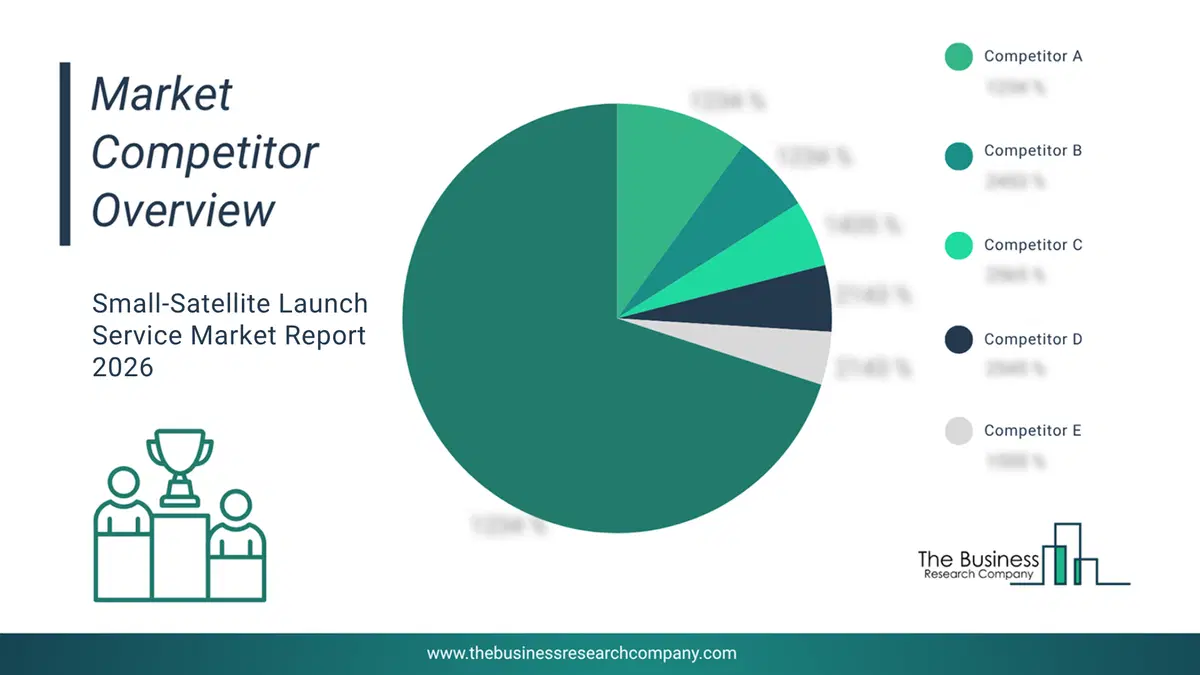
This chart is for illustrative purposes; the full report includes a detailed competitor analysis and comprehensive overview of the top 10 companies in the market.
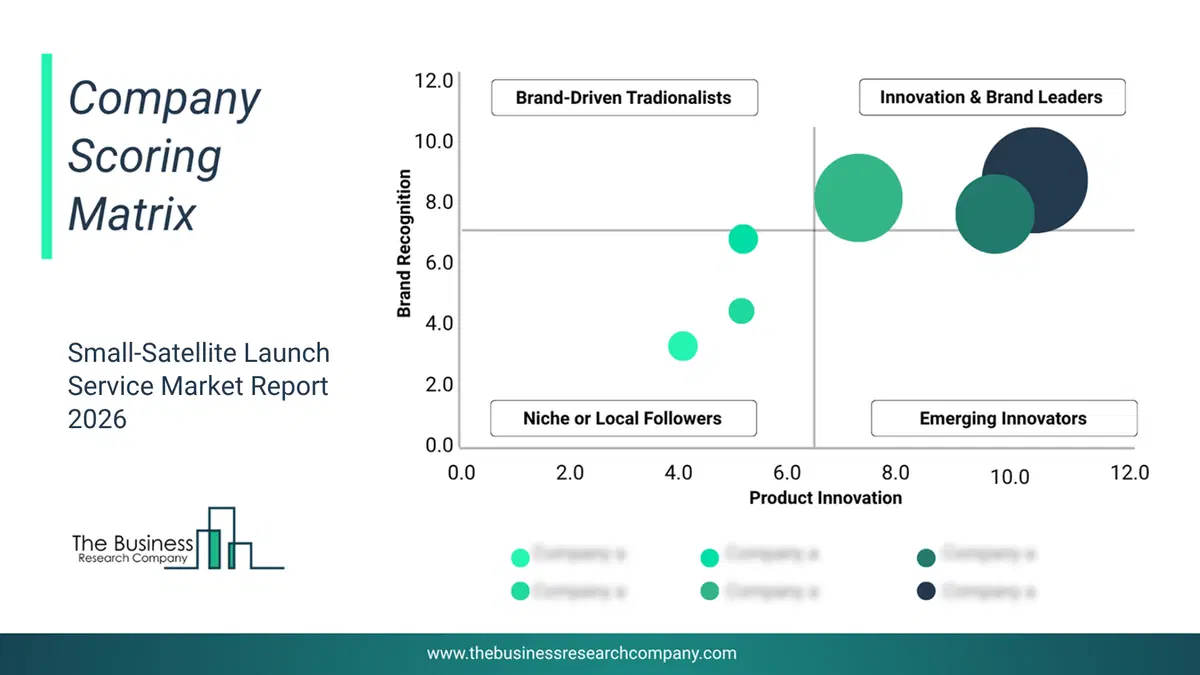
This chart maps companies by product innovation and brand strength, with bubble size indicating relative revenue, helping identify market leaders, challengers, and niche players. This is an illustrative chart; the full report provides a complete and accurate competitive analysis.
Global Small-Satellite Launch Service Market Trends and Insights
Major companies operating in the small-satellite launch service market are focusing on developing advanced rockets such as, privately developed orbital launch vehicles to enhance cost-effective satellite deployment, dedicated launch capabilities, and independent access to low-Earth orbit (LEO). Privately developed orbital launch vehicles are commercial rockets designed to transport small satellites and payloads into space using advanced propulsion, avionics, and guidance systems, offering more flexible and affordable launch options compared with traditional large-scale government-operated launch systems. For instance, in July 2026, Skyroot Aerospace, an India-based private space technology company, launched Vikram-1, the country’s first privately developed orbital rocket mission, as part of its efforts to expand commercial small-satellite launch services. The rocket successfully placed customer payloads and in-orbit experiments into a 450 km low-Earth orbit during its maiden mission, validating its propulsion, avionics, telemetry, guidance, navigation, and control systems for future commercial launches. Vikram-1 is designed to carry payloads of up to 350 kg and incorporates three solid-fuel stages along with a liquid-fuel orbital adjustment module powered by a 3D-printed engine, enabling efficient deployment of small satellites and technology demonstration payloads.What Are Latest Mergers And Acquisitions In The Small-Satellite Launch Service Market?
In September 2025, Indian Space Research Organisation (ISRO), an India-based space agency responsible for space research and exploration programs, partnered with Hindustan Aeronautics Limited (HAL) for the transfer of Small Satellite Launch Vehicle (SSLV) technology. Through this partnership, Indian Space Research Organisation (ISRO) and Hindustan Aeronautics Limited (HAL) aim to enable the commercial production and operation of SSLV systems, strengthen India’s private-sector participation in space manufacturing, enhance small satellite launch capabilities, and support cost-effective access to space for domestic and international customers. Hindustan Aeronautics Limited (HAL) is an India-based aerospace and defense company specializes in providing small satellite launch services.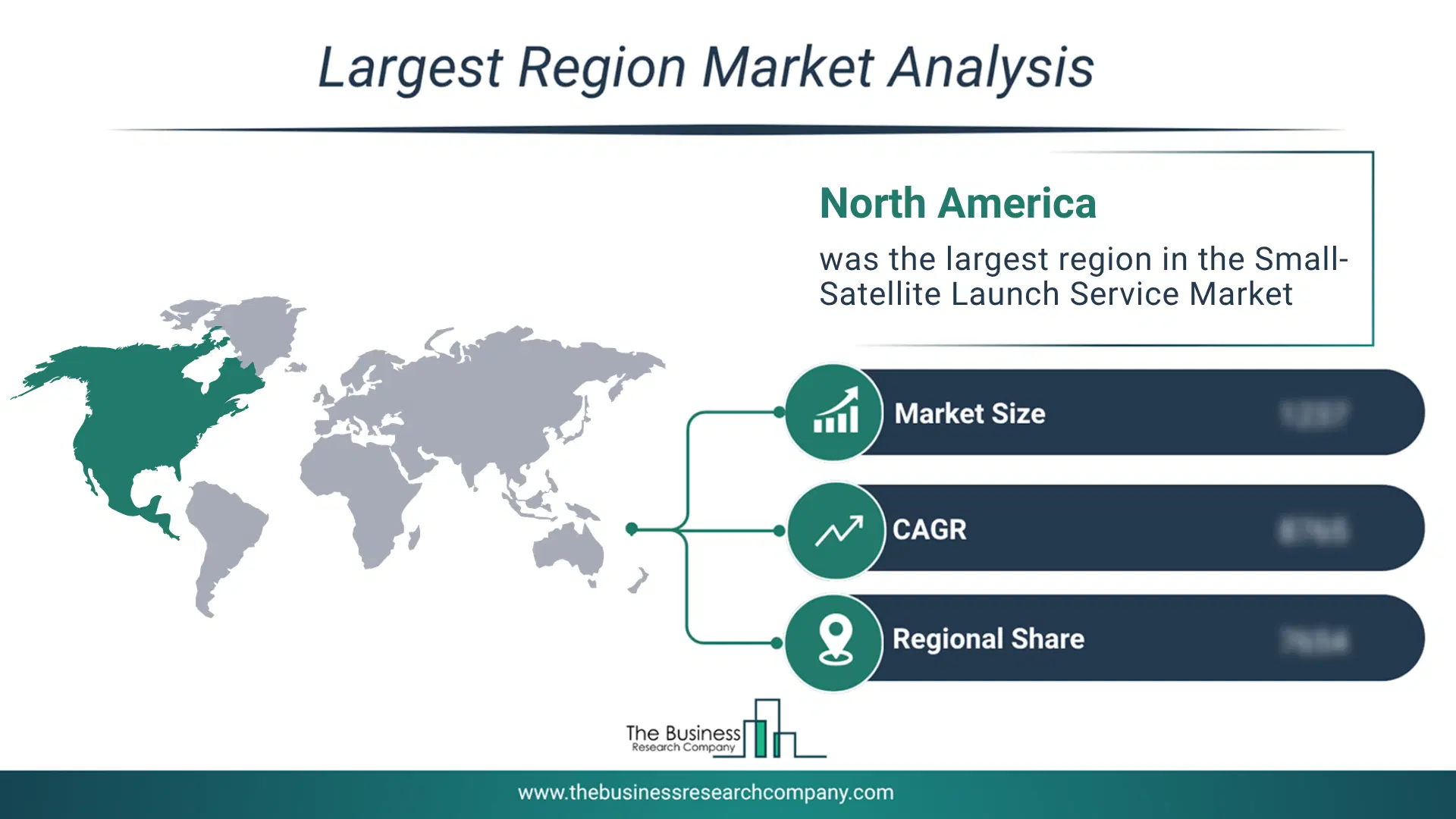
Regional Outlook/Insights
North America was the largest region in the small-satellite launch service market in 2025. Asia-Pacific is expected to be the fastest-growing region in the forecast period. The regions covered in this market report are Asia-Pacific, South East Asia, Western Europe, Eastern Europe, North America, South America, Middle East, Africa. The countries covered in this market report are Australia, Brazil, China, France, Germany, India, Indonesia, Japan, Taiwan, Russia, South Korea, UK, USA, Canada, Italy, Spain.What Defines the Small-Satellite Launch Service Market?
The small-satellite launch service market includes revenues earned by entities by providing services such as launch vehicle operations, satellite integration, payload processing, mission planning, orbital deployment, launch coordination, and post-launch support services. The market value includes the value of related goods sold by the service provider or included within the service offering. Only goods and services traded between entities or sold to end consumers are included.How is Market Value Defined and Measured?
The market value is defined as the revenues that enterprises gain from the sale of goods and/or services within the specified market and geography through sales, grants, or donations in terms of the currency (in USD unless otherwise specified). The revenues for a specified geography are consumption values that are revenues generated by organizations in the specified geography within the market, irrespective of where they are produced. It does not include revenues from resales along the supply chain, either further along the supply chain or as part of other products.
This chart presents market attractiveness based on a quantitative evaluation of growth, competition, strategic alignment, and risk, offering a clear view of opportunity areas for decision-making. This chart is for illustrative purposes; the full report contains the complete analysis.

This chart highlights the Total Addressable Market (TAM) by estimating the maximum revenue opportunity using an assumption-driven approach, supporting strategic planning and opportunity sizing across markets. The chart is illustrative; the full report provides a more comprehensive analysis.
What Key Data and Analysis Are Included in the Small-Satellite Launch Service Market Report 2026?
The small-satellite launch service market research report is one of a series of new reports from The Business Research Company that provides market statistics, including industry global market size, regional shares, competitors with the market share, detailed market segments, market trends and opportunities, and any further data you may need to thrive in the small-satellite launch service industry. The market research report delivers a complete perspective of everything you need, with an in-depth analysis of the current and future state of the industry.Small-Satellite Launch Service Market Report Forecast Analysis
| Report Attribute | Details |
|---|---|
| Market Size Value In 2026 | $13.83 billion |
| Revenue Forecast In 2030 | $25.08 billion |
| Growth Rate | CAGR of 16.0% from 2026 to 2035 |
| Base Year For Estimation | 2025 |
| Actual Estimates/Historical Data | 2020-2025 |
| Forecast Period | 2026 - 2030 |
| Market Representation | Revenue in USD Billion and CAGR from 2026 to 2030 |
| Segments Covered | Launch Service Type, Satellite Type, Orbit Type, Satellite Weight, End User |
| Regional Scope | Asia-Pacific, Western Europe, Eastern Europe, North America, South America, Middle East, Africa |
| Country Scope | The countries covered in the report are Australia, Brazil, China, France, Germany, India, Indonesia, Japan, Taiwan, Russia, South Korea, UK, USA, Canada, Italy, Spain. |
| Customization Scope | Request for Customization |
| Pricing And Purchase Options | Explore Purchase Options |