
Smart Adaptive Air Curtain Market Report 2026
Global Outlook – By Product Type (Recirculating Air Curtains, Non-Recirculating Air Curtains), By Mounting Type (Recessed, Surface-Mounted, Suspended), By Technology (Sensor-Based, Internet Of Things-Enabled, Automated Control, Manual Control), By Distribution Channel (Direct Sales, Online Retail, Distributors Or Wholesalers, Other Distribution Channels), By Application (Commercial, Industrial, Residential, Healthcare, Hospitality, Retail, Other Applications) – Market Size, Trends, Strategies, and Forecast to 2030
Smart Adaptive Air Curtain Market Overview
• Smart Adaptive Air Curtain market size has reached to $1.68 billion in 2025 • Expected to grow to $2.61 billion in 2030 at a compound annual growth rate (CAGR) of 9.3% • Growth Driver: Increasing Awareness Of Energy Conservation Fueling The Growth Of The Market Due To Rising Demand For Efficient Heating And Cooling Solutions • Market Trend: Advanced Industrial Air Curtains Enhance Energy Efficiency And Hygiene • North America was the largest region in 2025 and Asia-Pacific is the fastest growing region.What Is Covered Under Smart Adaptive Air Curtain Market?
A smart adaptive air curtain is an advanced device installed above doorways or openings that generates a controlled stream of air to separate indoor and outdoor environments. It uses sensors and adaptive controls to adjust airflow in real-time based on door movement, temperature, and occupancy. Its main purpose is to maintain indoor climate, reduce energy consumption, and prevent the entry of dust, insects, and pollutants. The main product types of smart adaptive air curtain are recirculating air curtains and non-recirculating air curtains. A recirculating air curtain refers to a type of air curtain system that captures the air it blows across an opening and returns it through a duct or grille to be reused, forming a closed-loop airflow. It includes different mounting types, such as recessed, surface-mounted, and suspended, and utilizes technologies, such as sensor-based, internet of things (IoT)-enabled, automated control, and manual control. It is distributed through direct sales, online retail, distributors or wholesalers, and others, and finds applications in commercial, industrial, residential, healthcare, hospitality, retail, and others.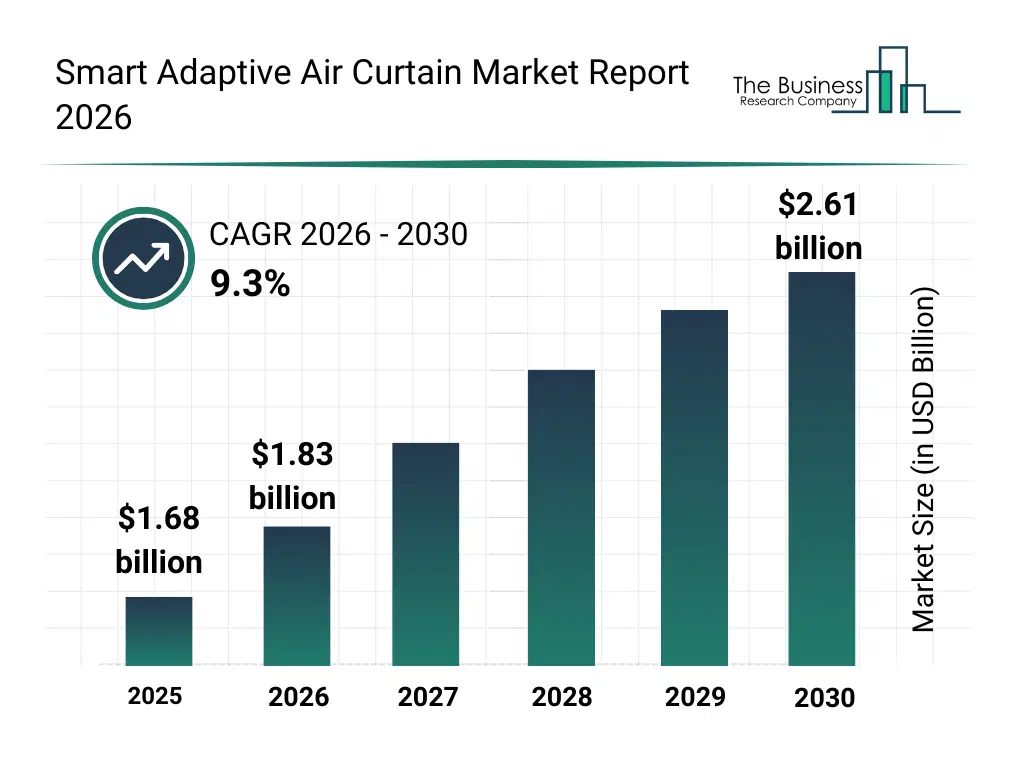
What Is The Smart Adaptive Air Curtain Market Size and Share 2026?
The smart adaptive air curtain market size has grown strongly in recent years. It will grow from $1.68 billion in 2025 to $1.83 billion in 2026 at a compound annual growth rate (CAGR) of 8.9%. The growth in the historic period can be attributed to growth in commercial construction, rising hvac installations, demand for energy savings, expansion of retail spaces, focus on indoor air quality.What Is The Smart Adaptive Air Curtain Market Growth Forecast?
The smart adaptive air curtain market size is expected to see strong growth in the next few years. It will grow to $2.61 billion in 2030 at a compound annual growth rate (CAGR) of 9.3%. The growth in the forecast period can be attributed to smart building adoption, stricter energy regulations, growth in healthcare infrastructure, increasing automation in hvac systems, demand for sustainable buildings. Major trends in the forecast period include sensor driven airflow optimization, real time adaptive climate control, energy efficient entryway management, integration with smart building systems, rising demand for hygiene control.Tariff Impact On Smart Adaptive Air Curtain Market
Tariffs have influenced the smart adaptive air curtain market by increasing costs of sensors, electronic controllers, and motor components. Asia Pacific and Europe are most affected due to manufacturing concentration. Product pricing has risen. However, tariffs are encouraging localized assembly and component sourcing.
Global Smart Adaptive Air Curtain Market Segmentation
1) By Product Type: Recirculating Air Curtains, Non-Recirculating Air Curtains 2) By Mounting Type: Recessed, Surface-Mounted, Suspended 3) By Technology: Sensor-Based, Internet Of Things-Enabled, Automated Control, Manual Control 4) By Distribution Channel: Direct Sales, Online Retail, Distributors Or Wholesalers, Other Distribution Channels 5) By Application: Commercial, Industrial, Residential, Healthcare, Hospitality, Retail, Other Applications Subsegments: 1) By Recirculating Air Curtains: Ceiling-Mounted, Wall-Mounted, Suspended, Floor-Mounted, High-Velocity, Low-Velocity 2) By Non-Recirculating Air Curtains: Ceiling-Mounted, Wall-Mounted, Suspended, Floor-Mounted, Single-Pass, Dual-PassWhat Is The Driver Of The Smart Adaptive Air Curtain Market?
The increasing awareness of energy conservation is expected to propel the growth of the smart adaptive air curtain market going forward. Energy conservation refers to efforts by households and businesses to reduce energy consumption and improve efficiency in heating and cooling. The awareness of energy conservation is increasing as rising energy costs are encouraging businesses and households to adopt smarter, more efficient technologies to reduce expenses. Smart adaptive air curtains aid in energy conservation by creating controlled air barriers, making them ideal for commercial and industrial entrances. They improve indoor climate management by reducing heat loss and preventing the entry of dust and pollutants, enhancing overall operational efficiency. For instance, in March 2025, according to the report study from 7 November to 12 December 2024 by the Department for Energy Security and Net Zero (DESNZ), a UK-based government agency, 51% of people reported saving money on heating bills as their top priority in Winter 2024, an increase from 47% in Winter 2023. Therefore, the increasing awareness of energy conservation is driving the growth of the smart adaptive air curtains industry.Key Players In The Global Smart Adaptive Air Curtain Market
Major companies operating in the smart adaptive air curtain market are Panasonic Corporation, Mitsubishi Electric India Pvt. Ltd., Daikin Industries Ltd., Toshiba Corporation, FläktGroup Holding GmbH, VTS Group Sp. z o.o., Rosenberg Ventilatoren GmbH, Schwank Group, Frico AB, Berner International LLC, Mark Climate Technology B.V., Thermoscreens Ltd., Soler & Palau Ventilation Group, Mars Air Systems LLC, 2VV s.r.o., Cronax Industries, Powered Aire Inc., Envirotec Limited, Airtecnics, Stavoklima s.r.o.
This chart is for illustrative purposes; the full report includes a detailed competitor analysis and comprehensive overview of the top 10 companies in the market.
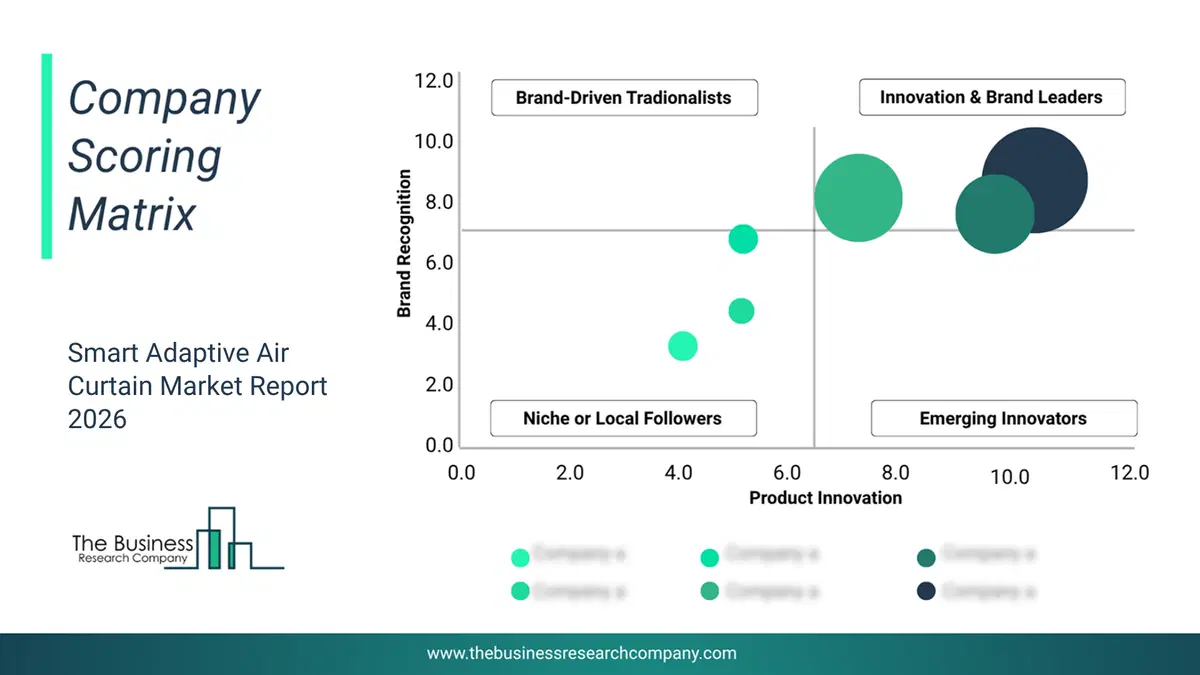
This chart maps companies by product innovation and brand strength, with bubble size indicating relative revenue, helping identify market leaders, challengers, and niche players. This is an illustrative chart; the full report provides a complete and accurate competitive analysis.
Global Smart Adaptive Air Curtain Market Trends and Insights
Major companies operating in the smart adaptive air curtain market are focusing on developing advanced products, such as industrial smart air curtains, to improve energy efficiency, indoor climate, and hygiene. Industrial smart air curtains are advanced air barriers for large facilities that control airflow to save energy and block dust, insects, and pollutants. For instance, in February 2023, Schwank GmbH, a Germany-based manufacturer of heating equipment, launched the Epic Series Air Curtain, a new industrial smart air curtain designed for flexible mounting with adjustable heights between 10 and 14 feet. The unit comes with a highly energy-efficient EC 1HP Direct Drive Motor, delivering 2–3 times the efficiency of standard motors. It offers easy maintenance access, smart configurable controls via a touchscreen, and a sleek, modern design with customizable color options. This air curtain is ideal for industrial facilities focused on energy conservation and climate separation, redefining standards in industrial air curtain technology.What Are Latest Mergers And Acquisitions In The Smart Adaptive Air Curtain Market?
In February 2023, Panasonic Corporation, a Japan-based provider of consumer electronics, acquired the air-conditioning business of Systemair AB for an undisclosed amount. With this acquisition, Panasonic aims to expand in the European HVAC market by leveraging Systemair’s chillers and heat pumps to deliver eco-friendly heating and cooling solutions and strengthen its global presence. Systemair AB is a Sweden-based air technology company specializing in ventilation solutions and smart adaptive air curtains.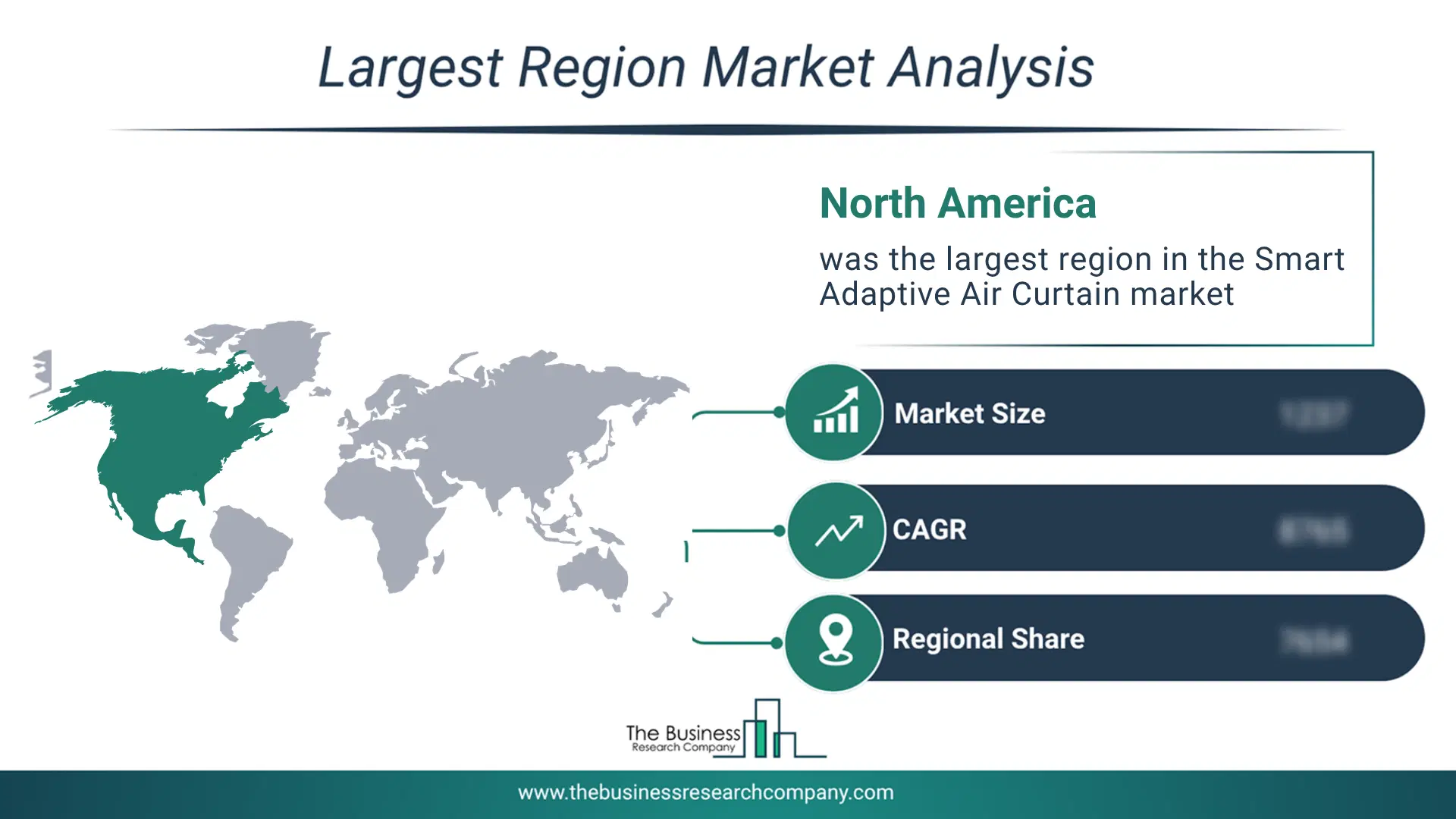
Regional Outlook
North America was the largest region in the smart adaptive air curtain market in 2025. Asia-Pacific is expected to be the fastest-growing region in the forecast period. The regions covered in this market report are Asia-Pacific, South East Asia, Western Europe, Eastern Europe, North America, South America, Middle East, Africa The countries covered in this market report are Australia, Brazil, China, France, Germany, India, Indonesia, Japan, Taiwan, Russia, South Korea, UK, USA, Canada, Italy, Spain.What Defines the Smart Adaptive Air Curtain Market?
The smart adaptive air curtain market consists of revenues earned by entities by providing services such as installation, maintenance, repair, retrofitting, system integration, and consulting for energy-efficient airflow management solutions. The market value includes the value of related goods sold by the service provider or included within the service offering. The smart adaptive air curtain market also includes sales of energy-efficient air curtains, ultraviolet-C sterilizing air curtains, high-velocity air curtains, compact modular air curtains, and custom-designed air curtains. Values in this market are ‘factory gate’ values, that is the value of goods sold by the manufacturers or creators of the goods, whether to other entities (including downstream manufacturers, wholesalers, distributors and retailers) or directly to end customers. The value of goods in this market includes related services sold by the creators of the goods.How is Market Value Defined and Measured?
The market value is defined as the revenues that enterprises gain from the sale of goods and/or services within the specified market and geography through sales, grants, or donations in terms of the currency (in USD unless otherwise specified). The revenues for a specified geography are consumption values that are revenues generated by organizations in the specified geography within the market, irrespective of where they are produced. It does not include revenues from resales along the supply chain, either further along the supply chain or as part of other products.
This chart presents market attractiveness based on a quantitative evaluation of growth, competition, strategic alignment, and risk, offering a clear view of opportunity areas for decision-making. This chart is for illustrative purposes; the full report contains the complete analysis.

This chart highlights the Total Addressable Market (TAM) by estimating the maximum revenue opportunity using an assumption-driven approach, supporting strategic planning and opportunity sizing across markets. The chart is illustrative; the full report provides a more comprehensive analysis.
What Key Data and Analysis Are Included in the Smart Adaptive Air Curtain Market Report 2026?
The smart adaptive air curtain market research report is one of a series of new reports from The Business Research Company that provides market statistics, including industry global market size, regional shares, competitors with the market share, detailed market segments, market trends and opportunities, and any further data you may need to thrive in the smart adaptive air curtain industry. The market research report delivers a complete perspective of everything you need, with an in-depth analysis of the current and future state of the industry.Smart Adaptive Air Curtain Market Report Forecast Analysis
| Report Attribute | Details |
|---|---|
| Market Size Value In 2026 | $1.83 billion |
| Revenue Forecast In 2030 | $2.61 billion |
| Growth Rate | CAGR of 9.3% from 2026 to 2030 |
| Base Year For Estimation | 2025 |
| Actual Estimates/Historical Data | 2020-2025 |
| Forecast Period | 2026 - 2030 |
| Market Representation | Revenue in USD Billion and CAGR from 2026 to 2030 |
| Segments Covered | Product Type, Mounting Type, Technology, Distribution Channel, Application |
| Regional Scope | Asia-Pacific, Western Europe, Eastern Europe, North America, South America, Middle East, Africa |
| Key Companies Profiled | Panasonic Corporation, Mitsubishi Electric India Pvt. Ltd., Daikin Industries Ltd., Toshiba Corporation, FläktGroup Holding GmbH, VTS Group Sp. z o.o., Rosenberg Ventilatoren GmbH, Schwank Group, Frico AB, Berner International LLC, Mark Climate Technology B.V., Thermoscreens Ltd., Soler & Palau Ventilation Group, Mars Air Systems LLC, 2VV s.r.o., Cronax Industries, Powered Aire Inc., Envirotec Limited, Airtecnics, Stavoklima s.r.o. |
| Customization Scope | Request for Customization |
| Pricing And Purchase Options | Explore Purchase Options |