
Smart Adaptive Elevator Algorithm Market Report 2026
Global Outlook – By Component (Software, Hardware, Services), By Deployment Mode (On-Premises, Cloud-Based), By Application (Commercial Buildings, Residential Buildings, Industrial Facilities, Hospitals, Airports, Others Applications), By End-User (Real Estate Developers, Facility Management Companies, Transportation Hubs, Other End-Users) – Market Size, Trends, Strategies, and Forecast to 2030
Smart Adaptive Elevator Algorithm Market Overview
• Smart Adaptive Elevator Algorithm market size has reached to $3.3 billion in 2025 • Expected to grow to $6.99 billion in 2030 at a compound annual growth rate (CAGR) of 16.2% • Growth Driver: The Increasing Demand For Smart Building Solutions Driving The Growth Of The Market due To Enhanced Energy Efficiency And Optimized Building Operations • Market Trend: AI-Driven Smart Adaptive Elevators Enhancing Efficiency Safety And Sustainability • Asia-Pacific was the largest region and fastest growing region.What Is Covered Under Smart Adaptive Elevator Algorithm Market?
A smart adaptive elevator algorithm is an intelligent system that optimizes elevator operations in real time by analyzing passenger traffic patterns and predicting demand, thereby reducing waiting times, improving energy efficiency, and enhancing the overall ride experience. The main components of a smart adaptive elevator algorithm are software, hardware, and services. Software refers to an intelligent control system that dynamically optimizes elevator operations by analyzing real-time traffic patterns and predicting passenger demand to reduce waiting times, improve energy efficiency, and enhance overall ride experience. It can be deployed either on-premises or cloud-based. These systems are applied across a variety of settings, including commercial buildings, residential buildings, industrial facilities, hospitals, airports, and others. Serving diverse end users such as real estate developers, facility management companies, transportation hubs, and others.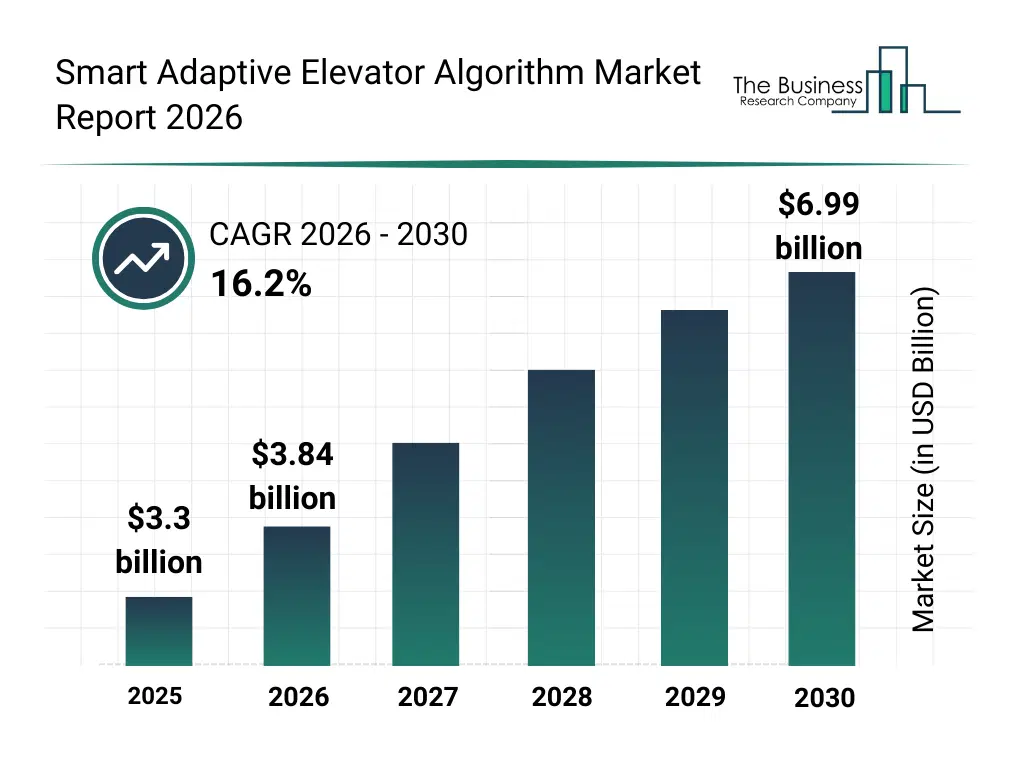
What Is The Smart Adaptive Elevator Algorithm Market Size and Share 2026?
The smart adaptive elevator algorithm market size has grown rapidly in recent years. It will grow from $3.3 billion in 2025 to $3.84 billion in 2026 at a compound annual growth rate (CAGR) of 16.4%. The growth in the historic period can be attributed to rising adoption of adaptive elevator algorithms, increased use of predictive analytics in elevator operations, growing integration of touchless control panels, expansion of destination dispatch solutions, rising demand for connected monitoring platforms.What Is The Smart Adaptive Elevator Algorithm Market Growth Forecast?
The smart adaptive elevator algorithm market size is expected to see rapid growth in the next few years. It will grow to $6.99 billion in 2030 at a compound annual growth rate (CAGR) of 16.2%. The growth in the forecast period can be attributed to increasing deployment of AI-driven elevator control systems, growing adoption of cloud-based elevator management, expansion of real-time traffic optimization, development of intelligent monitoring and reporting tools, rising integration with smart building systems. Major trends in the forecast period include integration of AI-based elevator traffic management systems, deployment of predictive analytics for elevator optimization, adoption of smart destination dispatch panels, expansion of touchless elevator control solutions, development of connected elevator monitoring platforms.
Global Smart Adaptive Elevator Algorithm Market Segmentation
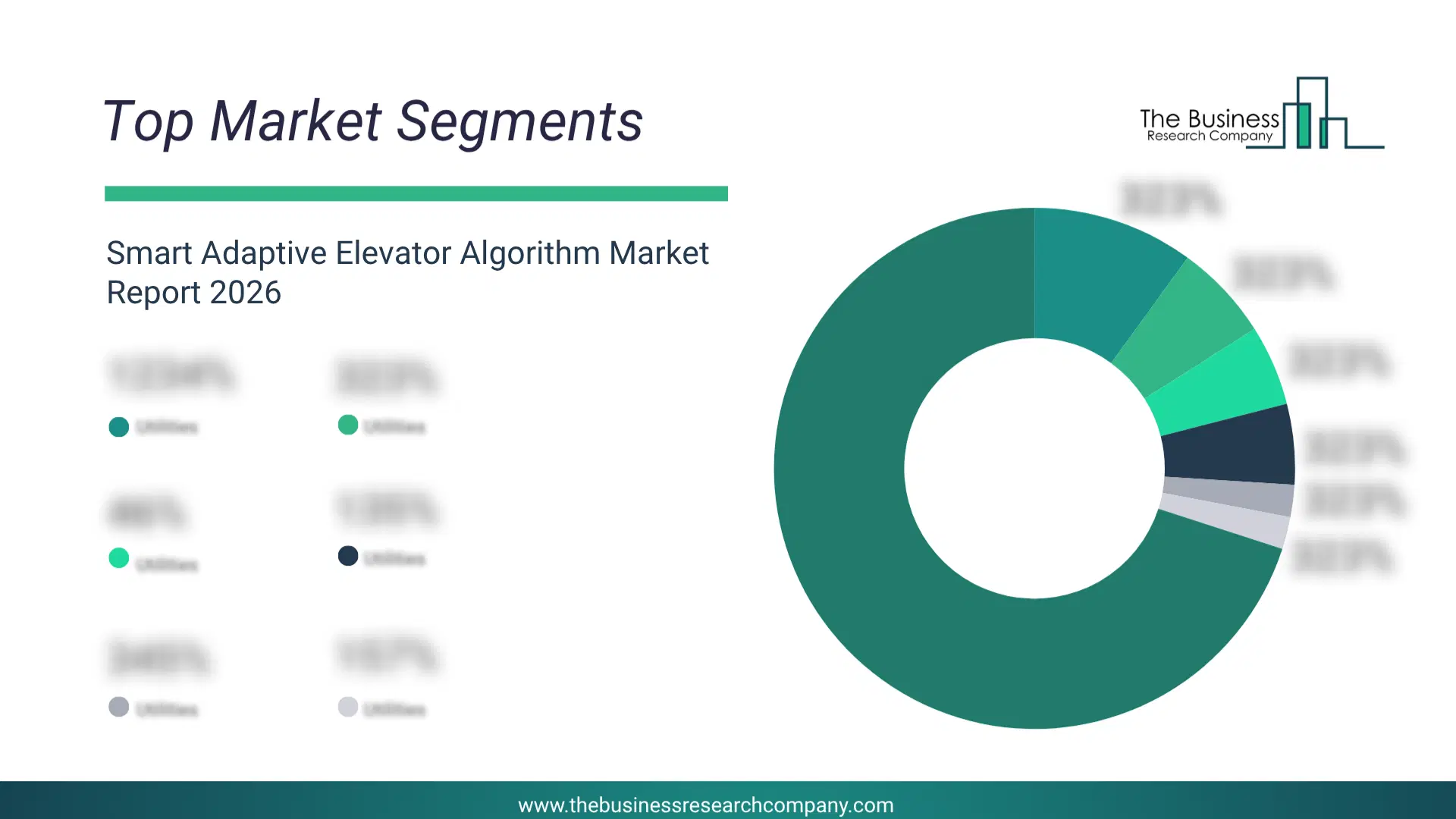
1) By Component: Software, Hardware, Services 2) By Deployment Mode: On-Premises, Cloud-Based 3) By Application: Commercial Buildings, Residential Buildings, Industrial Facilities, Hospitals, Airports, Others Applications 4) By End-User: Real Estate Developers, Facility Management Companies, Transportation Hubs, Other End-Users Subsegments: 1) By Software: Control System Software, Predictive Analytics Software, Traffic Management Software, Monitoring And Reporting Software 2) By Hardware: Elevator Controllers, Sensors And Detectors, Display Panels, Communication Modules 3) By Services: Installation And Integration, Maintenance And Support, Consulting And Optimization, Training And EducationWhat Is The Driver Of The Smart Adaptive Elevator Algorithm Market?
The increasing demand for smart building solutions is expected to propel the growth of the smart adaptive elevator algorithm market going forward. Smart building solutions refer to integrated technologies and systems in buildings that optimize energy efficiency, enhance occupant comfort, improve safety, and enable automated management through the Internet of Things, sensors, and data-driven analytics. The increasing demand for smart building solutions is primarily due to the growing need for energy efficiency, as these solutions optimize resource use, reduce operational costs, and support sustainable building management. Smart adaptive elevator algorithms enhance smart building solutions by optimizing elevator operations, reducing energy consumption, minimizing wait times, and improving overall building efficiency and occupant experience. For instance, in October 2024, according to the Central Statistics Office, an Ireland-based government agency, 30% of internet users adopted smart home security solutions such as internet-connected alarm systems, smoke detectors, security cameras, and smart doorbells, up from 17% in 2022. Therefore, the increasing demand for smart building solutions is driving the growth of the smart adaptive elevator algorithm industry.What Is The Driver Of The Smart Adaptive Elevator Algorithm Market?
The increasing residential construction activities are expected to propel the growth of the smart adaptive elevator algorithm market going forward. Residential construction activities refer to the processes and tasks involved in designing, building, and finishing structures intended for people to live in, such as houses, apartments, and condominiums. The increasing residential construction activities are due to urbanization and population growth, as more people are moving to cities and a rising population creates a higher demand for housing and residential infrastructure. The smart adaptive elevator algorithm enhances residential construction activities by optimizing vertical transportation efficiency, improving building safety, and supporting the integration of smart building technologies for modern living. For instance, in June 2024, according to the United States Census Bureau, a US-based government administration, in May 2024, the seasonally adjusted annual rate of privately owned housing completions rose to 1,514,000, marking a 1.0% increase from 1,499,000 in May 2023. Therefore, the increasing residential construction activities are driving the growth of the smart adaptive elevator algorithm industry.Key Players In The Global Smart Adaptive Elevator Algorithm Market
Major companies operating in the smart adaptive elevator algorithm market are Hitachi Limited, Thyssenkrupp AG, Mitsubishi Electric Corporation, Toshiba Corporation, Otis Worldwide Corporation, Schindler Group AG, KONE Corporation, Hyundai Elevator Co. Ltd., Fujitec Co. Ltd., Wittur Holding GmbH, Orona S. Coop, TK Elevator, Johnson Lifts Pvt. Ltd., Sigma Elevator Company Co. Ltd., Shanghai Mitsubishi Elevator Co. Ltd., Hitachi Building Systems Co. Ltd., Toshiba Elevator and Building Systems Corporation, Fujitec Singapore Corporation Ltd., KONE Elevators India Pvt. Ltd., Schindler India Pvt. Ltd.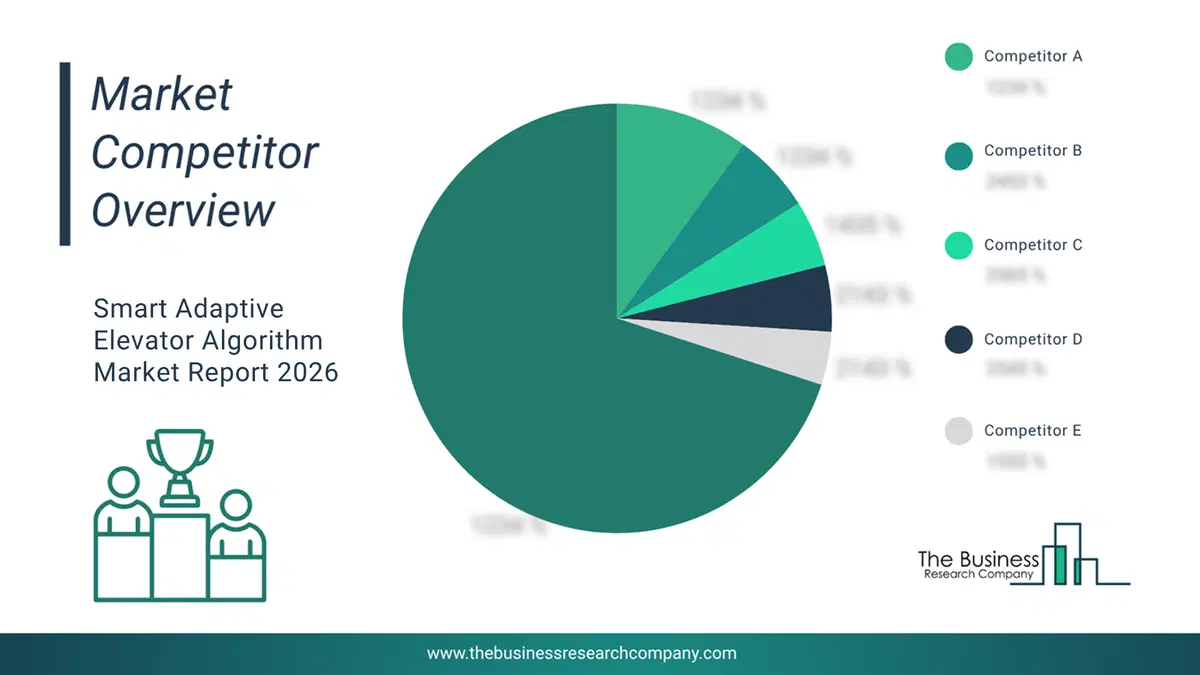
This chart is for illustrative purposes; the full report includes a detailed competitor analysis and comprehensive overview of the top 10 companies in the market.
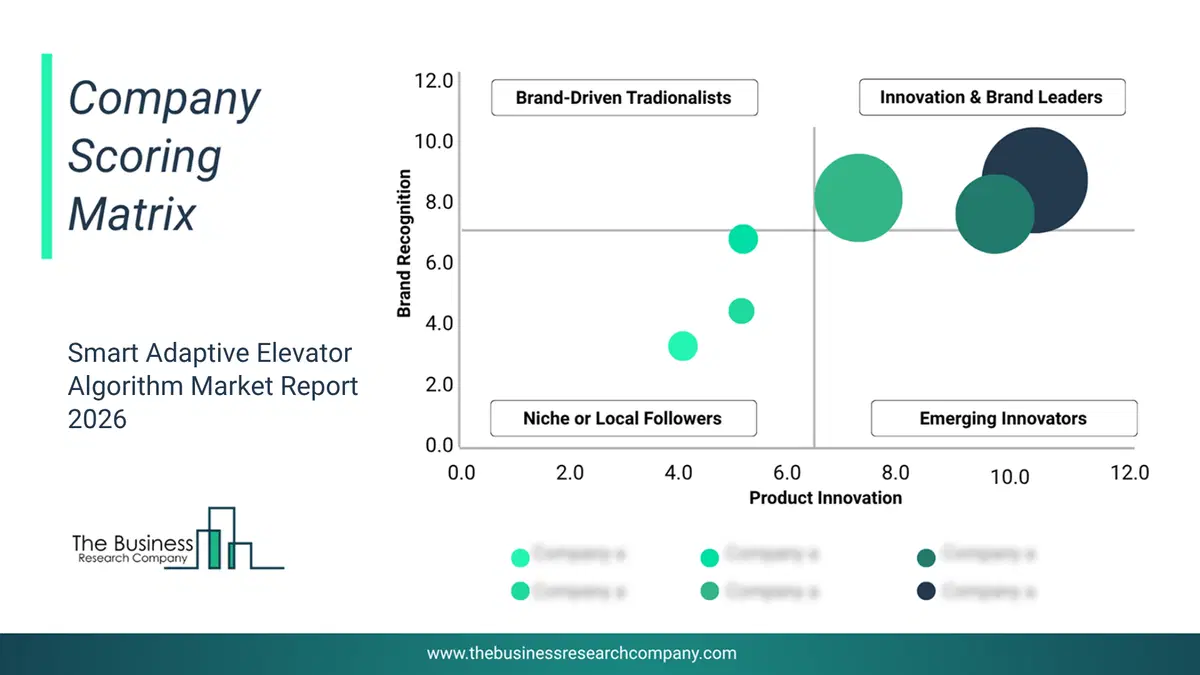
This chart maps companies by product innovation and brand strength, with bubble size indicating relative revenue, helping identify market leaders, challengers, and niche players. This is an illustrative chart; the full report provides a complete and accurate competitive analysis.
Global Smart Adaptive Elevator Algorithm Market Trends and Insights
Major companies operating in the smart adaptive elevator algorithm market are focusing on introducing technologically advanced solutions, such as AI-driven intelligent elevator systems, to enhance operational efficiency, reduce waiting times, and optimize energy consumption in buildings. AI-driven intelligent elevator systems refer to elevators that use artificial intelligence to optimize operations, reduce waiting times, and improve energy efficiency by analyzing passenger demand and building traffic patterns in real time. For instance, in December 2024, KONE Elevator India Private Limited, an India-based elevator engineering company, launched its Smart Elevator Series, which includes the KONE I MonoSpace SMART, KONE I MiniSpace SMART, and KONE A MonoSpace SMART models, all designed with advanced Smart Adaptive Elevator Algorithms. These elevators comply fully with the new IS 17900 safety standards and feature PESSRAL fail-safe redundancy, tamper-proof door systems, and light curtains to maximize safety. They also incorporate AI-powered 24/7 predictive maintenance monitoring, along with digital connectivity for integration with smart building systems such as HVAC, security, and contactless calling, supported by secure data protection protocols. Sustainability is prioritized through regenerative drive technology that recycles up to 30% of energy, LED lighting, and standby modes that reduce energy use by up to 90%, contributing to green building certifications.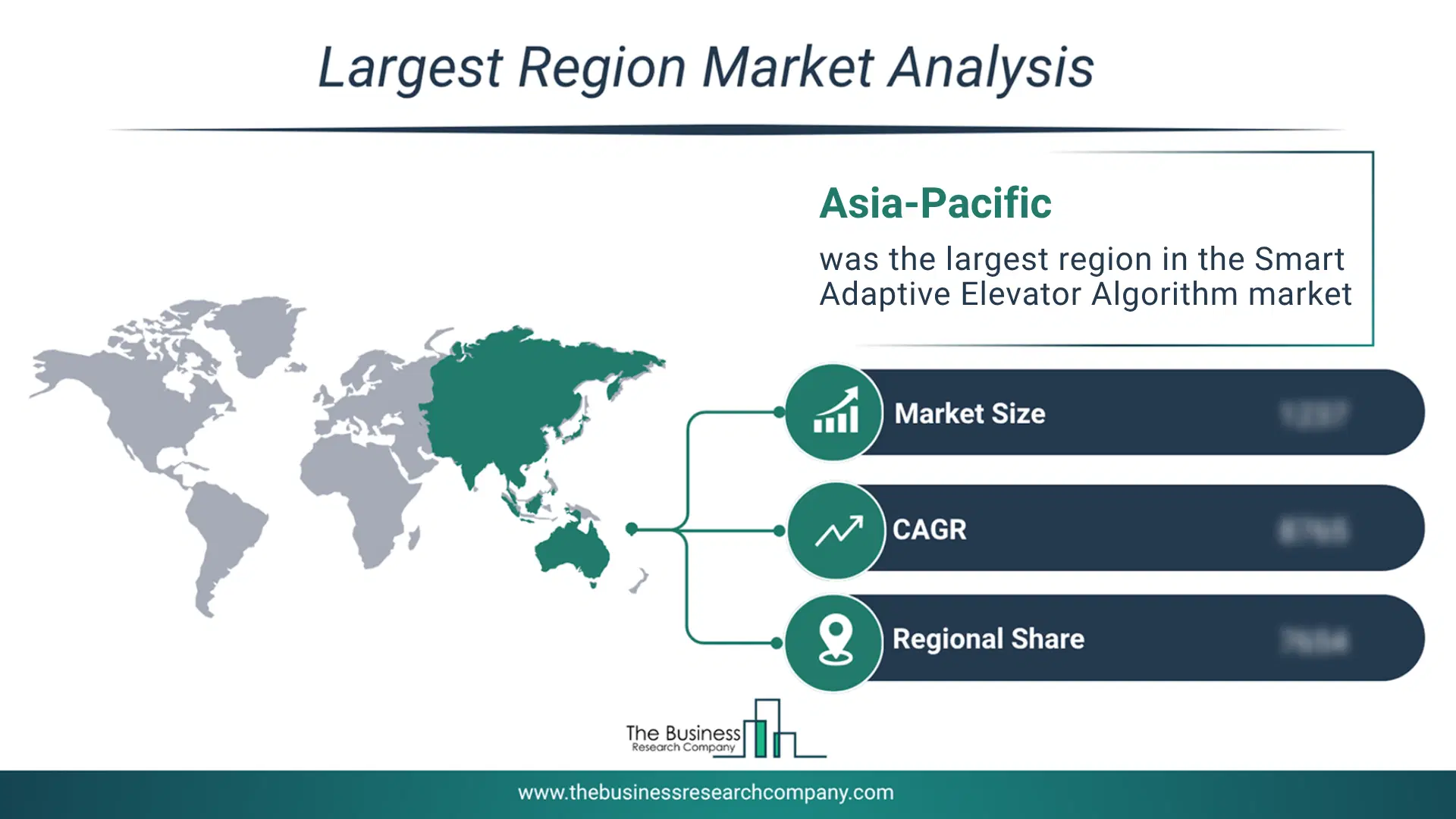
Regional Insights
Asia-Pacific was the largest region in the smart adaptive elevator algorithm market in 2025. The regions covered in this market report are Asia-Pacific, South East Asia, Western Europe, Eastern Europe, North America, South America, Middle East, Africa. The countries covered in this market report are Australia, Brazil, China, France, Germany, India, Indonesia, Japan, Taiwan, Russia, South Korea, UK, USA, Canada, Italy, Spain.What Defines the Smart Adaptive Elevator Algorithm Market?
The smart adaptive elevator algorithm market consists of revenues earned by entities by providing services such as installation and integration services, maintenance and support services, consulting and optimization services, software licensing and upgrades, and training and education services. The market value includes the value of related goods sold by the service provider or included within the service offering. The smart adaptive elevator algorithm market also includes sales of intelligent elevator control systems, destination dispatch panels, sensors and detectors, elevator monitoring and reporting software, and touchless operation panels. Values in this market are ‘factory gate’ values; that is, the value of goods sold by the manufacturers or creators of the goods, whether to other entities (including downstream manufacturers, wholesalers, distributors, and retailers) or directly to end customers. The value of goods in this market includes related services sold by the creators of the goods.How is Market Value Defined and Measured?
The market value is defined as the revenues that enterprises gain from the sale of goods and/or services within the specified market and geography through sales, grants, or donations in terms of the currency (in USD unless otherwise specified). The revenues for a specified geography are consumption values that are revenues generated by organizations in the specified geography within the market, irrespective of where they are produced. It does not include revenues from resales along the supply chain, either further along the supply chain or as part of other products.
This chart presents market attractiveness based on a quantitative evaluation of growth, competition, strategic alignment, and risk, offering a clear view of opportunity areas for decision-making. This chart is for illustrative purposes; the full report contains the complete analysis.

This chart highlights the Total Addressable Market (TAM) by estimating the maximum revenue opportunity using an assumption-driven approach, supporting strategic planning and opportunity sizing across markets. The chart is illustrative; the full report provides a more comprehensive analysis.
What Key Data and Analysis Are Included in theSmart Adaptive Elevator Algorithm Market Report 2026?
The smart adaptive elevator algorithm market research report is one of a series of new reports from The Business Research Company that provides market statistics, including industry global market size, regional shares, competitors with the market share, detailed market segments, market trends and opportunities, and any further data you may need to thrive in the smart adaptive elevator algorithm industry. The market research report delivers a complete perspective of everything you need, with an in-depth analysis of the current and future state of the industry.Smart Adaptive Elevator Algorithm Market Report Forecast Analysis
| Report Attribute | Details |
|---|---|
| Market Size Value In 2026 | $3.84 billion |
| Revenue Forecast In 2030 | $6.99 billion |
| Growth Rate | CAGR of 16.4% from 2026 to 2030 |
| Base Year For Estimation | 2025 |
| Actual Estimates/Historical Data | 2020-2025 |
| Forecast Period | 2026 - 2030 |
| Market Representation | Revenue in USD Billion and CAGR from 2026 to 2030 |
| Segments Covered | Component, Deployment Mode, Application, End-User |
| Regional Scope | Asia-Pacific, Western Europe, Eastern Europe, North America, South America, Middle East, Africa |
| Country Scope | The countries covered in this market report are Australia, Brazil, China, France, Germany, India, Indonesia, Japan, Taiwan, Russia, South Korea, UK, USA, Canada, Italy, Spain |
| Key Companies Profiled | Hitachi Limited, Thyssenkrupp AG, Mitsubishi Electric Corporation, Toshiba Corporation, Otis Worldwide Corporation, Schindler Group AG, KONE Corporation, Hyundai Elevator Co. Ltd., Fujitec Co. Ltd., Wittur Holding GmbH, Orona S. Coop, TK Elevator, Johnson Lifts Pvt. Ltd., Sigma Elevator Company Co. Ltd., Shanghai Mitsubishi Elevator Co. Ltd., Hitachi Building Systems Co. Ltd., Toshiba Elevator and Building Systems Corporation, Fujitec Singapore Corporation Ltd., KONE Elevators India Pvt. Ltd., Schindler India Pvt. Ltd. |
| Customization Scope | Request for Customization |
| Pricing And Purchase Options | Explore Purchase Options |