
Smart Agriculture Global Market Opportunities And Strategies To 2035
By Offering (Hardware, Software, Services), By Farm Size (Small Farms, Medium Farms, Large Farms), By Application (Precision Farming, Livestock Monitoring, Precision Aquaculture, Precision Forestry, Smart Greenhouse, Other Applications), And By Region, Opportunities And Strategies – Global Forecast To 2035
Smart Agriculture Market Definition
Smart agriculture refers to the use of advanced technologies such as Internet of Things (IoT), artificial intelligence (AI), sensors, drones and data analytics to enhance farming practices. These technologies enable real-time monitoring of crops, soil conditions, weather patterns and livestock, allowing farmers to make precise and data-driven decisions. The primary purpose of smart agriculture is to increase crop yield, optimize resource usage and ensure sustainable farming. It helps farmers minimize water, fertilizer and pesticide use, reduce operational costs and adapt to changing environmental conditions. The smart agriculture market consists of revenues generated by entities (organizations, sole traders and partnerships) by providing smart farming technologies and related services that enable precision farming, automated monitoring and data-driven agricultural practices. The market includes integrated solutions combining hardware, software and services designed to improve crop yield, optimize resource utilization and enhance farm management efficiency.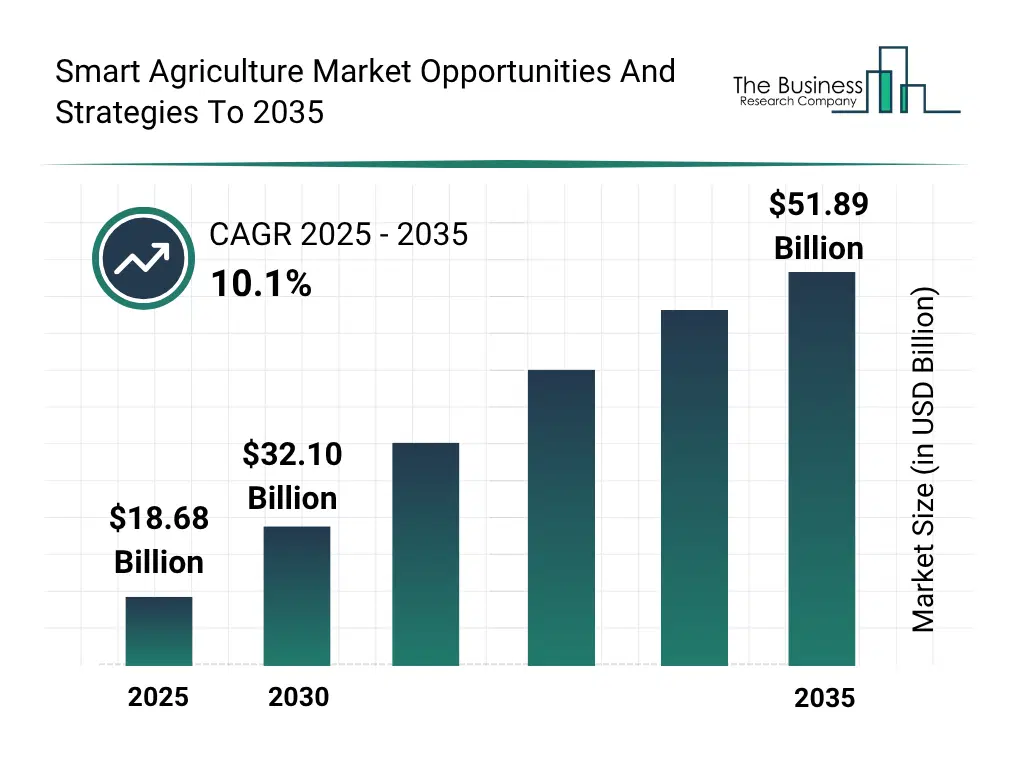
Smart Agriculture Market Size
The global smart agriculture market reached a value of nearly $18,681.5 million in 2025, having grown at a compound annual growth rate (CAGR) of 11.1% since 2020. The market is expected to grow from $18,681.5 million in 2025 to $32,097.1 million in 2030 at a rate of 11.4%. The market is then expected to grow at a CAGR of 10.1% from 2030 and reach $51,891.1 million in 2035. Growth in the historic period resulted from rising global food demand, declining availability of arable land, rising agriculture labor cost and escalating water scarcity. Factors that negatively affected growth in the historic period were poor rural internet connectivity and digital divide and data privacy and ownership concerns. Going forward, rising frequency of droughts and extreme weather, rising cost of farming inputs, government subsidies and incentives and growing demand for precision agriculture will drive the growth. Factors that could hinder the growth of the smart agriculture market in the future include high capital investment, limited access to credit for small farmers and impact of trade wars and tariffs.
Smart Agriculture Market Segmentation
The smart agriculture market is segmented by offering, by farm size and by application industry.By Offering –
The smart agriculture market is segmented by offering into:
- a) Hardware
- b) Software
- c) Services
By Farm Size –
The Smart Agriculture market is segmented by Farm Size into:
- a) Small Farms
- b) Medium Farms
- c) Large Farms
By Application –
The Smart Agriculture market is segmented by Application into:
- a) Precision Farming
- b) Livestock Monitoring
- c) Precision Aquaculture
- d) Precision Forestry
- e) Smart Greenhouse
- f) Other Applications
By Geography - The smart agriculture market is segmented by geography into:
- China
- India
- Japan
- Australia
- Indonesia
- South Korea
- USA
- Canada
- Brazil
- France
- Germany
- UK
- Italy
- Spain
- Russia
-
o Asia Pacific
o Africa