
Smart Air Quality Wearable Market Report 2026
Global Outlook – By Product Type (Wristbands, Clip-On Devices, Smart Masks, Portable Air Quality Sensors, Connected Environmental Monitoring Wristbands, Wearable Gas Detection Devices, Other Product Types), By Sensor Type (Gas Sensors, Particulate Matter Sensors, Combined Sensors, Volatile Compound Sensors, Environmental Condition Sensors, Other Sensor Types), By Distribution Channel (Online, Offline), By Connectivity (Bluetooth, Wi-Fi, Cellular, Low Power Wide Area Network, Volatile Compound Sensors, Other Connectivity), By Application (Personal Use, Healthcare, Industrial, Environmental Monitoring, Outdoor Activities, Other Applications) – Market Size, Trends, Strategies, and Forecast to 2030
Smart Air Quality Wearable Market Overview
• Smart Air Quality Wearable market size has reached to $0.96 billion in 2025 • Expected to grow to $2.41 billion in 2030 at a compound annual growth rate (CAGR) of 20.2% • Growth Driver: Increasing Awareness Of Air Pollution Driving Growth Of The Market Due To Real-Time Monitoring And Preventive Insights • Market Trend: Personalized Portable Air Purification System Enhances Respiratory Health • North America was the largest region in 2025 and Asia-Pacific is the fastest growing region.What Is Covered Under Smart Air Quality Wearable Market?
Smart air quality wearable is a compact, technology-enabled device designed to continuously monitor the surrounding air for pollutants and environmental conditions. It uses integrated sensors and connectivity features to provide real-time data on factors such as particulate matter, volatile compounds, and overall air quality levels. It helps individuals make informed decisions by offering instant alerts and insights about the air they breathe. The main product types of smart air quality wearable include wristbands, clip-on devices, smart masks, portable air quality sensors, connected environmental monitoring wristbands, wearable gas detection devices, and others. Wristbands and clip-on devices are designed to continuously monitor air quality in real time, providing users with actionable insights on pollutants, gas exposure, and environmental conditions. Different sensor types such as gas sensors, particulate matter sensors, combined sensors, volatile compound sensors, and environmental condition sensors. Multiple distribution channels are online and offline. Various connectivity options are Bluetooth, Wi-Fi, cellular, and low power wide area network, and they are used by several applications for personal use, healthcare, industrial monitoring, environmental monitoring, outdoor activities, and others.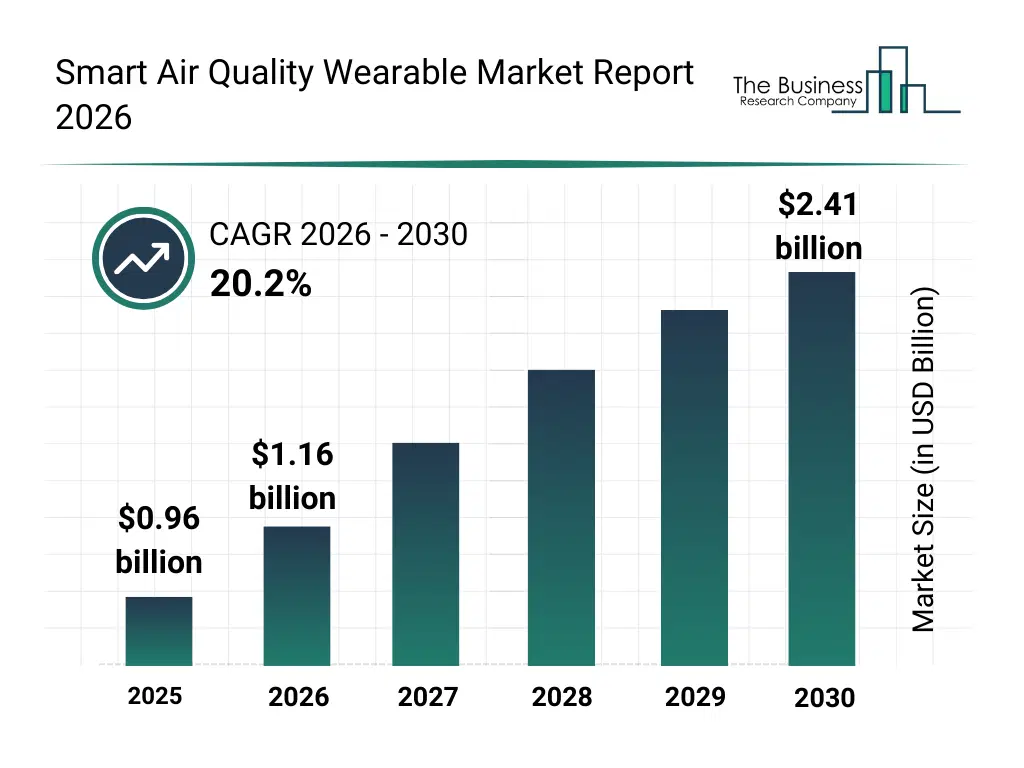
What Is The Smart Air Quality Wearable Market Size and Share 2026?
The smart air quality wearable market size has grown exponentially in recent years. It will grow from $0.96 billion in 2025 to $1.16 billion in 2026 at a compound annual growth rate (CAGR) of 20.4%. the growth in the historic period can be attributed to increasing urban pollution levels, growing consumer awareness of air quality issues, rising adoption of wearable health devices, expanding availability of low-cost sensors, and increasing government focus on air quality monitoring.What Is The Smart Air Quality Wearable Market Growth Forecast?
The smart air quality wearable market size is expected to see exponential growth in the next few years. It will grow to $2.41 billion in 2030 at a compound annual growth rate (CAGR) of 20.2%. the growth in the forecast period can be attributed to growing demand for personalized health insights, rising adoption of iot-enabled wearables, expanding industrial safety monitoring requirements, increasing preference for portable air monitoring devices, and growing use of smart masks with embedded sensors. Major trends in the forecast period include technology advancements in miniaturized sensors, innovations in ai-based air quality analytics, developments in smart mask integration, research and developments in low-power connectivity, and advancements in multi-sensor wearable platforms.
Global Smart Air Quality Wearable Market Segmentation
1) By Product Type: Wristbands, Clip-On Devices, Smart Masks, Portable Air Quality Sensors, Connected Environmental Monitoring Wristbands, Wearable Gas Detection Devices, Other Product Types 2) By Sensor Type: Gas Sensors, Particulate Matter Sensors, Combined Sensors, Volatile Compound Sensors, Environmental Condition Sensors, Other Sensor Types 3) By Distribution Channel: Online, Offline 4) By Connectivity: Bluetooth, Wi-Fi, Cellular, Low Power Wide Area Network, Volatile Compound Sensors, Other Connectivity 5) By Application: Personal Use, Healthcare, Industrial, Environmental Monitoring, Outdoor Activities, Other Applications Subsegments: 1) By Wristbands: Fitness Tracking Wristbands, Environmental Monitoring Wristbands, Health Monitoring Wristbands, Pollution Alert Wristbands, Multifunctional Smart Wristbands 2) By Clip-On Devices: Clothing Clip-On Monitors, Bag Clip-On Monitors, Belt Clip-On Monitors, Portable Clip-On Indicators, Personal Wearable Clip-On Detectors 3) By Smart Masks: Filter Integrated Smart Masks, Sensor Enabled Smart Masks, Connected Respiratory Masks, Pollution Protective Smart Masks, Intelligent Breathing Assistance Masks 4) By Portable Air Quality Sensors: Handheld Monitoring Sensors, Pocket Sized Air Quality Sensors, Personal Portable Detectors, Compact Environmental Sensors, Real-Time Portable Sensors 5) By Connected Environmental Monitoring Wristbands: Wireless Monitoring Wristbands, Bluetooth Enabled Wristbands, Smartphone Connected Wristbands, Continuous Tracking Wristbands, Integrated Environmental Wristbands 6) By Wearable Gas Detection Devices: Personal Gas Detection Bands, Body Worn Gas Monitors, Compact Gas Detection Wearables, Hazardous Gas Detection Devices, Real-Time Gas Alert Wearables 7) By Other Product Types: Smart Clothing Sensors, Wearable Environmental Patches, Air Quality Monitoring Badges, Smart Environmental Accessories, Alternative Wearable Monitoring DevicesWhat Are The Drivers Of The Smart Air Quality Wearable Market?
The increasing awareness of air pollution is expected to propel the growth of the smart air quality wearable market going forward. Awareness of air pollution refers to the growing understanding among individuals and communities about the harmful effects of airborne pollutants, including particulate matter, allergens, and chemical toxins, on respiratory and cardiovascular health. This awareness is rising due to increasing urbanization and industrialization, as higher pollution levels in cities are directly affecting respiratory and cardiovascular health. Smart air quality wearables support this awareness by providing real-time monitoring of air pollutants, personalized alerts, and actionable insights, enabling users to take preventive measures and reduce exposure. For instance, in May 2025, according to the United States Environmental Protection Agency, a US-based government agency, approximately 66 million tons of pollutants were released into the atmosphere in the United States in 2023. Therefore, the increasing awareness of air pollution is driving the growth of the smart air quality wearable industry. The rising adoption of smart-city initiatives is expected to fuel the growth of the smart air quality wearable market going forward. Smart-city initiatives refer to urban development strategies that utilize digital technologies and data analytics to optimize city functions and drive economic growth. Adoption of smart-city initiatives is rising as municipalities increasingly deploy intelligent transportation systems to reduce traffic congestion and improve mobility for citizens. Smart air quality wearables support smart-city initiatives by providing real-time personal pollution data, making them ideal for urban residents and commuters. They enhance public health monitoring by enabling data-driven decisions, improving overall urban environmental management. For instance, in October 2025, according to the European Commission, a Belgium-based executive branch of the European Union, 10 cities received the EU Mission Label in October 2023, which increased to 23 additional cities in March 2024, 20 more cities in October 2024, and 39 additional cities in May 2025, bringing the total number of labelled climate-neutral and smart cities to 103 out of 112 participating cities. Therefore, the rising adoption of smart city initiatives is driving the growth of the smart air quality wearable industry.Key Players In The Global Smart Air Quality Wearable Market
Major companies operating in the smart air quality wearable market are LG Electronics Inc., Dyson Ltd., American Air Filter Company Inc., Staywell Technologies Pvt. Ltd., Sensirion AG, Atlanta Healthcare, Wynd Technologies Inc., AirTamer, Oizom Instruments Pvt. Ltd., Aurassure Pvt. Ltd., HabitatMap Inc., Airveda Technologies Pvt. Ltd., Prana Air, Airdog, Atmotube, Wein Products Inc., AirPop Health Inc., Atovio Technologies, R-PUR S.A.S., Inno-Prods SAS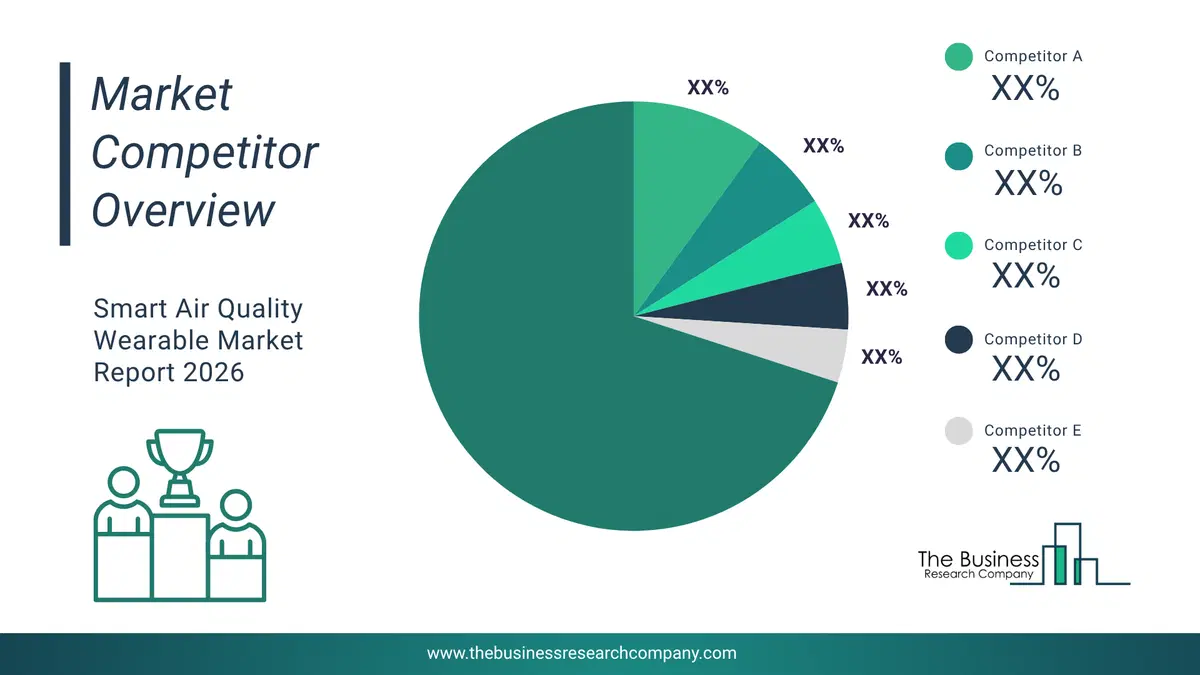
This chart is for illustrative purposes; the full report includes a detailed competitor analysis and comprehensive overview of the top 10 companies in the market.
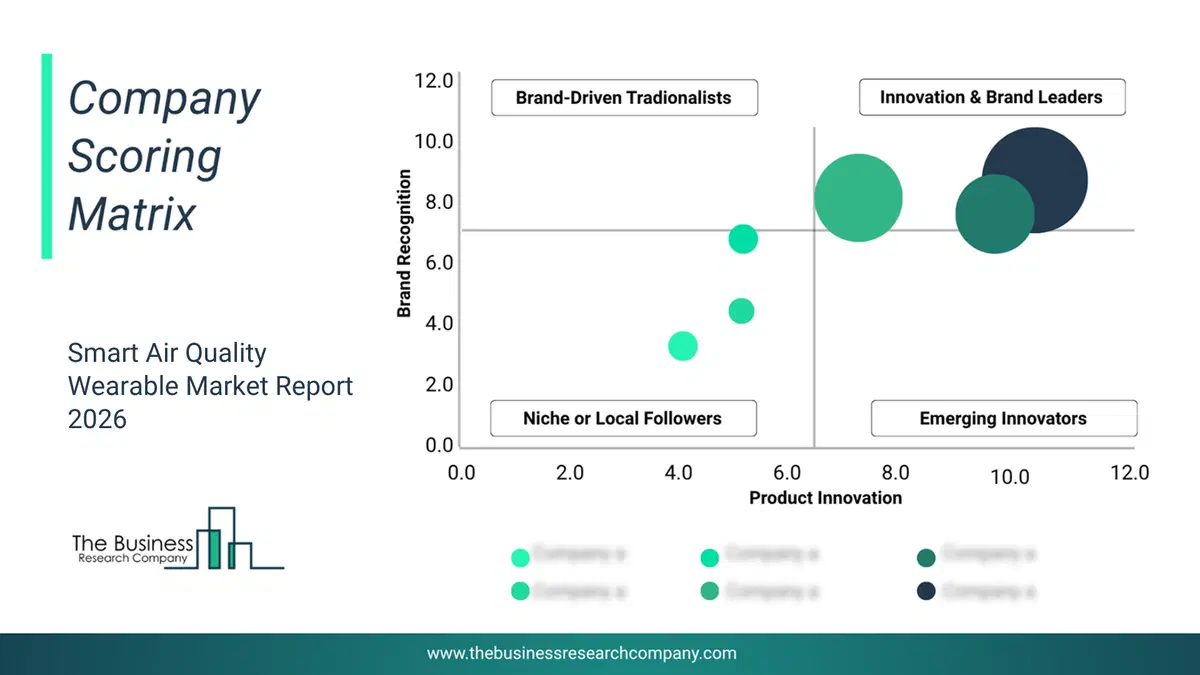
This chart maps companies by product innovation and brand strength, with bubble size indicating relative revenue, helping identify market leaders, challengers, and niche players. This is an illustrative chart; the full report provides a complete and accurate competitive analysis.
Global Smart Air Quality Wearable Market Trends and Insights
Major companies operating in the smart air quality wearable market are focusing on developing advanced products, such as personalized portable air purification systems, to improve respiratory health, reduce exposure to pollutants, and enhance user convenience. Personalized portable air purification systems refer to small, mobile devices designed to clean or filter the air immediately around an individual, providing a personal breathing zone of purified air. For instance, in October 2023, CosmoAesthetics Pty Ltd, an Australia-based medtech and consumer health company, launched AirSure, a smart wearable air purification device that filters particles as small as 2.5 micrometres, blocks pollutants and allergens, and incorporates aromatic infusion technology. The device provides continuous personal protection against airborne triggers such as dust, mold, and viruses, improving quality of life for individuals with pulmonary sensitivities and offering an enjoyable, convenient experience for indoor and outdoor activities.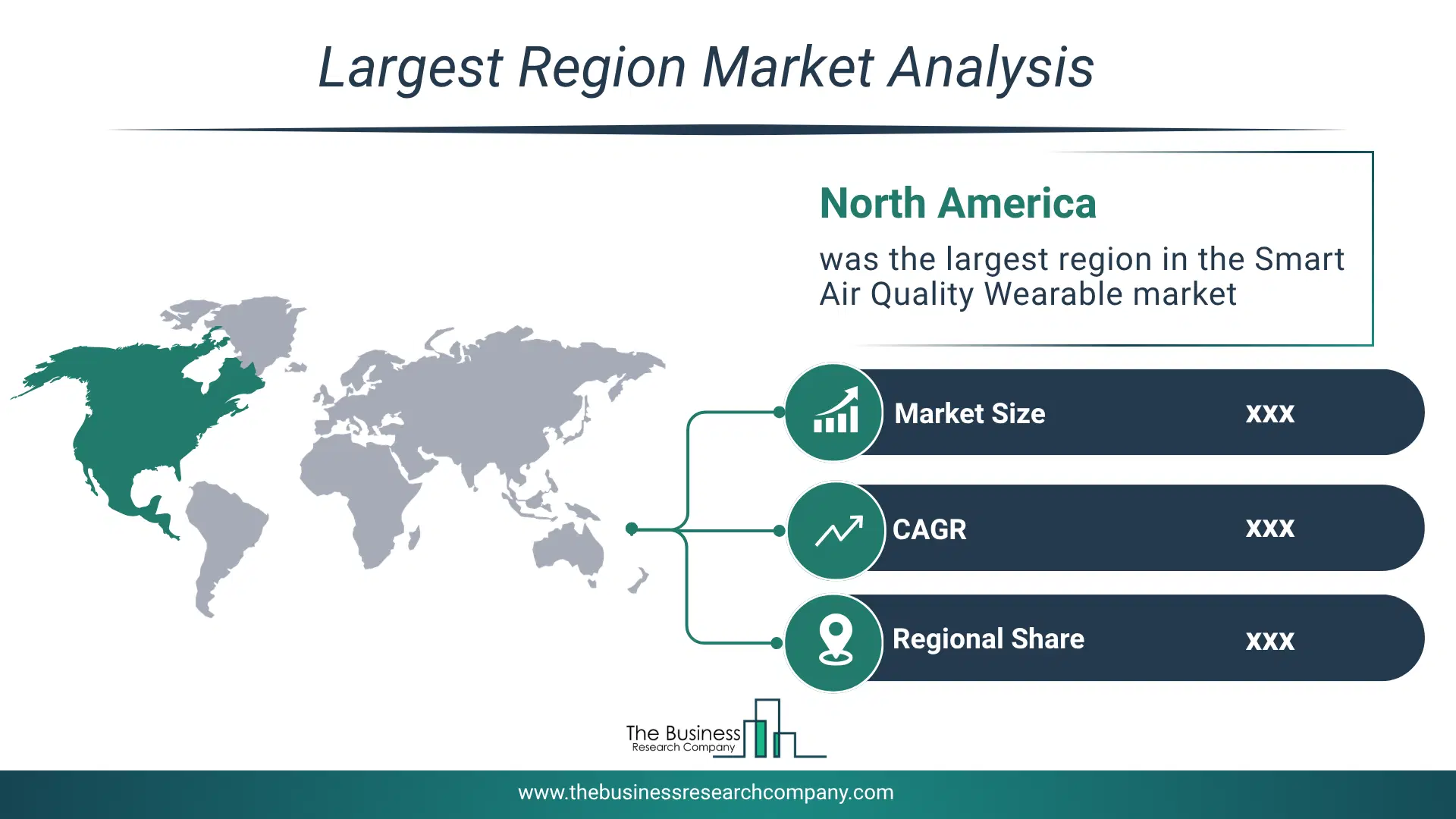
Regional Insights
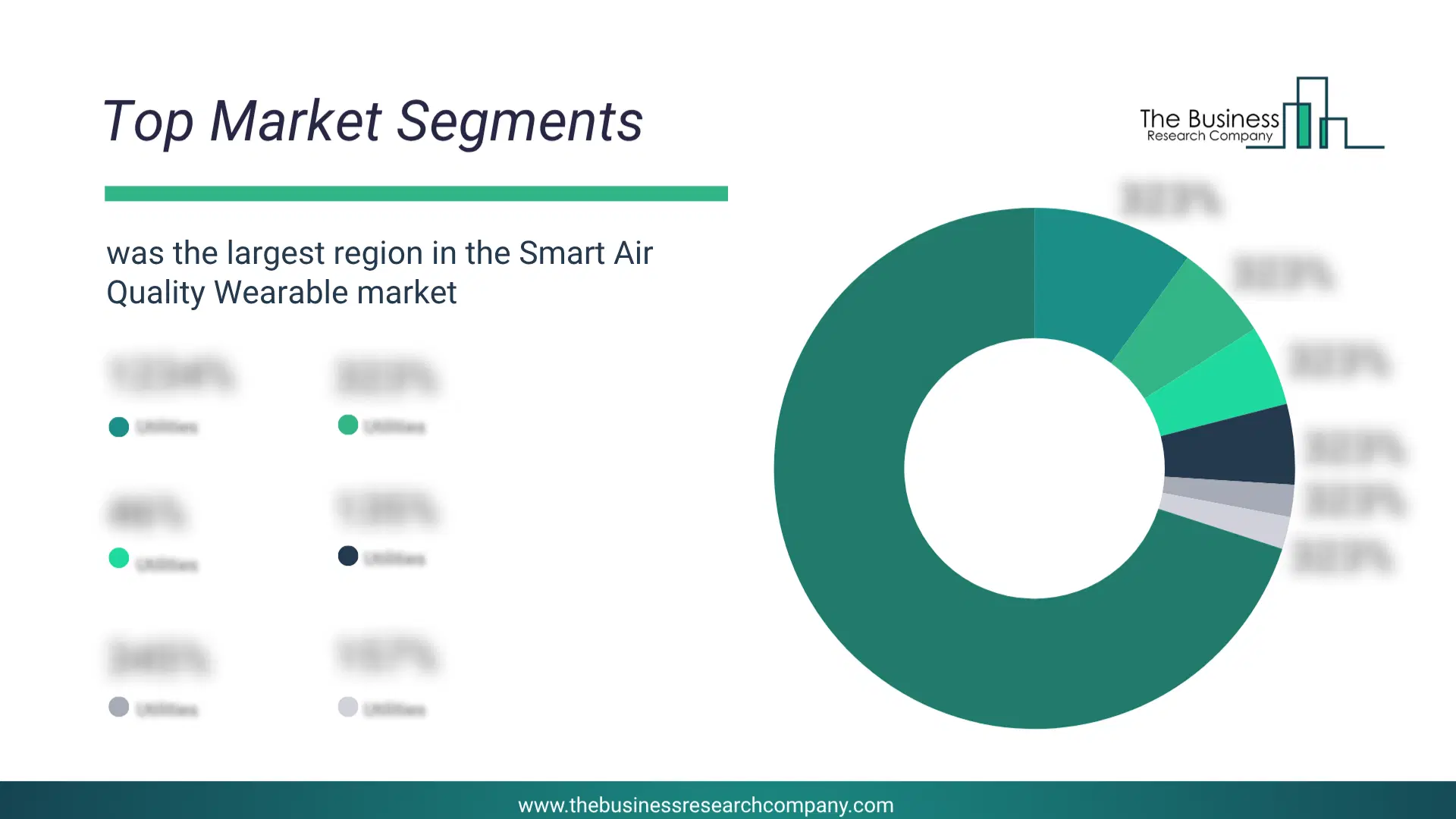
North America was the largest region in the smart air quality wearable market in 2025. Asia-Pacific is expected to be the fastest-growing region in the forecast period. The regions covered in this market report are Asia-Pacific, South East Asia, Western Europe, Eastern Europe, North America, South America, Middle East, Africa. The countries covered in this market report are Australia, Brazil, China, France, Germany, India, Indonesia, Japan, Taiwan, Russia, South Korea, UK, USA, Canada, Italy, Spain.What Defines the Smart Air Quality Wearable Market?
The smart air quality wearable market consists of revenues earned by entities by providing services such as real-time air quality monitoring services, data analytics and insights services, cloud connectivity and data storage services, device maintenance and calibration services, and mobile application integration services. The market value includes the value of related goods sold by the service provider or included within the service offering. The smart air quality wearable market also includes sales of smart air quality wearable devices, portable air quality sensors, smart pollution tracking bands, connected environmental monitoring wristbands, and wearable gas detection devices. Values in this market are ‘factory gate’ values, that is the value of goods sold by the manufacturers or creators of the goods, whether to other entities (including downstream manufacturers, wholesalers, distributors and retailers) or directly to end customers. The value of goods in this market includes related services sold by the creators of the goods.How is Market Value Defined and Measured?
The market value is defined as the revenues that enterprises gain from the sale of goods and/or services within the specified market and geography through sales, grants, or donations in terms of the currency (in USD unless otherwise specified). The revenues for a specified geography are consumption values that are revenues generated by organizations in the specified geography within the market, irrespective of where they are produced. It does not include revenues from resales along the supply chain, either further along the supply chain or as part of other products.
This chart presents market attractiveness based on a quantitative evaluation of growth, competition, strategic alignment, and risk, offering a clear view of opportunity areas for decision-making. This chart is for illustrative purposes; the full report contains the complete analysis.

This chart highlights the Total Addressable Market (TAM) by estimating the maximum revenue opportunity using an assumption-driven approach, supporting strategic planning and opportunity sizing across markets. The chart is illustrative; the full report provides a more comprehensive analysis.
What Key Data and Analysis Are Included in the Smart Air Quality Wearable Market Report 2026?
The smart air quality wearable market research report is one of a series of new reports from The Business Research Company that provides market statistics, including industry global market size, regional shares, competitors with the market share, detailed market segments, market trends and opportunities, and any further data you may need to thrive in the smart air quality wearable industry. The market research report delivers a complete perspective of everything you need, with an in-depth analysis of the current and future state of the industry.Smart Air Quality Wearable Market Report Forecast Analysis
| Report Attribute | Details |
|---|---|
| Market Size Value In 2026 | $1.16 billion |
| Revenue Forecast In 2030 | $2.41 billion |
| Growth Rate | CAGR of 20.4% from 2026 to 2030 |
| Base Year For Estimation | 2025 |
| Actual Estimates/Historical Data | 2020-2025 |
| Forecast Period | 2026 - 2030 |
| Market Representation | Revenue in USD Billion and CAGR from 2026 to 2030 |
| Segments Covered | Product Type, Sensor Type, Distribution Channel, Connectivity, Application |
| Regional Scope | Asia-Pacific, Western Europe, Eastern Europe, North America, South America, Middle East, Africa |
| Country Scope | The countries covered in the report are Australia, Brazil, China, France, Germany, India, Indonesia, Japan, Taiwan, Russia, South Korea, UK, USA, Canada, Italy, Spain. |
| Key Companies Profiled | LG Electronics Inc., Dyson Ltd., American Air Filter Company Inc., Staywell Technologies Pvt. Ltd., Sensirion AG, Atlanta Healthcare, Wynd Technologies Inc., AirTamer, Oizom Instruments Pvt. Ltd., Aurassure Pvt. Ltd., HabitatMap Inc., Airveda Technologies Pvt. Ltd., Prana Air, Airdog, Atmotube, Wein Products Inc., AirPop Health Inc., Atovio Technologies, R-PUR S.A.S., Inno-Prods SAS |
| Customization Scope | Request for Customization |
| Pricing And Purchase Options | Explore Purchase Options |