
Smart Allergy Alert Wearables Market Report 2026
Global Outlook – By Product Type (Wristband Wearables, Smart Patches, Clip On Wearables, Smart Jewelry Wearables, Smart Clothing And Textile Wearables, Other Product Types), By Connectivity Type (Bluetooth Enabled, Wireless Fidelity Enabled, Cellular Connected, Standalone Wearables), By Technology Type (Biosensor Based Wearables, Artificial Intelligence Enabled Wearables, Internet Of Things Connected Wearables, Global Positioning System And Geofencing Enabled Wearables, Cloud Integrated Wearables, Multi Sensor Wearables), By Application Type (Food Allergy, Pollen Allergy, Drug Allergy, Insect Allergy, Other Application Types), By End User Type (Children, Adults, Elderly) – Market Size, Trends, Strategies, and Forecast to 2030
Smart Allergy Alert Wearables Market Report 2026 Market Overview
• Smart Allergy Alert Wearables Market Report 2026 market size has reached to $1.73 billion in 2025 • Expected to grow to $3.37 billion in 2030 at a compound annual growth rate (CAGR) of 14.3% • Growth Driver: Rising Prevalence Of Allergies Worldwide Driving The Market Due To Changing Environmental Factors and Increased Clinical Diagnoses • Market Trend: Wearable Microneedle Technology Supports Early Allergic Reaction Detection • North America was the largest region in 2025 and Asia-Pacific is the fastest growing region.What Is Covered Under Smart Allergy Alert Wearables Market?
Smart allergy alert wearables are personal health-monitoring devices designed to support awareness and management of allergy-related conditions by continuously tracking relevant physiological or environmental indicators. These devices are developed to provide real-time insights and notifications that help individuals remain informed about potential allergy-related changes and exposures. The main product types of smart allergy alert wearables include wristband wearables, smart patches, clip on wearables, smart jewelry wearables, smart clothing and textile wearables, and other product types. Wristband wearables refer to wearable devices designed to monitor allergy-related conditions and provide alerts through wrist-based sensors and connected technologies. These products are available with connectivity types including Bluetooth enabled, wireless fidelity enabled, cellular connected, and standalone wearables and are based on technologies such as biosensor based wearables, artificial intelligence enabled wearables, internet of things connected wearables, global positioning system and geofencing enabled wearables, cloud integrated wearables, and multi sensor wearables. The various applications involved are food allergy, pollen allergy, drug allergy, insect allergy, and others, and they are used by several end user types such as children, adults, and elderly.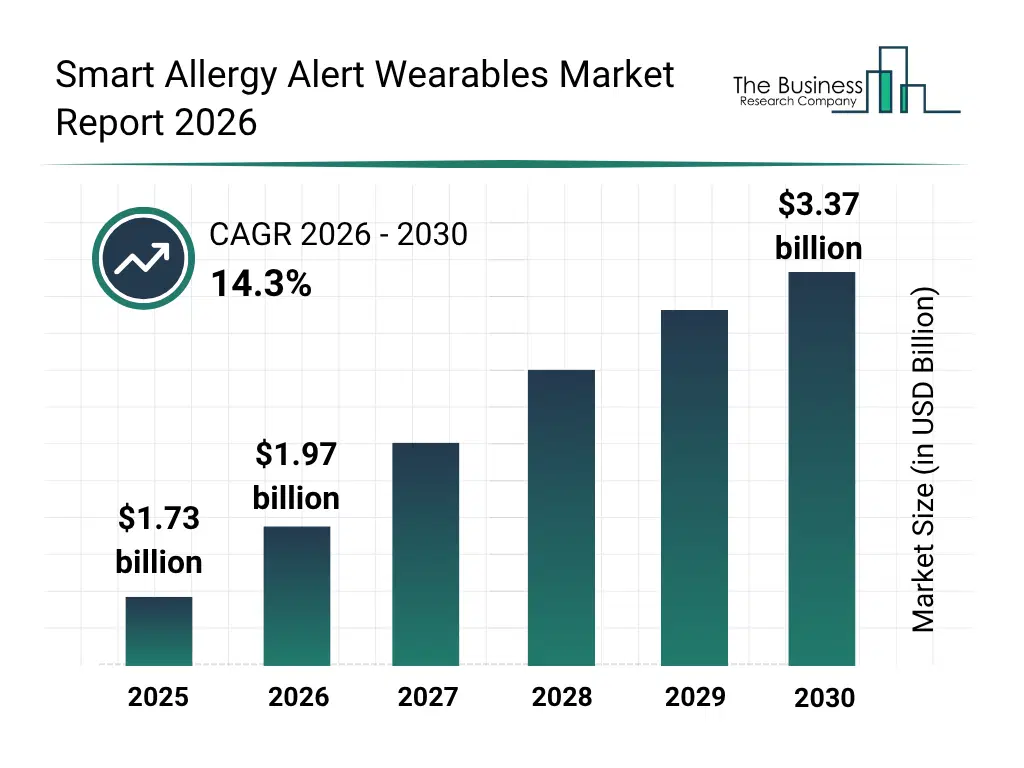
What Is The Smart Allergy Alert Wearables Market Size and Share 2026?
The smart allergy alert wearables market size has grown rapidly in recent years. It will grow from $1.73 billion in 2025 to $1.97 billion in 2026 at a compound annual growth rate (CAGR) of 14.0%. The growth in the historic period can be attributed to rising global prevalence of food and environmental allergies, increasing awareness of preventive healthcare and personal monitoring, growth in adoption of basic fitness and health wearable devices, expansion of digital health tracking applications, increasing demand for pediatric allergy management solutions.What Is The Smart Allergy Alert Wearables Market Growth Forecast?
The smart allergy alert wearables market size is expected to see rapid growth in the next few years. It will grow to $3.37 billion in 2030 at a compound annual growth rate (CAGR) of 14.3%. The growth in the forecast period can be attributed to growth in ai integrated personalized healthcare devices, increasing adoption of continuous remote patient monitoring systems, expansion of biosensor miniaturization technologies in wearables, rising demand for real time preventive health alert systems, integration of cloud based health data ecosystems for predictive allergy management. Major trends in the forecast period include ai-powered real-time allergen prediction and exposure risk analytics, cloud connected wearable allergy monitoring ecosystems for continuous tracking, multi-sensor biosensing wearables for environmental and physiological allergy detection, geofencing based allergen exposure alert systems for location sensitive warnings, adaptive personalized allergy response algorithms for individualized health insights.
Global Smart Allergy Alert Wearables Market Segmentation
1) By Product Type: Wristband Wearables, Smart Patches, Clip On Wearables, Smart Jewelry Wearables, Smart Clothing And Textile Wearables, Other Product Types 2) By Connectivity Type: Bluetooth Enabled, Wireless Fidelity Enabled, Cellular Connected, Standalone Wearables 3) By Technology Type: Biosensor Based Wearables, Artificial Intelligence Enabled Wearables, Internet Of Things Connected Wearables, Global Positioning System And Geofencing Enabled Wearables, Cloud Integrated Wearables, Multi Sensor Wearables 4) By Application Type: Food Allergy, Pollen Allergy, Drug Allergy, Insect Allergy, Other Application Types 5) By End User Type: Children, Adults, Elderly Subsegments: 1) By Wristband Wearables: Skin Temperature Monitoring Wristbands, Pollen Exposure Alert Wristbands, Air Quality Detection Wristbands, Heart Rate Monitoring Wristbands, Child Safety Allergy Alert Wristbands, Sleep And Allergy Tracking Wristbands, Medication Reminder Wristbands, Bluetooth Connected Wristbands 2) By Smart Patches: Continuous Allergen Detection Patches, Sweat Analysis Smart Patches, Skin Reaction Monitoring Patches, Drug Delivery Smart Patches, Disposable Smart Patches, Reusable Smart Patches, Wireless Connected Smart Patches, Flexible Biosensor Patches 3) By Clip On Wearables: Portable Air Quality Clip Devices, Pollen Detection Clip Devices, Ultraviolet Exposure Monitoring Clips, Breath Monitoring Clip Devices, Clothing Attachment Allergy Sensors, Child Monitoring Clip Devices, Bluetooth Enabled Clip Devices, Multi Sensor Clip Wearables 4) By Smart Jewelry Wearables: Allergy Alert Smart Necklaces, Health Monitoring Smart Rings, Pollen Detection Smart Bracelets, Air Quality Monitoring Pendants, Fashion Integrated Allergy Jewelry, Emergency Notification Smart Jewelry, Voice Assisted Smart Jewelry, Bluetooth Connected Smart Jewelry 5) By Smart Clothing And Textile Wearables: Allergen Detecting Smart Shirts, Air Quality Monitoring Jackets, Respiratory Monitoring Smart Masks, Sensor Embedded Smart Fabrics, Temperature Regulating Smart Clothing, Fitness And Allergy Tracking Apparel, Washable Smart Textile Wearables, Wireless Connected Smart Garments 6) By Other Product Types: Smart Allergy Alert Ear Wearables, Smart Headbands, Portable Allergy Detection Devices, Wearable Respiratory Monitors, Integrated Medical Alert Devices, Multi Function Health Wearables, Compact Biosensor Devices, Hybrid Smart WearablesWhat Are The Drivers Of The Smart Allergy Alert Wearables Market?
The rising prevalence of allergies worldwide is expected to propel the growth of the smart allergy alert wearables market going forward. The rising prevalence of allergies worldwide represents a growing medical condition where human immune systems hypersensitively react to typically harmless environmental substances or food proteins. This widespread increase in patient numbers stems from escalating climate-driven pollen seasons and heightened industrial pollutant exposures that lower individual tolerance thresholds globally. Smart allergy alert wearables directly assist this expanding patient population by continuously analyzing physiological changes and environmental triggers to transmit preventive warnings before life-threatening symptoms manifest. For instance, in November 2024, according to the Centers for Disease Control and Prevention National Health, a US-based national public health agency, the percentage of adults aged 18 years and over experiencing an asthma episode or attack in the past 12 months increased from 3.7% in 2022 to 3.8% in 2023. Therefore, the rising prevalence of allergies worldwide is driving the growth of the smart allergy alert wearables industry. The expansion of digital health ecosystems and telehealth infrastructure is expected to propel the growth of the smart allergy alert wearables market going forward. The expansion of digital health ecosystems and telehealth infrastructure refers to the increasing integration of connected healthcare technologies, virtual care platforms, and remote monitoring systems that enable broader access to personalized medical services. This expansion is increasing due to the growing demand for accessible healthcare delivery, as patients and providers increasingly rely on remote care solutions for convenient and continuous health management. Smart allergy alert wearables support this expanding digital healthcare environment by continuously monitoring physiological signals and environmental allergen exposure and delivering real-time data that can be integrated into telehealth consultations and remote patient management systems. For instance, in April 2023, FAIR Health Inc., a US-based non-profit organization, showed a 7.3% national increase in telehealth usage, rising from 5.5% of medical claim lines in December 2022 to 5.9% in January 2023. Therefore, the expansion of digital health ecosystems and telehealth infrastructure is driving the growth of the smart allergy alert wearables industry.Key Players In The Global Smart Allergy Alert Wearables Market
Major companies operating in the smart allergy alert wearables market report are Adevair Technologies Inc., Allergy Amulet Inc., Abbott Laboratories, Apple Inc., Dexcom Inc., eScent Insight Inc., Gentag Inc., MedicAlert Foundation, Medtronic plc, Philips Healthcare, Respiray OÜ, Sensio Air Inc., Strados Labs Inc.
This chart is for illustrative purposes; the full report includes a detailed competitor analysis and comprehensive overview of the top 10 companies in the market.
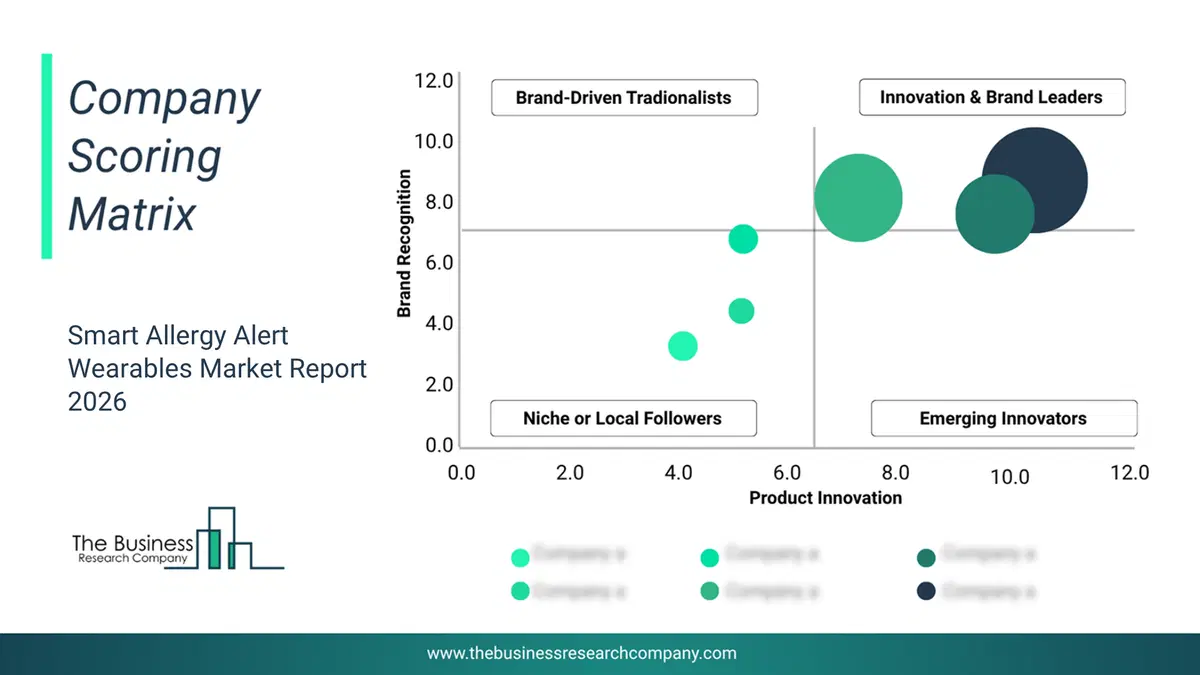
This chart maps companies by product innovation and brand strength, with bubble size indicating relative revenue, helping identify market leaders, challengers, and niche players. This is an illustrative chart; the full report provides a complete and accurate competitive analysis.
Global Smart Allergy Alert Wearables Market Trends and Insights
Major companies operating in the smart allergy alert wearables market are focusing on developing advanced solutions, such as microneedle biosensor allergy monitoring patches, to improve early detection of allergic reactions and enable proactive allergy management. Microneedle biosensor allergy monitoring patches refer to wearable skin-interfacing devices that use microscale needles and biosensing technology to continuously monitor allergy-related biomarkers and provide early alerts before severe symptoms occur. For instance, in March 2026, King Abdullah University of Science and Technology (KAUST), a Saudi Arabia-based research university, developed the AllergE Patch, a wearable microneedle biosensor designed for early allergic-reaction detection and anaphylaxis monitoring. The device monitors Immunoglobulin E (IgE) levels beneath the skin to identify emerging allergic responses before visible symptoms appear, supporting real-time allergy tracking, early intervention, and improved management of severe allergic conditions.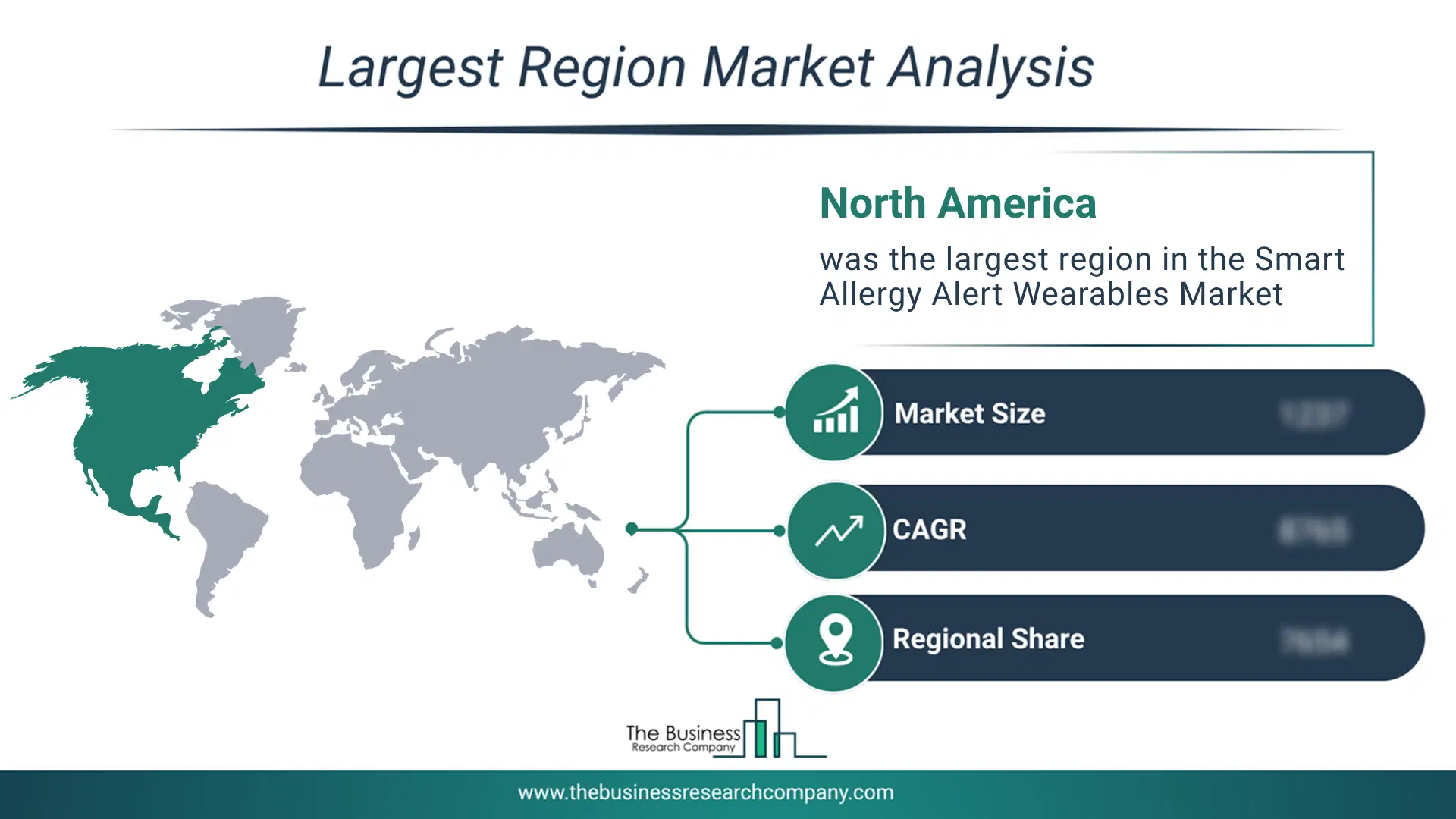
Regional Outlook
North America was the largest region in the smart allergy alert wearables market in 2025. Asia-Pacific is expected to be the fastest-growing region in the forecast period. The regions covered in this market report are Asia-Pacific, South East Asia, Western Europe, Eastern Europe, North America, South America, Middle East, Africa. The countries covered in this market report are Australia, Brazil, China, France, Germany, India, Indonesia, Japan, Taiwan, Russia, South Korea, UK, USA, Canada, Italy, Spain.What Defines the Smart Allergy Alert Wearables Market?
The smart allergy alert wearables market includes sales of smart rings, wearable air-quality monitors, allergen detection devices, connected respiratory monitoring wearables, skin-integrated sensors, and AI-enabled wearable health monitoring systems. Values in this market are ‘factory gate’ values, that is the value of goods sold by the manufacturers or creators of the goods, whether to other entities (including downstream manufacturers, wholesalers, distributors, and retailers) or directly to end customers. The value of goods in this market includes related services sold by the creators of the goods.How is Market Value Defined and Measured?
The market value is defined as the revenues that enterprises gain from the sale of goods and/or services within the specified market and geography through sales, grants, or donations in terms of the currency (in USD unless otherwise specified). The revenues for a specified geography are consumption values that are revenues generated by organizations in the specified geography within the market, irrespective of where they are produced. It does not include revenues from resales along the supply chain, either further along the supply chain or as part of other products.
This chart presents market attractiveness based on a quantitative evaluation of growth, competition, strategic alignment, and risk, offering a clear view of opportunity areas for decision-making. This chart is for illustrative purposes; the full report contains the complete analysis.

This chart highlights the Total Addressable Market (TAM) by estimating the maximum revenue opportunity using an assumption-driven approach, supporting strategic planning and opportunity sizing across markets. The chart is illustrative; the full report provides a more comprehensive analysis.
What Key Data and Analysis Are Included in the Smart Allergy Alert Wearables Market Report 2026?
The smart allergy alert wearables market research report is one of a series of new reports from The Business Research Company that provides market statistics, including industry global market size, regional shares, competitors with the market share, detailed market segments, market trends and opportunities, and any further data you may need to thrive in the smart allergy alert wearables industry. The market research report delivers a complete perspective of everything you need, with an in-depth analysis of the current and future state of the industry.Smart Allergy Alert Wearables Market Report Forecast Analysis
| Report Attribute | Details |
|---|---|
| Market Size Value In 2026 | $1.97 billion |
| Revenue Forecast In 2030 | $3.37 billion |
| Growth Rate | CAGR of 14.3% from 2026 to 2030 |
| Base Year For Estimation | 2025 |
| Actual Estimates/Historical Data | 2020-2025 |
| Forecast Period | 2026 - 2030 |
| Market Representation | Revenue in USD Billion and CAGR from 2026 to 2030 |
| Segments Covered | Product Type, Connectivity Type, Technology Type, Application Type, End User Type |
| Regional Scope | Asia-Pacific, Western Europe, Eastern Europe, North America, South America, Middle East, Africa |
| Country Scope | The countries covered in the report are Australia, Brazil, China, France, Germany, India, Indonesia, Japan, Taiwan, Russia, South Korea, UK, USA, Canada, Italy, Spain. |
| Key Companies Profiled | Adevair Technologies Inc., Allergy Amulet Inc., Abbott Laboratories, Apple Inc., Dexcom Inc., eScent Insight Inc., Gentag Inc., MedicAlert Foundation, Medtronic plc, Philips Healthcare, Respiray OÜ, Sensio Air Inc., Strados Labs Inc. |
| Customization Scope | Request for Customization |
| Pricing And Purchase Options | Explore Purchase Options |