
Smart Bathroom Global Market Opportunities And Strategies To 2035
By Product (Hi-Tech Toilets, Soaking Tubs, Digital Faucets, Other Products), By Connectivity (Bluetooth, Wi-Fi, Other connectivity), By Distribution (Offline, Online), By Application (Commercial, Residential), And By Region, Opportunities And Strategies – Global Forecast To 2035
Smart Bathroom Market Definition
Smart bathroom is a digitally enhanced bathroom environment equipped with connected devices, sensors, and automation technologies that enable intelligent control of fixtures such as toilets, showers, faucets, mirrors, lighting, and ventilation systems. These systems are often integrated with IoT platforms, mobile apps, or voice assistants to provide personalized and automated user experiences. The primary purpose of a smart bathroom is to improve convenience, hygiene, energy efficiency, and user comfort through automation and smart control. The smart bathroom market consists of sales by entities (organizations, sole traders and partnerships) of smart bathroom that are used by residential homeowners, commercial facilities such as hotels and offices, healthcare institutions, airports, shopping malls and other infrastructure where hygiene, water management and user comfort are important considerations. The concept of a smart bathroom has emerged as part of the broader smart home and smart building ecosystem, where devices are interconnected and capable of automation, remote control and data-driven functionality.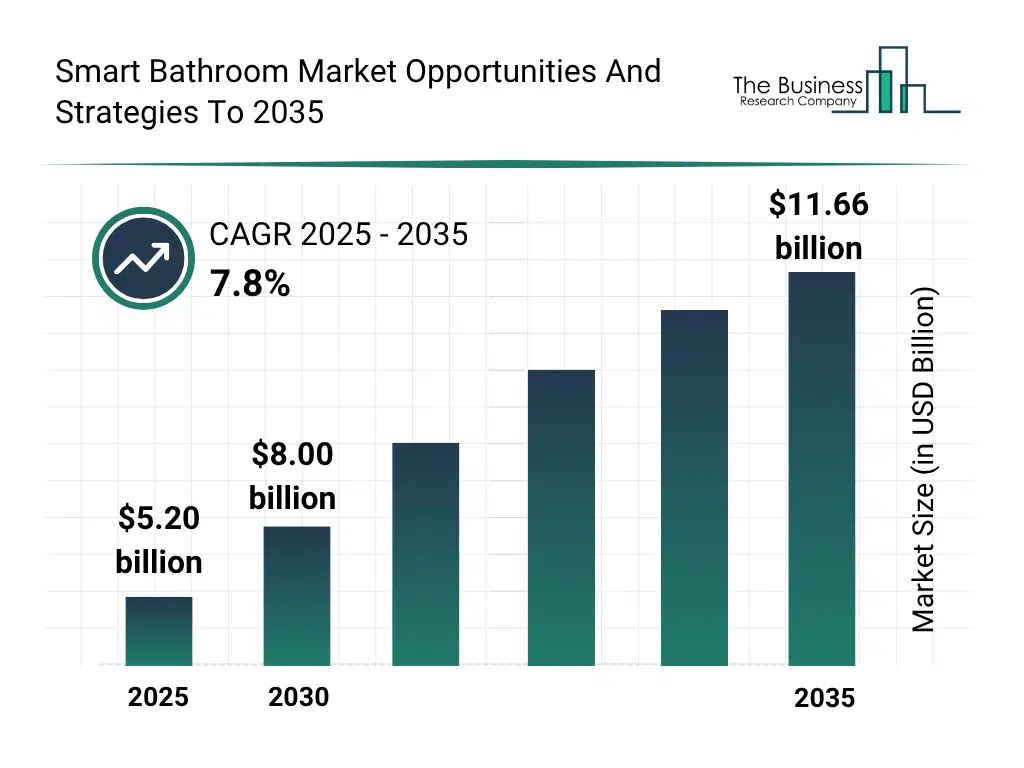
Smart Bathroom Market Size
The global smart bathroom market reached a value of nearly $5,198.5 million in 2025, having grown at a compound annual growth rate (CAGR) of 9.9% since 2020. The market is expected to grow from $5,198.5 million in 2025 to $7,995.3 million in 2030 at a rate of 9.0%. The market is then expected to grow at a CAGR of 7.8% from 2030 and reach $11,660.7 million in 2035. Growth in the historic period resulted from growth in smart city projects, expansion of residential housing construction, growth in hospitality and tourism and increasing home renovation and remodeling activities. Factors that negatively affected growth in the historic period were high initial product and installation costs and data privacy and connectivity concerns (for IoT devices). Going forward, aging population and accessibility needs, rising hygiene awareness and touchless technologies, growth in smart home adoption and increasing demand for luxury home interiors will drive the growth. Factors that could hinder the growth of the smart bathroom market in the future include dependence on continuous power supply, limited consumer awareness in developing regions and impact of trade war and tariff.
Smart Bathroom Market Segmentation
The smart bathroom market is segmented by product, by connectivity, by distribution and by application.
By Product –
The smart bathroom market is segmented by product into:
By Connectivity –
The smart bathroom market is segmented by connectivity into:
By Distribution –
The smart bathroom market is segmented by distribution industry into:
By Application –
The smart bathroom market is segmented by application into:
By Geography - The smart bathroom market is segmented by geography into:
By Product –
The smart bathroom market is segmented by product into:
- a) Hi-Tech Toilets
- b) Soaking Tubs
- c) Digital Faucets
- d) Other Products
By Connectivity –
The smart bathroom market is segmented by connectivity into:
- a) Bluetooth
- b) Wi-Fi
- c) Other Connectivity
By Distribution –
The smart bathroom market is segmented by distribution industry into:
- a) Offline
- b) Online
By Application –
The smart bathroom market is segmented by application into:
- a) Commercial
- b) Residential
By Geography - The smart bathroom market is segmented by geography into:
- China
- India
- Japan
- Australia
- Indonesia
- South Korea
- USA
- Canada
- Brazil
- France
- Germany
- UK
- Italy
- Spain
- Russia
-
o Asia Pacific
o Africa