
Smart Building Acoustic Sensor Market Report 2026
Global Outlook – By Product Type (Wired Acoustic Sensors, Wireless Acoustic Sensors), By Distribution Channel (Direct Sales, Distributors Or Wholesalers, Online Retail), By Application (Noise Monitoring, Security And Surveillance, Heating, Ventilation, And Air Conditioning (HVAC) System Monitoring, Occupancy Detection, Other Applications), By End-User (Commercial Buildings, Residential Buildings, Industrial Facilities, Educational Institutions, Healthcare Facilities, Other End-Users) – Market Size, Trends, Strategies, and Forecast to 2030
Smart Building Acoustic Sensor Market Overview
• Smart Building Acoustic Sensor market size has reached to $1.6 billion in 2025 • Expected to grow to $3.42 billion in 2030 at a compound annual growth rate (CAGR) of 16.4% • Growth Driver: Rise Of Smart Cities Driving The Market Growth Due To Increasing Urbanization • Market Trend: Innovations In Wireless Acoustic Sensor Technology Enhance Energy Efficiency And Real-Time Event Detection In Smart Buildings • North America was the largest region and fastest growing region.What Is Covered Under Smart Building Acoustic Sensor Market?
A smart building acoustic sensor is an advanced device that actively monitors and analyzes sound within buildings to support intelligent operations. It captures acoustic signals and applies AI or machine learning to differentiate background noise, human activity, and unusual events. The sensor enhances building automation systems with real-time insights, improving safety, operational efficiency, and overall occupant experience. The main product types of smart building acoustic sensors are wired acoustic sensors and wireless acoustic sensors. Wired acoustic sensors are devices connected through physical cables to monitor and analyze sound levels in buildings for various applications. It is distributed through several distribution channels, such as direct sales, distributors or wholesalers, and online retail for multiple applications, including noise monitoring, security and surveillance, heating, ventilation, and air conditioning (HVAC) system monitoring, occupancy detection, and others, and is used by various end-users, including commercial buildings, residential buildings, industrial facilities, educational institutions, healthcare facilities, and others.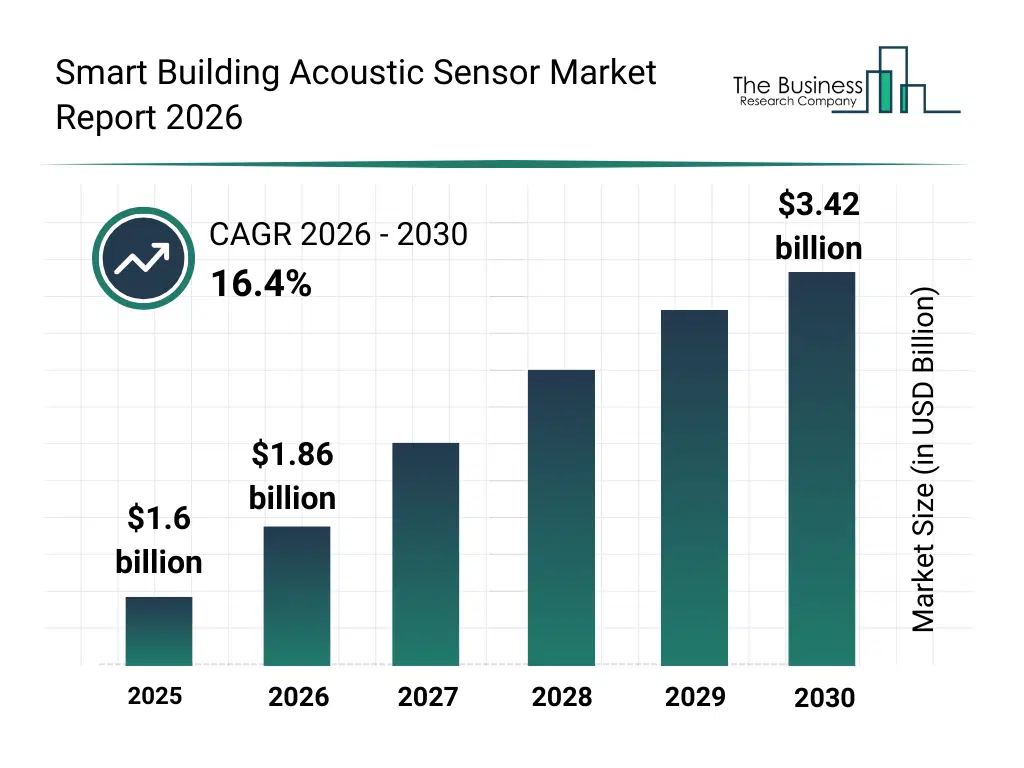
What Is The Smart Building Acoustic Sensor Market Size and Share 2026?
The smart building acoustic sensor market size has grown rapidly in recent years. It will grow from $1.6 billion in 2025 to $1.86 billion in 2026 at a compound annual growth rate (CAGR) of 16.3%. The growth in the historic period can be attributed to rising adoption of smart acoustic sensors, increasing use of IoT-enabled noise monitoring, growth in AI-based sound analysis, expansion of occupancy detection solutions, integration with building automation systems.What Is The Smart Building Acoustic Sensor Market Growth Forecast?
The smart building acoustic sensor market size is expected to see rapid growth in the next few years. It will grow to $3.42 billion in 2030 at a compound annual growth rate (CAGR) of 16.4%. The growth in the forecast period can be attributed to increasing deployment of wireless and wired acoustic sensors, adoption of AI-driven monitoring solutions, expansion of real-time sound analytics, development of predictive noise management, rising integration with HVAC and security systems. Major trends in the forecast period include deployment of AI-based acoustic monitoring systems, integration of wireless and wired sensor networks, adoption of IOT-enabled noise analysis platforms, expansion of smart building occupancy detection, development of connected hvac and security acoustic solutions.
Global Smart Building Acoustic Sensor Market Segmentation
1) By Product Type: Wired Acoustic Sensors, Wireless Acoustic Sensors 2) By Distribution Channel: Direct Sales, Distributors Or Wholesalers, Online Retail 3) By Application: Noise Monitoring, Security And Surveillance, Heating, Ventilation, And Air Conditioning (HVAC) System Monitoring, Occupancy Detection, Other Applications 4) By End-User: Commercial Buildings, Residential Buildings, Industrial Facilities, Educational Institutions, Healthcare Facilities, Other End-Users Subsegments: 1) By Wired Acoustic Sensors: Analog Wired Sensors, Digital Wired Sensors, Networked (Ethernet Or PoE) Wired Sensors 2) By Wireless Acoustic Sensors: Wireless Fidelity (Wi-Fi) Enabled Sensors, Bluetooth-Enabled Sensors, Zigbee Or Z-Wave Sensors, Long Range Wide Area Network (LoRaWAN) Or Narrowband Internet of Things (NB-IoT) SensorsWhat Is The Driver Of The Smart Building Acoustic Sensor Market?
The rise of smart cities is expected to propel the growth of the smart building acoustic sensor market going forward. A smart city is an urban area that utilizes different types of electronic methods and sensors to collect data to manage assets, resources, and services efficiently. The smart cities are rising due to increasing global urbanization and government investments in digital infrastructure to improve urban livability and operational efficiency. The growing development of smart cities is largely driven by rapid urbanization, as more than half of the global population lives in urban areas, creating demand for intelligent infrastructure solutions. The expansion of smart cities increases demand for acoustic sensors, as these devices are essential for noise monitoring, environmental quality assessment, and creating healthier urban living environments through real-time sound level management. For instance, in April 2025, according to the International Institute for Management Development (IMD), a Switzerland based business school, the number of cities assessed in the Smart City Index 2025 reached 146, marking an expansion of the study’s global city coverage. Therefore, the rise of smart cities is driving the growth of the smart building acoustic sensor industry.Key Players In The Global Smart Building Acoustic Sensor Market
Major companies operating in the smart building acoustic sensor market are Robert Bosch GmbH, Siemens AG, Cisco Systems Inc, Schneider Electric SE, Honeywell International Inc, ABB Ltd, Johnson Controls International plc, Texas Instruments Incorporated, Infineon Technologies AG, STMicroelectronics N.V., Emerson Electric Co, Murata Manufacturing Co. Ltd, Analog Devices Inc, Delta Electronics Inc, Legrand SA, Omron Corporation, Beckhoff Automation GmbH, Axis Communications AB, Crestron Electronics Inc, Sound Intelligence B.V.
This chart is for illustrative purposes; the full report includes a detailed competitor analysis and comprehensive overview of the top 10 companies in the market.
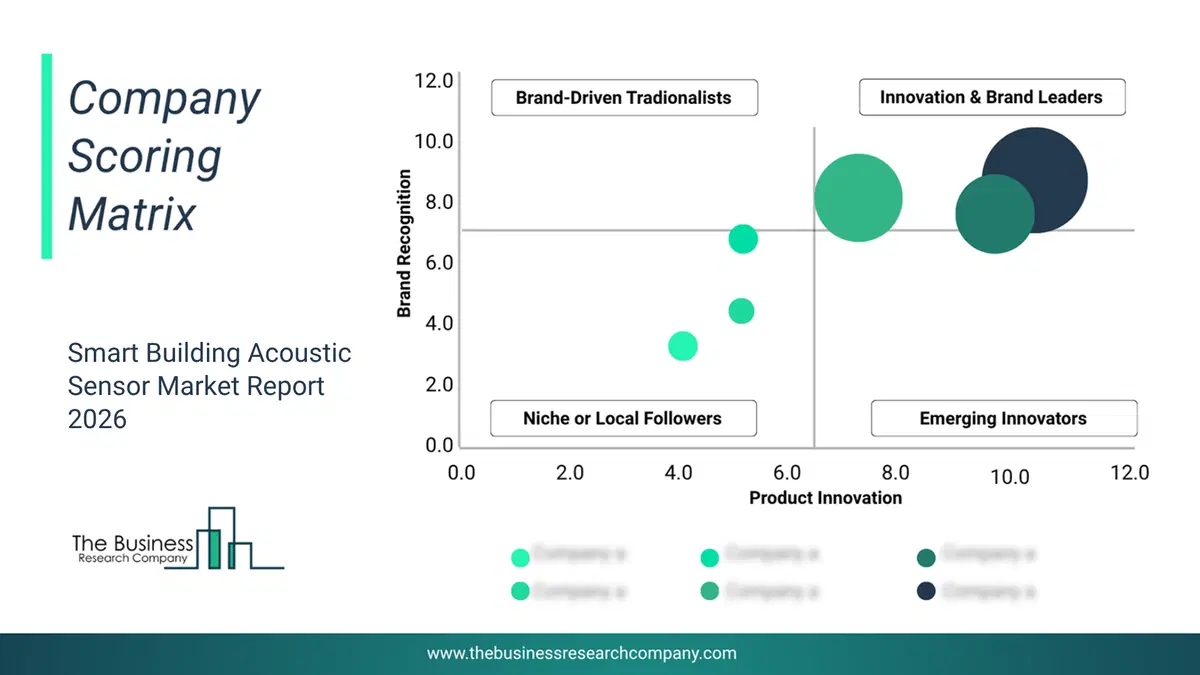
This chart maps companies by product innovation and brand strength, with bubble size indicating relative revenue, helping identify market leaders, challengers, and niche players. This is an illustrative chart; the full report provides a complete and accurate competitive analysis.
Global Smart Building Acoustic Sensor Market Trends and Insights
Major companies operating in the smart building acoustic sensor market are focusing on developing advanced solutions, such as wireless sensor systems, to enable seamless integration with building management platforms, enhance energy efficiency, and provide real-time acoustic event detection. Wireless sensor systems refer to networks of interconnected sensors that transmit data via wireless communication technologies, eliminating the need for physical cabling for power or data transfer. For instance, in February 2025, PassiveLogic, a US-based autonomous building infrastructure company, launched the Sense Nano. It harvests energy from its environment, no wires or batteries required. Truly wireless sensor design allows flexible placement in buildings, with a compact form factor (less than 2 in diameter) and architecturally sensitive housing (CNC-machined aircraft-alloy aluminium). It supports rapid deployment via a companion mobile app (Quantum Lens), where the sensor’s location is automatically recognized and integration into a building’s digital twin is streamlined.What Are Latest Mergers And Acquisitions In The Smart Building Acoustic Sensor Market?
In December 2023, Motorola Solutions, a US-based technology company that provides safety and security products and services, acquired IPVideo Corporation for an undisclosed amount. Through this acquisition, Motorola Solutions seeks to enhance its physical-security ecosystem by adding a non-video threat-detection device, extending situational awareness to privacy-sensitive locations such as restrooms, hospital rooms, classrooms, and hotel rooms where cameras cannot be used. IPVideo Corporation is a US-based provider of the HALO IoT Smart Sensor, which is a type of smart building acoustic sensor.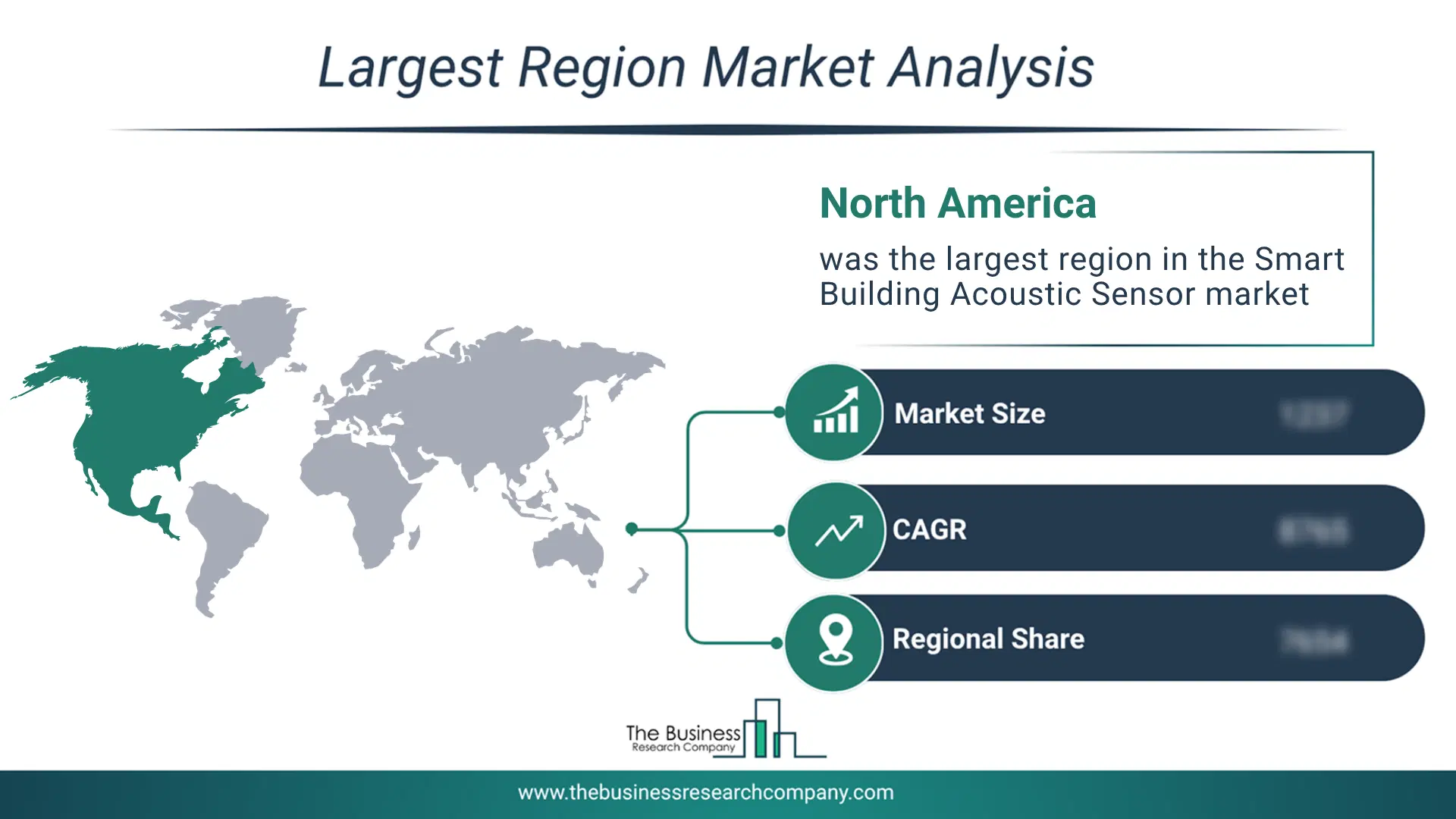
Regional Insights
North America was the largest region in the smart building acoustic sensor market in 2025. Asia-Pacific is expected to be the fastest-growing region in the forecast period. The regions covered in this market report are Asia-Pacific, South East Asia, Western Europe, Eastern Europe, North America, South America, Middle East, Africa. The countries covered in this market report are Australia, Brazil, China, France, Germany, India, Indonesia, Japan, Taiwan, Russia, South Korea, UK, USA, Canada, Italy, Spain.What Defines the Smart Building Acoustic Sensor Market?
The smart building acoustic sensor market consists of sales of standalone smart acoustic sensors, ceiling-mounted sound detection units, AI-enabled sound processing chips, integrated acoustic sensor modules, and multi-sensor devices. Values in this market are ‘factory gate’ values, that is, the value of goods sold by the manufacturers or creators of the goods, whether to other entities (including downstream manufacturers, wholesalers, distributors, and retailers) or directly to end customers. The value of goods in this market includes related services sold by the creators of the goods.How is Market Value Defined and Measured?
The market value is defined as the revenues that enterprises gain from the sale of goods and/or services within the specified market and geography through sales, grants, or donations in terms of the currency (in USD unless otherwise specified). The revenues for a specified geography are consumption values that are revenues generated by organizations in the specified geography within the market, irrespective of where they are produced. It does not include revenues from resales along the supply chain, either further along the supply chain or as part of other products.
This chart presents market attractiveness based on a quantitative evaluation of growth, competition, strategic alignment, and risk, offering a clear view of opportunity areas for decision-making. This chart is for illustrative purposes; the full report contains the complete analysis.

This chart highlights the Total Addressable Market (TAM) by estimating the maximum revenue opportunity using an assumption-driven approach, supporting strategic planning and opportunity sizing across markets. The chart is illustrative; the full report provides a more comprehensive analysis.
What Key Data and Analysis Are Included in theSmart Building Acoustic Sensor Market Report 2026?
The smart building acoustic sensor market research report is one of a series of new reports from The Business Research Company that provides market statistics, including industry global market size, regional shares, competitors with the market share, detailed market segments, market trends and opportunities, and any further data you may need to thrive in the smart building acoustic sensor industry. The market research report delivers a complete perspective of everything you need, with an in-depth analysis of the current and future state of the industry.Smart Building Acoustic Sensor Market Report Forecast Analysis
| Report Attribute | Details |
|---|---|
| Market Size Value In 2026 | $1.86 billion |
| Revenue Forecast In 2030 | $3.42 billion |
| Growth Rate | CAGR of 16.3% from 2026 to 2030 |
| Base Year For Estimation | 2025 |
| Actual Estimates/Historical Data | 2020-2025 |
| Forecast Period | 2026 - 2030 |
| Market Representation | Revenue in USD Billion and CAGR from 2026 to 2030 |
| Segments Covered | Product Type, Distribution Channel, Application, End-User |
| Regional Scope | Asia-Pacific, Western Europe, Eastern Europe, North America, South America, Middle East, Africa |
| Country Scope | The countries covered in this market report are Australia, Brazil, China, France, Germany, India, Indonesia, Japan, Taiwan, Russia, South Korea, UK, USA, Canada, Italy, Spain |
| Key Companies Profiled | Robert Bosch GmbH, Siemens AG, Cisco Systems Inc, Schneider Electric SE, Honeywell International Inc, ABB Ltd, Johnson Controls International plc, Texas Instruments Incorporated, Infineon Technologies AG, STMicroelectronics N.V., Emerson Electric Co, Murata Manufacturing Co. Ltd, Analog Devices Inc, Delta Electronics Inc, Legrand SA, Omron Corporation, Beckhoff Automation GmbH, Axis Communications AB, Crestron Electronics Inc, Sound Intelligence B.V. |
| Customization Scope | Request for Customization |
| Pricing And Purchase Options | Explore Purchase Options |