

Smart Bumper Market Report 2026
Global Outlook – By Type (Camera-Based Bumpers, Radar-Based Bumpers, Ultrasonic-Based Bumpers, Light Detection And Ranging-Based Bumpers), By Material (Plastic, Aluminum, Carbon Fiber, Steel, Composite Materials), By Application (Smart Parking Systems, Vehicle Safety Systems, Traffic Management Systems, Security And Surveillance Systems), By End-Use (Original Equipment Manufacturers (OEMs), Aftermarket) – Market Size, Trends, Strategies, and Forecast to 2030
Smart Bumper Market Overview
• Smart Bumper market size has reached to $6.2 billion in 2025 • Expected to grow to $9.64 billion in 2030 at a compound annual growth rate (CAGR) of 9.2% • Growth Driver: Rising Emphasis On Car Safety Driving Growth In The Market Due To Advancements In Technology And Consumer Demand For Enhanced Protection • Market Trend: Next-Generation Vehicle Systems Enhance Driver Assistance And Road Safety • Asia-Pacific was the largest region in 2025.What Is Covered Under Smart Bumper Market?
A smart bumper is an advanced vehicle safety feature that integrates sensors and technology to provide real-time feedback to drivers. It enhances collision avoidance by detecting obstacles and alerting the driver, reducing the likelihood of accidents. Smart bumpers contribute significantly to overall vehicle safety and pedestrian protection. The main types of smart bumpers are camera-based bumpers, radar-based bumpers, ultrasonic-based bumpers, and LiDAR-based bumpers. A camera-based bumper is a vehicle safety system that uses cameras for real-time obstacle detection, parking assistance, and collision prevention. The materials used for smart bumpers include plastic, aluminum, carbon fiber, steel, and composite materials. These bumpers are applied in smart parking systems, vehicle safety systems, traffic management systems, and security and surveillance systems. They are used by various end-users, including original equipment manufacturers (OEMs) and the aftermarket.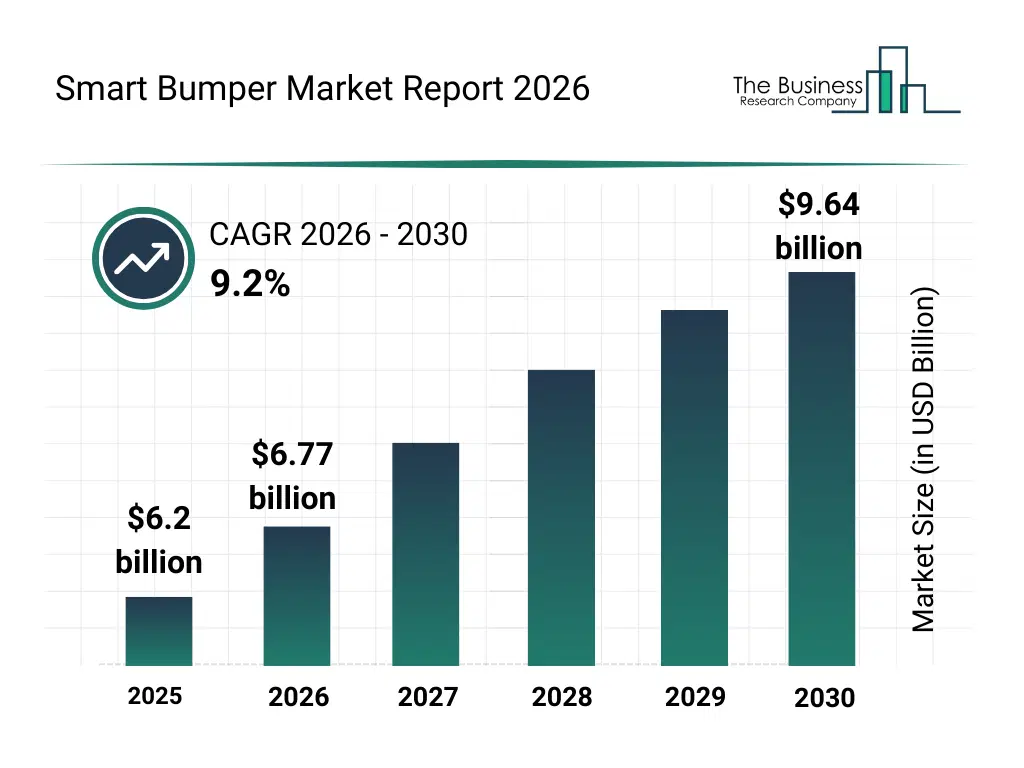
What Is The Smart Bumper Market Size and Share 2026?
The smart bumper market size has grown strongly in recent years. It will grow from $6.2 billion in 2025 to $6.77 billion in 2026 at a compound annual growth rate (CAGR) of 9.3%. The growth in the historic period can be attributed to stricter vehicle safety regulations, increasing installation of parking assistance systems, growth in passenger vehicle production, rising awareness of pedestrian safety, advances in automotive sensor technologies.What Is The Smart Bumper Market Growth Forecast?
The smart bumper market size is expected to see strong growth in the next few years. It will grow to $9.64 billion in 2030 at a compound annual growth rate (CAGR) of 9.2%. The growth in the forecast period can be attributed to increasing adoption of autonomous driving features, rising demand for smart safety components in electric vehicles, expansion of connected vehicle ecosystems, growing focus on vehicle-to-infrastructure integration, increasing investment in advanced sensing technologies. Major trends in the forecast period include increasing integration of multi-sensor bumper systems, rising adoption of advanced driver assistance features, growing use of radar and lidar in vehicle exteriors, expansion of pedestrian safety technologies, enhanced focus on real-time obstacle detection.
Global Smart Bumper Market Segmentation
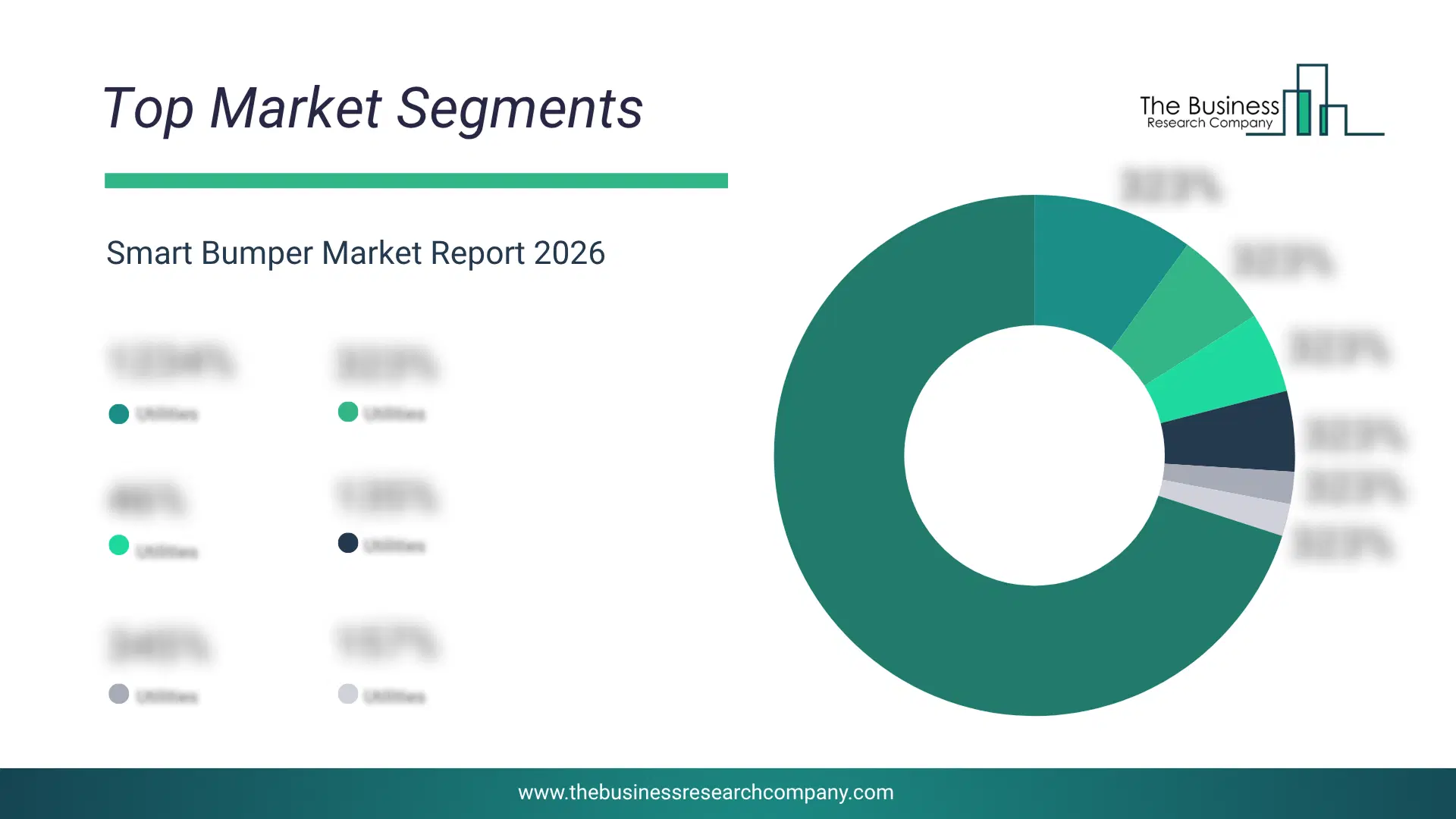
1) By Type: Camera-Based Bumpers, Radar-Based Bumpers, Ultrasonic-Based Bumpers, Light Detection And Ranging-Based Bumpers 2) By Material: Plastic, Aluminum, Carbon Fiber, Steel, Composite Materials 3) By Application: Smart Parking Systems, Vehicle Safety Systems, Traffic Management Systems, Security And Surveillance Systems 4) By End-Use: Original Equipment Manufacturers (OEMs), Aftermarket Subsegments: 1) By Camera-Based Bumpers: Monocular Camera Systems, Stereo Camera Systems, 360-Degree Camera Systems 2) By Radar-Based Bumpers: Short-Range Radar (SRR) Bumpers, Medium-Range Radar (MRR) Bumpers, Long-Range Radar (LRR) Bumpers 3) By Ultrasonic-Based Bumpers: Proximity Sensing Ultrasonic Bumpers, Collision Avoidance Ultrasonic Bumpers, Automated Parking Assistance Ultrasonic Bumpers 4) By Light Detection And Ranging (LiDAR)-Based Bumpers: Solid-State LiDAR Bumpers, Mechanical LiDAR Bumpers, Hybrid LiDAR BumpersWhat Are The Drivers Of The Smart Bumper Market?
The increasing focus on car safety is expected to propel the growth of the smart bumper market going forward. Car safety encompasses practices and technologies to prevent accidents and minimize injuries during collisions, ensuring protection for all road users. The increasing focus on car safety is attributed to stricter government regulations, and advancements in automotive safety technologies aimed at reducing accidents and fatalities. A smart bumper enhances vehicle safety by integrating sensors, cameras, and impact-absorbing materials to prevent collisions, protect pedestrians, assist with parking, and minimize crash damage. For instance, in March 2024, according to the Government Accountability Office, a US-based government agency, by 2027, 51% of U.S. registered vehicles are expected to include at least some driver assistance technologies, up from 28% in 2022. Therefore, the increasing focus on car safety is driving the growth of the smart bumper industry. The rising adoption of autonomous and connected vehicles is expected to propel the growth of the smart bumper market going forward. An autonomous and connected vehicle is a self-driving vehicle equipped with advanced communication technologies that enable real-time data exchange with other vehicles, infrastructure, and cloud systems to enhance safety, efficiency, and mobility. The rise in autonomous and connected vehicle adoption is attributed to increasing demand for road safety, and government initiatives supporting smart mobility solutions. Smart bumper enhances autonomous and connected vehicle features by integrating advanced sensors and AI-driven impact detection, enabling real-time obstacle recognition, collision prevention, and vehicle-to-everything (V2X) communication for improved safety and efficiency. For instance, in December 2024, according to the National Association of Insurance Commissioners, a US-based non-profit organization, it is expected that there will be 4.5 million self-driving vehicles on U.S. roads by 2030. Therefore, the rising adoption of autonomous and connected vehicles is driving the growth of the smart bumper industry.Key Players In The Global Smart Bumper Market
Major companies operating in the smart bumper market report include Ford Motor Co., Robert Bosch GmbH, Tesla Inc., LG Electronics Inc., Denso Corporation, Continental AG, Hyundai Mobis Co. Ltd., Magna International Inc., Faurecia S.A., Forvia, Valeo S.A., Autoliv Inc., Harman International Industries Inc., Opmobility, Motherson Sumi Systems Limited, Visteon Corporation, REHAU AG + Co., ZF Friedrichshafen AG, Aptiv PLC, Infineon Technologies AG, NXP Semiconductors N.V., Veoneer Inc., Sensata Technologies Holding plc, HELLA GmbH & Co. KGaA, Panasonic Automotive Systems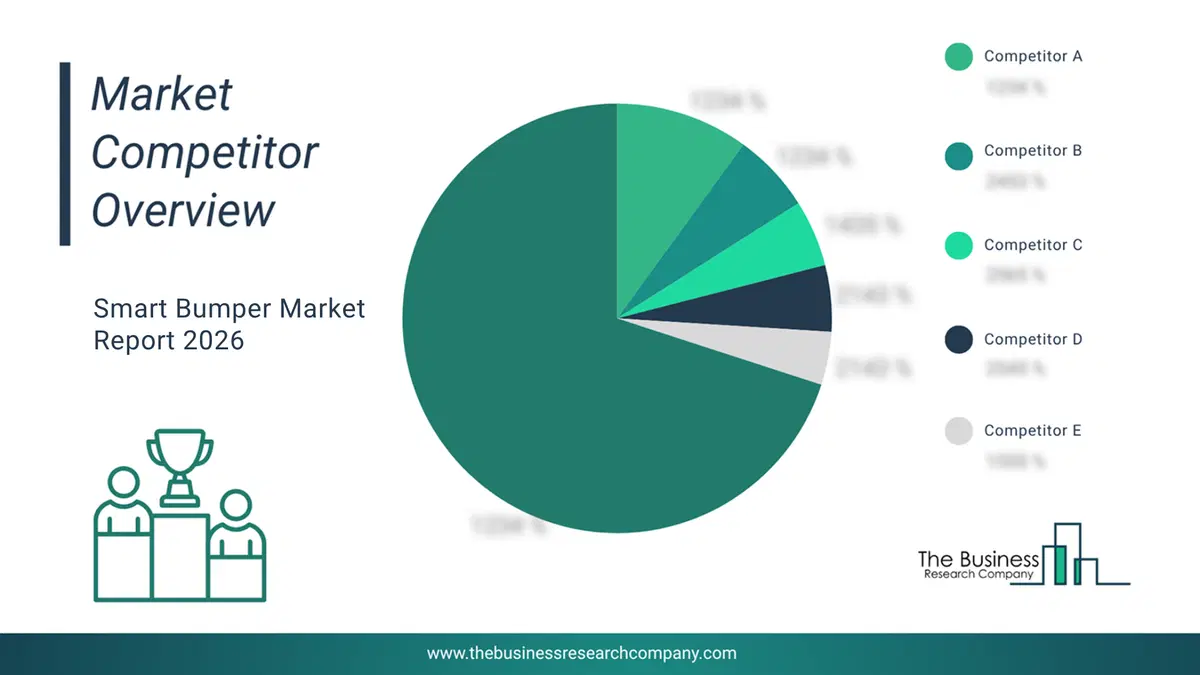
This chart is for illustrative purposes; the full report includes a detailed competitor analysis and comprehensive overview of the top 10 companies in the market.
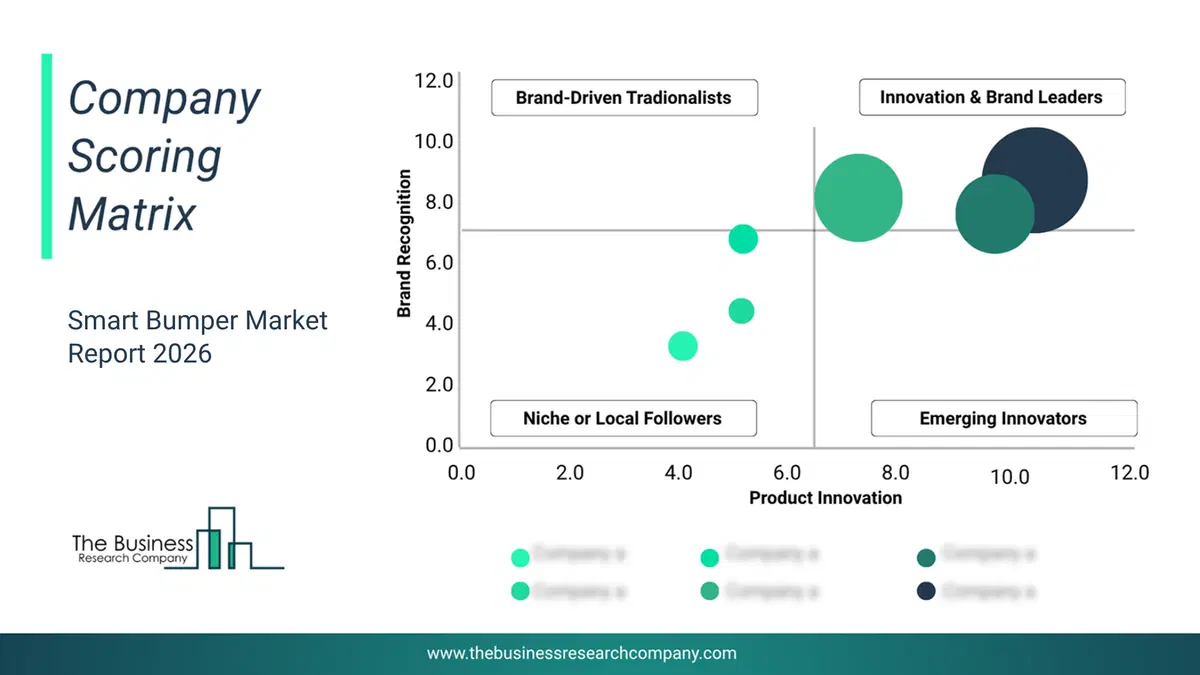
This chart maps companies by product innovation and brand strength, with bubble size indicating relative revenue, helping identify market leaders, challengers, and niche players. This is an illustrative chart; the full report provides a complete and accurate competitive analysis.
Global Smart Bumper Market Trends and Insights
Major companies operating in the smart bumper market are increasingly focusing on developing advanced solutions such as sensor- and artificial intelligence (AI)-integrated bumpers to meet the rising demand for real-time safety, collision prevention, and autonomous driving support. Sensor- and AI-integrated bumpers incorporate technologies that detect obstacles, continuously monitor the vehicle’s surroundings, and enable collision avoidance along with enhanced ADAS functionalities. For instance, in June 2025, Hyundai Mobis, a South Korea–based automotive parts supplier, unveiled a new “Rear Safety Control” system that leverages rear side radar sensors and front cameras mounted on the bumper and vehicle body to automatically detect dangerously close trailing vehicles on highways. The system first alerts the driver with visual and audio warnings if a vehicle approaches within ~10 meters; if the danger persists, it autonomously accelerates the car to restore a safe distance, offering an active collision avoidance and driver assist function beyond traditional static bumpers.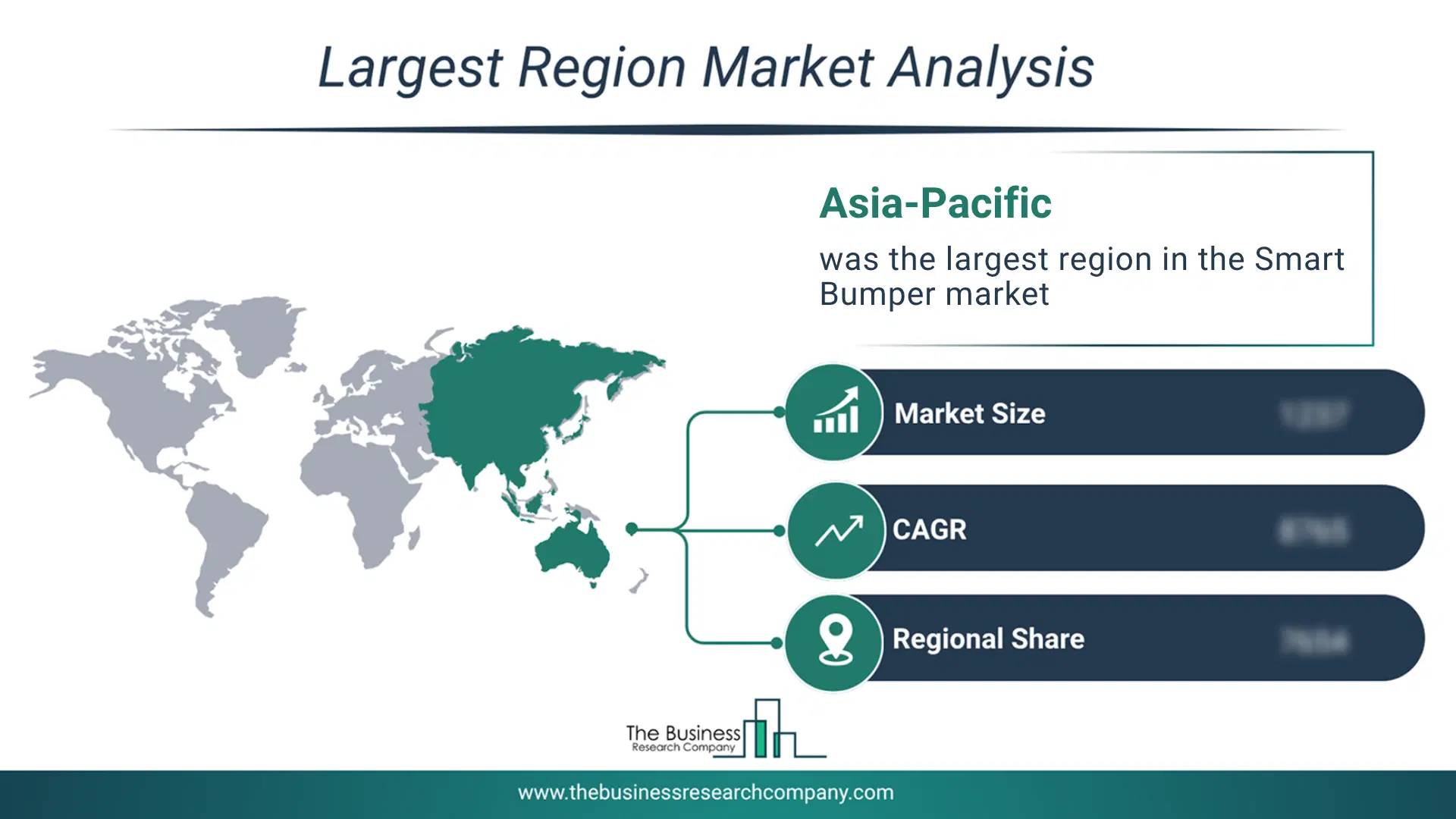
Regional Outlook
Asia-Pacific was the largest region in the smart bumper market in 2025. The regions covered in this market report include Asia-Pacific, South East Asia, Western Europe, Eastern Europe, North America, South America, Middle East, Africa. The countries covered in this market report include Australia, Brazil, China, France, Germany, India, Indonesia, Japan, Taiwan, Russia, South Korea, UK, USA, Canada, Italy, SpainWhat Defines the Smart Bumper Market?
The smart bumper market consists of sales of sensor-integrated bumpers, vehicle-specific solutions, connectivity modules, and energy-absorbing materials. Values in this market are ‘factory gate’ values, that is, the value of goods sold by the manufacturers or creators of the goods, whether to other entities (including downstream manufacturers, wholesalers, distributors, and retailers) or directly to end customers. The value of goods in this market includes related services sold by the creators of the goods.How is Market Value Defined and Measured?
The market value is defined as the revenues that enterprises gain from the sale of goods and/or services within the specified market and geography through sales, grants, or donations in terms of the currency (in USD unless otherwise specified). The revenues for a specified geography are consumption values that are revenues generated by organizations in the specified geography within the market, irrespective of where they are produced. It does not include revenues from resales along the supply chain, either further along the supply chain or as part of other products.
This chart presents market attractiveness based on a quantitative evaluation of growth, competition, strategic alignment, and risk, offering a clear view of opportunity areas for decision-making. This chart is for illustrative purposes; the full report contains the complete analysis.

This chart highlights the Total Addressable Market (TAM) by estimating the maximum revenue opportunity using an assumption-driven approach, supporting strategic planning and opportunity sizing across markets. The chart is illustrative; the full report provides a more comprehensive analysis.
What Key Data and Analysis Are Included in the Smart Bumper Market Report 2026?
The smart bumper market research report is one of a series of new reports from The Business Research Company that provides market statistics, including industry global market size, regional shares, competitors with the market share, detailed market segments, market trends and opportunities, and any further data you may need to thrive in the smart bumper industry. The market research report delivers a complete perspective of everything you need, with an in-depth analysis of the current and future state of the industry.Smart Bumper Market Report Forecast Analysis
| Report Attribute | Details |
|---|---|
| Market Size Value In 2026 | $6.77 billion |
| Revenue Forecast In 2030 | $9.64 billion |
| Growth Rate | CAGR of 9.3% from 2026 to 2030 |
| Base Year For Estimation | 2025 |
| Actual Estimates/Historical Data | 2020-2025 |
| Forecast Period | 2026 - 2030 - 2030 |
| Market Representation | Revenue in USD Billion and CAGR from 2026 to 2030 |
| Segments Covered | Type, Material, Application, End-Use |
| Regional Scope | Asia-Pacific, Western Europe, Eastern Europe, North America, South America, Middle East, Africa |
| Country Scope | The countries covered in the report are Australia, Brazil, China, France, Germany, India, Indonesia, Japan, Taiwan, Russia, South Korea, UK, USA, Canada, Italy, Spain. |
| Key Companies Profiled | Ford Motor Co., Robert Bosch GmbH, Tesla Inc., LG Electronics Inc., Denso Corporation, Continental AG, Hyundai Mobis Co. Ltd., Magna International Inc., Faurecia S.A., Forvia, Valeo S.A., Autoliv Inc., Harman International Industries Inc., Opmobility, Motherson Sumi Systems Limited, Visteon Corporation, REHAU AG + Co., ZF Friedrichshafen AG, Aptiv PLC, Infineon Technologies AG, NXP Semiconductors N.V., Veoneer Inc., Sensata Technologies Holding plc, HELLA GmbH & Co. KGaA, Panasonic Automotive Systems |
| Customization Scope | Request for Customization |
| Pricing And Purchase Options | Explore Purchase Options |