
Smart Card In Government Market Report 2026
Global Outlook – By Component (Hardware, Software, Services.), By Card Type (Contact-Based Smart Cards, Contactless Smart Cards, Dual-Interface Smart Cards, Hybrid Smart Cards.), By Technology (Microprocessor Smart Cards, Memory Smart Cards, Biometric-Enabled Smart Cards, Optical and Other Advanced Cards.), By Application (National Identification Cards, E-Passports, Driver’s Licenses, Voter Identification Cards, Healthcare and Social Security Cards, Subsidy or Welfare Distribution Cards, Border Control and Immigration, Other Applications.), By End-User (Federal Government, State and Local Government, Public Safety, Transportation, Other End-Users) – Market Size, Trends, Strategies, and Forecast to 2030
Smart Card In Government Market Overview
• Smart Card In Government market size has reached to $6.25 billion in 2025 • Expected to grow to $9.93 billion in 2030 at a compound annual growth rate (CAGR) of 9.7% • Growth Driver: Increasing Digitalization Of Public Services Fueling The Growth Of The Market Due To Rising Adoption Of Secure Digital Identity Solutions • Market Trend: Modernizing Government Identity Solutions With Remote Enrollment, Enhanced Security, And High-Accuracy Credentialing • North America was the largest region in 2025 and Asia-Pacific is the fastest growing region.What Is Covered Under Smart Card In Government Market?
Smart card in government refers to a secure, tamper-resistant card embedded with a microprocessor or memory chip that stores and processes data for official purposes. It is used to enhance authentication, identity verification, and secure access to governmental services and systems. These cards help improve efficiency, reduce fraud, and strengthen the security of governmental operations and transactions. The main components of the Smart Card in Government include hardware, software, and services. Hardware refers to the physical smart cards and embedded chip modules used for secure identification, authentication, and data storage in government applications. There are card types such as contact-based smart cards, contactless smart cards, dual-interface smart cards, and hybrid smart cards. The technology types include microprocessor smart cards, memory smart cards, biometric-enabled smart cards, and optical or others. The applications cover national identification cards, e-passports, driver’s licenses, voter identification cards, healthcare and social security cards, subsidy or welfare distribution cards, border control and immigration, and others, and the major end-users are federal government, state and local government, public safety, transportation, and others.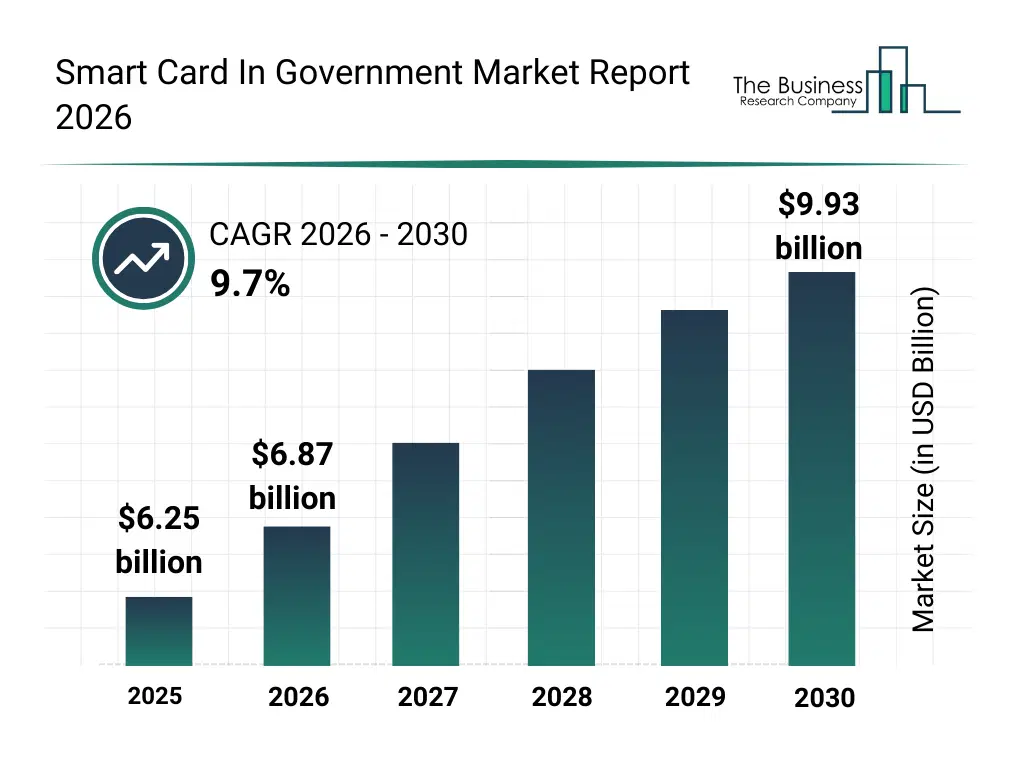
What Is The Smart Card In Government Market Size and Share 2026?
The smart card in government market size has grown strongly in recent years. It will grow from $6.25 billion in 2025 to $6.87 billion in 2026 at a compound annual growth rate (CAGR) of 9.9%. The growth in the historic period can be attributed to growing demand for secure identity, rising need for digital governance, increasing adoption of e-services, expansion of government digitization programs, and growing focus on fraud prevention.What Is The Smart Card In Government Market Growth Forecast?
The smart card in government market size is expected to see strong growth in the next few years. It will grow to $9.93 billion in 2030 at a compound annual growth rate (CAGR) of 9.7%. The growth in the forecast period can be attributed to increasing investment in cybersecurity, rising citizen convenience expectations, growing smart city initiatives, expansion of contactless transaction systems, and rising adoption of multi-application smartcards. Major trends in the forecast period include technology advancements in smartcard security, innovations in biometric-enabled cards, developments in cloud-based credential management, research and developments in blockchain identity solutions, and innovations in sustainable card materials.
Global Smart Card In Government Market Segmentation
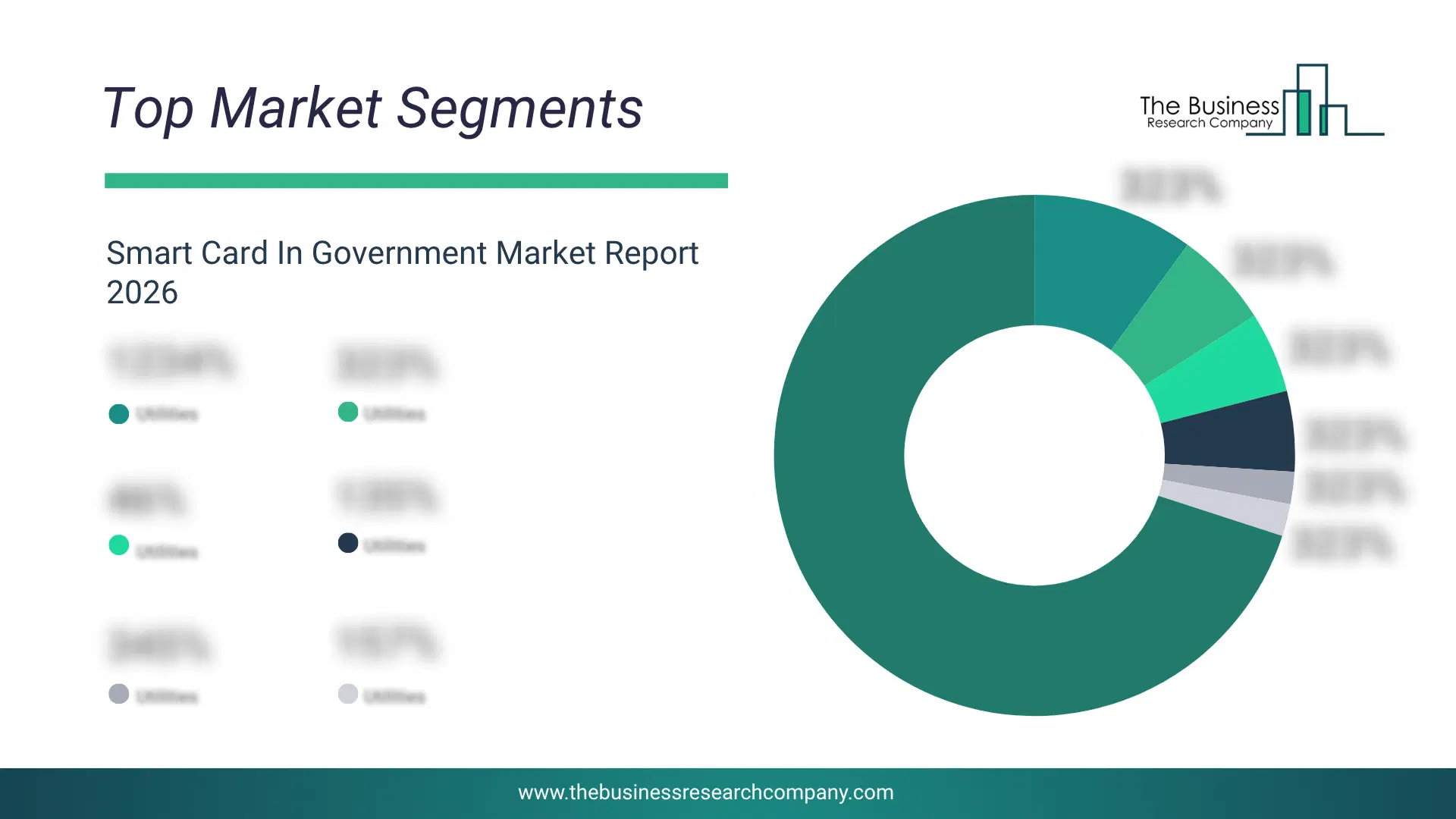
1) By Component: Hardware, Software, Services. 2) By Card Type: Contact-Based Smart Cards, Contactless Smart Cards, Dual-Interface Smart Cards, Hybrid Smart Cards. 3) By Technology: Microprocessor Smart Cards, Memory Smart Cards, Biometric-Enabled Smart Cards, Optical and Other Advanced Cards. 4) By Application: National Identification Cards, E-Passports, Driver’s Licenses, Voter Identification Cards, Healthcare and Social Security Cards, Subsidy or Welfare Distribution Cards, Border Control and Immigration, Other Applications. 5) By End-User: Federal Government, State and Local Government, Public Safety, Transportation, Other End-Users Subsegments: 1) By Hardware: Smart Card Chips, Smart Card Readers, Embedded Integrated Circuits, Biometric Sensor Modules, Antenna Modules, Card Operating Systems. 2) By Software: Card Management Software, Authentication Software, Identity Management Software, Security Encryption Software, Operating System Middleware, Application Programming Software. 3) By Services: Consulting Services, Integration Services, Deployment Services, Maintenance Services, Support Services, Managed Security Services.What Is The Driver Of The Smart Card In Government Market?
The increasing digitalization of public services is expected to propel the growth of the smart card in government market going forward. Digitalization of public services involves transforming traditional government operations and citizen interactions into efficient online and digital platforms. The rise in digitalization of public services is due to governments adopting automation and online platforms to deliver faster more efficient citizen services matching private sector expectations. Smart cards in government help in the digitalization of public services by serving as secure physical tokens for digital identity, enabling citizens to access e-government platforms safely and authenticate their identity for online services. For instance, in February 2025, according to Eurostat, a Luxembourg-based statistical authority of the European Union, 70.0 percent of people aged 16 to 74 in the European Union reported using a website or an application of a public authority in 2024, marking a 0.7 percentage point increase from the 69.3 percent recorded in 2023. Therefore, the increasing digitalization of public services is driving the growth of the smart card in government industry.Key Players In The Global Smart Card In Government Market
Major companies operating in the smart card in government market are Thales S.A., Infineon Technologies AG, STMicroelectronics N.V., NXP Semiconductors N.V., Avery Dennison Corporation, Zebra Technologies Corporation, Giesecke+Devrient GmbH, HID Global Corporation, Entrust Inc., SICPA S.A., Mühlbauer Holding AG, Bundesdruckerei GmbH, CPI Card Group Inc., Polska Wytwórnia Papierów Wartościowych S.A., IN Groupe S.A., Evolis S.A., Veridos GmbH, Watchdata Technologies Co. Ltd., KL Hi-Tech Secure Print Limited, PAV CARD GmbH, Madras Security Printers Pvt. Ltd., Matica Technologies AG, ID Smart Cards Creations Pvt. Ltd.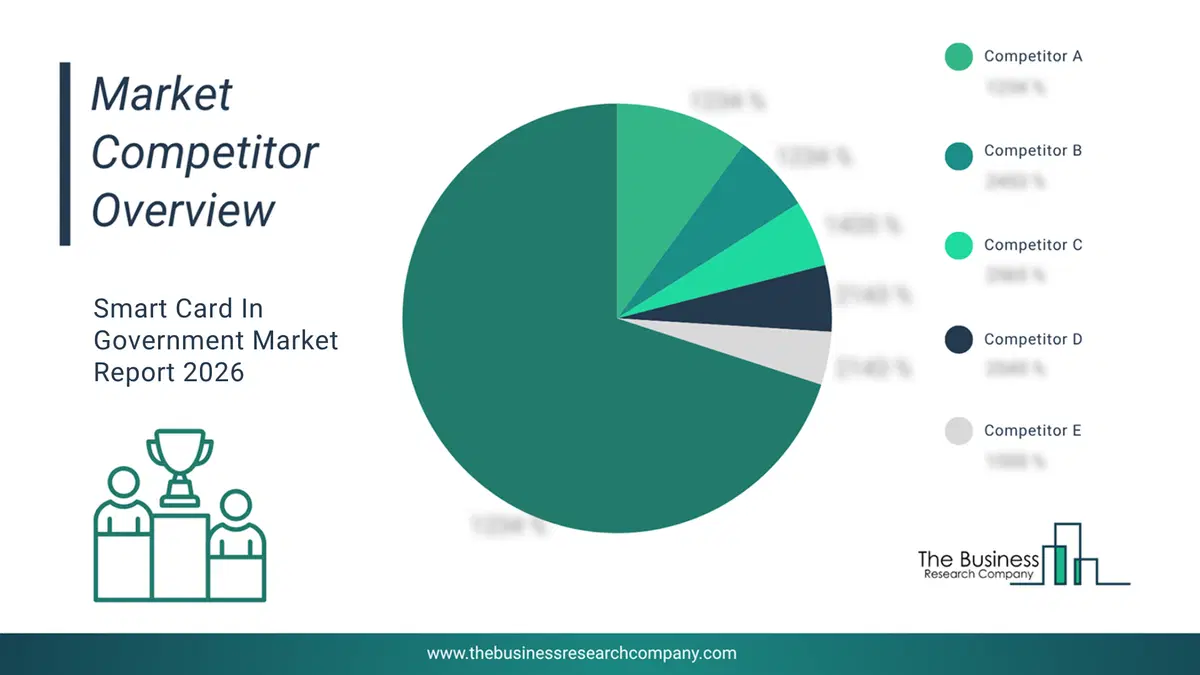
This chart is for illustrative purposes; the full report includes a detailed competitor analysis and comprehensive overview of the top 10 companies in the market.
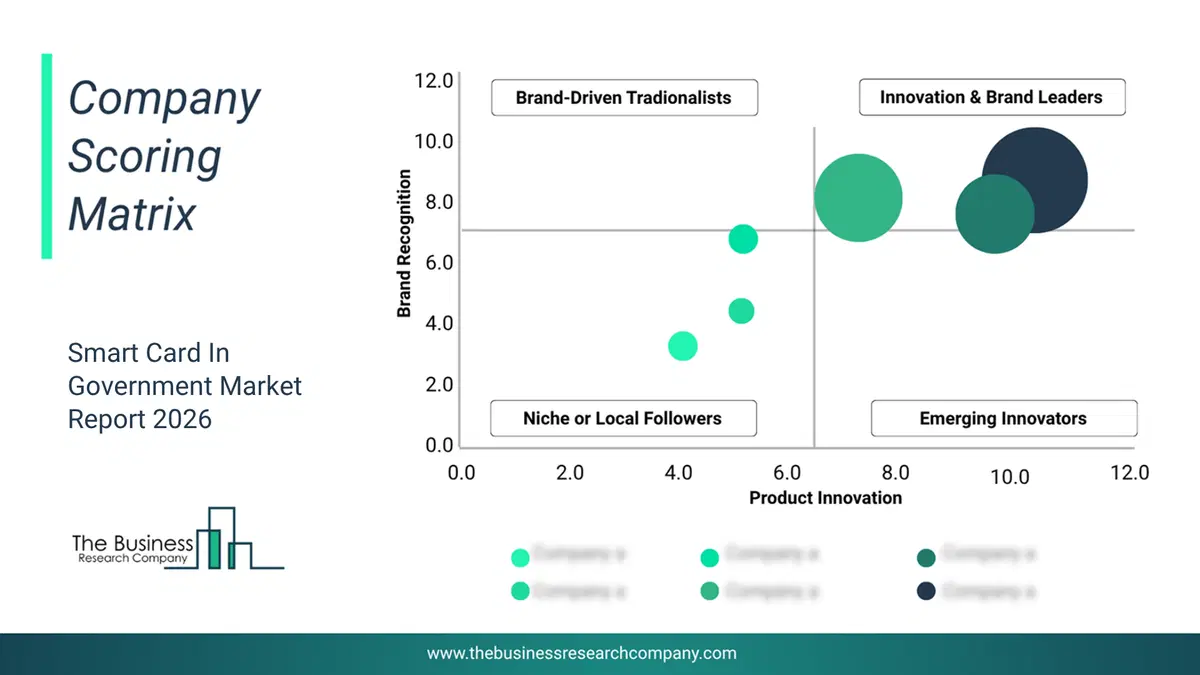
This chart maps companies by product innovation and brand strength, with bubble size indicating relative revenue, helping identify market leaders, challengers, and niche players. This is an illustrative chart; the full report provides a complete and accurate competitive analysis.
Global Smart Card In Government Market Trends and Insights
Major companies operating in the smart card in the government market are focusing on advanced technology, such as supervised multi-acquisition remote enrollment, to streamline identity proofing, enhance security, and provide efficient access to credentialing services for civil and criminal applications. Supervised multi-acquisition remote enrollment is the capability of a system to allow a single remote agent to securely oversee multiple enrollment processes simultaneously, maintaining compliance with digital identity standards. For instance, in October 2025, Idemia Public Security North America, a US-based identity technologies provider, announced the rollout of its new Supervised Multi-Acquisition Remote Technology for Enrollment (SMART-E) kiosks and the launch of next-generation driver’s licenses and ID cards in several U.S. states. The SMART-E system allows a single remote agent to oversee multiple enrollments simultaneously with a fingerprint rejection rate below two percent, while the new identification cards feature tamper-resistant materials designed to meet ten-year durability standards. These innovations are being deployed in Pennsylvania, Colorado, California, and Texas to modernize identity proofing and credentialing infrastructures.What Are Latest Mergers And Acquisitions In The Smart Card In Government Market?
In July 2025, IN Groupe, a France-based secure identity and trust services provider, acquired Idemia Smart Identity for an undisclosed amount. Through this acquisition, IN Groupe sought to combine its expertise in secure document production and identity credentials with Idemia Smart Identity’s biometric technologies and digital ID platforms to become a leader in end-to-end physical and digital identity solutions and trusted services. Idemia Smart Identity is a France-based company specializing in physical and digital smart identity card solutions.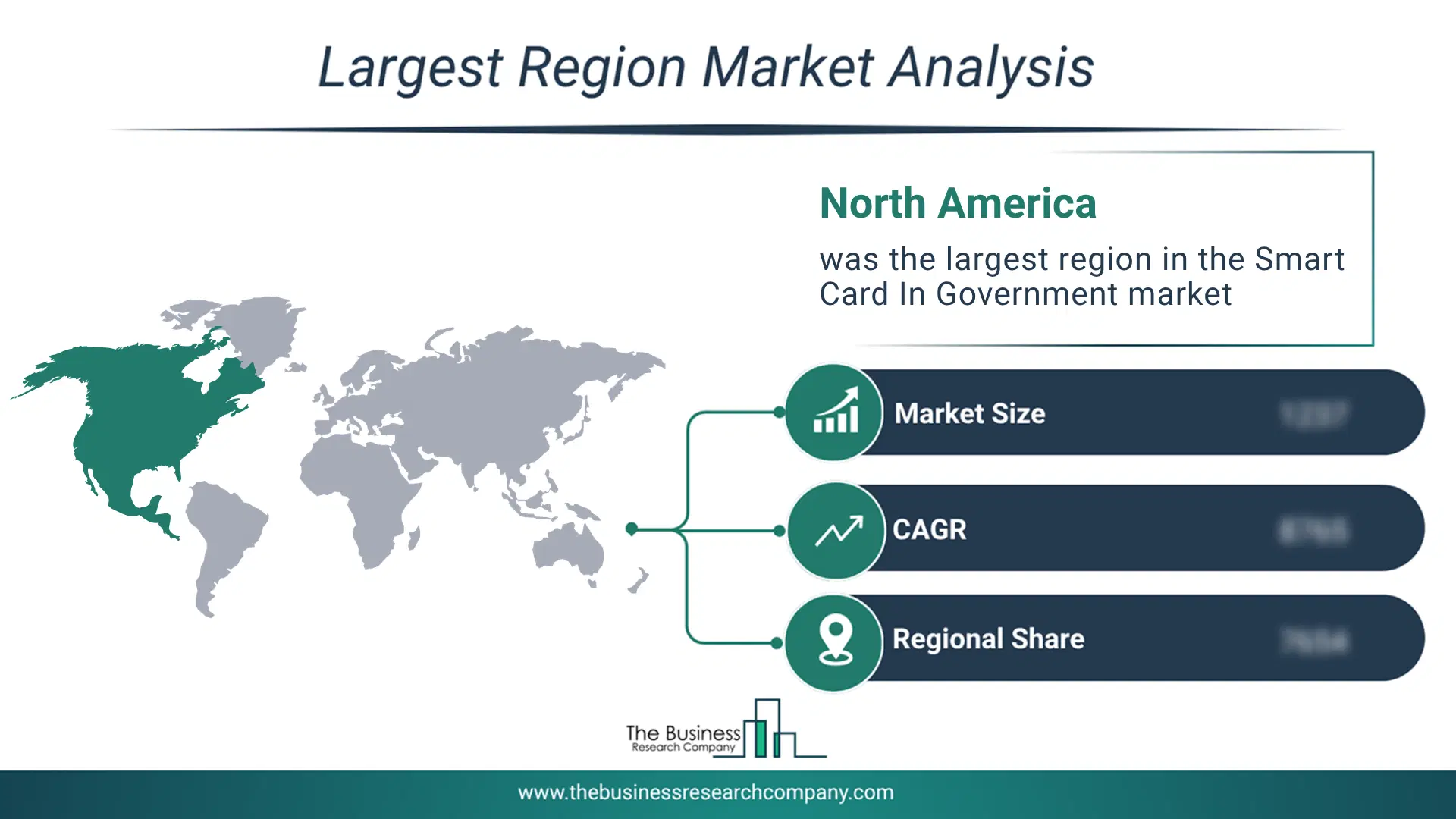
Regional Insights
North America was the largest region in the smart card in government market in 2025. Asia-Pacific is expected to be the fastest-growing region in the forecast period. The regions covered in this market report are Asia-Pacific, South East Asia, Western Europe, Eastern Europe, North America, South America, Middle East, Africa. The countries covered in this market report are Australia, Brazil, China, France, Germany, India, Indonesia, Japan, Taiwan, Russia, South Korea, UK, USA, Canada, Italy, Spain.What Defines the Smart Card In Government Market?
The smart card in government market consists of revenues earned by entities by providing services such as data security and encryption, authentication services, card lifecycle management, and consulting and training. The market value includes the value of related goods sold by the service provider or included within the service offering. The smart card in government market includes sales of biometric scanners, authentication tokens, card issuance kiosks, and secure storage modules. Values in this market are ‘factory gate’ values, that is, the value of goods sold by the manufacturers or creators of the goods, whether to other entities (including downstream manufacturers, wholesalers, distributors, and retailers) or directly to end customers. The value of goods in this market includes related services sold by the creators of the goods.How is Market Value Defined and Measured?
The market value is defined as the revenues that enterprises gain from the sale of goods and/or services within the specified market and geography through sales, grants, or donations in terms of the currency (in USD unless otherwise specified). The revenues for a specified geography are consumption values that are revenues generated by organizations in the specified geography within the market, irrespective of where they are produced. It does not include revenues from resales along the supply chain, either further along the supply chain or as part of other products.
This chart presents market attractiveness based on a quantitative evaluation of growth, competition, strategic alignment, and risk, offering a clear view of opportunity areas for decision-making. This chart is for illustrative purposes; the full report contains the complete analysis.

This chart highlights the Total Addressable Market (TAM) by estimating the maximum revenue opportunity using an assumption-driven approach, supporting strategic planning and opportunity sizing across markets. The chart is illustrative; the full report provides a more comprehensive analysis.
What Key Data and Analysis Are Included in the Smart Card In Government Market Report 2026?
The smart card in government market research report is one of a series of new reports from The Business Research Company that provides market statistics, including industry global market size, regional shares, competitors with the market share, detailed market segments, market trends and opportunities, and any further data you may need to thrive in the smart card in government industry. The market research report delivers a complete perspective of everything you need, with an in-depth analysis of the current and future state of the industry.Smart Card In Government Market Report Forecast Analysis
| Report Attribute | Details |
|---|---|
| Market Size Value In 2026 | $6.87 billion |
| Revenue Forecast In 2030 | $9.93 billion |
| Growth Rate | CAGR of 9.9% from 2026 to 2030 |
| Base Year For Estimation | 2025 |
| Actual Estimates/Historical Data | 2020-2025 |
| Forecast Period | 2026 - 2030 |
| Market Representation | Revenue in USD Billion and CAGR from 2026 to 2030 |
| Segments Covered | Component, Card Type, Technology, Application, End-User |
| Regional Scope | Asia-Pacific, Western Europe, Eastern Europe, North America, South America, Middle East, Africa |
| Country Scope | The countries covered in the report are Australia, Brazil, China, France, Germany, India, Indonesia, Japan, Taiwan, Russia, South Korea, UK, USA, Canada, Italy, Spain. |
| Key Companies Profiled | Thales S.A., Infineon Technologies AG, STMicroelectronics N.V., NXP Semiconductors N.V., Avery Dennison Corporation, Zebra Technologies Corporation, Giesecke+Devrient GmbH, HID Global Corporation, Entrust Inc., SICPA S.A., Mühlbauer Holding AG, Bundesdruckerei GmbH, CPI Card Group Inc., Polska Wytwórnia Papierów Wartościowych S.A., IN Groupe S.A., Evolis S.A., Veridos GmbH, Watchdata Technologies Co. Ltd., KL Hi-Tech Secure Print Limited, PAV CARD GmbH, Madras Security Printers Pvt. Ltd., Matica Technologies AG, ID Smart Cards Creations Pvt. Ltd. |
| Customization Scope | Request for Customization |
| Pricing And Purchase Options | Explore Purchase Options |