

Smart City ICT Infrastructure Market Report 2026
Global Outlook – By Type (Smart Grid, Smart Building, Smart Water Network, Smart Healthcare, Smart Education, Smart Security, Smart Transport), By Components (Hardware, Software, Services), By Deployment Type (On-Premises, Cloud-Based, Hybrid Solutions), By Technology (Internet Of Things, Artificial Intelligence, Big Data Analytics, Cloud Computing), By Application (Communications Industry, Transportation Industry, Express Industry, Government, Education, Other Applications) – Market Size, Trends, Strategies, and Forecast to 2030
Smart City ICT Infrastructure Market Overview
• Smart City ICT Infrastructure market size has reached to $2018.36 billion in 2025 • Expected to grow to $5163.98 billion in 2030 at a compound annual growth rate (CAGR) of 20.6% • Growth Driver: Rising Adoption Of Digital Solutions Driving Growth In The Market Due To Advancements In IoT And Cloud Computing • Market Trend: IoT Integration And Low-Power Network Technologies Driving Efficiency And Automation In Urban Infrastructure • North America was the largest region in 2025 and Asia-Pacific is the fastest growing region.Market Gains By 2030 – Top Opportunities By Segment
Market Gain identifies the most promising market opportunities by highlighting the segments or products expected to generate the highest incremental revenue growth over the next five years.
What Is Covered Under Smart City ICT Infrastructure Market?
Smart city information and communication technology (ICT) infrastructure refers to the integrated framework of digital technologies, including high-speed broadband networks, data centers, internet of things (IoT) devices, cloud computing platforms, and intelligent systems, designed to support real-time data collection, processing, communication, and management across urban services to enhance operational efficiency, sustainability, and quality of life. It is used to enable data-driven decision-making, optimize resource utilization, improve public service delivery, support predictive maintenance, and foster citizen engagement through digitally connected platforms. The main types of smart city ICT infrastructure are smart grid, smart building, smart water network, smart healthcare, smart education, smart security, and smart transport. A smart grid is an advanced electrical grid system that integrates digital communication technologies, sensors, and automation to efficiently monitor, manage, and optimize the generation, distribution, and consumption of electricity in real time. The components in this infrastructure include hardware, software, and services, which are deployed on-premises, cloud-based, and hybrid solutions, with technologies such as the Internet of Things, artificial intelligence, big data analytics, and cloud computing for applications including the communications industry, transportation industry, express industry, government, education, and others.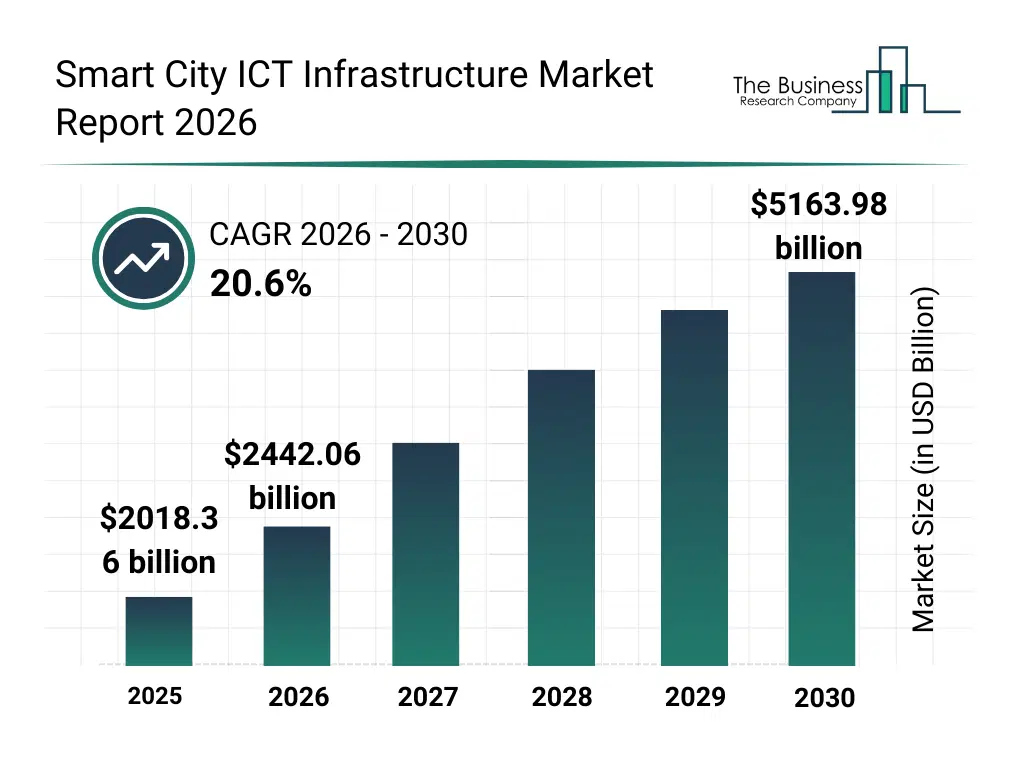
What Is The Smart City ICT Infrastructure Market Size and Share 2026?
The smart city ict infrastructure market size has grown exponentially in recent years. It will grow from $2018.36 billion in 2025 to $2442.06 billion in 2026 at a compound annual growth rate (CAGR) of 21.0%. The growth in the historic period can be attributed to urban population growth, early smart city pilots, expansion of broadband infrastructure, government digitization initiatives, adoption of IoT sensors.What Is The Smart City ICT Infrastructure Market Growth Forecast?
The smart city ict infrastructure market size is expected to see exponential growth in the next few years. It will grow to $5163.98 billion in 2030 at a compound annual growth rate (CAGR) of 20.6%. The growth in the forecast period can be attributed to smart governance investments, expansion of connected infrastructure, demand for data driven urban planning, cybersecurity focused city platforms, sustainable urban development goals. Major trends in the forecast period include integrated urban data platforms, real time city monitoring systems, AI driven urban analytics, cloud based city infrastructure, connected public services.
Global Smart City ICT Infrastructure Market Segmentation
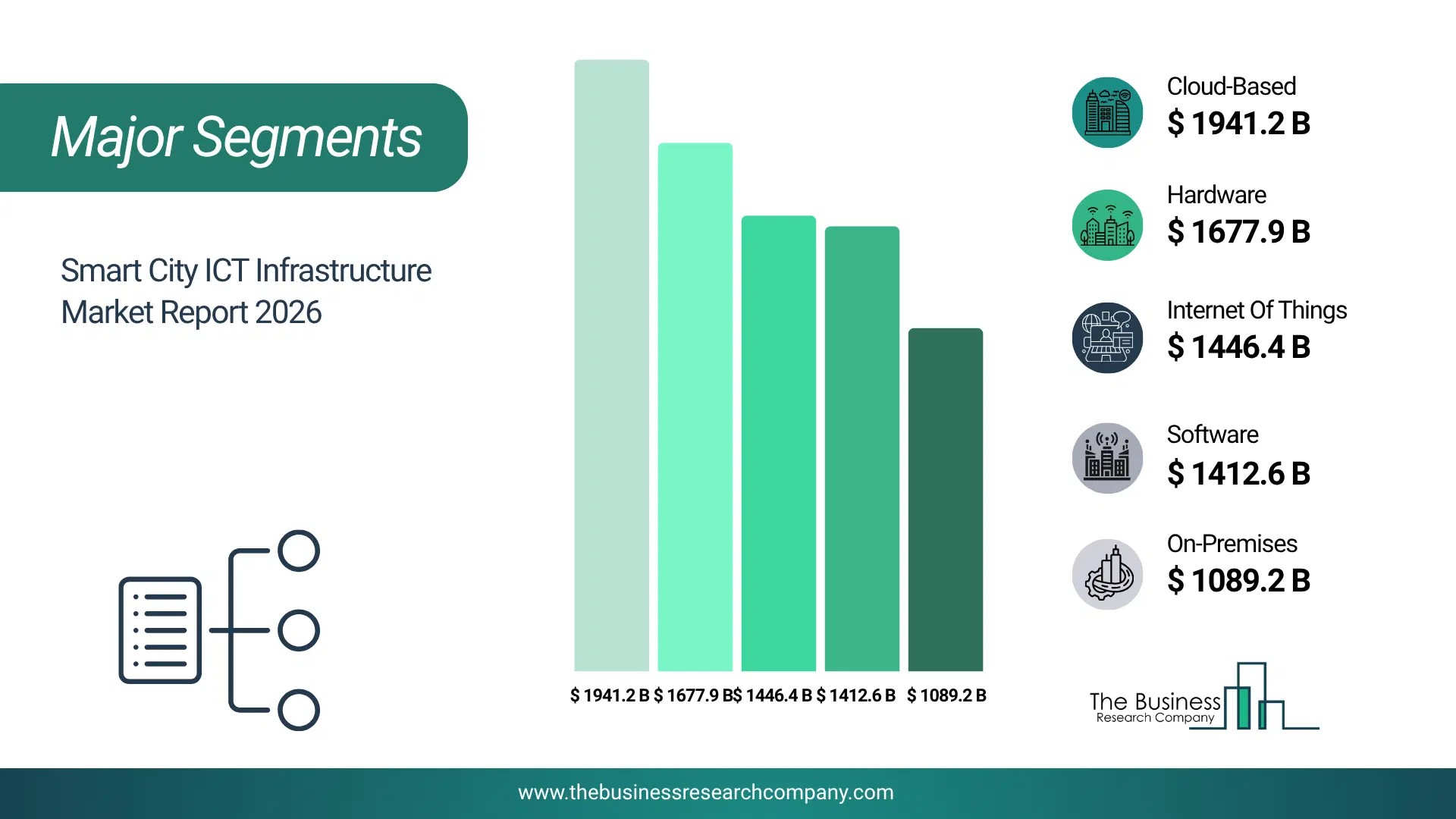
1) By Type: Smart Grid, Smart Building, Smart Water Network, Smart Healthcare, Smart Education, Smart Security, Smart Transport 2) By Components: Hardware, Software, Services 3) By Deployment Type: On-Premises, Cloud-Based, Hybrid Solutions 4) By Technology: Internet Of Things, Artificial Intelligence, Big Data Analytics, Cloud Computing 5) By Application: Communications Industry, Transportation Industry, Express Industry, Government, Education, Other Applications Subsegments: 1) By Smart Grid: Advanced Metering Infrastructure (AMI), Distribution Management System (DMS), Energy Management Systems (EMS), Demand Response, Supervisory Control And Data Acquisition (SCADA) 2) By Smart Building: Building Automation Systems, Energy Management Systems, Smart Lighting, HVAC Control, Security And Access Control Systems 3) By Smart Water Network: Smart Meters, Leak Detection Systems, Pressure Management, Water Quality Monitoring, Advanced Analytics 4) By Smart Healthcare: Remote Patient Monitoring, Electronic Health Records (EHR), Telemedicine, Health Information Systems, Smart Medical Devices 5) By Smart Education: Virtual Classrooms, Learning Management Systems (LMS), Interactive Whiteboards, Smart Content, Student Information Systems 6) By Smart Security: Video Surveillance, Biometric Access Control, Emergency Response Systems, Cybersecurity Solutions, Intrusion Detection Systems 7) By Smart Transport: Intelligent Transportation Systems (ITS), Traffic Management Systems, Smart Parking, Connected Vehicles, Public Transit Management The top segments in the smart city ict infrastructure market will be: • Cloud-Based will reach $1941206.08 Million by 2030. • Hardware will reach $1677974.43 Million by 2030. • Internet Of Things will reach $1446441.8 Million by 2030. • On-Premises will reach $1089267.35 Million by 2030. • Software will reach $1412592.27 Million by 2030.What Is The Driver Of The Smart City ICT Infrastructure Market?
The increase in the adoption of digital solutions is expected to drive the growth of the smart city ICT infrastructure market going forward. Digital solutions refer to technology-driven systems, platforms, and tools that leverage software, data, and connectivity to streamline operations, enhance user experiences, and drive innovation across various sectors. The adoption of digital solution is rising as it enables automation, real-time data access, and improved resource management, all of which contribute to smoother and more efficient operations. Smart city information and communication technology (ICT) Infrastructure provides foundational connectivity, real-time data processing, and integrated platforms necessary to enable the seamless deployment and scalability of digital solutions across urban environments. For instance, in December 2023, according to the European Commission (EC), the Belgium-based executive body of the European Union (EU), the adoption of cloud-based solutions in 2023 in the European Union increased by 4.2 percentage points, with 45.2% of enterprises purchasing cloud computing services, showcasing a notable rise compared to 2021. Therefore, the increase in the adoption of digital solutions drives the smart city ICT infrastructure industry.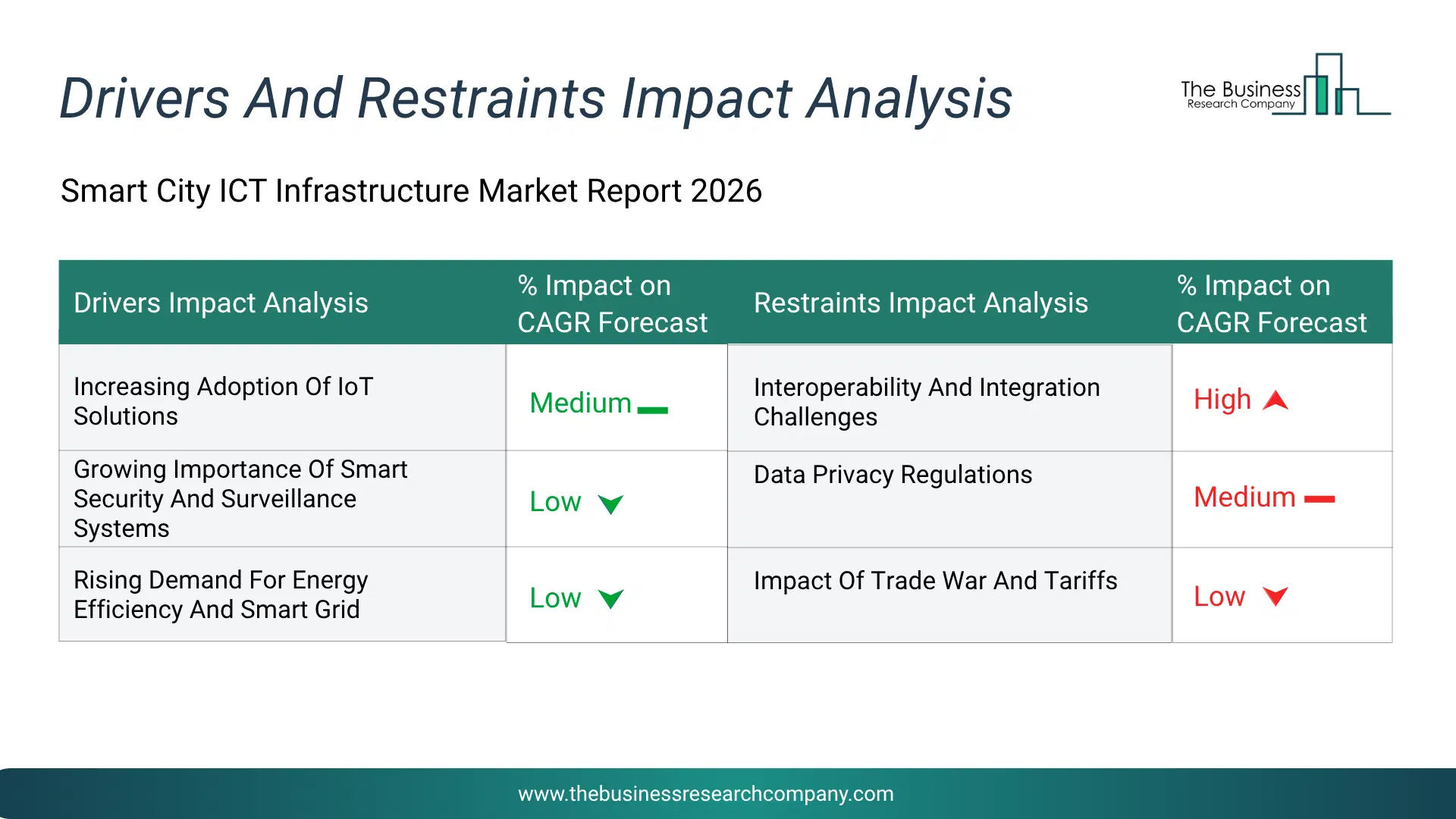
Infographic Chart Showing Key Market Drivers Analysis And Restraints For Smart City Ict Infrastructure Market
The chart presents an impact analysis of key drivers and restraints, quantifying their relative influence on the market's growth rate and helping assess the balance between growth enablers and limiting factors. This chart offers a high-level perspective; the full report contains more detailed insights.
How Will The Drivers Impact Growth In The Global Smart City ICT Infrastructure Market?
• Increasing Adoption Of IoT Solutions (Medium) – During the forecast period, increasing adoption of iot solutions is expected to be a key driver of growth for the smart city ict infrastructures market during the forecast period. expanding deployments of sensors, meters, cameras and connected control devices across utilities, transport networks, buildings and public spaces will significantly increase the volume of real-time data generated at the city level. this surge in connected endpoints will drive sustained demand for robust communication networks, edge computing infrastructure, centralized data centers and cloud-based platforms capable of ingesting, processing and analyzing continuous data streams. as urban authorities move toward predictive maintenance, automated operations and real-time service optimization, ict infrastructure will become the foundational layer that enables interoperability and coordination across multiple city domains. the increased adoption of iot solutions growth contribution during the forecast period in 2025 is 1.0%. • Growing Importance Of Smart Security And Surveillance Systems (Low) – During the forecast period, the global growing importance of smart security and surveillance systems will propel the growth of the smart city ICT infrastructures market. Cities are increasingly adopting networked surveillance cameras, intelligent access control systems and sensor-based monitoring solutions that rely on high-bandwidth connectivity and real-time data processing. These systems require resilient communication backbones, edge analytics capabilities and centralized command-and-control platforms to support continuous monitoring, incident detection and coordinated response. As surveillance systems evolve toward AI-enabled video analytics and automated threat detection, the computational and storage requirements of urban ICT infrastructure will expand significantly. This will stimulate demand for cloud computing resources, high-performance data centers and secure data transmission networks. The global growing importance of smart security and surveillance systems growth contribution during the forecast period in 2025 is 0.8%. • Rising Demand For Energy Efficiency And Smart Grid (Low) – During the forecast period, the rising demand for energy efficiency and smart grid is anticipated to support the growth of the smart city ict infrastructures market in the forecast period. this transition toward smart grids requires extensive ict infrastructure, including connected meters, grid-edge sensors, communication networks, data management platforms and advanced analytics systems. as cities seek to balance fluctuating energy demand, integrate distributed renewable energy sources and improve grid reliability, the volume and complexity of energy data will rise sharply. this will intensify demand for scalable data processing platforms, cloud-based control systems and ai-driven optimization tools. the shift toward automated grid operations and predictive maintenance will further expand the role of ict infrastructure as a core operational backbone for urban energy systems, making smart grid digitalization one of the most structurally important growth drivers in the market. the rising demand for energy efficiency and smart grid growth contribution during the forecast period in 2025 is 0.5%. • Demand For Sustainability, Carbon Reduction, And Climate-Resilient Cities (Low) – During the forecast period, demand for sustainability, carbon reduction and climate-resilient cities are expected to be a key driver of the smart city ict infrastructures market during the forecast period. municipal governments are under growing pressure to monitor emissions, optimize resource consumption, reduce waste and improve the resilience of critical infrastructure to climate-related disruptions. achieving these objectives requires comprehensive digital platforms capable of collecting and analyzing data from energy systems, water networks, transportation infrastructure and environmental sensors. as cities implement integrated sustainability strategies, demand will rise for cloud-based analytics platforms, digital twins and real-time monitoring systems that support scenario modeling, performance tracking and evidence-based policy decisions. ict infrastructure will also play a key role in coordinating cross-sector sustainability initiatives, enabling interoperability between utilities, transport agencies and environmental monitoring systems. the demand for sustainability, carbon reduction and climate-resilient cities growth contribution during the forecast period in 2025 is 0.3%.How Will The Restraints Impact Growth In The Global Smart City ICT Infrastructure Market?
• Interoperability And Integration Challenges (Medium) – During the forecast period, interoperability and integration challenges are restricting the growth of the smart city ict infrastructures market during the forecast period. urban infrastructure environments typically consist of heterogeneous technologies sourced from different vendors, operating on incompatible data standards and communication protocols. integrating these systems into a unified, real-time digital platform is technically complex, time-consuming and costly. lack of standardization increases the risk of vendor lock-in, limits system scalability and reduces flexibility in future upgrades. these technical barriers often delay project rollouts and increase the likelihood of cost overruns and performance shortfalls. as a result, municipal authorities may hesitate to commit to large, multi-domain ict deployments due to concerns about long-term compatibility, operational disruption and system reliability, thereby restraining broader market adoption. growth affected by interoperability and integration challenges across regions during the forecast period in 2025 is -2.0%. • Data Privacy Regulations (Low) – During the forecast period, data privacy regulations are restricting the growth of the smart city ict infrastructures market during the forecast period. compliance with evolving data protection laws imposes strict requirements on how data is collected, stored, processed and shared across interconnected systems. these regulatory obligations increase legal complexity, administrative overhead and implementation costs for smart city projects. uncertainty around cross-border data transfers, data ownership and consent management further complicate large-scale digital infrastructure deployments. in some cases, regulatory scrutiny and public concerns over surveillance and data misuse can delay project approvals or lead to the cancellation of planned initiatives. growth affected by data privacy regulations across regions during the forecast period in 2025 is -1.8%. • Impact Of Trade War And Tariffs (Low) – During the forecast period, the impact of trade war and tariffs is restricting the growth of the smart city ict infrastructures market during the forecast period. smart city deployments rely heavily on globally sourced equipment such as networking devices, sensors, servers, base stations and semiconductor components. tariffs and trade restrictions disrupt supply chains, raise import costs and create price volatility for essential infrastructure hardware. these cost pressures reduce the affordability of large-scale ict projects and strain municipal budgets, particularly in price-sensitive regions. in addition, geopolitical uncertainty complicates long-term planning and vendor sourcing strategies, leading to delays in procurement and deployment timelines. the cumulative effect of higher equipment costs, longer lead times and reduced investment confidence slows the pace of smart city ict infrastructure rollouts, thereby acting as a material restraint on market expansion. growth affected by impact of trade war and tariffs across regions during the forecast period in 2025 is -0.3%.Key Players In The Global Smart City ICT Infrastructure Market
Major companies operating in the smart city ict infrastructure market are Microsoft Corporation, Verizon Communications, AT&T Inc., Deutsche Telekom AG, Huawei Technologies Co. Ltd., Siemens AG, Hitachi Ltd., Accenture, International Business Machines Corporation (IBM), Cisco Systems Inc., Vodafone Group Plc., Oracle Corporation, Telefonica SA, Schneider Electric, Honeywell International Inc., ABB Group, Tata Consultancy Services (TCS), Telefonaktiebolaget LM Ericsson, Nokia Corp., NTT Communications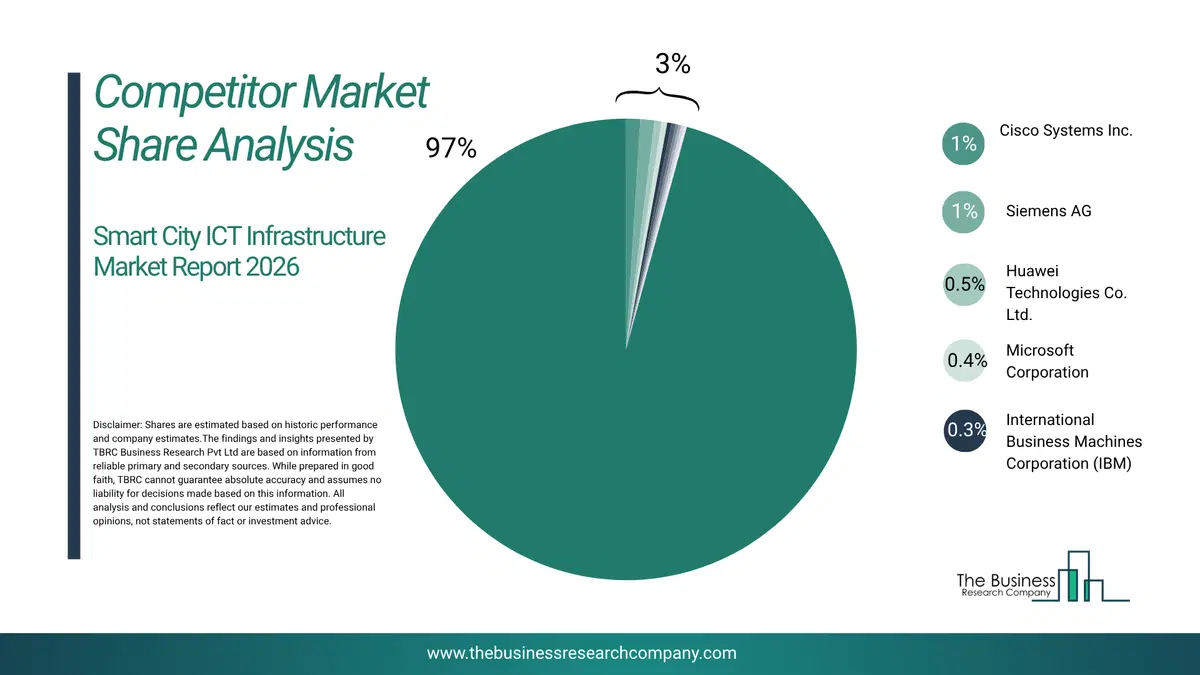
This chart is for illustrative purposes; the full report includes a detailed competitor analysis and comprehensive overview of the top 10 companies in the market.
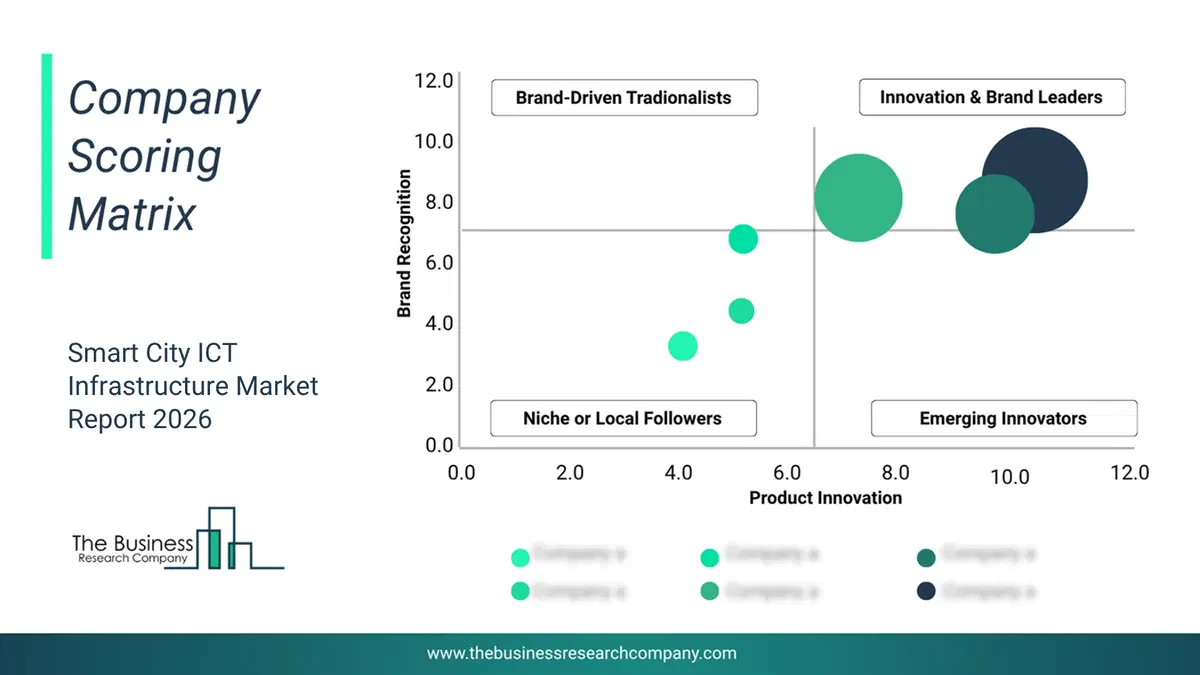
This chart maps companies by product innovation and brand strength, with bubble size indicating relative revenue, helping identify market leaders, challengers, and niche players. This is an illustrative chart; the full report provides a complete and accurate competitive analysis.
Global Smart City ICT Infrastructure Market Trends and Insights
Major companies operating in the smart city ICT infrastructure market are focusing on IoT integration, such as low-power network technologies designed to enhance urban connectivity and automation. These technologies enable efficient management of smart city infrastructure, reducing manual intervention and improving overall efficiency. For instance, in February 2024, British Telecommunications plc, a UK-based telecommunications company, launched a nationwide Narrowband Internet of Things (NB-IoT) network to support the development and expansion of smart city initiatives across the country. This low-power, wide-area network covers 97% of the United Kingdom population and is specifically designed to connect low-data-demand assets such as street lighting and underground water sensors enabling automation, long battery life, and cost-effective operations. The network is expected to significantly enhance efficiency across sectors by enabling real-time monitoring, reducing manual intervention, and laying the digital foundation for large-scale Internet of Things (IoT) deployments in smart cities and beyond.What Are Latest Mergers And Acquisitions In The Smart City ICT Infrastructure Market?
In March 2025, Barcelona City Council, a Spain-based government commission, collaborated with Huawei Technologies Co., Ltd., to accelerate urban digital transformation through strategic collaboration. With this partnership, the aim of Barcelona and Huawei is to jointly design and implement advanced technological frameworks that support intelligent urban management, foster sustainable development, and enhance the overall digital ecosystem of the city. Huawei Technologies Co. Ltd. is a China-based provider of information and communications technology (ICT) infrastructure and smart devices.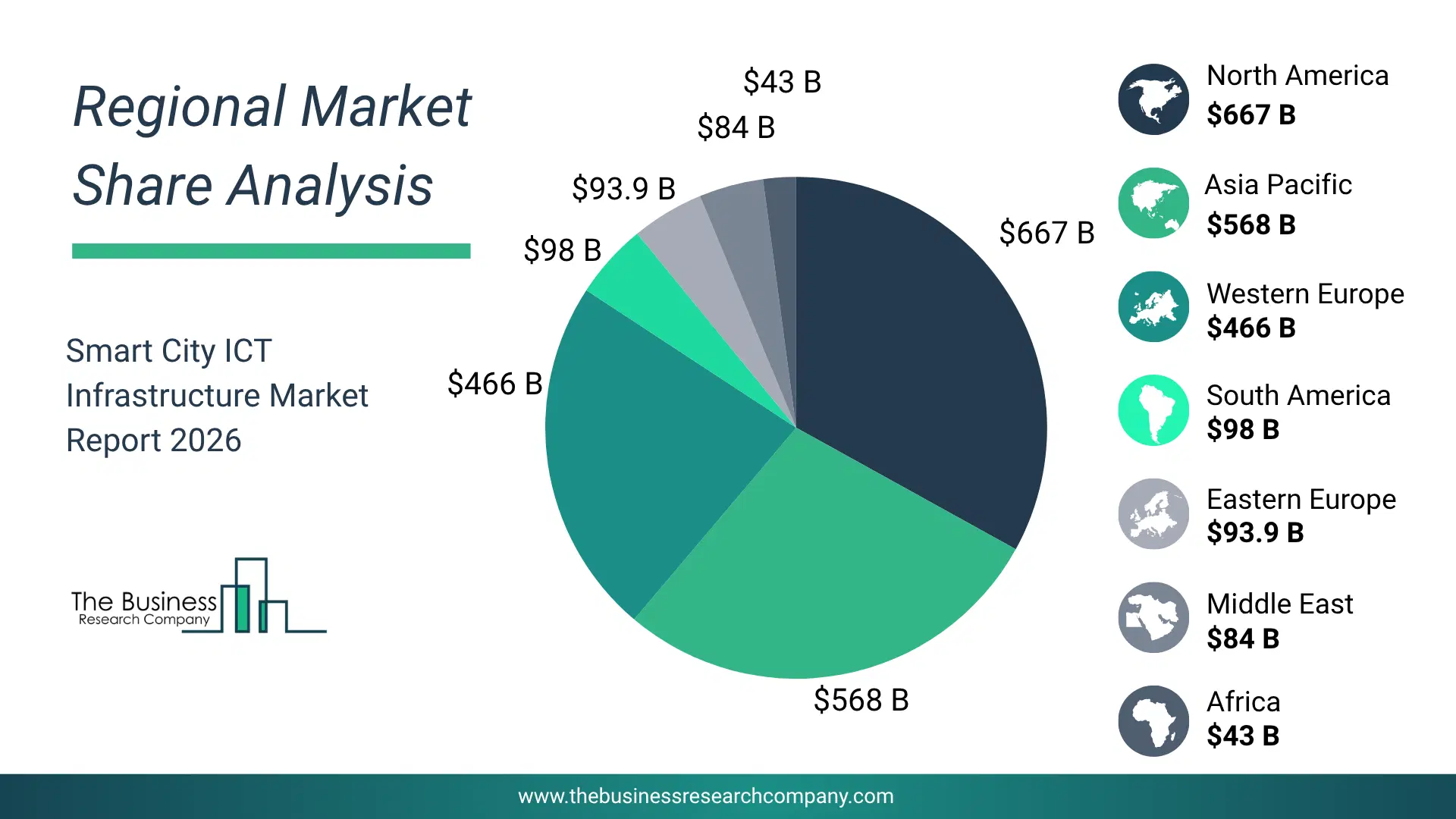
Regional Insights
North America was the largest region in the smart city ICT infrastructure market in 2025. Asia-Pacific is expected to be the fastest-growing region in the forecast period. The regions covered in this market report are Asia-Pacific, South East Asia, Western Europe, Eastern Europe, North America, South America, Middle East, Africa. The countries covered in this market report are Australia, Brazil, China, France, Germany, India, Indonesia, Japan, Taiwan, Russia, South Korea, UK, USA, Canada, Italy, Spain.What Defines the Smart City ICT Infrastructure Market?
The smart city ICT infrastructure market consists of revenues earned by entities by providing ICT services such as data networking, cloud computing, intelligent transportation systems, information distribution technologies, and connected public services. The market value includes the value of related goods sold by the service provider or included within the service offering. The smart city ICT infrastructure market also includes sales of IoT devices, communication networks, and cybersecurity solutions. Values in this market are ‘factory gate’ values, that is the value of goods sold by the manufacturers or creators of the goods, whether to other entities (including downstream manufacturers, wholesalers, distributors and retailers) or directly to end customers. The value of goods in this market includes related services sold by the creators of the goods.How is Market Value Defined and Measured?
The market value is defined as the revenues that enterprises gain from the sale of goods and/or services within the specified market and geography through sales, grants, or donations in terms of the currency (in USD unless otherwise specified). The revenues for a specified geography are consumption values that are revenues generated by organizations in the specified geography within the market, irrespective of where they are produced. It does not include revenues from resales along the supply chain, either further along the supply chain or as part of other products.
This chart presents market attractiveness based on a quantitative evaluation of growth, competition, strategic alignment, and risk, offering a clear view of opportunity areas for decision-making. This chart is for illustrative purposes; the full report contains the complete analysis.

This chart highlights the Total Addressable Market (TAM) by estimating the maximum revenue opportunity using an assumption-driven approach, supporting strategic planning and opportunity sizing across markets. The chart is illustrative; the full report provides a more comprehensive analysis.
What Key Data and Analysis Are Included in the Smart City ICT Infrastructure Market Report 2026?
The smart city ict infrastructure market research report is one of a series of new reports from The Business Research Company that provides market statistics, including industry global market size, regional shares, competitors with the market share, detailed market segments, market trends and opportunities, and any further data you may need to thrive in the smart city ict infrastructure industry. The market research report delivers a complete perspective of everything you need, with an in-depth analysis of the current and future state of the industry.Smart City ICT Infrastructure Market Report Forecast Analysis
| Report Attribute | Details |
|---|---|
| Market Size Value In 2026 | $2442.06 billion |
| Revenue Forecast In 2030 | $5163.98 billion |
| Growth Rate | CAGR of 21.0% from 2026 to 2030 |
| Base Year For Estimation | 2025 |
| Actual Estimates/Historical Data | 2020-2025 |
| Forecast Period | 2026 - 2030 - 2035 |
| Market Representation | Revenue in USD Billion and CAGR from 2026 to 2030 |
| Segments Covered | Type, Components, Deployment Type, Technology, Application |
| Regional Scope | Asia-Pacific, Western Europe, Eastern Europe, North America, South America, Middle East, Africa |
| Country Scope | The countries covered in the report are Australia, Brazil, China, France, Germany, India, Indonesia, Japan, Taiwan, Russia, South Korea, UK, USA, Canada, Italy, Spain. |
| Key Companies Profiled | Microsoft Corporation, Verizon Communications, AT&T Inc., Deutsche Telekom AG, Huawei Technologies Co. Ltd., Siemens AG, Hitachi Ltd., Accenture, International Business Machines Corporation (IBM), Cisco Systems Inc., Vodafone Group Plc., Oracle Corporation, Telefonica SA, Schneider Electric, Honeywell International Inc., ABB Group, Tata Consultancy Services (TCS), Telefonaktiebolaget LM Ericsson, Nokia Corp., NTT Communications |
| Customization Scope | Request for Customization |
| Pricing And Purchase Options | Explore Purchase Options |