
Smart City Platforms Market Report 2026
Global Outlook – By Offering (Platforms, Services), By Deployment Model (On Premise, Cloud), By Delivery Model (Offshore, Hybrid, Onshore), By Application (Smart Infrastructure, Smart Governance and Smart Education, Smart Energy, Smart Mobility, Smart Healthcare, Smart Buildings, Other Applications) – Market Size, Trends, Strategies, and Forecast to 2030
Smart City Platforms Market Overview
• Smart City Platforms market size has reached to $217.98 billion in 2025 • Expected to grow to $390.87 billion in 2030 at a compound annual growth rate (CAGR) of 12.2% • Growth Driver: Advanced Technology Drive Accelerates Smart City Platform Market Growth • Market Trend: AI-Powered Urban Solutions Revolutionize City Efficiency And Sustainability • North America was the largest region in 2025.What Is Covered Under Smart City Platforms Market?
Smart city platforms refer to an open technological architecture that enables towns to connect to their own current systems and is intended to share municipal information with residents or other entities who need it. They are used to promote innovation and increase cross-sectoral interoperability. The major offerings of smart city platforms are platforms and services. Platforms refer to a group of technologies that are enabled as a base on which other applications, technologies, or processes are developed. It can be deployed in two ways such as on-premise and cloud. The delivery models include offshore, hybrid, and onshore. Several applications include smart infrastructure, smart governance, smart education, smart energy, smart mobility, smart healthcare, smart buildings, and others.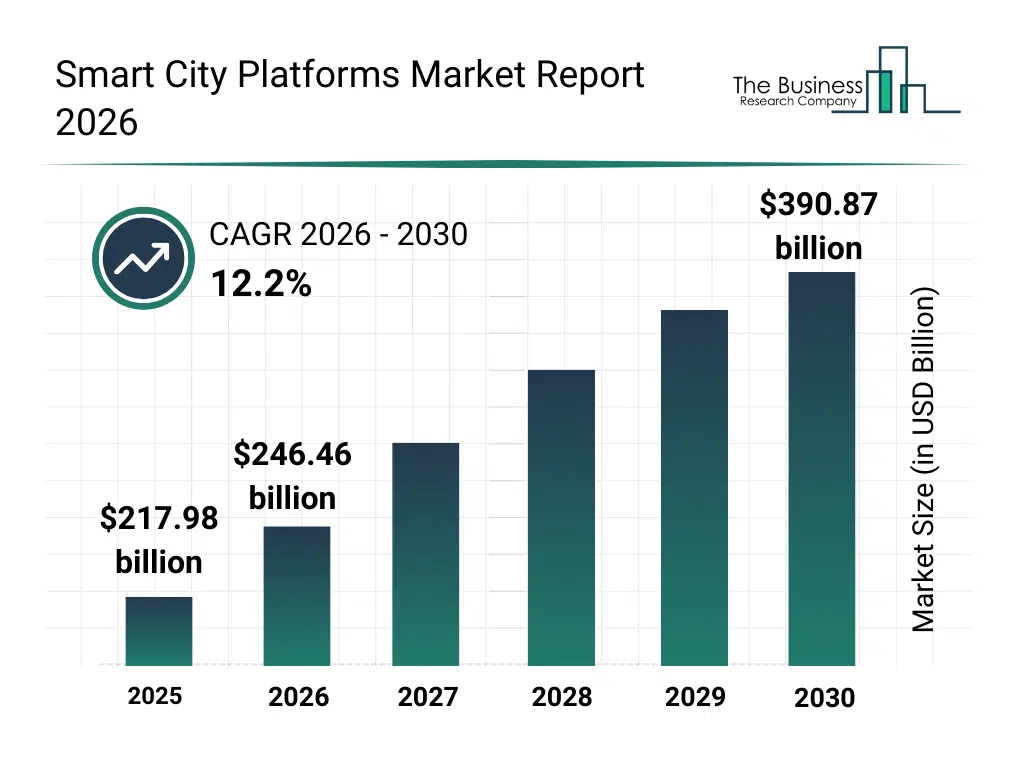
What Is The Smart City Platforms Market Size and Share 2026?
The smart city platforms market size has grown rapidly in recent years. It will grow from $217.98 billion in 2025 to $246.46 billion in 2026 at a compound annual growth rate (CAGR) of 13.1%. The growth in the historic period can be attributed to rise of digital municipal systems, initial smart city pilots, government funding for urban ict projects, early integration of urban sensors, demand for data-driven decision making.What Is The Smart City Platforms Market Growth Forecast?
The smart city platforms market size is expected to see rapid growth in the next few years. It will grow to $390.87 billion in 2030 at a compound annual growth rate (CAGR) of 12.2%. The growth in the forecast period can be attributed to expansion of cloud-based city platforms, adoption of ai-powered analytics, integration of multi-sector platforms, growth of citizen-centric digital services, deployment of interoperable municipal ecosystems. Major trends in the forecast period include cross-sectoral data interoperability, citizen engagement & feedback systems, real-time urban monitoring, predictive analytics for municipal services, platform-based innovation hubs.
Global Smart City Platforms Market Segmentation
1) By Offering: Platforms, Services 2) By Deployment Model: On Premise, Cloud 3) By Delivery Model: Offshore, Hybrid, Onshore 4) By Application: Smart Infrastructure, Smart Governance and Smart Education, Smart Energy, Smart Mobility, Smart Healthcare, Smart Buildings, Other Applications Subsegments: 1) By Platforms: Smart Mobility Platforms, Smart Energy Platforms, Smart Water Management Platforms, Smart Waste Management Platforms, Smart Lighting Platforms 2) By Services: Consulting Services, Integration Services, Data Analytics Services, Maintenance And Support Services, Training And Development ServicesWhat Is The Driver Of The Smart City Platforms Market?
The rise in advanced technology is expected to propel the growth of the smart city platform market going forward. Advancement in technology refers to the development and improvement of technologies or applied sciences that become more precise, accurate, efficient, powerful, or capable. The advancement in technology is helpful in smart city platforms through the use of advanced technologies and data-driven solutions to enhance the quality of life. This includes the implementation of smart grids for efficient energy distribution, intelligent transportation systems to improve traffic flow, sensors for measuring air quality, and e-governance platforms for citizen engagement and improved governance. For instance, in January 2024, according to PricewaterhouseCoopers International Limited a UK-based professional services firm, in early 2024, about 73% of U.S. companies have adopted artificial intelligence (AI), with more than half also using generative AI (GenAI) solutions, indicating a significant increase in technology integration across various industries. Therefore, the rise in advanced technology is driving the growth of the smart city platforms industry.Key Players In The Global Smart City Platforms Market
Major companies operating in the smart city platforms market are Alphabet Inc.; Microsoft Corporation; Alibaba Group Holding Limited; AT&T Inc.; Dell Technologies Inc.; Huawei Technologies Co Ltd.; Hitachi Ltd.; Amazon Web Services Inc.; Siemens AG; General Electric Company; Intel Corporation; International Business Machines Corporation; Cisco Systems Inc.; Qualcomm Technologies Inc.; Oracle Corporation; Honeywell International Inc.; SAP SE; Schneider Electric SE; ABB Ltd; Johnson Controls International plc; NEC Corporation; SAS Institute Inc.; Advantech Co Ltd.; Cubic Corporation; Cradlepoint Inc.; Bosch IO GmbH; Quantela Inc.
This chart is for illustrative purposes; the full report includes a detailed competitor analysis and comprehensive overview of the top 10 companies in the market.
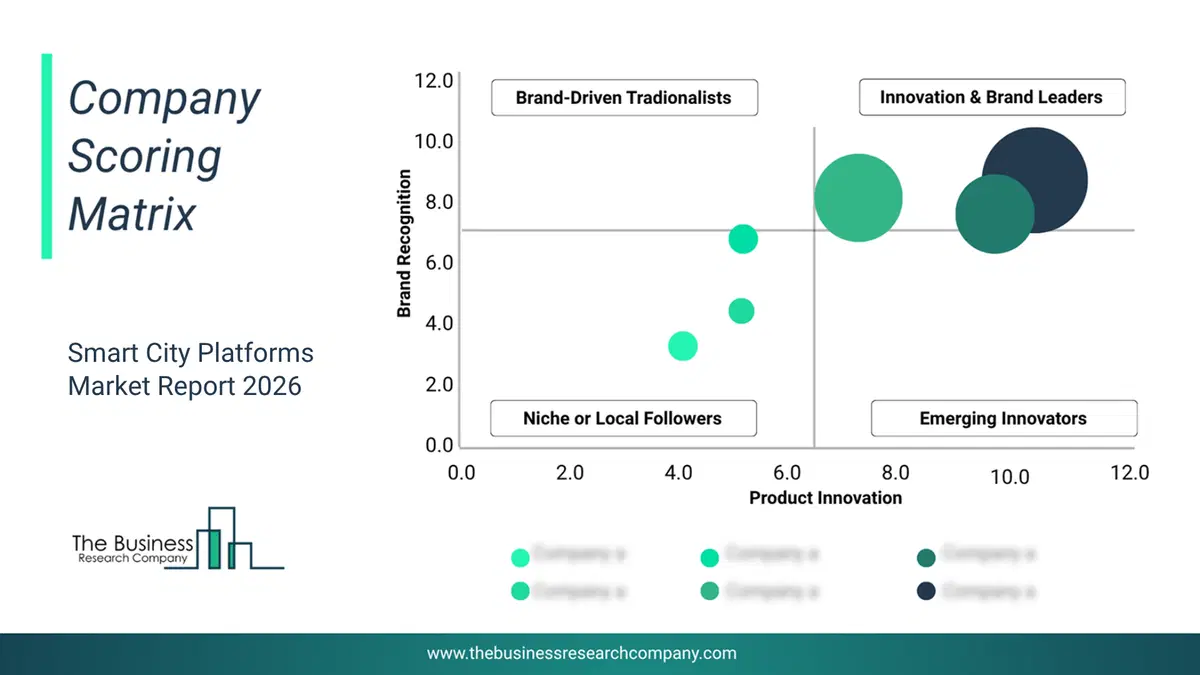
This chart maps companies by product innovation and brand strength, with bubble size indicating relative revenue, helping identify market leaders, challengers, and niche players. This is an illustrative chart; the full report provides a complete and accurate competitive analysis.
Global Smart City Platforms Market Trends and Insights
Major companies in the smart city platforms market are focusing on developing innovative solutions such as AI-powered urban management to enhance city efficiency and sustainability. AI-powered urban management is the use of artificial intelligence to monitor, analyze, and optimize city operations such as traffic, energy, safety, and public services for smarter and more efficient urban living. For instance, in November 2025, Zhejiang Dahua Technology Co. Ltd., a China-based publicly traded company, launched next-generation smart city solutions powered by Xinghan Large-scale AI Models at the 2025 Smart City Expo World Congress (SCEWC) in Barcelona, under the theme "Together for a Sustainable Future." These solutions feature real-time, integrated monitoring with AI-driven emergency response, dynamic traffic management without requiring additional infrastructure, and intelligent fleet safety systems that promote green transportation. They also enable unified city governance through AI-powered interactions and enhance environmental protection using AI, IoT, and drone-based sensing for early hazard detection.What Are Latest Mergers And Acquisitions In The Smart City Platforms Market?
In August 2024, Routeware, Inc., a US-based technology company, acquired Wastech, Inc. for an undisclosed amount. With this acquisition, Routeware aimed to enhance its product suite and strengthen its offerings for municipal and hauler customers by integrating complementary software platforms. Wastech Inc. is a US-based company that specializes in providing smart city platforms, particularly through their ownership of the rubiconsmartcity platform, which is designed for municipalities and local governments.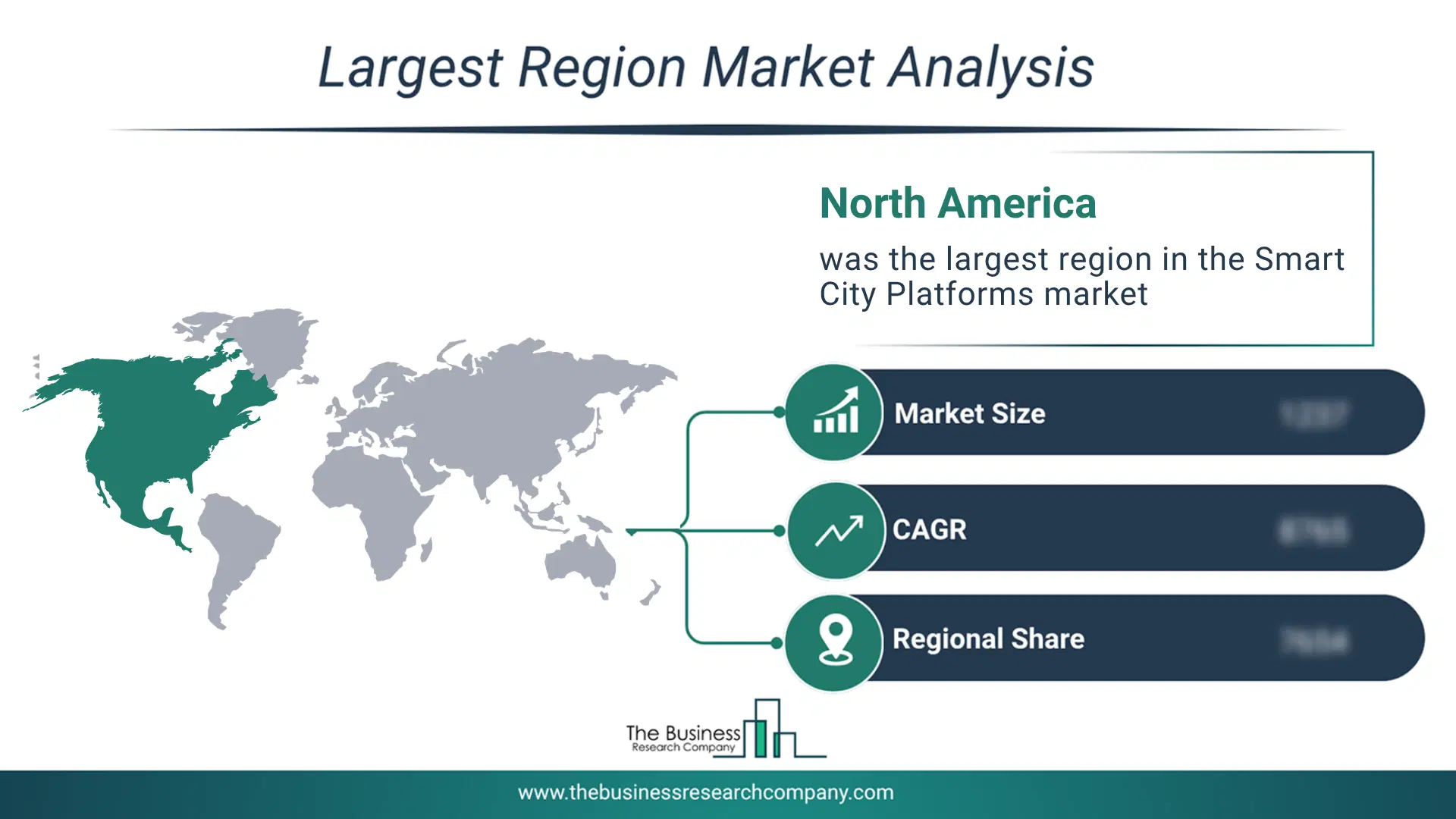
Regional Insights
North America was the largest region in the smart city platforms market in 2025. The regions covered in this market report are Asia-Pacific, South East Asia, Western Europe, Eastern Europe, North America, South America, Middle East, Africa. The countries covered in this market report are Australia, Brazil, China, France, Germany, India, Indonesia, Japan, Taiwan, Russia, South Korea, UK, USA, Canada, Italy, SpainWhat Defines the Smart City Platforms Market?
The smart city platforms market consists of revenues earned by entities by providing smart city platform services such as security management, mobility, and smart city lightings. The market value includes the value of related goods sold by the service provider or included within the service offering. The smart city platforms market also includes sales of automation systems, emergency management systems, and security and access control systems, which are used in providing smart city platform services. Values in this market are ‘factory gate’ values, that is the value of goods sold by the manufacturers or creators of the goods, whether to other entities (including downstream manufacturers, wholesalers, distributors and retailers) or directly to end customers. The value of goods in this market includes related services sold by the creators of the goods.How is Market Value Defined and Measured?
The market value is defined as the revenues that enterprises gain from the sale of goods and/or services within the specified market and geography through sales, grants, or donations in terms of the currency (in USD unless otherwise specified). The revenues for a specified geography are consumption values that are revenues generated by organizations in the specified geography within the market, irrespective of where they are produced. It does not include revenues from resales along the supply chain, either further along the supply chain or as part of other products.
This chart presents market attractiveness based on a quantitative evaluation of growth, competition, strategic alignment, and risk, offering a clear view of opportunity areas for decision-making. This chart is for illustrative purposes; the full report contains the complete analysis.

This chart highlights the Total Addressable Market (TAM) by estimating the maximum revenue opportunity using an assumption-driven approach, supporting strategic planning and opportunity sizing across markets. The chart is illustrative; the full report provides a more comprehensive analysis.
What Key Data and Analysis Are Included in the Smart City Platforms Market Report 2026?
The smart city platforms market research report is one of a series of new reports from The Business Research Company that provides market statistics, including industry global market size, regional shares, competitors with the market share, detailed market segments, market trends and opportunities, and any further data you may need to thrive in the smart city platforms industry. The market research report delivers a complete perspective of everything you need, with an in-depth analysis of the current and future state of the industry.Smart City Platforms Market Report Forecast Analysis
| Report Attribute | Details |
|---|---|
| Market Size Value In 2026 | $246.46 billion |
| Revenue Forecast In 2030 | $390.87 billion |
| Growth Rate | CAGR of 12.2% from 2026 to 2030 |
| Base Year For Estimation | 2025 |
| Actual Estimates/Historical Data | 2020-2025 |
| Forecast Period | 2026 - 2030 |
| Market Representation | Revenue in USD Billion and CAGR from 2026 to 2030 |
| Segments Covered | Offering, Deployment Model, Delivery Model, Application |
| Regional Scope | Asia-Pacific, Western Europe, Eastern Europe, North America, South America, Middle East, Africa |
| Country Scope | The Countries Covered In This Market Report Are Australia, Brazil, China, France, Germany, India, Indonesia, Japan, Taiwan, Russia, South Korea, Uk, Usa, Canada, Italy, Spain. |
| Key Companies Profiled | Alphabet Inc., Microsoft Corporation, Alibaba Group Holding Limited, AT&T Inc., Dell Technologies Inc., Huawei Technologies Co Ltd., Hitachi Ltd., Amazon Web Services Inc., Siemens AG, General Electric Company, Intel Corporation, International Business Machines Corporation, Cisco Systems Inc., Qualcomm Technologies Inc., Oracle Corporation, Honeywell International Inc., SAP SE, Schneider Electric SE, ABB Ltd, Johnson Controls International plc, NEC Corporation, SAS Institute Inc., Advantech Co Ltd., Cubic Corporation, Cradlepoint Inc., Bosch IO GmbH, Quantela Inc. |
| Customization Scope | Request for Customization |
| Pricing And Purchase Options | Explore Purchase Options |