
Smart Clock Market Report 2026
Global Outlook – By Product Type (Health-Monitoring Smart Clocks, Sleep-Tracking Smart Clocks, Fitness-Integrated Smart Clocks, Standard Connected Smart Clocks), By Connectivity Type (Wi-Fi Enabled Smart Clocks, Bluetooth Enabled Smart Clocks, Wi-Fi And Bluetooth Enabled Smart Clocks), By Operating System and Platform (Android-Compatible Smart Clocks, iOS-Compatible Smart Clocks, Proprietary OS Smart Clocks), By Application (Personal Home Use, Sleep And Wellness Monitoring, Elderly Care And Health Monitoring, Child Monitoring And Smart Alarm Use), By End User (Children, Adults, Geriatric Population6) By Distribution Channel (Online Retail, Specialty Electronics Stores, Supermarkets And Hypermarkets, Other Distribution Channels) – Market Size, Trends, Strategies, and Forecast to 2030
Smart Clock Market Overview
• Smart Clock market size has reached to $1.3 billion in 2025 • Expected to grow to $2.88 billion in 2030 at a compound annual growth rate (CAGR) of 17.3% • Growth Driver: Connected Devices Behind the Growth of the Smart Clock Market • Market Trend: Increasing Focus On Smart Clocks With Wireless Charging Technology • North America was the largest region in 2025.What Is Covered Under Smart Clock Market?
A smart clock refers to a type of digital clock that integrates advanced technology and connectivity features that serve the basic purpose of traditional clocks by displaying the time and providing alarm features. These clocks come equipped with health-monitoring features such as heart rate tracking, sleep analysis, and activity tracking. The main types of smart clocks are iOS system clocks, android system clocks, and others. Android system clocks pertain to the timekeeping features embedded within the Android operating system. These are distributed through various distribution channels such as specialty stores, online, and other distribution channels. These are used in various applications such as children, adults, and others.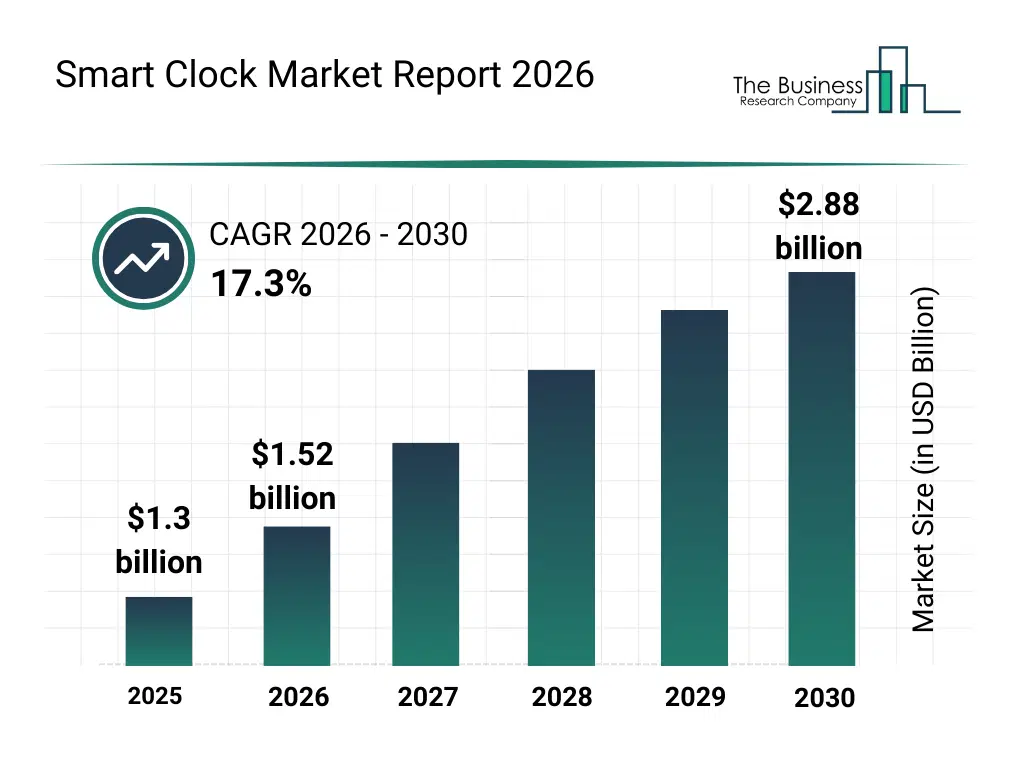
What Is The Smart Clock Market Size and Share 2026?
The smart clock market size has grown rapidly in recent years. It will grow from $1.3 billion in 2025 to $1.52 billion in 2026 at a compound annual growth rate (CAGR) of 17.0%. The growth in the historic period can be attributed to expansion of smart home adoption, growth in consumer electronics usage, rising demand for connected lifestyle devices, increasing penetration of voice assistants, availability of affordable smart devices.What Is The Smart Clock Market Growth Forecast?
The smart clock market size is expected to see rapid growth in the next few years. It will grow to $2.88 billion in 2030 at a compound annual growth rate (CAGR) of 17.3%. The growth in the forecast period can be attributed to increasing focus on personal wellness monitoring, expansion of smart home ecosystems, growing adoption of AI-powered personal assistants, rising demand for multifunctional consumer devices, increasing integration with wearable technologies. Major trends in the forecast period include increasing integration of health monitoring features, rising demand for voice-assistant enabled clocks, growing adoption of smart home compatible devices, expansion of sleep tracking capabilities, enhanced focus on user-centric design.
Global Smart Clock Market Segmentation
1) By Product Type: Health-Monitoring Smart Clocks, Sleep-Tracking Smart Clocks, Fitness-Integrated Smart Clocks, Standard Connected Smart Clocks 2) By Connectivity Type: Wi-Fi Enabled Smart Clocks, Bluetooth Enabled Smart Clocks, Wi-Fi And Bluetooth Enabled Smart Clocks 3) By Operating System and Platform: Android-Compatible Smart Clocks, iOS-Compatible Smart Clocks, Proprietary OS Smart Clocks 4) By Application: Personal Home Use, Sleep And Wellness Monitoring, Elderly Care And Health Monitoring, Child Monitoring And Smart Alarm Use 5) By End User: Children, Adults, Geriatric Population 6) By Distribution Channel: Online Retail, Specialty Electronics Stores, Supermarkets And Hypermarkets, Other Distribution Channels Subsegments: 1) By Health-Monitoring Smart Clocks: Heart Rate Monitoring Clocks, Multi-Vital Monitoring Clocks, Elderly Health Monitoring Clocks 2) By Sleep-Tracking Smart Clocks: Sleep Stage Analysis Clocks, Smart Alarm And Circadian Rhythm Clocks, Light-Based Sleep Therapy Clocks 3) By Fitness-Integrated Smart Clocks: Activity And Step Tracking Clocks, Calorie And Movement Monitoring Clocks, Workout And Daily Fitness Tracking Clocks 4) By Standard Connected Smart Clocks: Wi-Fi Enabled Smart Clocks, Bluetooth Enabled Smart Clocks, App-Connected Smart Alarm ClocksWhat Is The Driver Of The Smart Clock Market?
The increasing demand for smart and connected devices is expected to fuel the growth of the smart clock market going forward. Smart and connected devices refer to appliances that are enhanced with internet connectivity and advanced computing capabilities. The increasing adoption of connected devices can be attributed to a combination of factors such as convenience, health monitoring, remote work, and evolving lifestyle trends. Smart clocks can be integrated into a broader smart home ecosystem, allowing them to interact with other connected devices such as smart lights, thermostats, and security systems. For instance, in December 2024, according to GOV.UK, a U.K.-based government agency reported that the total number of consumer IoT connected devices worldwide will exceed 17 billion in 2030. Therefore, the increasing demand for smart and connected devices across the globe is driving the smart clock industry.Key Players In The Global Smart Clock Market
Major companies operating in the smart clock market are Samsung Electronics Co. Ltd., Xiaomi Corporation, Lenovo Group Limited, Huawei Technologies Co. Ltd., LG Electronics Inc., Koninklijke Philips N.V., Panasonic Holdings Corporation, Sony Group Corporation, AsusTek Computer Inc., Timex Group USA Inc., iHome Inc., Hatch Retail Inc., Withings SAS, LaMetric Ltd., Garmin Ltd., Casio Computer Co. Ltd., Sharp Corporation, JBL Inc., Bose Corporation, Anker Innovations Limited
This chart is for illustrative purposes; the full report includes a detailed competitor analysis and comprehensive overview of the top 10 companies in the market.
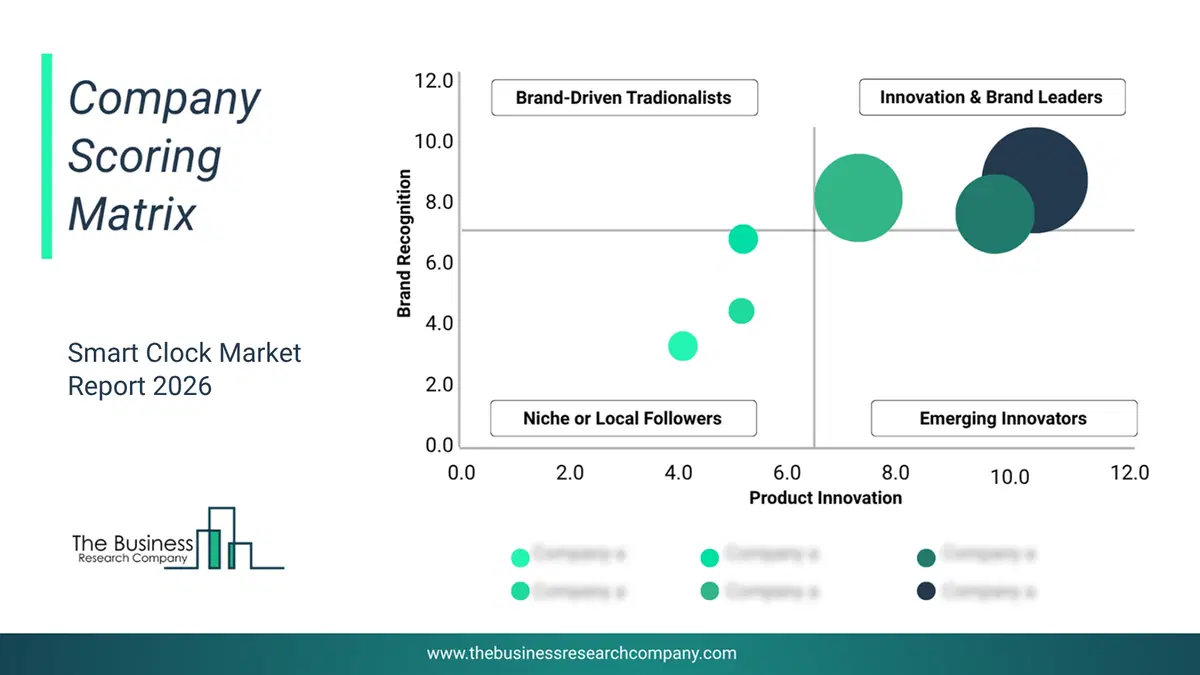
This chart maps companies by product innovation and brand strength, with bubble size indicating relative revenue, helping identify market leaders, challengers, and niche players. This is an illustrative chart; the full report provides a complete and accurate competitive analysis.
Global Smart Clock Market Trends and Insights
Major companies operating in the smart clock market are focused on developing innovative products with advanced technologies, such as digital alarm clocks with wireless charging, to increase their profitability in the market. With the integration of wireless charging into the smart clock, users can easily incorporate charging into their daily routines without the need for separate charging pads or cables, creating a more cohesive and user-friendly experience. For instance, in January 2024, Portronics, an India-based company that provides innovative, digital, and portable solutions, launched Bella. This is a versatile 3-in-1 wireless charger with a clutter-free design, digital alarm clock, and adjustable display brightness. It intelligently and quickly charges Qi-enabled smartphones, TWS earphones, and smartwatches with wide compatibility and convenient features such as auto time saving; it offers convenience and durability.What Are Latest Mergers And Acquisitions In The Smart Clock Market?
In November 2023, SiTime Corporation, a US-based provider of precision MEMS timing semiconductors, oscillators, and clock generators, acquired the clock products and licensed clock intellectual property of Aura Semiconductor for $148 million in fixed payments plus up to $120 million in earnouts. Through this acquisition, SiTime aims to strengthen its semiconductor timing portfolio by integrating Aura’s advanced clock technologies and expanding its presence in precision timing and smart clock applications. Aura Semiconductor is an India-based semiconductor company that provides mixed-signal integrated circuits, including clock generators, oscillators, and IoT radio solutions.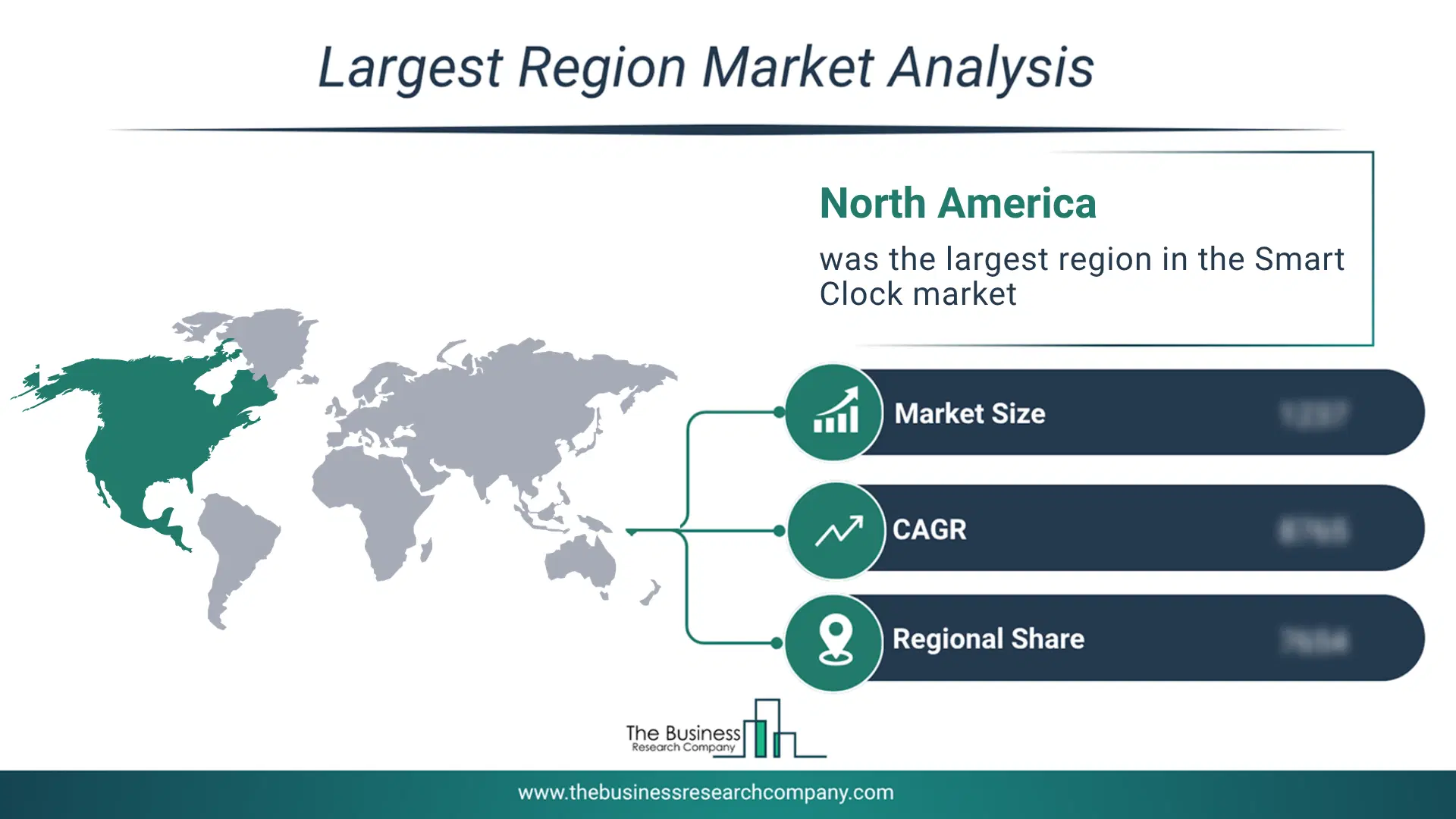
Regional Insights
North America was the largest region in the smart clock market in 2025. The regions covered in this market report are Asia-Pacific, South East Asia, Western Europe, Eastern Europe, North America, South America, Middle East, Africa. The countries covered in this market report are Australia, Brazil, China, France, Germany, India, Indonesia, Japan, Taiwan, Russia, South Korea, UK, USA, Canada, Italy, Spain.What Defines the Smart Clock Market?
The smart clock market consists of sales of digital smart clocks, voice-activated smart clocks, touchscreen smart clocks, health and fitness tracking smart clocks, and smart clocks with internet connectivity. Values in this market are ‘factory gate’ values, that is the value of goods sold by the manufacturers or creators of the goods, whether to other entities (including downstream manufacturers, wholesalers, distributors, and retailers) or directly to end customers. The value of goods in this market includes related services sold by the creators of the goods.How is Market Value Defined and Measured?
The market value is defined as the revenues that enterprises gain from the sale of goods and/or services within the specified market and geography through sales, grants, or donations in terms of the currency (in USD unless otherwise specified). The revenues for a specified geography are consumption values that are revenues generated by organizations in the specified geography within the market, irrespective of where they are produced. It does not include revenues from resales along the supply chain, either further along the supply chain or as part of other products.
This chart presents market attractiveness based on a quantitative evaluation of growth, competition, strategic alignment, and risk, offering a clear view of opportunity areas for decision-making. This chart is for illustrative purposes; the full report contains the complete analysis.

This chart highlights the Total Addressable Market (TAM) by estimating the maximum revenue opportunity using an assumption-driven approach, supporting strategic planning and opportunity sizing across markets. The chart is illustrative; the full report provides a more comprehensive analysis.
What Key Data and Analysis Are Included in the Smart Clock Market Report 2026?
The smart clock market research report is one of a series of new reports from The Business Research Company that provides market statistics, including industry global market size, regional shares, competitors with the market share, detailed market segments, market trends and opportunities, and any further data you may need to thrive in the smart clock industry. The market research report delivers a complete perspective of everything you need, with an in-depth analysis of the current and future state of the industry.Smart Clock Market Report Forecast Analysis
| Report Attribute | Details |
|---|---|
| Market Size Value In 2026 | $1.52 billion |
| Revenue Forecast In 2030 | $2.88 billion |
| Growth Rate | CAGR of 17.3% from 2026 to 2030 |
| Base Year For Estimation | 2025 |
| Actual Estimates/Historical Data | 2020-2025 |
| Forecast Period | 2026 - 2030 |
| Market Representation | Revenue in USD Billion and CAGR from 2026 to 2030 |
| Segments Covered | Product Type, Connectivity Type, Operating System and Platform, Application, End User, Distribution Channel |
| Regional Scope | Asia-Pacific, Western Europe, Eastern Europe, North America, South America, Middle East, Africa |
| Country Scope | The Countries Covered In This Market Report Are Australia, Brazil, China, France, Germany, India, Indonesia, Japan, Taiwan, Russia, South Korea, Uk, Usa, Canada, Italy, Spain. |
| Key Companies Profiled | Samsung Electronics Co. Ltd., Xiaomi Corporation, Lenovo Group Limited, Huawei Technologies Co. Ltd., LG Electronics Inc., Koninklijke Philips N.V., Panasonic Holdings Corporation, Sony Group Corporation, AsusTek Computer Inc., Timex Group USA Inc., iHome Inc., Hatch Retail Inc., Withings SAS, LaMetric Ltd., Garmin Ltd., Casio Computer Co. Ltd., Sharp Corporation, JBL Inc., Bose Corporation, Anker Innovations Limited |
| Customization Scope | Request for Customization |
| Pricing And Purchase Options | Explore Purchase Options |