
Smart Disposable Medical Device Market Report 2026
Global Outlook – By Product Type (Smart Syringes, Smart Wearable Patches, Smart Pills), By Connectivity (Bluetooth, Near Field Communication (NFC)), By Application (Patient Monitoring, Drug Delivery, Diagnostics), By End-User (Hospitals And Clinics, Home Care, Ambulatory Surgical Centers) – Market Size, Trends, Strategies, and Forecast to 2030
Smart Disposable Medical Device Market Overview
• Smart Disposable Medical Device market size has reached to $6.49 billion in 2025 • Expected to grow to $16.1 billion in 2030 at a compound annual growth rate (CAGR) of 19.9% • Growth Driver: Increasing Focus On Minimizing Hospital-Acquired Infections Fueling The Growth Of The Market Due To Rising Need For Enhanced Patient Safety And Infection Prevention • Market Trend: Focus On Innovation And Digital Health Integration With Dual-Therapy Compatibility To Enhance Treatment Management And Improve Patient Outcomes • North America was the largest region in 2025.What Is Covered Under Smart Disposable Medical Device Market?
A smart disposable medical device is a one-time-use medical tool embedded with advanced technologies such as sensors, microprocessors, or wireless communication systems that enable it to collect, monitor, analyze, or transmit physiological or diagnostic data during its use. These devices are designed to maintain high precision and reliability throughout their operational life, ensuring accurate performance before being safely discarded to minimize contamination and reduce the need for sterilization. The main product types of smart disposable medical devices include smart syringes, smart inhalers, smart wearable patches, and smart pills. Smart syringes are medical devices designed to deliver injections in a safe, controlled, and efficient manner while minimizing the risks associated with reuse and inaccurate dosing. It offers various connectivities such as Bluetooth, near field communication (NFC), and wireless fidelity (Wi-Fi) and is applied for patient monitoring, drug delivery, and diagnostics. It is used by several end-users, including hospitals and clinics, home care, and ambulatory surgical centers.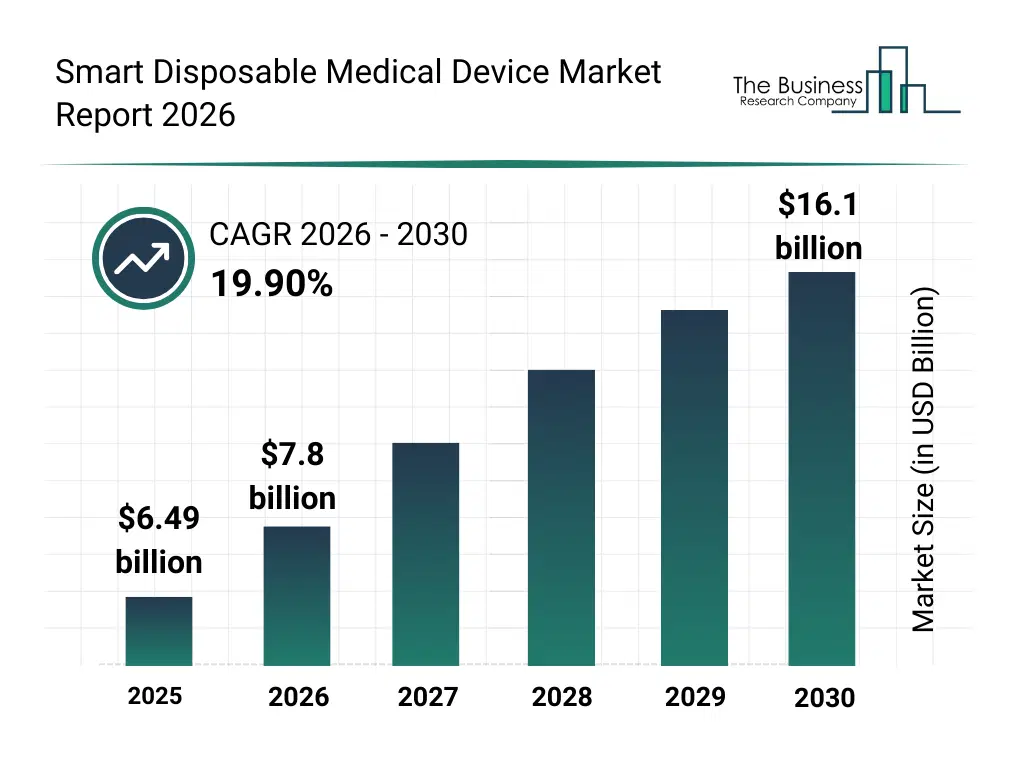
What Is The Smart Disposable Medical Device Market Size and Share 2026?
The smart disposable medical device market size has grown exponentially in recent years. It will grow from $6.49 billion in 2025 to $7.8 billion in 2026 at a compound annual growth rate (CAGR) of 20.2%. The growth in the historic period can be attributed to hospital-acquired infection concerns, demand for sterilization-free devices, growth in chronic disease monitoring, wearable technology adoption, regulatory safety requirements.What Is The Smart Disposable Medical Device Market Growth Forecast?
The smart disposable medical device market size is expected to see rapid growth in the next few years. It will grow to $16.1 billion in 2030 at a compound annual growth rate (CAGR) of 19.9%. The growth in the forecast period can be attributed to remote monitoring expansion, smart drug adherence tools, sustainability-driven material innovation, integration with digital health platforms, outpatient care growth. Major trends in the forecast period include single-use connected medical devices, embedded sensor disposable tools, infection control focused devices, real-time data transmitting disposables, smart drug delivery solutions.
Global Smart Disposable Medical Device Market Segmentation
1) By Product Type: Smart Syringes, Smart Wearable Patches, Smart Pills 2) By Connectivity: Bluetooth, Near Field Communication (NFC) 3) By Application: Patient Monitoring, Drug Delivery, Diagnostics 4) By End-User: Hospitals And Clinics, Home Care, Ambulatory Surgical Centers Subsegments: 1) By Smart Syringes: Connected Insulin Syringes, Connected Vaccination Syringes, Connected Needle-Free Syringes, Connected Prefilled Syringes 2) By Smart Wearable Patches: Connected Monitoring Patches, Connected Drug Delivery Patches, Connected Pain Management Patches, Connected Cardiac Monitoring Patches 3) By Smart Pills: Ingestible Monitoring Pills, Ingestible Drug Delivery Pills, Ingestible Temperature Sensing Pills, Ingestible Diagnostic PillsWhat Is The Driver Of The Smart Disposable Medical Device Market?
The increasing focus on minimizing hospital-acquired infections is expected to propel the growth of the smart disposable medical device market going forward. Hospital-acquired infections (HAIs) are infections that patients get while receiving treatment in a hospital or other healthcare facility, typically appearing 48 hours or more after admission and not present at the time of entry. The rising focus on minimizing hospital-acquired infections is driven by the need to improve patient safety, as reducing these infections lowers complication risks and enhances recovery outcomes. Smart disposable medical devices help minimize hospital-acquired infections by ensuring single-use sterility while providing real-time monitoring, thereby reducing cross-contamination risks and enhancing patient safety. For instance, in March 2025, according to the Health Security Agency, a UK-based government body, hospital-acquired infections were observed in 7.6% of patients in 2023, with pneumonia and lower respiratory tract infections being the most common (29.6%), followed by urinary tract infections (17.5%) and sepsis or disseminated infections (10.6%). Therefore, the increasing focus on minimizing hospital-acquired infections is driving the growth of the smart disposable medical device.Key Players In The Global Smart Disposable Medical Device Market
Major companies operating in the smart disposable medical device market are Abbott Laboratories, Medtronic plc, Boston Scientific Corporation, Terumo Corporation, Dexcom Inc., Insulet Corporation, iRhythm Technologies Inc., Ypsomed Holding AG, Biotricity Inc., Tasso Inc., Gentag Inc., Nemaura Medical Inc., Proteus Digital Health Inc., SmartTab Systems Inc., Celero Systems Inc., BlueSpark Technologies Inc., Bodytrak Inc., Element Science Inc., Becton Dickinson and Company, Roche Diagnostics, VitalConnect Inc
This chart is for illustrative purposes; the full report includes a detailed competitor analysis and comprehensive overview of the top 10 companies in the market.
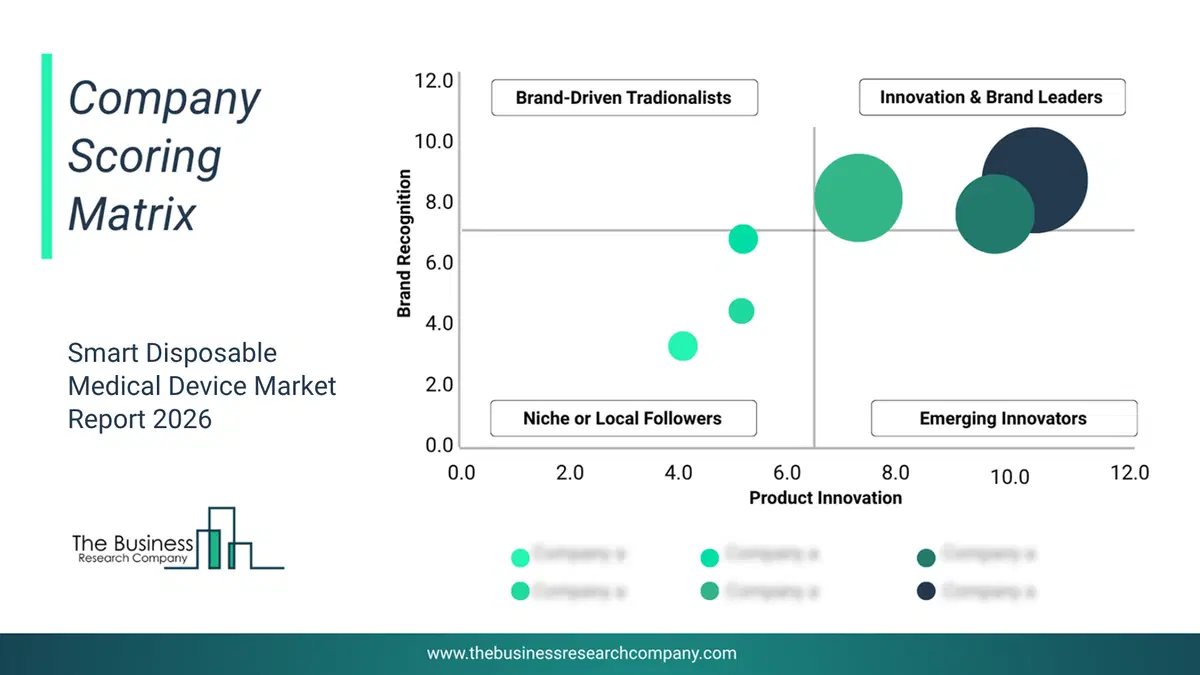
This chart maps companies by product innovation and brand strength, with bubble size indicating relative revenue, helping identify market leaders, challengers, and niche players. This is an illustrative chart; the full report provides a complete and accurate competitive analysis.
Global Smart Disposable Medical Device Market Trends and Insights
Major companies operating in the smart disposable medical device market are focusing on developing innovative approaches, such as dual-therapy compatibility to enable seamless tracking and management of multiple drug classes through a single connected platform. Dual-therapy compatibility refers to the ability of a smart medical device to work with and track two different types of therapies or medications simultaneously. For instance, in January 2023, Biocorp, a France-based medical technology company, announced the US Food and Drug Administration approval for Mallya, a smart medical device for disposable injector pens. This enables users of both insulin and GLP-1 receptor agonist pens to link their devices to a smartphone, allowing them to monitor dosing as well as the date and time of each injection. The connectivity feature helps ensure more precise management of therapy. By offering both convenience and real-time tracking, Mallya promotes better adherence to treatment and supports improved patient outcomes.What Are Latest Mergers And Acquisitions In The Smart Disposable Medical Device Market?
In June 2023, Novo Nordisk, a Denmark-based healthcare company, acquired Biocorp for $178 million (€154 million). Through this acquisition, Novo Nordisk aims to strengthen its digital health capabilities by integrating Biocorp smart connected devices, like the Mallya insulin pen sensor, to improve chronic disease management and patient outcomes. Biocorp is a France-based manufacturer of smart disposable medical devices.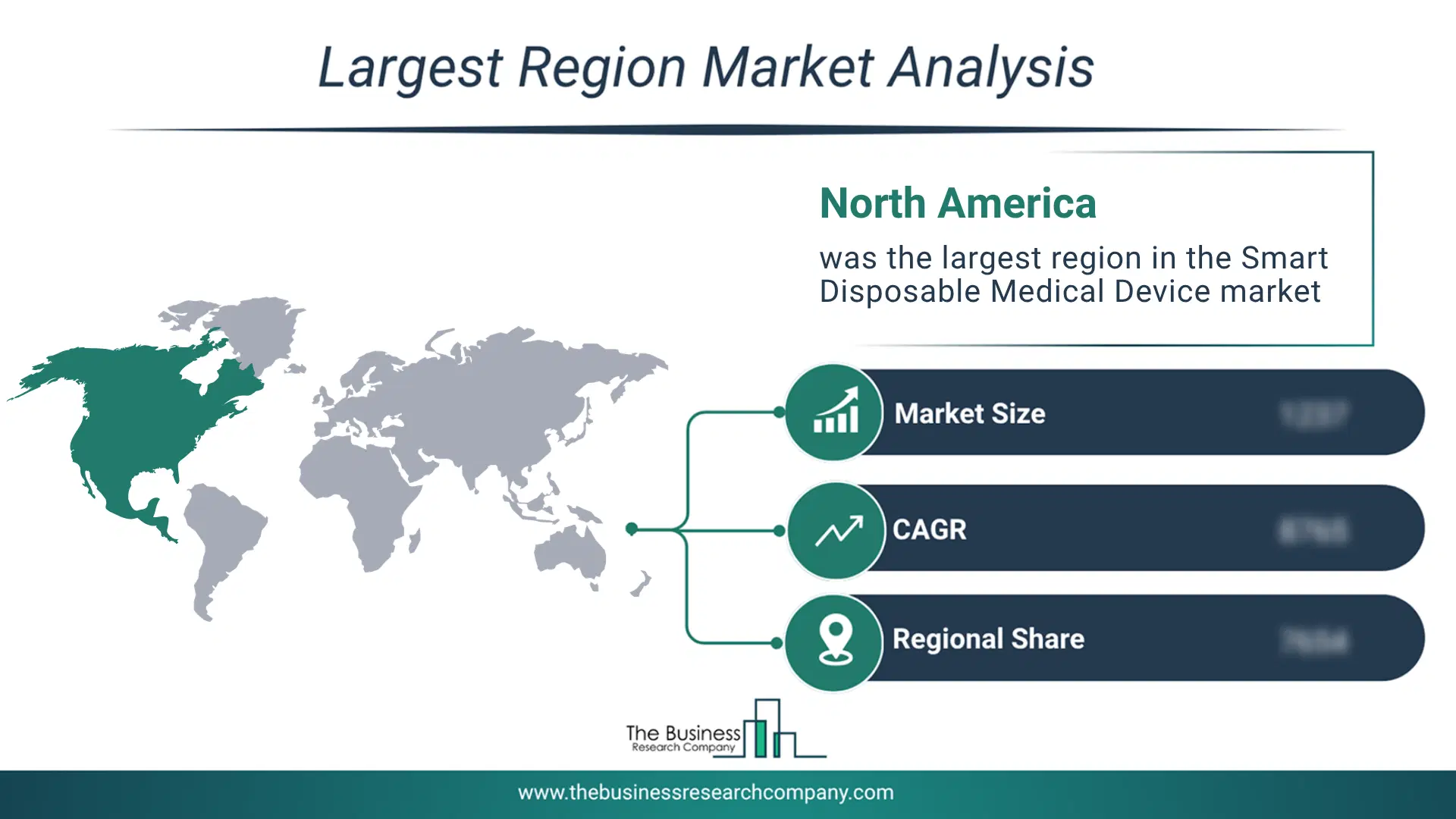
Regional Outlook
North America was the largest region in the smart disposable medical device market in 2025. The regions covered in this market report are Asia-Pacific, South East Asia, Western Europe, Eastern Europe, North America, South America, Middle East, Africa. The countries covered in this market report are Australia, Brazil, China, France, Germany, India, Indonesia, Japan, Taiwan, Russia, South Korea, UK, USA, Canada, Italy, SpainWhat Defines the Smart Disposable Medical Device Market?
The smart disposable medical device market consists of sales of smart catheters, smart bandages, smart biopsy needles, connected surgical staplers, and smart wound dressings. Values in this market are ‘factory gate’ values, that is, the value of goods sold by the manufacturers or creators of the goods, whether to other entities (including downstream manufacturers, wholesalers, distributors, and retailers) or directly to end customers. The value of goods in this market includes related services sold by the creators of the goods.How is Market Value Defined and Measured?
The market value is defined as the revenues that enterprises gain from the sale of goods and/or services within the specified market and geography through sales, grants, or donations in terms of the currency (in USD unless otherwise specified). The revenues for a specified geography are consumption values that are revenues generated by organizations in the specified geography within the market, irrespective of where they are produced. It does not include revenues from resales along the supply chain, either further along the supply chain or as part of other products.
This chart presents market attractiveness based on a quantitative evaluation of growth, competition, strategic alignment, and risk, offering a clear view of opportunity areas for decision-making. This chart is for illustrative purposes; the full report contains the complete analysis.

This chart highlights the Total Addressable Market (TAM) by estimating the maximum revenue opportunity using an assumption-driven approach, supporting strategic planning and opportunity sizing across markets. The chart is illustrative; the full report provides a more comprehensive analysis.
What Key Data and Analysis Are Included in the Smart Disposable Medical Device Market Report 2026?
The smart disposable medical device market research report is one of a series of new reports from The Business Research Company that provides market statistics, including industry global market size, regional shares, competitors with the market share, detailed market segments, market trends and opportunities, and any further data you may need to thrive in the smart disposable medical device industry. The market research report delivers a complete perspective of everything you need, with an in-depth analysis of the current and future state of the industry.Smart Disposable Medical Device Market Report Forecast Analysis
| Report Attribute | Details |
|---|---|
| Market Size Value In 2026 | $7.8 billion |
| Revenue Forecast In 2030 | $16.1 billion |
| Growth Rate | CAGR of 19.9% from 2026 to 2030 |
| Base Year For Estimation | 2025 |
| Actual Estimates/Historical Data | 2020-2025 |
| Forecast Period | 2026 - 2030 |
| Market Representation | Revenue in USD Billion and CAGR from 2026 to 2030 |
| Segments Covered | Product Type, Connectivity, Application, End-User |
| Regional Scope | Asia-Pacific, Western Europe, Eastern Europe, North America, South America, Middle East, Africa |
| Country Scope | The countries covered in the report are Australia, Brazil, China, France, Germany, India, Indonesia, Japan, Taiwan, Russia, South Korea, UK, USA, Canada, Italy, Spain. |
| Key Companies Profiled | Abbott Laboratories, Medtronic plc, Boston Scientific Corporation, Terumo Corporation, Dexcom Inc., Insulet Corporation, iRhythm Technologies Inc., Ypsomed Holding AG, Biotricity Inc., Tasso Inc., Gentag Inc., Nemaura Medical Inc., Proteus Digital Health Inc., SmartTab Systems Inc., Celero Systems Inc., BlueSpark Technologies Inc., Bodytrak Inc., Element Science Inc., Becton Dickinson and Company, Roche Diagnostics, VitalConnect Inc |
| Customization Scope | Request for Customization |
| Pricing And Purchase Options | Explore Purchase Options |