

Smart Elevators Market Report 2026
Global Outlook – By Setup (Modernization, Maintenance, New Deployments), By Carriage (Passenger, Freight), By Installation (Low And Mid Rise, High-Rise), By Application (Residential, Commercial, Industrial) – Market Size, Trends, Strategies, and Forecast to 2030
Smart Elevators Market Overview
• Smart Elevators market size has reached to $18.02 billion in 2025 • Expected to grow to $29.44 billion in 2030 at a compound annual growth rate (CAGR) of 10.4% • Growth Driver: Impact of Increased Construction of High-Rise Buildings on Smart Elevators Market Growth • Market Trend: Elevating Innovation Smart Elevators With Eco-Efficient Technology • North America was the largest region in 2025 and Asia-Pacific is the fastest growing region.What Is Covered Under Smart Elevators Market?
A smart elevator refers to an elevator system that incorporates advanced technologies to enhance efficiency, safety, and the user experience. Smart elevators are designed to minimize wait times, reduce energy consumption, and optimize the flow of people within a building. The main setups of smart elevators are modernization, maintenance, and new deployments. The integration of smart elevator systems in modernization efforts involves the incorporation of advanced technologies to upgrade and optimize vertical transportation within existing structures. The carriage of smart elevators includes passengers and freight through various installations, such as low, mid-rise, and high-rise, and various applications, such as residential, commercial, and industrial.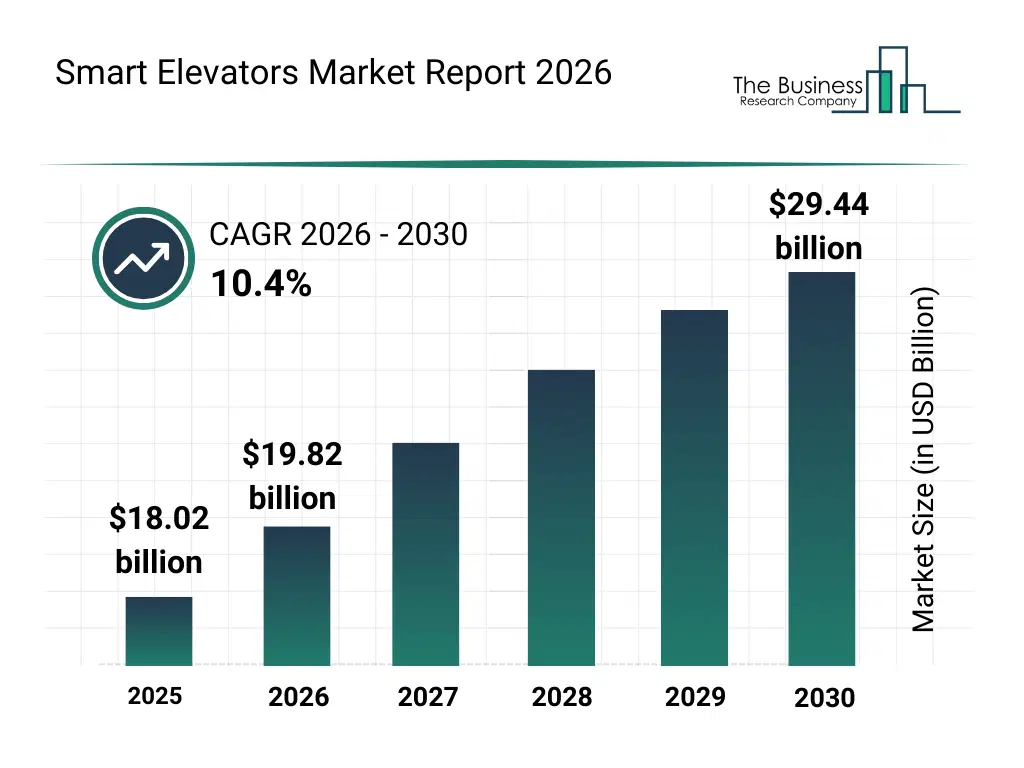
What Is The Smart Elevators Market Size and Share 2026?
The smart elevators market size has grown strongly in recent years. It will grow from $18.02 billion in 2025 to $19.82 billion in 2026 at a compound annual growth rate (CAGR) of 9.9%. The growth in the historic period can be attributed to urbanization and high-rise construction growth, increasing modernization of existing elevator systems, demand for energy-efficient building solutions, adoption of digital control systems, growth of commercial real estate development.What Is The Smart Elevators Market Growth Forecast?
The smart elevators market size is expected to see rapid growth in the next few years. It will grow to $29.44 billion in 2030 at a compound annual growth rate (CAGR) of 10.4%. The growth in the forecast period can be attributed to increasing investments in smart building infrastructure, rising demand for touchless and connected elevator systems, expansion of predictive maintenance services, growing focus on carbon-neutral buildings, increasing integration with building management systems. Major trends in the forecast period include increasing adoption of ai-based elevator dispatch systems, rising deployment of predictive maintenance technologies, growing integration of energy-efficient elevator solutions, expansion of smart elevators in high-rise buildings, enhanced focus on passenger experience optimization.
Global Smart Elevators Market Segmentation
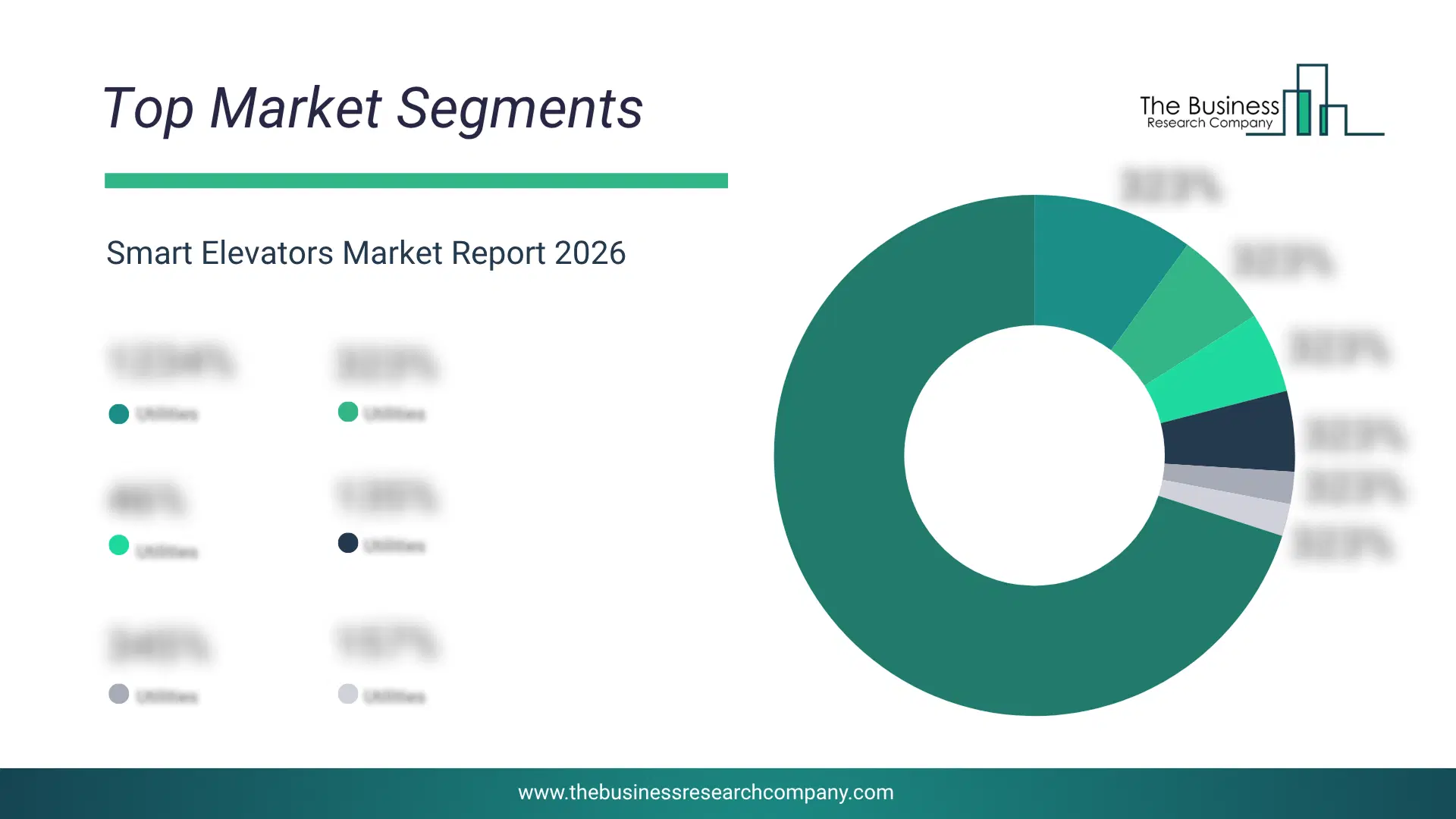
1) By Setup: Modernization, Maintenance, New Deployments 2) By Carriage: Passenger, Freight 3) By Installation: Low And Mid Rise, High-Rise 4) By Application: Residential, Commercial, Industrial Subsegments: 1) By Modernization: Retrofit of Existing Elevators, Upgrading Control Systems 2) By Maintenance: Preventive Maintenance, Predictive Maintenance 3) By New Deployments: Residential Smart Elevators, Commercial Smart Elevators, Industrial Smart ElevatorsWhat Is The Driver Of The Smart Elevators Market?
The increased construction of high-rise buildings is expected to propel the growth of the smart elevator market going forward. A high-rise building is a multistorey building tall enough to require the use of a system of mechanical vertical transportation, such as elevators. Smart elevators are useful to high-rise buildings as they provide a means of vertical transportation and smart elevator systems are equipped with advanced technologies that enhance efficiency, safety, and user experience within these buildings. For instance, in January 2024, according to the Council on Tall Buildings and Urban Habitat, a US-based international body in the field of tall buildings, 2023 reported a record of 185 completed buildings worldwide of 200 meters or greater height, raising the global total to 2,532 such high rise buildings. Therefore, the increased construction of high-rise buildings is driving the growth of the smart elevator industry.Key Players In The Global Smart Elevators Market
Major companies operating in the smart elevators market report include Hitachi Ltd., Thyssenkrupp AG, Mitsubishi Electric, Otis Elevator Company, Schindler Group, Kone Corporation, Hyundai Elevators Co. Ltd., Fujitec Co. Ltd., Sigma Elevator Company, Toshiba Elevator and Building Systems Corporation, Nidec Elevator Group, Emerald Elevators, TK Elevator, Canny Elevator Co., Ltd., Zhejiang Meilun Elevator Co., Ltd., SJEC Corporation, Kleemann Hellas SA, Orona Group, Doppler S.A., IFE Elevators Co., Ltd., Express Lift Company, Stannah Group, Wittur Group, AVT Beckett,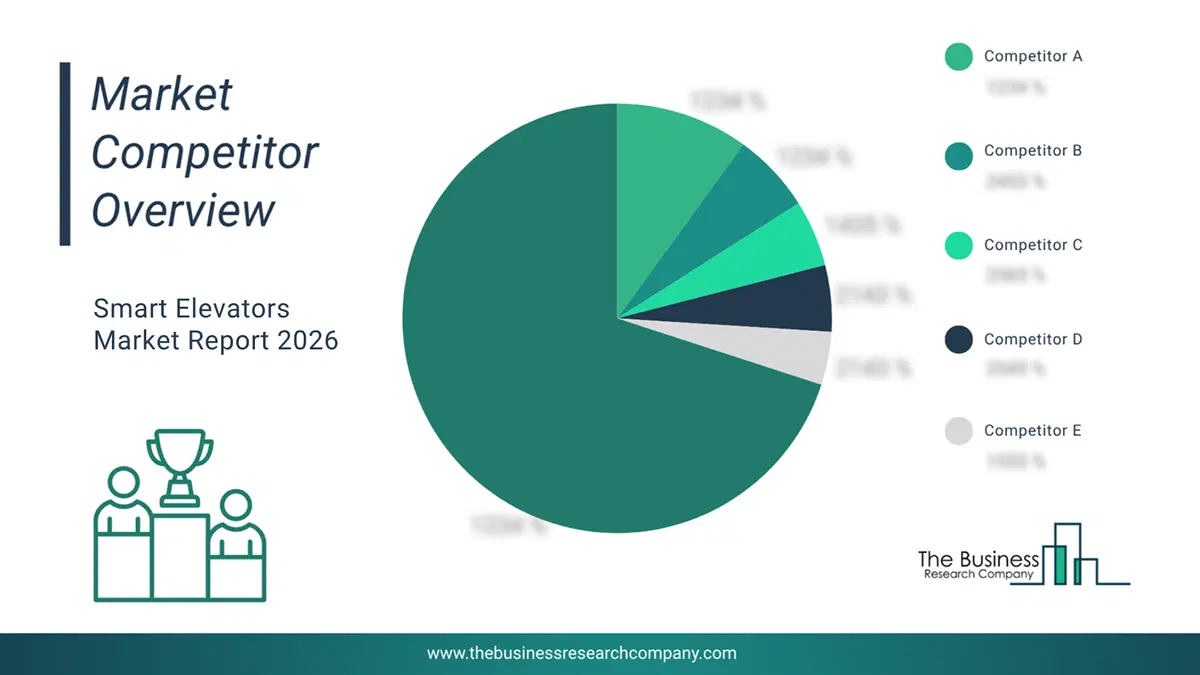
This chart is for illustrative purposes; the full report includes a detailed competitor analysis and comprehensive overview of the top 10 companies in the market.
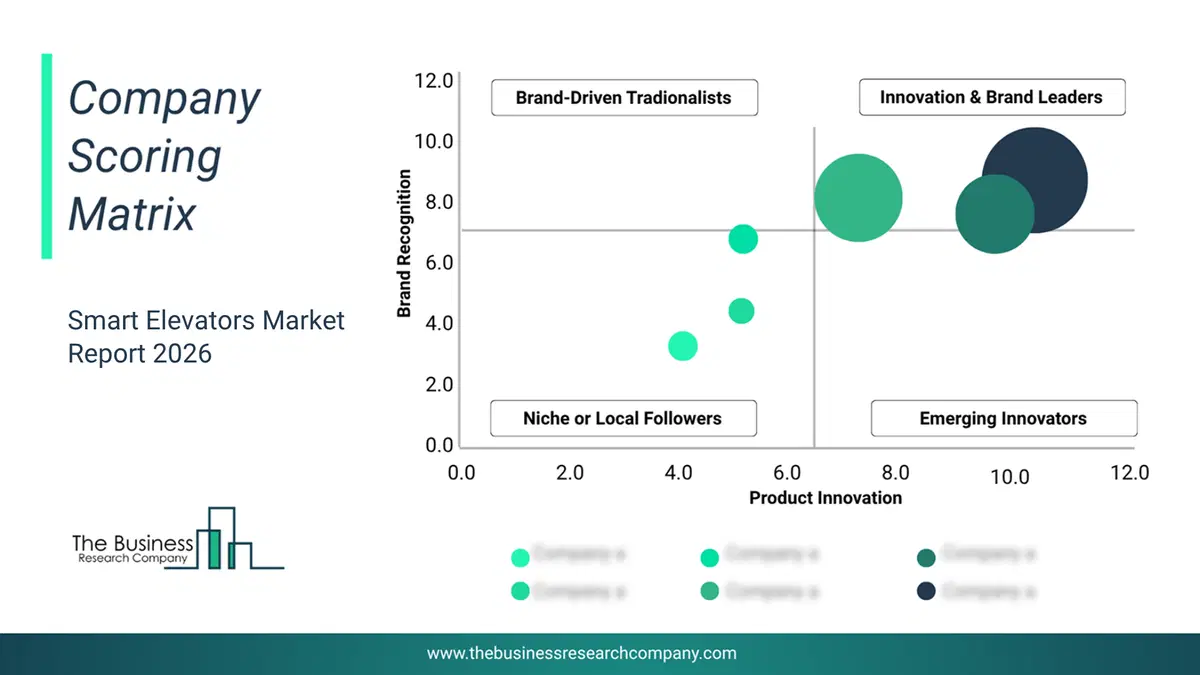
This chart maps companies by product innovation and brand strength, with bubble size indicating relative revenue, helping identify market leaders, challengers, and niche players. This is an illustrative chart; the full report provides a complete and accurate competitive analysis.
Global Smart Elevators Market Trends and Insights
Major companies operating in the smart elevator market are developing innovative technologies, such as in-car multimedia displays, to gain a competitive advantage. In-car multimedia displays in elevators deliver real-time information and entertainment to passengers during their rides. For instance, in May 2023, TK Elevator, a Germany-based urban mobility solutions company, launched EOX. Which is an eco-efficient and digitally enhanced elevator platform, tailored for low- to mid-rise buildings in North America. Designed to align with modern standards, it combines sustainability with advanced technology. EOX cuts energy usage by up to 45% and reduces embodied carbon by 50% through features like a regenerative drive that recycles energy and an eco-mode that moderates speed during low-traffic periods. It also offers cutting-edge digital functionalities, including in-car multimedia displays for passenger interaction, predictive maintenance with the MAX platform, and enhanced safety features, such as in-car sensors and two-way communication systems.What Are Latest Mergers And Acquisitions In The Smart Elevators Market?
In May 2024, KONE Corporation., a Finland-based elevator manufacturing company, acquired Orbitz Elevators Pty Ltd. for an undisclosed amount. With this acquisition, KONE aims to expand its service capabilities and deliver enhanced People Flow solutions to customers in Australia and New Zealand. Orbitz Elevators Pty Ltd. is an Australia -based elevator company that specializes in the design, supply, installation, maintenance, and modernization of elevators.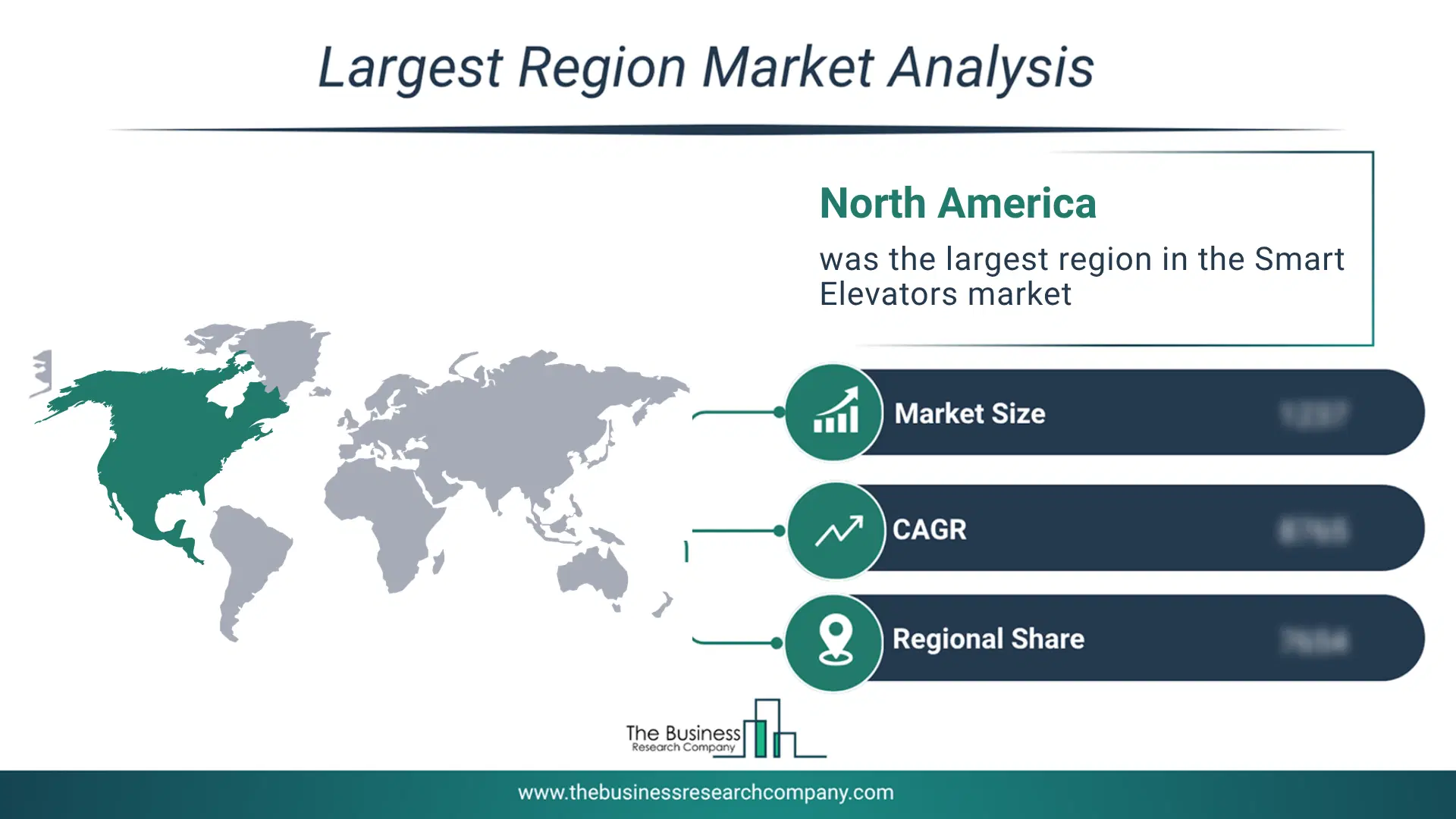
Regional Outlook
North America was the largest region in the smart elevators market in 2025. Asia-Pacific is expected to be the fastest-growing region in the forecast period. The regions covered in this market report include Asia-Pacific, South East Asia, Western Europe, Eastern Europe, North America, South America, Middle East, Africa. The countries covered in this market report include Australia, Brazil, China, France, Germany, India, Indonesia, Japan, Taiwan, Russia, South Korea, UK, USA, Canada, Italy, SpainWhat Defines the Smart Elevators Market?
The smart elevator market includes revenues earned by entities by providing services including elevator maintenance, elevator modernization, elevator repair and testing, escalator maintenance and repair, and smart elevator technology such as touchless elevator buttons and mobile controls. The market value includes the value of related goods sold by the service provider or included within the service offering. Only goods and services traded between entities or sold to end consumers are included. The smart elevators market also includes sales of automated delivery systems, destination control systems, touchless elevator systems and energy-efficient elevators. Values in this market are ‘factory gate’ values, that is the value of goods sold by the manufacturers or creators of the goods, whether to other entities (including downstream manufacturers, wholesalers, distributors and retailers) or directly to end customers. The value of goods in this market includes related services sold by the creators of the goods.How is Market Value Defined and Measured?
The market value is defined as the revenues that enterprises gain from the sale of goods and/or services within the specified market and geography through sales, grants, or donations in terms of the currency (in USD unless otherwise specified). The revenues for a specified geography are consumption values that are revenues generated by organizations in the specified geography within the market, irrespective of where they are produced. It does not include revenues from resales along the supply chain, either further along the supply chain or as part of other products.
This chart presents market attractiveness based on a quantitative evaluation of growth, competition, strategic alignment, and risk, offering a clear view of opportunity areas for decision-making. This chart is for illustrative purposes; the full report contains the complete analysis.

This chart highlights the Total Addressable Market (TAM) by estimating the maximum revenue opportunity using an assumption-driven approach, supporting strategic planning and opportunity sizing across markets. The chart is illustrative; the full report provides a more comprehensive analysis.
What Key Data and Analysis Are Included in the Smart Elevators Market Report 2026?
The smart elevators market research report is one of a series of new reports from The Business Research Company that provides market statistics, including industry global market size, regional shares, competitors with the market share, detailed market segments, market trends and opportunities, and any further data you may need to thrive in the smart elevators industry. The market research report delivers a complete perspective of everything you need, with an in-depth analysis of the current and future state of the industry.Smart Elevators Market Report Forecast Analysis
| Report Attribute | Details |
|---|---|
| Market Size Value In 2026 | $19.82 billion |
| Revenue Forecast In 2030 | $29.44 billion |
| Growth Rate | CAGR of 9.9% from 2026 to 2030 |
| Base Year For Estimation | 2025 |
| Actual Estimates/Historical Data | 2020-2025 |
| Forecast Period | 2026 - 2030 - 2030 |
| Market Representation | Revenue in USD Billion and CAGR from 2026 to 2030 |
| Segments Covered | Setup, Carriage, Installation, Application |
| Regional Scope | Asia-Pacific, Western Europe, Eastern Europe, North America, South America, Middle East, Africa |
| Country Scope | The countries covered in the report are Australia, Brazil, China, France, Germany, India, Indonesia, Japan, Taiwan, Russia, South Korea, UK, USA, Canada, Italy, Spain. |
| Key Companies Profiled | Hitachi Ltd., Thyssenkrupp AG, Mitsubishi Electric, Otis Elevator Company, Schindler Group, Kone Corporation, Hyundai Elevators Co. Ltd., Fujitec Co. Ltd., Sigma Elevator Company, Toshiba Elevator and Building Systems Corporation, Nidec Elevator Group, Emerald Elevators, TK Elevator, Canny Elevator Co., Ltd., Zhejiang Meilun Elevator Co., Ltd., SJEC Corporation, Kleemann Hellas SA, Orona Group, Doppler S.A., IFE Elevators Co., Ltd., Express Lift Company, Stannah Group, Wittur Group, AVT Beckett, |
| Customization Scope | Request for Customization |
| Pricing And Purchase Options | Explore Purchase Options |