

Smart Factory Market Report 2026
Global Outlook – By Product (Machine Vision Systems, Industrial Robotics, Control Devices, Sensor Communication Technologies, Other Products), By Component (Smart Factory Hardware, Smart Factory Software, Smart Factory Services), By Industry Vertical (Automotive, Aerospace And Defense, Electrical And Electronics, Food And Beverages, Energy And Utilities, Healthcare And Pharmaceuticals, Other Industry Verticals) – Market Size, Trends, Strategies, and Forecast to 2030
Smart Factory Market Overview
• Smart Factory market size has reached to $88.81 billion in 2025 • Expected to grow to $157.8 billion in 2030 at a compound annual growth rate (CAGR) of 12.1% • Growth Driver: Industrial Robots Fueling Growth In The Smart Factory Market • Market Trend: Industry 4.0 Integration Revolutionizing Smart Factory Market For Enhanced Efficiency • Asia-Pacific was the largest region and fastest growing region.What Is Covered Under Smart Factory Market?
Smart factories refer to factories where physical production processes and operations are combined with digital technology, smart computing, and big data to create a more opportunistic system for companies that are focusing on manufacturing automation and supply chain management. The main types of products in the smart factory market are machine vision systems, industrial robotics, control devices, sensors, communication technologies, and others. An industrial robot refers to a mechanical machine that is programmed to automatically perform production-related tasks in industrial environments. The different components include smart factory hardware, smart factory software and smart factory services and are employed in automotive, aerospace and defense, electrical and electronics, food and beverages, healthcare and pharmaceuticals, and other industry verticals.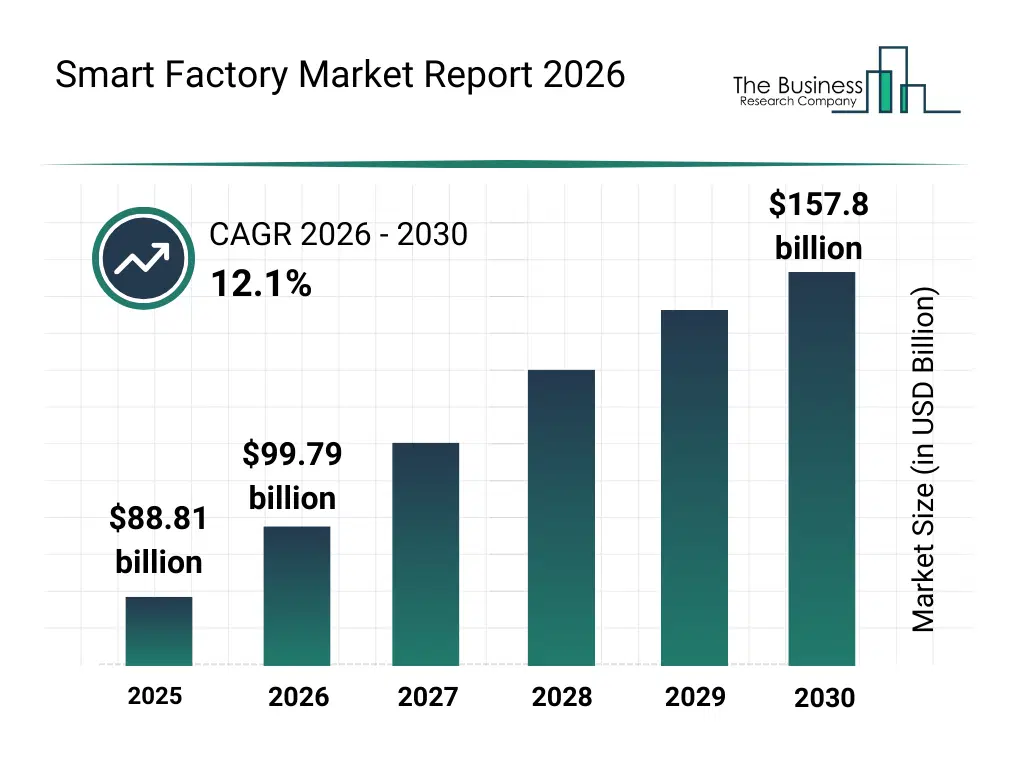
What Is The Smart Factory Market Size and Share 2026?
The smart factory market size has grown rapidly in recent years. It will grow from $88.81 billion in 2025 to $99.79 billion in 2026 at a compound annual growth rate (CAGR) of 12.4%. The growth in the historic period can be attributed to increasing manufacturing automation levels, rising demand for operational efficiency, adoption of programmable control systems, expansion of sensor-based monitoring, growing use of data-driven manufacturing processes.What Is The Smart Factory Market Growth Forecast?
The smart factory market size is expected to see rapid growth in the next few years. It will grow to $157.8 billion in 2030 at a compound annual growth rate (CAGR) of 12.1%. The growth in the forecast period can be attributed to increasing investments in smart manufacturing infrastructure, rising adoption of ai-driven production optimization, expansion of iiot-enabled factories, growing demand for flexible manufacturing systems, increasing focus on resilient supply chains. Major trends in the forecast period include increasing deployment of connected manufacturing systems, rising adoption of industrial robotics and automation, growing use of real-time production analytics, expansion of predictive maintenance capabilities, enhanced focus on digital twin integration.
Global Smart Factory Market Segmentation
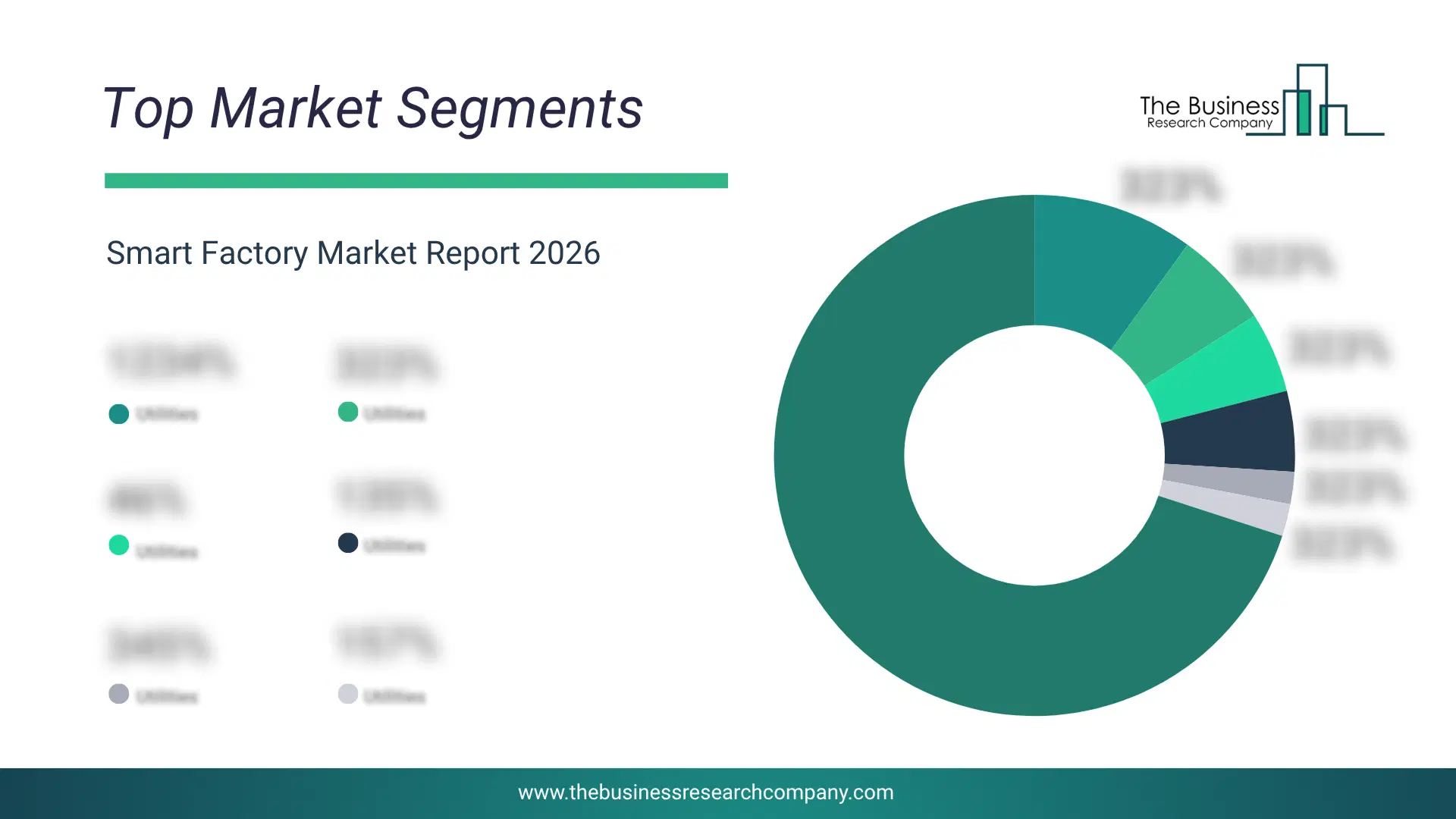
1) By Product: Machine Vision Systems, Industrial Robotics, Control Devices, Sensor Communication Technologies, Other Products 2) By Component: Smart Factory Hardware, Smart Factory Software, Smart Factory Services 3) By Industry Vertical: Automotive, Aerospace And Defense, Electrical And Electronics, Food And Beverages, Energy And Utilities, Healthcare And Pharmaceuticals, Other Industry Verticals Subsegments: 1) By Machine Vision Systems: 2D Machine Vision, 3D Machine Vision, Vision Sensors, Frame Grabbers, Vision Software 2) By Industrial Robotics: Articulated Robots, SCARA Robots, Cartesian Robots, Collaborative Robots (Cobots), Gantry Robots 3) By Control Devices: Programmable Logic Controllers (PLCs), Distributed Control Systems (DCS), Supervisory Control And Data Acquisition (SCADA) Systems, Human-Machine Interface (HMI) Devices 4) By Sensor Communication Technologies: Wired Communication, Wireless Communication, Industrial Internet Of Things (IIoT) Protocols 5) By Other Products: Advanced Analytics Software, Artificial Intelligence Solutions, Cloud Computing ServicesWhat Is The Driver Of The Smart Factory Market?
The growing demand for industrial robots is expected to propel the growth of the smart factory market going forward. Industrial robots refer to mechanical machines that are programmed to automatically perform production-related tasks in industrial environments. A smart factory focuses on the optimization and industrial automation of its resources, using tools such as information and smart sensor technologies, robotics, the internet of things, or artificial intelligence. For instance, in September 2024, according to the International Federation of Robotics (IFR), a Germany-based non-profit organization, there are now 4,281,585 industrial robots operating in factories worldwide, reflecting a 10% increase from 2023. Annual installations surpassed half a million units for the third year in a row. By region, Asia accounted for 70% of all new robot installations in 2023, followed by Europe with 17% and the Americas with 10%. Therefore, the growing demand for industrial robots is driving the smart factory industry.Key Players In The Global Smart Factory Market
Major companies operating in the smart factory market are ABB Ltd.; Emerson Electric Co.; General Electric Company; Honeywell International Inc.; International Business Machines Corporation; Johnson Controls International PLC; Mitsubishi Electric Corporation; Robert Bosch GmbH; Rockwell Automation Inc.; Schneider Electric SE; Siemens AG; Yokogawa Electric Corp.; Cisco Systems Inc.; Dassault Systèmes SE; Endress+Hauser AG; Kollmorgen Corp.; KUKA AG; Omron Corporation; Oracle Corporation; Microsoft Corporation; PTC Inc.; SAP SE; Hitachi Ltd.; Fanuc Corporation; Cognex Corporation; FLIR Systems Inc.; CoreTigo Ltd.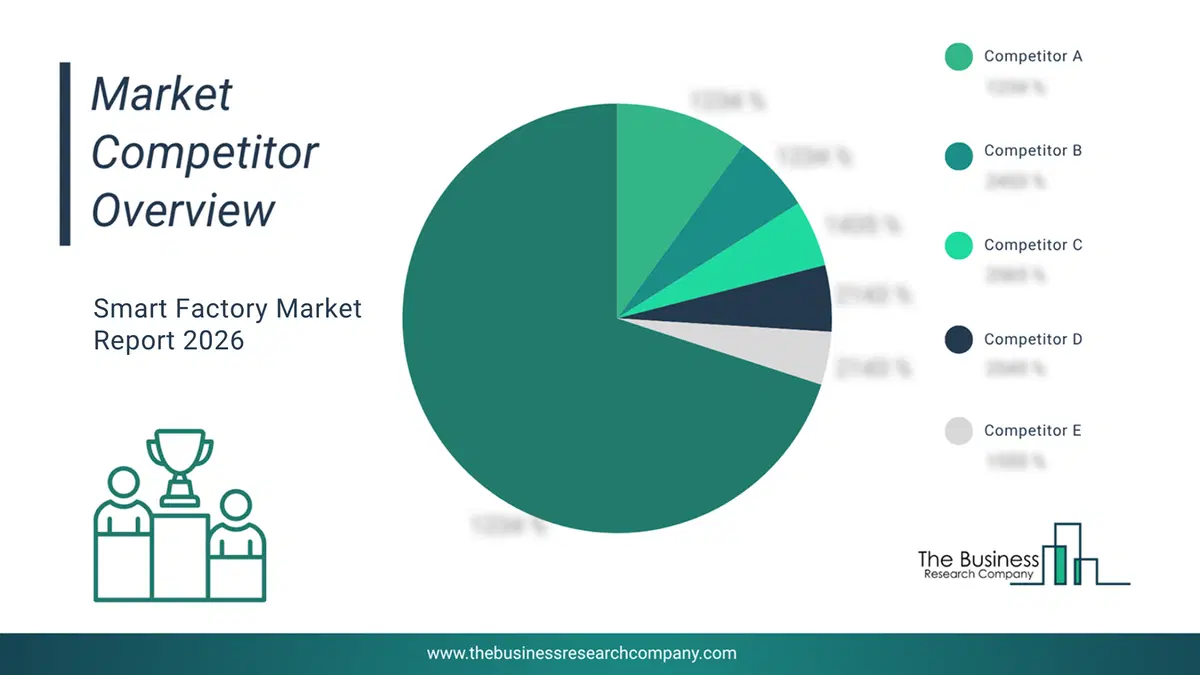
This chart is for illustrative purposes; the full report includes a detailed competitor analysis and comprehensive overview of the top 10 companies in the market.
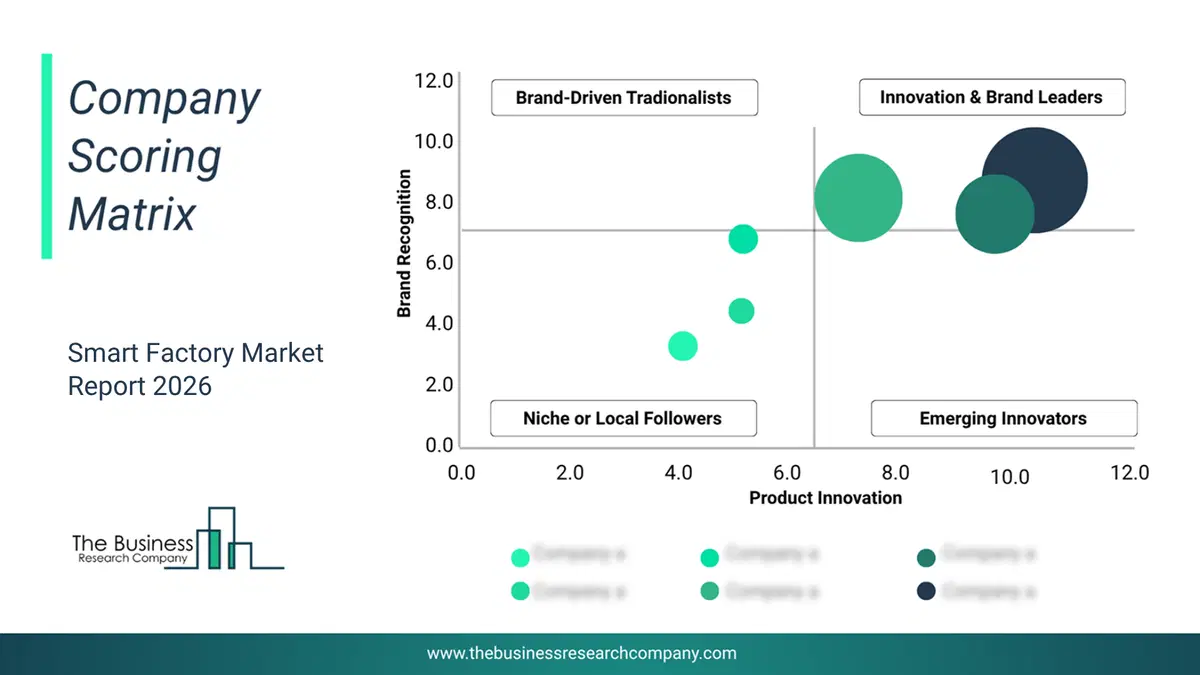
This chart maps companies by product innovation and brand strength, with bubble size indicating relative revenue, helping identify market leaders, challengers, and niche players. This is an illustrative chart; the full report provides a complete and accurate competitive analysis.
Global Smart Factory Market Trends and Insights
Major companies operating in the smart factory market are involved in the integration of new and innovative technologies, such as Industry 4.0 solutions, to automate production capacity and increase efficiency while installing a new production line or setting up a new production unit. Industry 4.0, also known as the Fourth Industrial Revolution, refers to the incorporation of the Internet of Things (IoT), cloud computing and analytics, artificial intelligence (AI), and machine learning technologies into their operations and manufacturing facilities. For instance, in February 2023, Deloitte Touche Tohmatsu Limited (Deloitte), a UK-based professional services network company, through its subsidiary Deloitte Canada, opened a new 9,000-square-foot smart factory in Montreal, demonstrating a variety of Industry 4.0 solutions for automating production and warehousing. The factory will operate manufacturing lines, store and transfer inventory, track shipments, and make use of a variety of technologies, including artificial intelligence (AI), sensors, robots, IoT, big data, and the cloud.What Are Latest Mergers And Acquisitions In The Smart Factory Market?
In October 2024, Nulogy, a Canada-based technology company, acquired Mingo Smart Factory for an undisclosed amount. The aim of the acquisition is to enhance Nulogy's manufacturing supply chain solutions by integrating Mingo Smart Factory's real-time analytics and productivity technology, providing greater value to the extended supply chain. Mingo Smart Factory is a Canada-based technology company that specializes in manufacturing productivity solutions.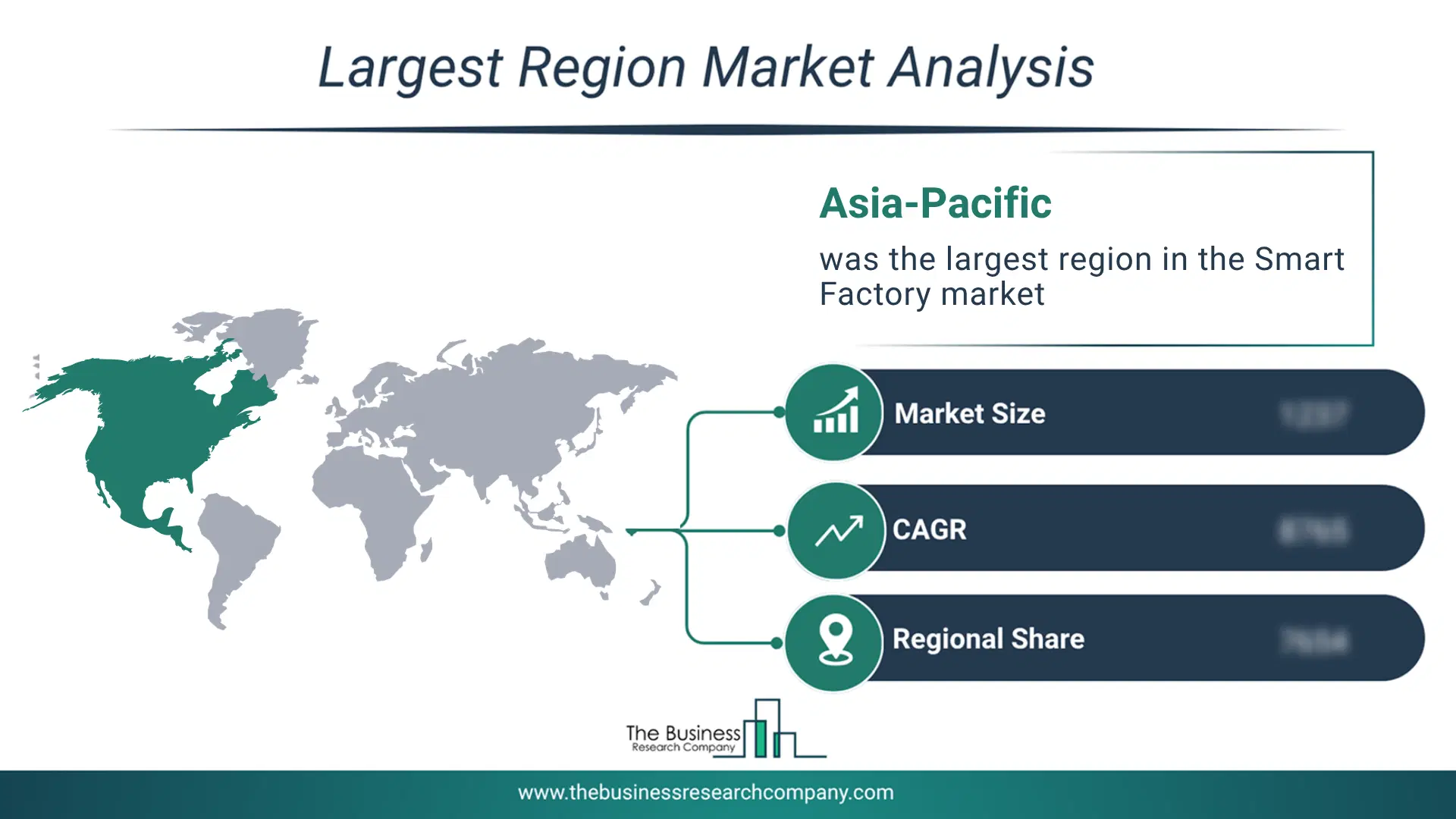
Regional Insights
Asia-Pacific was the largest region in the smart factory market in 2025. Asia-Pacific is expected to be the fastest-growing region in the forecast period. The regions covered in this market report are Asia-Pacific, South East Asia, Western Europe, Eastern Europe, North America, South America, Middle East, Africa. The countries covered in this market report are Australia, Brazil, China, France, Germany, India, Indonesia, Japan, Taiwan, Russia, South Korea, UK, USA, Canada, Italy, SpainWhat Defines the Smart Factory Market?
The smart factory market consists of sales of blockchain manufacturing, the industrial internet of things, and asset management. Values in this market are ‘factory gate’ values, that is the value of goods sold by the manufacturers or creators of the goods, whether to other entities (including downstream manufacturers, wholesalers, distributors and retailers) or directly to end customers. The value of goods in this market includes related services sold by the creators of the goods.How is Market Value Defined and Measured?
The market value is defined as the revenues that enterprises gain from the sale of goods and/or services within the specified market and geography through sales, grants, or donations in terms of the currency (in USD unless otherwise specified). The revenues for a specified geography are consumption values that are revenues generated by organizations in the specified geography within the market, irrespective of where they are produced. It does not include revenues from resales along the supply chain, either further along the supply chain or as part of other products.
This chart presents market attractiveness based on a quantitative evaluation of growth, competition, strategic alignment, and risk, offering a clear view of opportunity areas for decision-making. This chart is for illustrative purposes; the full report contains the complete analysis.

This chart highlights the Total Addressable Market (TAM) by estimating the maximum revenue opportunity using an assumption-driven approach, supporting strategic planning and opportunity sizing across markets. The chart is illustrative; the full report provides a more comprehensive analysis.
What Key Data and Analysis Are Included in the Smart Factory Market Report 2026?
The smart factory market research report is one of a series of new reports from The Business Research Company that provides market statistics, including industry global market size, regional shares, competitors with the market share, detailed market segments, market trends and opportunities, and any further data you may need to thrive in the smart factory industry. The market research report delivers a complete perspective of everything you need, with an in-depth analysis of the current and future state of the industry.Smart Factory Market Report Forecast Analysis
| Report Attribute | Details |
|---|---|
| Market Size Value In 2026 | $99.79 billion |
| Revenue Forecast In 2030 | $157.8 billion |
| Growth Rate | CAGR of 12.1% from 2026 to 2030 |
| Base Year For Estimation | 2025 |
| Actual Estimates/Historical Data | 2020-2025 |
| Forecast Period | 2026 - 2030 |
| Market Representation | Revenue in USD Billion and CAGR from 2026 to 2030 |
| Segments Covered | Product, Component, Industry Vertical |
| Regional Scope | Asia-Pacific, Western Europe, Eastern Europe, North America, South America, Middle East, Africa |
| Country Scope | The Countries Covered In This Market Report Are Australia, Brazil, China, France, Germany, India, Indonesia, Japan, Taiwan, Russia, South Korea, Uk, Usa, Canada, Italy, Spain. |
| Key Companies Profiled | ABB Ltd., Emerson Electric Co., General Electric Company, Honeywell International Inc., International Business Machines Corporation, Johnson Controls International PLC, Mitsubishi Electric Corporation, Robert Bosch GmbH, Rockwell Automation Inc., Schneider Electric SE, Siemens AG, Yokogawa Electric Corp., Cisco Systems Inc., Dassault Systèmes SE, Endress+Hauser AG, Kollmorgen Corp., KUKA AG, Omron Corporation, Oracle Corporation, Microsoft Corporation, PTC Inc., SAP SE, Hitachi Ltd., Fanuc Corporation, Cognex Corporation, FLIR Systems Inc., CoreTigo Ltd. |
| Customization Scope | Request for Customization |
| Pricing And Purchase Options | Explore Purchase Options |