
Smart Forestry Market Report 2026
Global Outlook – By Type (Machinery, Software), By Technology (Global Positioning System (GPS), Geographic Information System (GIS), Remote Sensing), By Application (Timber Harvesting, Forest Management, Reforestation), By End-User (Private Foresters, Government Agencies, Research Institutes) – Market Size, Trends, Strategies, and Forecast to 2030
Smart Forestry Market Overview
• Smart Forestry market size has reached to $5.49 billion in 2025 • Expected to grow to $9.12 billion in 2030 at a compound annual growth rate (CAGR) of 10.6% • Growth Driver: Increasing Demand For Responsible Forestry Practices Drives Growth In The Smart Forestry Market • Market Trend: Innovative Digital Platforms Transforming Smart Forestry With Komatsu Limited's New Solution For Enhanced Efficiency And Sustainability • North America was the largest region in 2025.What Is Covered Under Smart Forestry Market?
Smart forestry is the utilization of innovative technologies and data-driven methodologies in forest management to monitor and analyze real-time forest conditions such as tree health and biodiversity. Its primary purpose is to improve the efficiency and sustainability of forest management through informed decision-making. This method promotes habitat conservation, climate change mitigation, and community livelihoods. The main types of smart forestry are machinery and software. Machinery refers to advanced equipment designed for various forestry tasks to improve efficiency, precision, and sustainability in forest management. They provide various technologies, such as global positioning systems (GPS), geographic information systems (GIS), and remote sensing, for several applications, including timber harvesting, forest management, and reforestation. They are used by various end-users, such as private foresters, government agencies, and research institutes.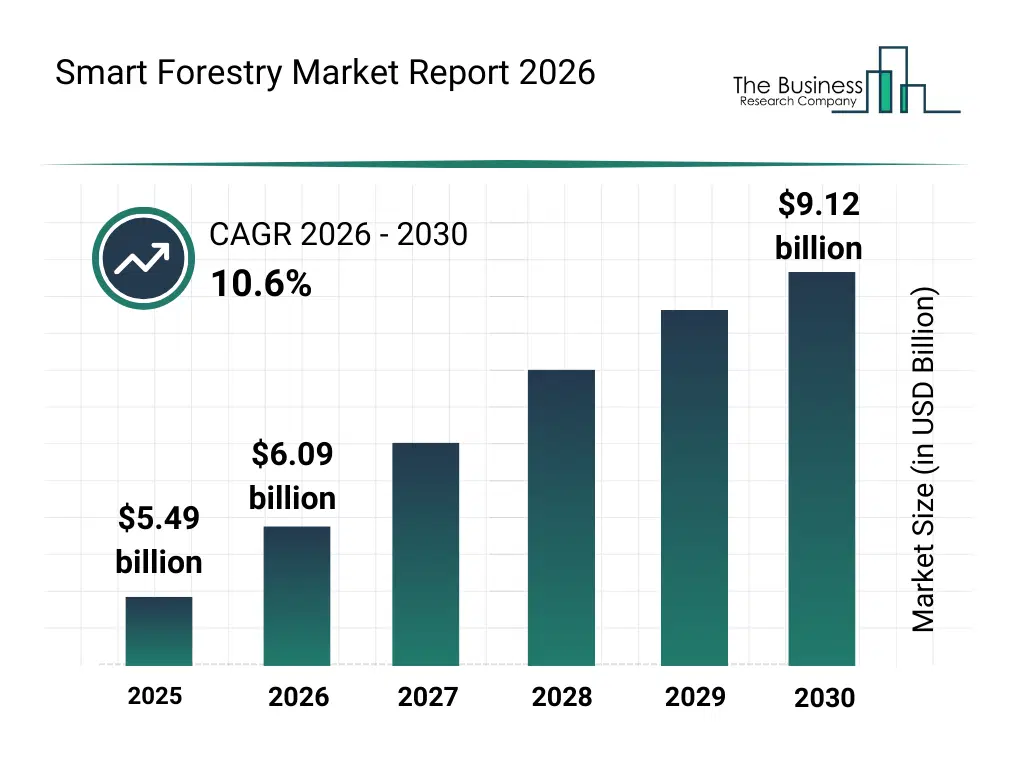
What Is The Smart Forestry Market Size and Share 2026?
The smart forestry market size has grown rapidly in recent years. It will grow from $5.49 billion in 2025 to $6.09 billion in 2026 at a compound annual growth rate (CAGR) of 10.9%. The growth in the historic period can be attributed to deforestation monitoring needs, forest resource optimization, government forestry initiatives, adoption of mapping technologies, climate change concerns.What Is The Smart Forestry Market Growth Forecast?
The smart forestry market size is expected to see rapid growth in the next few years. It will grow to $9.12 billion in 2030 at a compound annual growth rate (CAGR) of 10.6%. The growth in the forecast period can be attributed to carbon monitoring programs, biodiversity conservation initiatives, smart land management adoption, investment in digital forestry tools, sustainability compliance requirements. Major trends in the forecast period include increasing use of remote sensing technologies, growing adoption of data driven forest management, expansion of precision forestry practices, rising integration of GIS and GPS systems, focus on sustainable resource monitoring.Tariff Impact On Smart Forestry Market
Tariffs have affected the smart forestry market by increasing costs of sensors, drones, and mapping equipment. Forestry management and monitoring applications are most impacted, particularly in Asia Pacific. Higher technology costs have slowed adoption in developing regions. However, tariffs have supported regional technology development.
Global Smart Forestry Market Segmentation
1) By Type: Machinery, Software 2) By Technology: Global Positioning System (GPS), Geographic Information System (GIS), Remote Sensing 3) By Application: Timber Harvesting, Forest Management, Reforestation 4) By End-User: Private Foresters, Government Agencies, Research Institutes Subsegments: 1) By Machinery: Harvesting Equipment, Forestry Vehicles, Tree Planting Machines 2) By Software: Forest Management Software, Inventory Management Software, Geographic Information Systems (GIS)What Is The Driver Of The Smart Forestry Market?
The increasing demand for responsible forestry practices is expected to propel the growth of the smart forestry market going forward. Responsible forestry practices are defined as managing and using forest resources so that forest ecosystems maintain their long-term health, productivity, and biodiversity while serving the social, economic, and environmental demands of current and future generations. The demand for responsible forestry practices is rising due to several factors, such as ecological awareness, legislation and regulation, and demand for sustainable products, initiatives, and certifications. Smart forestry enhances responsible forestry practices by utilizing advanced technologies for precise monitoring, sustainable resource management, and reducing environmental impact. For instance, in June 2025, according to the Forestry Commission, a UK-based government department, in 2024–25, England saw 7,164 hectares of new tree planting (10.4 million trees), comprising 5,765 hectares of woodland creation (9.5 million trees) and 1,399 hectares of planting outside woodland (888,000 trees). Therefore, the increasing demand for responsible forestry practices is driving the growth of the smart forestry industry.Key Players In The Global Smart Forestry Market
Major companies operating in the smart forestry market are Deere & Company, Hexagon AB, Trimble Inc., Maxar Technologies Inc., Esri International LLC, Ponsse Oyj, AFRY AB, Planet Labs PBC, Pix4D SA, Komatsu Forest AB, EcoTrust Software Ltda., Silvacom Ltd., GEOSYS, Rottne Industri AB, Tigercat International Inc., TreeMetrics, Skytec LLC, Agremo Ltd., ForestX AB, Landmark Spatial Solutions, CollectiveCrunch Oy, Blue Marble Geographics, GIS Cloud Ltd.
This chart is for illustrative purposes; the full report includes a detailed competitor analysis and comprehensive overview of the top 10 companies in the market.
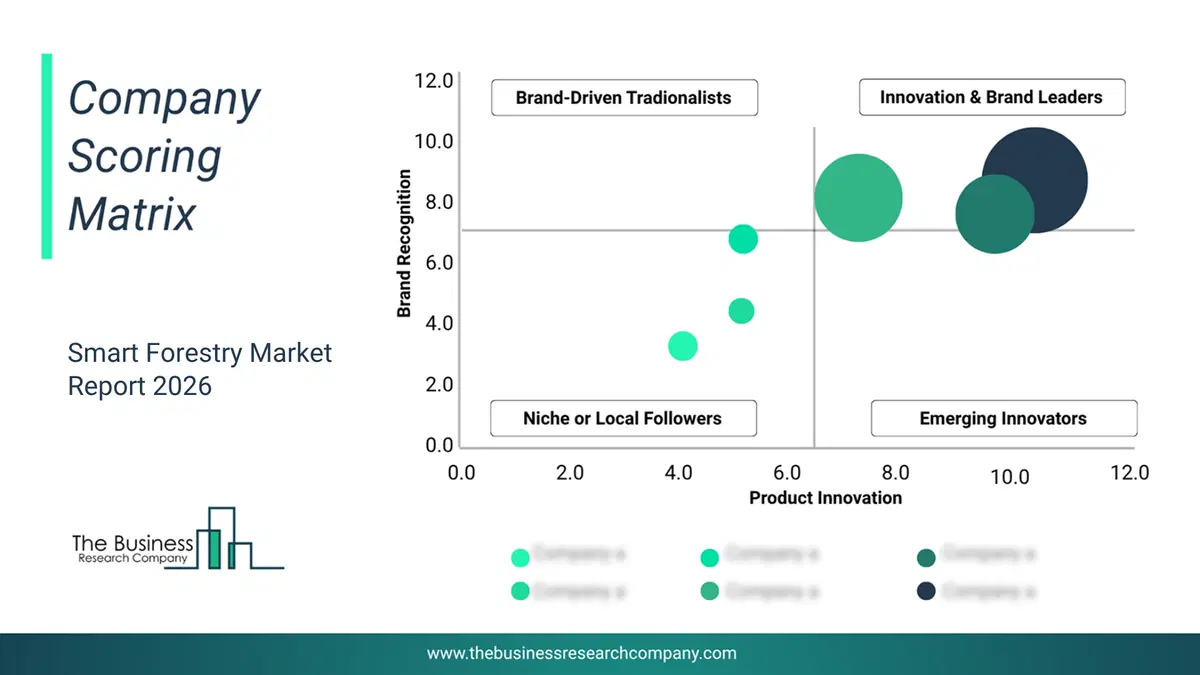
This chart maps companies by product innovation and brand strength, with bubble size indicating relative revenue, helping identify market leaders, challengers, and niche players. This is an illustrative chart; the full report provides a complete and accurate competitive analysis.
Global Smart Forestry Market Trends and Insights
Major companies operating in the smart forestry market are focused on developing innovative solutions, such as new digital platforms, to help make the workplace safe, smart, productive, and sustainable. A new digital platform is an online system that enables users to interact, share, and collaborate through integrated services and applications, often enhancing connectivity and functionality across various digital ecosystems. For instance, in June 2024, Komatsu Limited, a Japan-based company that manufactures construction, mining, forestry, and military equipment, launched the new digital platform. The new digital platform launched by Komatsu Limited offers several unique features. It integrates real-time data analytics and AI to enhance equipment management and operational efficiency across construction and mining sites. The platform enables predictive maintenance, reducing downtime, and optimizing machine performance. It also offers remote monitoring capabilities, allowing operators to track machine health and productivity from any location, enhancing overall fleet management.What Are Latest Mergers And Acquisitions In The Smart Forestry Market?
In July 2023, Deere & Company, a US-based company that manufactures agricultural machinery, heavy equipment, forestry machinery, diesel engines, drivetrains used in heavy equipment, and lawn care equipment, acquired Smart Apply, Inc. for an undisclosed amount. The acquisition of Smart Apply, Inc. by Deere & Company enhances its precision agriculture capabilities by integrating advanced technology for efficient crop spraying and nutrient application. This strategic move allows Deere to offer more innovative solutions to farmers, improve operational efficiency, and strengthen its position in the agricultural technology market. Smart Apply, Inc. is a Finland-based software and technology company specializing in forest management and digital solutions for the forestry industry.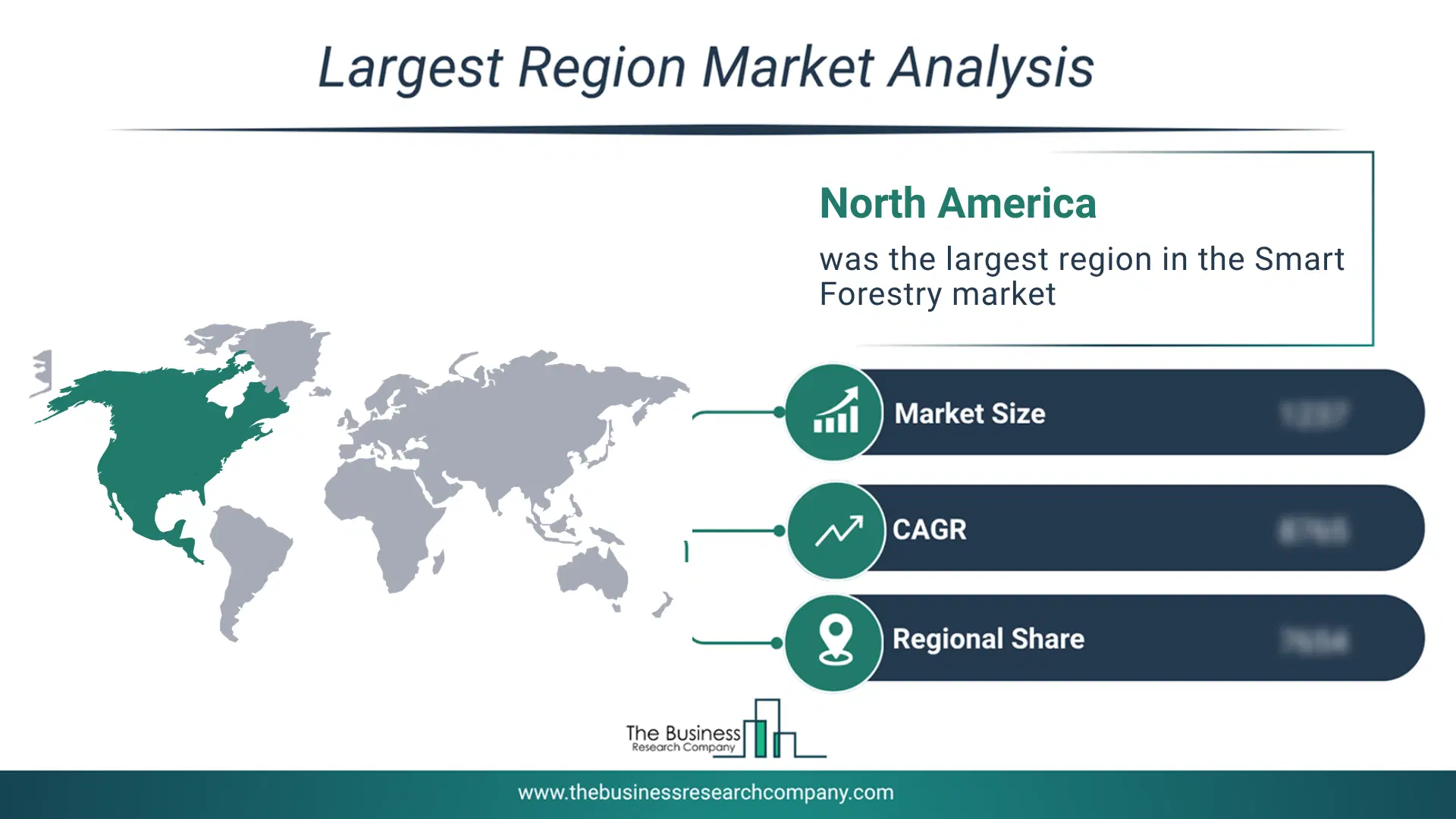
Regional Outlook
North America was the largest region in the smart forestry market in 2025. The regions covered in this market report are Asia-Pacific, South East Asia, Western Europe, Eastern Europe, North America, South America, Middle East, Africa The countries covered in this market report are Australia, Brazil, China, France, Germany, India, Indonesia, Japan, Taiwan, Russia, South Korea, UK, USA, Canada, Italy, Spain.What Defines the Smart Forestry Market?
The smart forestry market consists of revenues earned by entities by providing services such as forest monitoring, resource management, biodiversity protection, and illegal logging prevention. The market value includes the value of related goods sold by the service provider or included within the service offering. The smart forestry market also includes sales of IoT sensors, smart cameras, scanners, weather stations, and drones. Values in this market are ‘factory gate’ values, that is, the value of goods sold by the manufacturers or creators of the goods, whether to other entities (including downstream manufacturers, wholesalers, distributors, and retailers) or directly to end customers. The value of goods in this market includes related services sold by the creators of the goods.How is Market Value Defined and Measured?
The market value is defined as the revenues that enterprises gain from the sale of goods and/or services within the specified market and geography through sales, grants, or donations in terms of the currency (in USD unless otherwise specified). The revenues for a specified geography are consumption values that are revenues generated by organizations in the specified geography within the market, irrespective of where they are produced. It does not include revenues from resales along the supply chain, either further along the supply chain or as part of other products.
This chart presents market attractiveness based on a quantitative evaluation of growth, competition, strategic alignment, and risk, offering a clear view of opportunity areas for decision-making. This chart is for illustrative purposes; the full report contains the complete analysis.

This chart highlights the Total Addressable Market (TAM) by estimating the maximum revenue opportunity using an assumption-driven approach, supporting strategic planning and opportunity sizing across markets. The chart is illustrative; the full report provides a more comprehensive analysis.
What Key Data and Analysis Are Included in the Smart Forestry Market Report 2026?
The smart forestry market research report is one of a series of new reports from The Business Research Company that provides market statistics, including industry global market size, regional shares, competitors with the market share, detailed market segments, market trends and opportunities, and any further data you may need to thrive in the smart forestry industry. The market research report delivers a complete perspective of everything you need, with an in-depth analysis of the current and future state of the industry.Smart Forestry Market Report Forecast Analysis
| Report Attribute | Details |
|---|---|
| Market Size Value In 2026 | $6.09 billion |
| Revenue Forecast In 2030 | $9.12 billion |
| Growth Rate | CAGR of 10.6% from 2026 to 2030 |
| Base Year For Estimation | 2025 |
| Actual Estimates/Historical Data | 2020-2025 |
| Forecast Period | 2026 - 2030 |
| Market Representation | Revenue in USD Billion and CAGR from 2026 to 2030 |
| Segments Covered | Type, Technology, Application, End-User |
| Regional Scope | Asia-Pacific, Western Europe, Eastern Europe, North America, South America, Middle East, Africa |
| Key Companies Profiled | Deere & Company, Hexagon AB, Trimble Inc., Maxar Technologies Inc., Esri International LLC, Ponsse Oyj, AFRY AB, Planet Labs PBC, Pix4D SA, Komatsu Forest AB, EcoTrust Software Ltda., Silvacom Ltd., GEOSYS, Rottne Industri AB, Tigercat International Inc., TreeMetrics, Skytec LLC, Agremo Ltd., ForestX AB, Landmark Spatial Solutions, CollectiveCrunch Oy, Blue Marble Geographics, GIS Cloud Ltd. |
| Customization Scope | Request for Customization |
| Pricing And Purchase Options | Explore Purchase Options |