
Smart Gas Leak Detection Robots Market Report 2026
Global Outlook – By Type (Mobile Gas Detection Robots, Fixed Rail Gas Detection Robots, Drone-Based Gas Detection Robots, Other Types), By Application (Oil And Gas Industry, Chemical Manufacturing, Urban Gas Pipeline Networks, Other Applications), By End User (Industrial Enterprises, Government And Public Safety Agencies, Research And Environmental Organizations) – Market Size, Trends, Strategies, and Forecast to 2030
Smart Gas Leak Detection Robots Market Overview
• Smart Gas Leak Detection Robots market size has reached to $1.34 billion in 2025 • Expected to grow to $2.71 billion in 2030 at a compound annual growth rate (CAGR) of 15% • Growth Driver: Surge In Methane Leak Reduction Initiatives Fueling The Growth Of The Market Due To Stricter Environmental Regulations And Need For Automated Monitoring • Market Trend: Technological Advancements In Smart Gas Leak Detection Robots • North America was the largest region in 2025 and Asia-Pacific is the fastest growing region.What Is Covered Under Smart Gas Leak Detection Robots Market?
Smart gas leak detection robots refer to autonomous or remotely controlled robotic systems equipped with advanced sensors and technologies designed to detect, monitor, and report the presence of hazardous gases in industrial, commercial, or residential environments. These robots help in preventing accidents and ensuring safety by providing real-time gas concentration data, navigating difficult or dangerous areas, and reducing the need for human exposure in potentially harmful conditions. The main types of smart gas leak detection robots are mobile gas detection robots, fixed rail gas detection robots, drone-based gas detection robots, and others. Mobile gas detection robots are autonomous vehicles designed to navigate industrial and hazardous environments to identify and locate gas leaks. It finds applications in the oil and gas industry, chemical manufacturing, urban gas pipeline networks, and others, serving end-users, such as industrial enterprises, government and public safety agencies, and research and environmental organizations.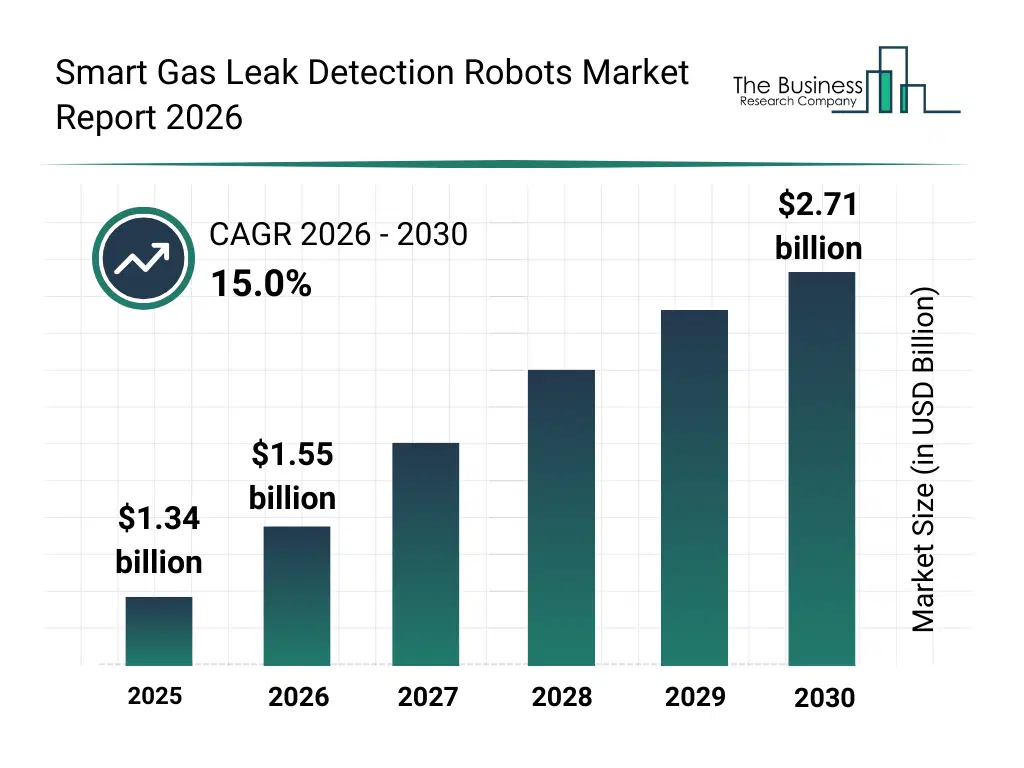
What Is The Smart Gas Leak Detection Robots Market Size and Share 2026?
The smart gas leak detection robots market size has grown rapidly in recent years. It will grow from $1.34 billion in 2025 to $1.55 billion in 2026 at a compound annual growth rate (CAGR) of 15.2%. The growth in the historic period can be attributed to growth in industrial safety regulations, expansion of oil and gas infrastructure, rising incidents of gas leakage risks, increasing adoption of robotic inspection tools, availability of advanced sensor technologies.What Is The Smart Gas Leak Detection Robots Market Growth Forecast?
The smart gas leak detection robots market size is expected to see rapid growth in the next few years. It will grow to $2.71 billion in 2030 at a compound annual growth rate (CAGR) of 15.0%. The growth in the forecast period can be attributed to increasing investments in smart industrial safety systems, rising demand for autonomous monitoring solutions, expansion of urban gas pipeline networks, growing use of ai-driven anomaly detection, increasing government focus on public safety. Major trends in the forecast period include increasing deployment of autonomous inspection robots, rising integration of advanced gas sensors, growing use of real-time data analytics, expansion of robotics in hazardous environments, enhanced focus on worker safety.Tariff Impact On Smart Gas Leak Detection Robots Market
Tariffs are impacting the smart gas leak detection robots market by increasing the cost of imported sensors, robotic platforms, embedded electronics, and communication modules essential for advanced detection systems. Oil and gas facilities, chemical plants, and urban infrastructure projects in North America and Asia-Pacific are most affected due to reliance on imported high-precision components. These tariffs are contributing to higher system costs and slower deployment timelines. At the same time, they are encouraging local manufacturing of robotic platforms, regional sensor development, and innovation in cost-efficient detection technologies to improve supply security.
Global Smart Gas Leak Detection Robots Market Segmentation
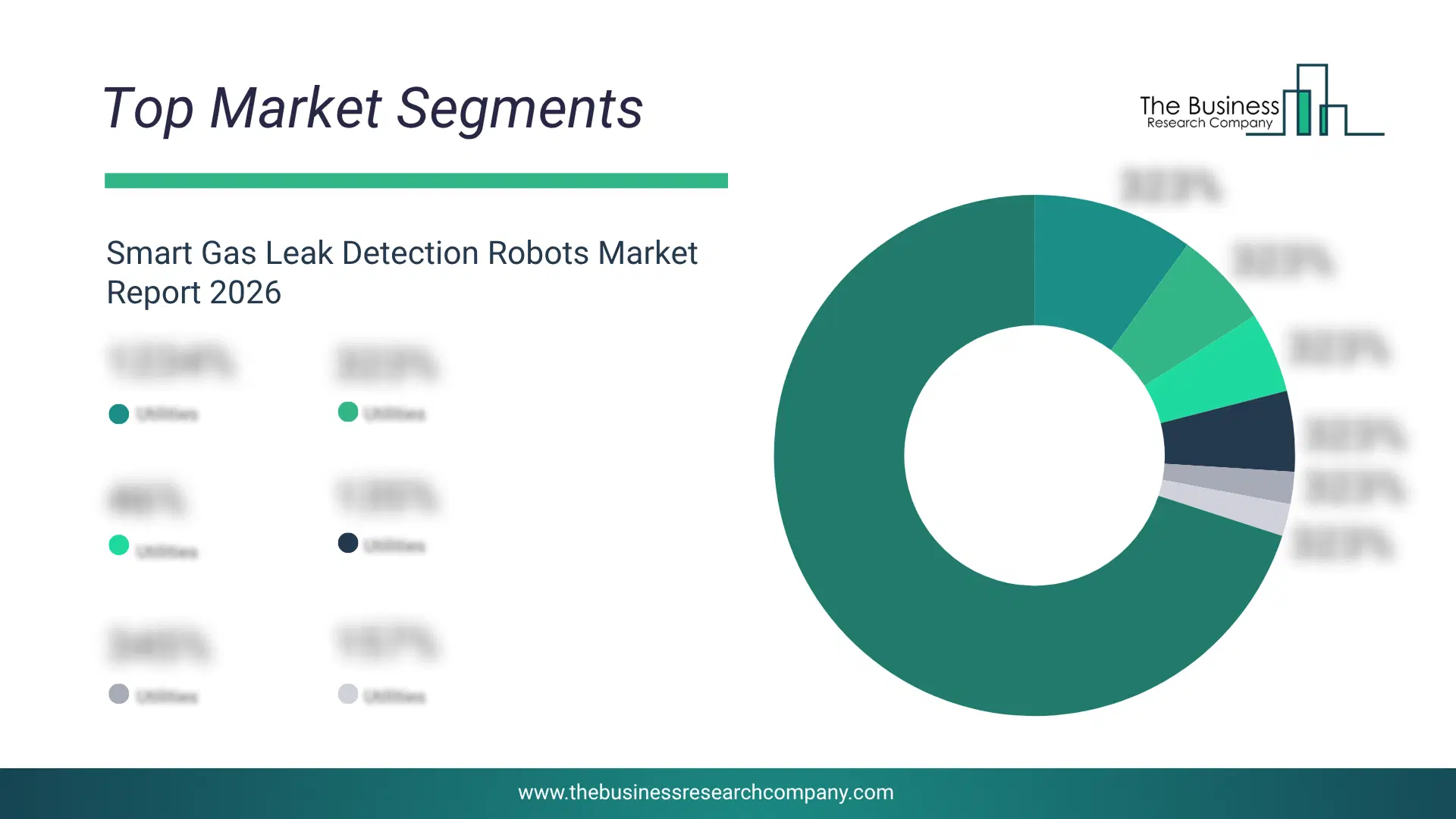
1) By Type: Mobile Gas Detection Robots, Fixed Rail Gas Detection Robots, Drone-Based Gas Detection Robots, Other Types 2) By Application: Oil And Gas Industry, Chemical Manufacturing, Urban Gas Pipeline Networks, Other Applications 3) By End User: Industrial Enterprises, Government And Public Safety Agencies, Research And Environmental Organizations Subsegments: 1) By Mobile Gas Detection Robots: Wheeled Robots, Tracked Robots, Legged Robots, Hybrid Mobility Robots 2) By Fixed Rail Gas Detection Robots: Overhead Rail Robots, Ground Rail Robots, Conveyor Integrated Robots 3) By Drone-Based Gas Detection Robots: Quadcopter Drones, Hexacopter Drones, Fixed Wing Drones 4) By Other Types: Portable Handheld Robots, Autonomous Hybrid Robots, Modular Sensor RobotsWhat Is The Driver Of The Smart Gas Leak Detection Robots Market?
The increasing methane leak reduction initiatives are expected to propel the growth of the smart gas leak detection robots market going forward. Methane leak reduction initiatives refer to government-led programs and regulations aimed at detecting, monitoring, and minimizing methane emissions from oil, gas, and industrial systems due to methane’s high global-warming potential. These initiatives are rising as countries strengthen environmental regulations, expand methane detection standards, and implement stricter compliance requirements for industrial facilities. Smart gas leak detection robots support these initiatives by offering automated, precise, and continuous inspection capabilities, enabling industries to locate leaks faster, prevent hazardous releases, and meet regulatory obligations. For instance, in December 2024, according to the U.S. Department of Energy (DOE), the US expanded its methane monitoring and leak-detection enforcement under the methane emissions reduction program, increasing methane mitigation activities by more than 15% compared with 2023, with full operational deployment scheduled through 2025. Therefore, the increasing methane leak reduction initiatives are driving the growth of the smart gas leak detection robots industry.Key Players In The Global Smart Gas Leak Detection Robots Market
Major companies operating in the smart gas leak detection robots market are ANYbotics AG, Boston Dynamics Inc., Taurob GmbH, ExRobotics B.V., ULC Robotics, SMP Robotics Limited, OTSAW Digital Pte Ltd, IDMind Technologies, Inuktun Services Ltd, SuperDroid Robots Inc., Clearpath Robotics Inc., Robosynthesis Ltd, Aerialtronics B.V., Percepto Robotics Ltd, Flyability SA, DJI (SZ DJI Technology Co., Ltd.), SkyX Systems Corp., Voliro Airborne Robotics AG, Robsense Technology, Gridbots Technologies Pvt. Ltd., Acutronic Robotics AG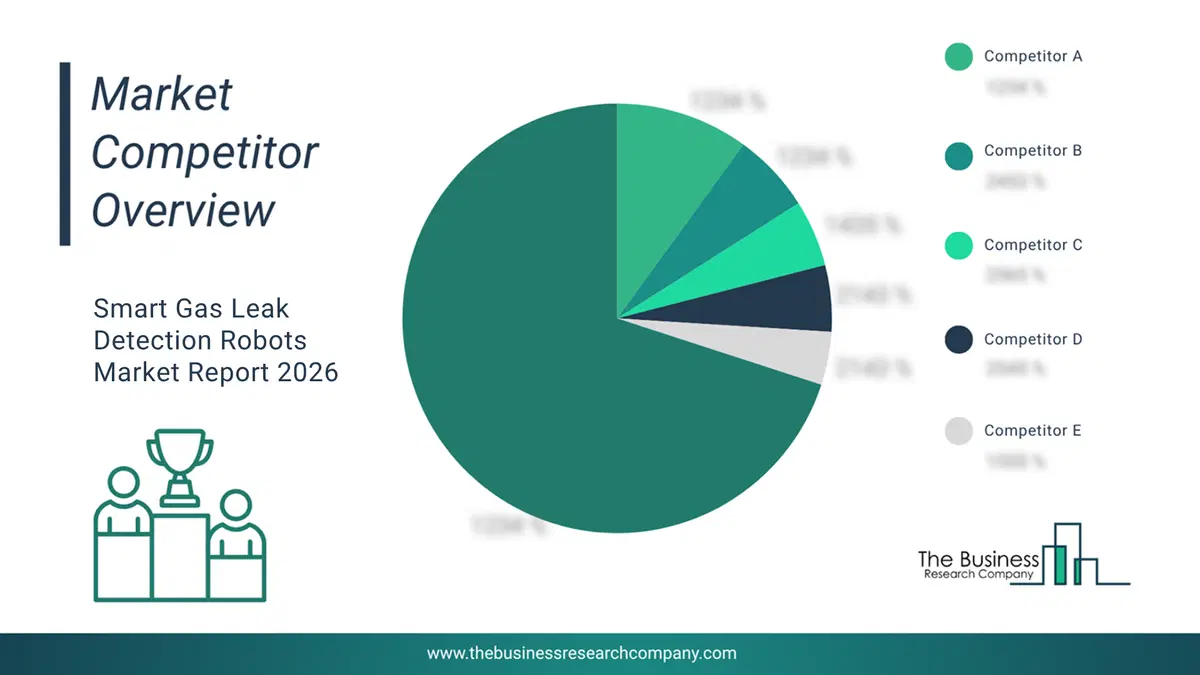
This chart is for illustrative purposes; the full report includes a detailed competitor analysis and comprehensive overview of the top 10 companies in the market.
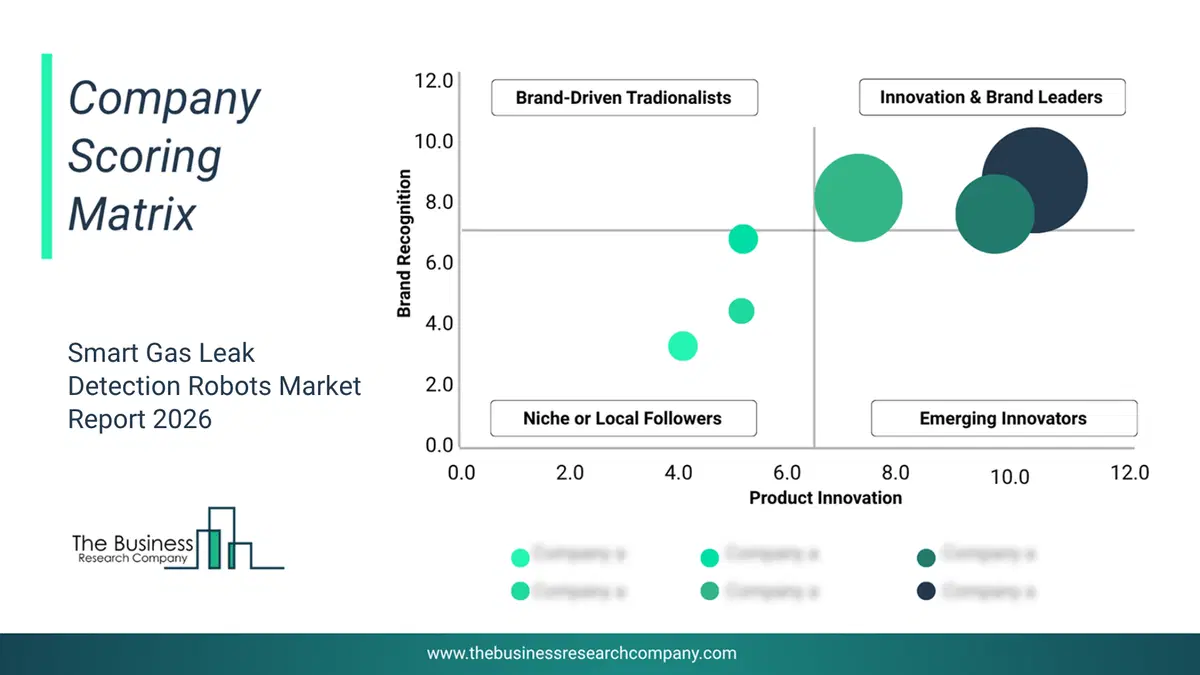
This chart maps companies by product innovation and brand strength, with bubble size indicating relative revenue, helping identify market leaders, challengers, and niche players. This is an illustrative chart; the full report provides a complete and accurate competitive analysis.
Global Smart Gas Leak Detection Robots Market Trends and Insights
Major companies operating in the smart gas leak detection robots market are focusing on technological advancements, such as modular gas detection systems, to enhance the flexibility, efficiency, and safety of gas leak detection in various industrial settings. A modular gas detection system is a flexible setup that lets users add or replace different gas sensors to detect various gases according to their needs. For instance, in June 2025, ANYbotics AG, a Switzerland-based provider of autonomous robotic solutions, launched a new gas leak and presence detection solution for its ANYmal inspection robot, designed to revolutionize industrial gas leak management. This solution integrates advanced modular gas detectors with a 360° acoustic imaging payload to precisely locate leak sources, measure ambient gas concentrations, and quantify the rate and cost of gas losses. It can detect a wide range of gases, such as steam, compressed air, toxic gases, hydrocarbons, oxygen, and ammonia. The modular design allows flexible sensor swapping and on-site calibration, enabling continuous monitoring during autonomous or teleoperated missions.What Are Latest Mergers And Acquisitions In The Smart Gas Leak Detection Robots Market?
In July 2025, Vacuum Instruments Corporation, a US-based manufacturer of leak detectors and gas handling systems, including smart gas leak detection robots, partnered with ABB Ltd. to integrate ABB’s automation systems into VICT’s operations. This partnership between VIC and ABB aims to enhance the accuracy, speed, and reliability of automated leak detection in manufacturing environments, thereby reducing human error, optimizing testing cycles, and ensuring compliance with strict quality and safety standards. ABB Ltd. is a Switzerland-based automation company.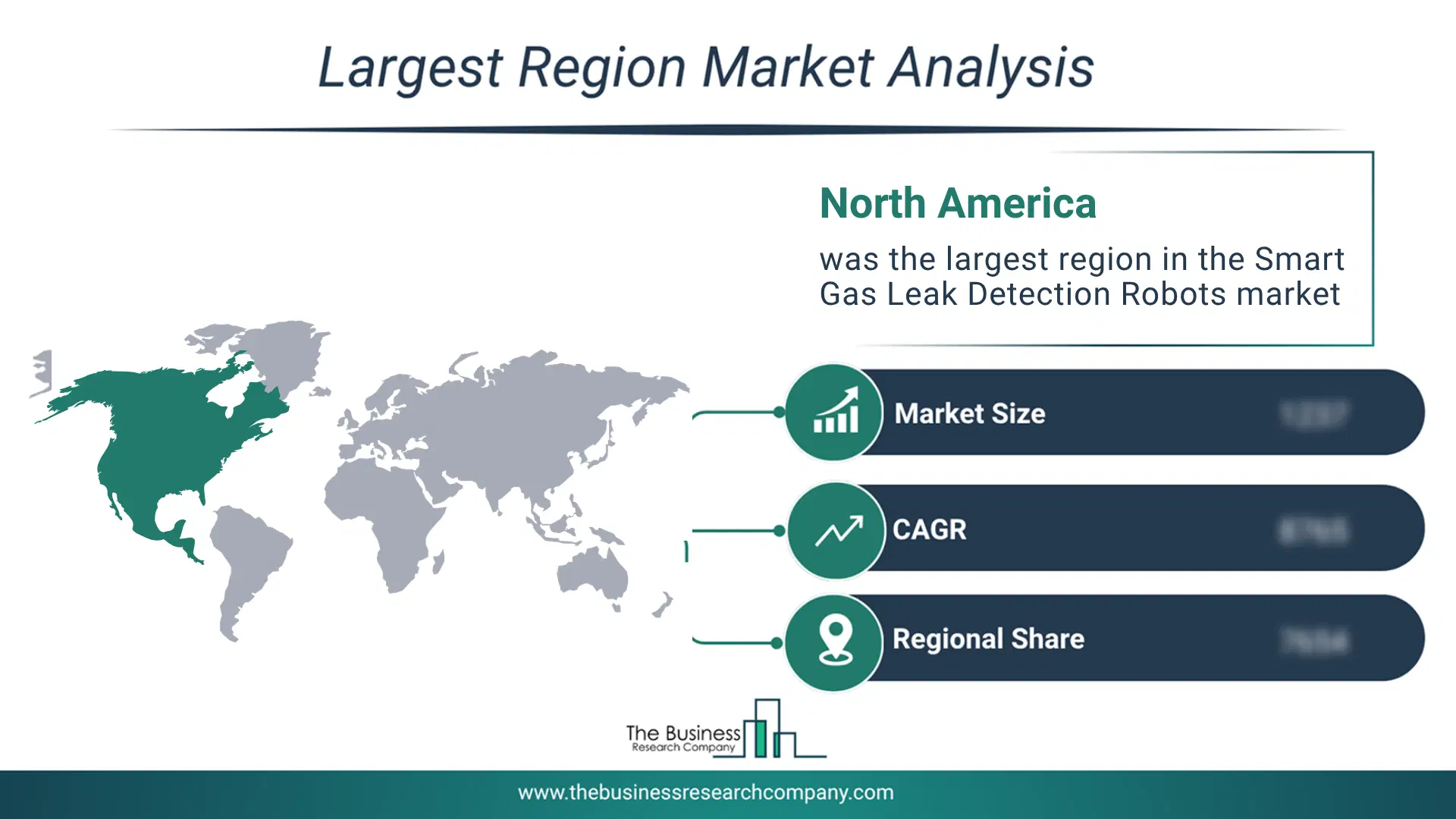
Regional Outlook
North America was the largest region in the smart gas leak detection robots market in 2025. Asia-Pacific is expected to be the fastest-growing region in the forecast period. The regions covered in this market report are Asia-Pacific, South East Asia, Western Europe, Eastern Europe, North America, South America, Middle East, Africa The countries covered in this market report are Australia, Brazil, China, France, Germany, India, Indonesia, Japan, Taiwan, Russia, South Korea, UK, USA, Canada, Italy, Spain.What Defines the Smart Gas Leak Detection Robots Market?
The smart gas leak detection robots market consists of revenues earned by entities by providing services such as remote gas monitoring, automated leak inspection, predictive safety analytics, real-time incident alerting, hazardous area surveillance, and preventive risk assessment. The market value includes the value of related goods sold by the service provider or included within the service offering. The smart gas leak detection robots market also includes sales of robotic leak detectors, autonomous inspection drones, mobile robotic platforms, multi-gas sensing devices, safety monitoring robots, and industrial surveillance units. Values in this market are ‘factory gate’ values, that is, the value of goods sold by the manufacturers or creators of the goods, whether to other entities (including downstream manufacturers, wholesalers, distributors, and retailers) or directly to end customers. The value of goods in this market includes related services sold by the creators of the goods.How is Market Value Defined and Measured?
The market value is defined as the revenues that enterprises gain from the sale of goods and/or services within the specified market and geography through sales, grants, or donations in terms of the currency (in USD unless otherwise specified). The revenues for a specified geography are consumption values that are revenues generated by organizations in the specified geography within the market, irrespective of where they are produced. It does not include revenues from resales along the supply chain, either further along the supply chain or as part of other products.
This chart presents market attractiveness based on a quantitative evaluation of growth, competition, strategic alignment, and risk, offering a clear view of opportunity areas for decision-making. This chart is for illustrative purposes; the full report contains the complete analysis.

This chart highlights the Total Addressable Market (TAM) by estimating the maximum revenue opportunity using an assumption-driven approach, supporting strategic planning and opportunity sizing across markets. The chart is illustrative; the full report provides a more comprehensive analysis.
What Key Data and Analysis Are Included in the Smart Gas Leak Detection Robots Market Report 2026?
The smart gas leak detection robots market research report is one of a series of new reports from The Business Research Company that provides market statistics, including industry global market size, regional shares, competitors with the market share, detailed market segments, market trends and opportunities, and any further data you may need to thrive in the smart gas leak detection robots industry. The market research report delivers a complete perspective of everything you need, with an in-depth analysis of the current and future state of the industry.Smart Gas Leak Detection Robots Market Report Forecast Analysis
| Report Attribute | Details |
|---|---|
| Market Size Value In 2026 | $1.55 billion |
| Revenue Forecast In 2030 | $2.71 billion |
| Growth Rate | CAGR of 15% from 2026 to 2030 |
| Base Year For Estimation | 2025 |
| Actual Estimates/Historical Data | 2020-2025 |
| Forecast Period | 2026 - 2030 |
| Market Representation | Revenue in USD Billion and CAGR from 2026 to 2030 |
| Segments Covered | Type, Application, End User |
| Regional Scope | Asia-Pacific, Western Europe, Eastern Europe, North America, South America, Middle East, Africa |
| Key Companies Profiled | ANYbotics AG, Boston Dynamics Inc., Taurob GmbH, ExRobotics B.V., ULC Robotics, SMP Robotics Limited, OTSAW Digital Pte Ltd, IDMind Technologies, Inuktun Services Ltd, SuperDroid Robots Inc., Clearpath Robotics Inc., Robosynthesis Ltd, Aerialtronics B.V., Percepto Robotics Ltd, Flyability SA, DJI (SZ DJI Technology Co., Ltd.), SkyX Systems Corp., Voliro Airborne Robotics AG, Robsense Technology, Gridbots Technologies Pvt. Ltd., Acutronic Robotics AG |
| Customization Scope | Request for Customization |
| Pricing And Purchase Options | Explore Purchase Options |