
Smart Grid Synchronization Market Report 2026
Global Outlook – By Component (Hardware, Software, Services), By Deployment (On-Premises, Cloud, Hybrid), By Technology (Phasor Measurement Units, Synchrophasors, Digital Fault Recorders, Smart Meters, Other Technologies), By Application (Transmission, Distribution, Generation, Other Applications), By End-User (Utilities, Industrial, Commercial, Residential, Other End-Users) – Market Size, Trends, Strategies, and Forecast to 2030
Smart Grid Synchronization Market Overview
• Smart Grid Synchronization market size has reached to $8.5 billion in 2025 • Expected to grow to $16.11 billion in 2030 at a compound annual growth rate (CAGR) of 13.7% • Growth Driver: Rising Smart Meter Adoption Driving The Market Growth Due To Enhanced Energy Efficiency And Real-Time Grid Management • Market Trend: Advancements In Precision Time Synchronization For Enhanced Grid Reliability • North America was the largest region in 2025 and Asia-Pacific is the fastest growing region.What Is Covered Under Smart Grid Synchronization Market?
Smart grid synchronization is the process of coordinating the operation of distributed energy resources, power generation units, and loads within a smart grid to ensure they operate in phase and at the same frequency. It involves aligning voltage, frequency, and phase angle between sources before connecting them to the grid. It helps to maintain grid stability, prevent disturbances, and enable seamless integration of renewable energy and Distributed Generation. The main components of smart grid synchronization are hardware, software, and services. Hardware refers to physical devices used to measure, monitor, and control electrical grid parameters in real time, ensuring accurate synchronization and stable operation. These solutions are deployed through various deployment models, including on-premises, cloud, and hybrid. They utilize different technologies, such as phasor measurement units, synchrophasors, digital fault recorders, smart meters, and other technologies, and are applied across transmission, distribution, generation, and other applications. The solutions serve multiple end-users, including utilities, industrial, commercial, residential, and other end-users.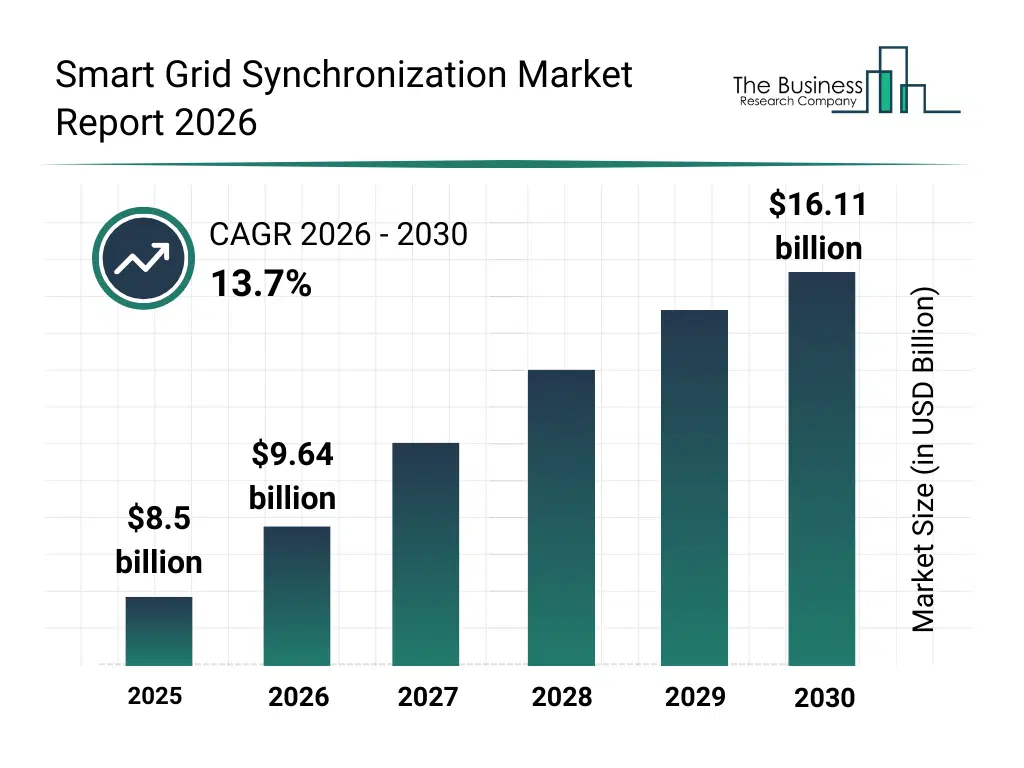
What Is The Smart Grid Synchronization Market Size and Share 2026?
The smart grid synchronization market size has grown rapidly in recent years. It will grow from $8.5 billion in 2025 to $9.64 billion in 2026 at a compound annual growth rate (CAGR) of 13.4%. The growth in the historic period can be attributed to phasor measurement unit adoption, wide area monitoring systems, grid stability programs, transmission modernization, blackout prevention initiatives.What Is The Smart Grid Synchronization Market Growth Forecast?
The smart grid synchronization market size is expected to see rapid growth in the next few years. It will grow to $16.11 billion in 2030 at a compound annual growth rate (CAGR) of 13.7%. The growth in the forecast period can be attributed to renewable variability management, Microgrid synchronization demand, high DER penetration, real time grid control needs, advanced grid analytics growth. Major trends in the forecast period include synchrophasor based grid coordination, high precision time synchronization devices, pmu dense deployment networks, real time phase angle monitoring, automated grid frequency alignment.
Global Smart Grid Synchronization Market Segmentation
1) By Component: Hardware; Software; Services 2) By Deployment: On-Premises; Cloud; Hybrid 3) By Technology: Phasor Measurement Units; Synchrophasors; Digital Fault Recorders; Smart Meters; Other Technologies 4) By Application: Transmission; Distribution; Generation; Other Applications 5) By End-User: Utilities; Industrial; Commercial; Residential; Other End-Users Subsegments: 1) By Hardware: Smart Meters; Sensors; Controllers; Communication Devices; Energy Storage Systems 2) By Software: Grid Management Software; Data Analytics Platforms; Monitoring and Control Software; Predictive Maintenance Software; Energy Optimization Software 3) By Services: Installation Services; Integration Services; Consulting Services; Maintenance Services; Training and Support ServicesWhat Is The Driver Of The Smart Grid Synchronization Market?
The rising adoption of smart meters is expected to propel the growth of the smart grid synchronization market going forward. Smart meters are electronic devices that automatically measure and transmit real-time electricity, gas, or water usage to utilities for accurate billing and efficient energy management. The adoption of smart meters is increasing due to the push for energy efficiency, as they provide real-time usage data that helps consumers reduce consumption and utilities optimize grid management, lowering costs and environmental impact. Smart Grid Synchronization helps Smart Meters by enabling seamless communication between meters and the grid, which supports automated energy management, reduces outages, and optimizes power delivery. For instance, in November 2025, according to Gov.uk, a UK-based government body, in Q3 2025, major energy suppliers across Great Britain installed a total of 680,000 smart and advanced meters. Therefore, the rising adoption of smart meters is driving the growth of the smart grid synchronization industry.Key Players In The Global Smart Grid Synchronization Market
Major companies operating in the smart grid synchronization market are Siemens AG., Hitachi Energy Ltd., Cisco Systems Inc., Oracle Corporation, Schneider Electric SE, Honeywell International Inc., ABB Ltd., Eaton Corporation plc., Quanta Technology LLC, Prysmian Group, Emerson Electric Co., Fluence Energy Inc., Itron Inc., Schweitzer Engineering Laboratories Inc., Landis+Gyr Group AG., Bentley Systems Incorporated, Crompton Greaves, S&C Electric Company, Kamstrup A/S, ETAP, Toshiba Corporation, and General Electric Company.
This chart is for illustrative purposes; the full report includes a detailed competitor analysis and comprehensive overview of the top 10 companies in the market.
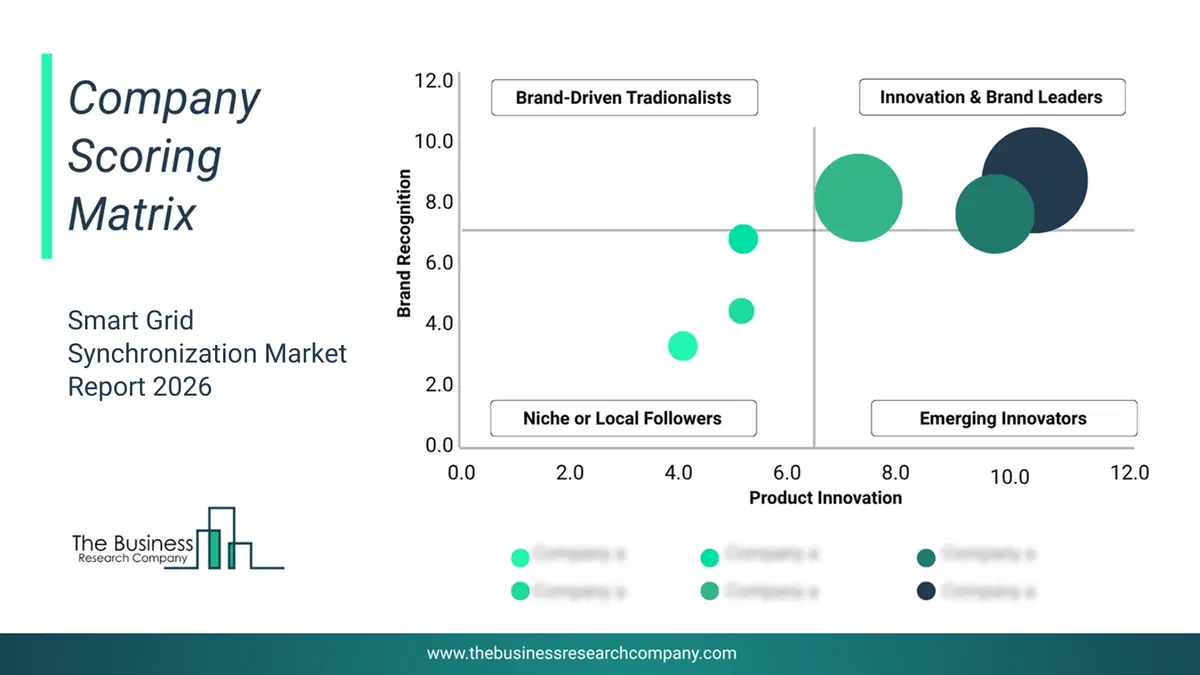
This chart maps companies by product innovation and brand strength, with bubble size indicating relative revenue, helping identify market leaders, challengers, and niche players. This is an illustrative chart; the full report provides a complete and accurate competitive analysis.
Global Smart Grid Synchronization Market Trends and Insights
Major companies operating in the smart grid synchronization market are focusing on developing innovative solutions, such as precision time synchronization technologies, to meet the rising demand for enhanced grid reliability, interoperability, and resilient digital power infrastructure. Precision Time Synchronization technologies are methods that align clocks across devices or systems with microsecond or nanosecond accuracy to enable coordinated operations in networks, industrial systems, and critical applications. For instance, in December 2025, Siemens AG, a Germany-based industrial automation and power systems technology company, introduced the siprotec 5 precision time protocol (PTP) grandmaster clock (GMC), designed to fortify digital substations and critical grid infrastructure. The Siprotec 5 PTP GMC integrates Precision Time Protocol (IEEE 1588v2) grandmaster capabilities with enhanced cybersecurity features, including strict separation of process bus and station bus networks and patent-pending seamless grandmaster changeover technology to maintain continuous synchronization without disruptive time jumps during clock transitions. This innovation supports resilient, fail-safe time coordination essential for modern smart grids, improves protection functions against disturbances, and strengthens overall grid reliability.What Are Latest Mergers And Acquisitions In The Smart Grid Synchronization Market?
In September 2024, Siemens AG, a Germany-based technology company, acquired Trayer Engineering Corporation for an undisclosed amount. With this acquisition, Siemens aims to integrate its resilient, weatherproof switchgear with Siemens Xcelerator digital tools to deliver end-to-end solutions for utilities upgrading secondary power distribution networks against extreme weather. Trayer Engineering Corporation is a US-based manufacturing company that offers smart grid synchronization solutions.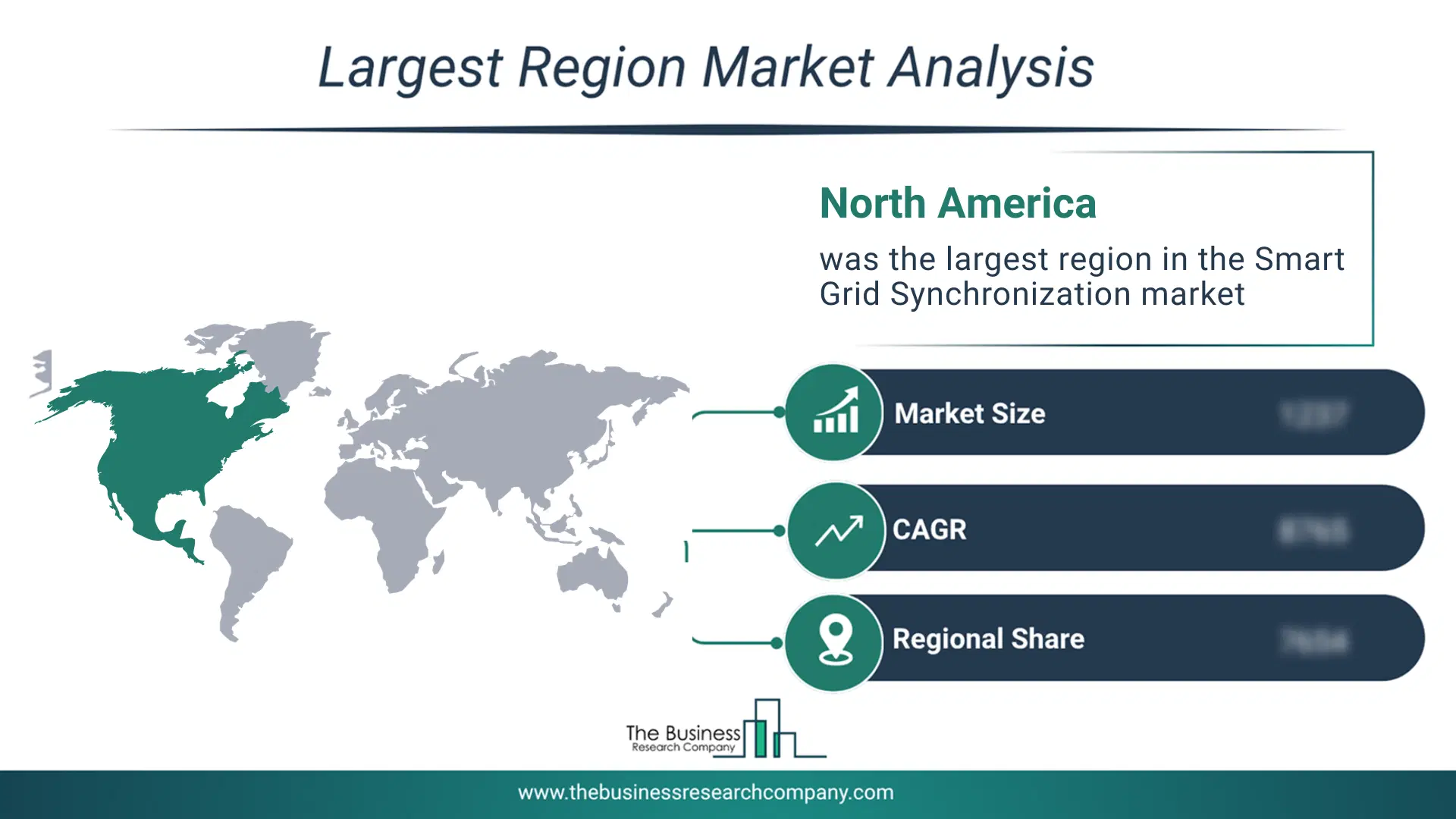
Regional Insights
North America was the largest region in the smart grid synchronization market in 2025. Asia-Pacific is expected to be the fastest-growing region in the forecast period. The regions covered in this market report are Asia-Pacific, South East Asia, Western Europe, Eastern Europe, North America, South America, Middle East, Africa. The countries covered in this market report are Australia, Brazil, China, France, Germany, India, Indonesia, Japan, Taiwan, Russia, South Korea, UK, USA, Canada, Italy, Spain.What Defines the Smart Grid Synchronization Market?
The smart grid synchronization market consists of revenues earned by entities by providing services such as frequency and voltage synchronization services, integration of phasor measurement units (PMUs) and sensors, data acquisition and analytics, system calibration and tuning, grid performance optimization, and managed synchronization solutions. The market value includes the value of related goods sold by the service provider or included within the service offering. The smart grid synchronization market includes sales of voltage and current sensors, time-synchronization devices, data acquisition and communication modules, grid monitoring and control software, synchronization controllers, and servers and data storage systems. Values in this market are ‘factory gate’ values, that is, the value of goods sold by the manufacturers or creators of the goods, whether to other entities (including downstream manufacturers, wholesalers, distributors, and retailers) or directly to end customers. The value of goods in this market includes related services sold by the creators of the goods.How is Market Value Defined and Measured?
The market value is defined as the revenues that enterprises gain from the sale of goods and/or services within the specified market and geography through sales, grants, or donations in terms of the currency (in USD unless otherwise specified). The revenues for a specified geography are consumption values that are revenues generated by organizations in the specified geography within the market, irrespective of where they are produced. It does not include revenues from resales along the supply chain, either further along the supply chain or as part of other products.
This chart presents market attractiveness based on a quantitative evaluation of growth, competition, strategic alignment, and risk, offering a clear view of opportunity areas for decision-making. This chart is for illustrative purposes; the full report contains the complete analysis.

This chart highlights the Total Addressable Market (TAM) by estimating the maximum revenue opportunity using an assumption-driven approach, supporting strategic planning and opportunity sizing across markets. The chart is illustrative; the full report provides a more comprehensive analysis.
What Key Data and Analysis Are Included in the Smart Grid Synchronization Market Report 2026?
The smart grid synchronization market research report is one of a series of new reports from The Business Research Company that provides market statistics, including industry global market size, regional shares, competitors with the market share, detailed market segments, market trends and opportunities, and any further data you may need to thrive in the smart grid synchronization industry. The market research report delivers a complete perspective of everything you need, with an in-depth analysis of the current and future state of the industry.Smart Grid Synchronization Market Report Forecast Analysis
| Report Attribute | Details |
|---|---|
| Market Size Value In 2026 | $9.64 billion |
| Revenue Forecast In 2030 | $16.11 billion |
| Growth Rate | CAGR of 13.4% from 2026 to 2030 |
| Base Year For Estimation | 2025 |
| Actual Estimates/Historical Data | 2020-2025 |
| Forecast Period | 2026 - 2030 - 2030 |
| Market Representation | Revenue in USD Billion and CAGR from 2026 to 2030 |
| Segments Covered | Component, Deployment, Technology, Application, End-User |
| Regional Scope | Asia-Pacific, Western Europe, Eastern Europe, North America, South America, Middle East, Africa |
| Country Scope | The countries covered in the report are Australia, Brazil, China, France, Germany, India, Indonesia, Japan, Taiwan, Russia, South Korea, UK, USA, Canada, Italy, Spain. |
| Key Companies Profiled | Siemens AG., Hitachi Energy Ltd., Cisco Systems Inc., Oracle Corporation, Schneider Electric SE, Honeywell International Inc., ABB Ltd., Eaton Corporation plc., Quanta Technology LLC, Prysmian Group, Emerson Electric Co., Fluence Energy Inc., Itron Inc., Schweitzer Engineering Laboratories Inc., Landis+Gyr Group AG., Bentley Systems Incorporated, Crompton Greaves, S&C Electric Company, Kamstrup A/S, ETAP, Toshiba Corporation, and General Electric Company. |
| Customization Scope | Request for Customization |
| Pricing And Purchase Options | Explore Purchase Options |