
Smart Home Greywater Sensors Market Report 2026
Global Outlook – By Product Type (Ultrasonic Sensors, Conductivity Sensors, Optical Sensors, Other Product Types), By Connectivity (Wired, Wireless), By Application (Residential, Commercial, Industrial), By Distribution Channel (Online, Offline), By End-User (Individual Households, Apartments, Hotels, Hospitals, Other End-Users) – Market Size, Trends, Strategies, and Forecast to 2030
Smart Home Greywater Sensors Market Overview
• Smart Home Greywater Sensors market size has reached to $0.97 billion in 2025 • Expected to grow to $2 billion in 2030 at a compound annual growth rate (CAGR) of 15.6% • Growth Driver: Surge In Smart Home Solutions Fueling The Growth Of The Market Due To Rising Demand For Automation And Resource Efficiency • Market Trend: Innovative Real-Time Water Monitoring Technology Promises Greater Household Efficiency And Sustainability • North America was the largest region in 2025 and Asia-Pacific is the fastest growing region.What Is Covered Under Smart Home Greywater Sensors Market?
A smart home greywater sensor is an advanced monitoring device embedded within residential water systems that continuously tracks and analyses the quality, flow, and temperature of greywater to ensure safe and efficient reuse within smart home environments. Its purpose is to optimize water conservation by enabling the safe recycling of greywater for non-potable uses such as landscape irrigation, toilet flushing, and laundry. The main product types of smart home greywater sensors are ultrasonic sensors, conductivity sensors, optical sensors, and others. An ultrasonic sensor is a device that uses high-frequency sound waves to detect the distance, presence, or movement of objects by measuring the time taken for the sound to travel to the target and back. The different connectivities are wired and wireless. The various applications involved are residential, commercial, and industrial, and they are used by several end users such as individual households, apartments, hotels, hospitals, and others.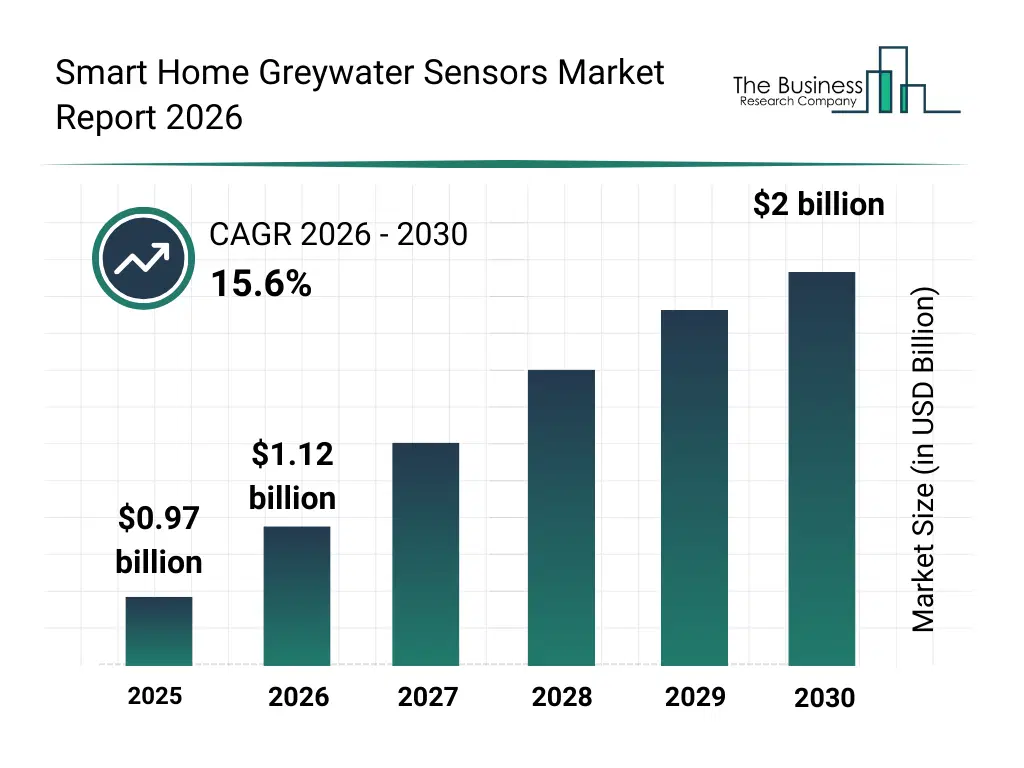
What Is The Smart Home Greywater Sensors Market Size and Share 2026?
The smart home greywater sensors market size has grown rapidly in recent years. It will grow from $0.97 billion in 2025 to $1.12 billion in 2026 at a compound annual growth rate (CAGR) of 15.5%. The growth in the historic period can be attributed to increasing residential water consumption, early adoption of water-saving fixtures, rising awareness of water reuse practices, expansion of smart home adoption, availability of basic water quality sensors.What Is The Smart Home Greywater Sensors Market Growth Forecast?
The smart home greywater sensors market size is expected to see rapid growth in the next few years. It will grow to $2 billion in 2030 at a compound annual growth rate (CAGR) of 15.6%. The growth in the forecast period can be attributed to increasing water scarcity concerns, rising investments in sustainable housing, expansion of smart city water management, growing demand for automated water reuse monitoring, increasing regulatory support for water conservation technologies. Major trends in the forecast period include increasing adoption of residential water reuse systems, rising deployment of wireless greywater sensors, growing integration with smart home platforms, expansion of real-time water quality monitoring, enhanced focus on household water conservation.
Global Smart Home Greywater Sensors Market Segmentation
1) By Product Type: Ultrasonic Sensors, Conductivity Sensors, Optical Sensors, Other Product Types 2) By Connectivity: Wired, Wireless 3) By Application: Residential, Commercial, Industrial 4) By Distribution Channel: Online, Offline 5) By End-User: Individual Households, Apartments, Hotels, Hospitals, Other End-Users Subsegments: 1) By Ultrasonic Sensors: Single Beam Ultrasonic Sensors, Dual Beam Ultrasonic Sensors, Multi Beam Ultrasonic Sensors 2) By Conductivity Sensors: Contact Conductivity Sensors, Inductive Conductivity Sensors, Toroidal Conductivity Sensors 3) By Optical Sensors: Infrared Optical Sensors, Ultraviolet Optical Sensors, Laser Optical Sensors 4) By Other Types: Capacitive Sensors, Pressure Sensors, Temperature SensorsWhat Is The Driver Of The Smart Home Greywater Sensors Market?
The growing interest in smart home solutions is expected to propel the growth of the smart home greywater sensor market going forward. Smart home solutions refer to interconnected household devices and systems that residents can monitor, control, and automate, spanning functions such as lighting, security, climate control, and water usage via digital platforms. The rise in smart home solutions is due to growing consumer demand for automation, as they enhance convenience and optimize household resource management. The smart home greywater sensor supports smart home solutions by monitoring and managing wastewater reuse, promoting water efficiency while integrating seamlessly with home automation systems. For instance, in February 2025, according to Ubisense, a UK-based software company, in 2023, connected Internet of Things (IoT) devices reached 16.6 billion, a 15% increase from 2022. Therefore, the growing interest in smart home solutions is driving the growth of the smart home greywater sensor industry.Key Players In The Global Smart Home Greywater Sensors Market
Major companies operating in the smart home greywater sensors market are Samsung Electronics Co. Ltd., Roca Sanitario S.A., Resideo Technologies Inc., Xylem Inc., Grundfos Holding A/S, Moen Incorporated, SDS Infrastructure Private Limited, SwitchBot Inc., Monnit Corporation, INTEWA GmbH, Proteus Sensor, Flume Inc., Hydraloop Systems B.V., Honeywell International Inc., Siemens AG, Schneider Electric SE, Aqualabo Group, Sensaphone Inc., Aquamonix Inc., Greyter Water Systems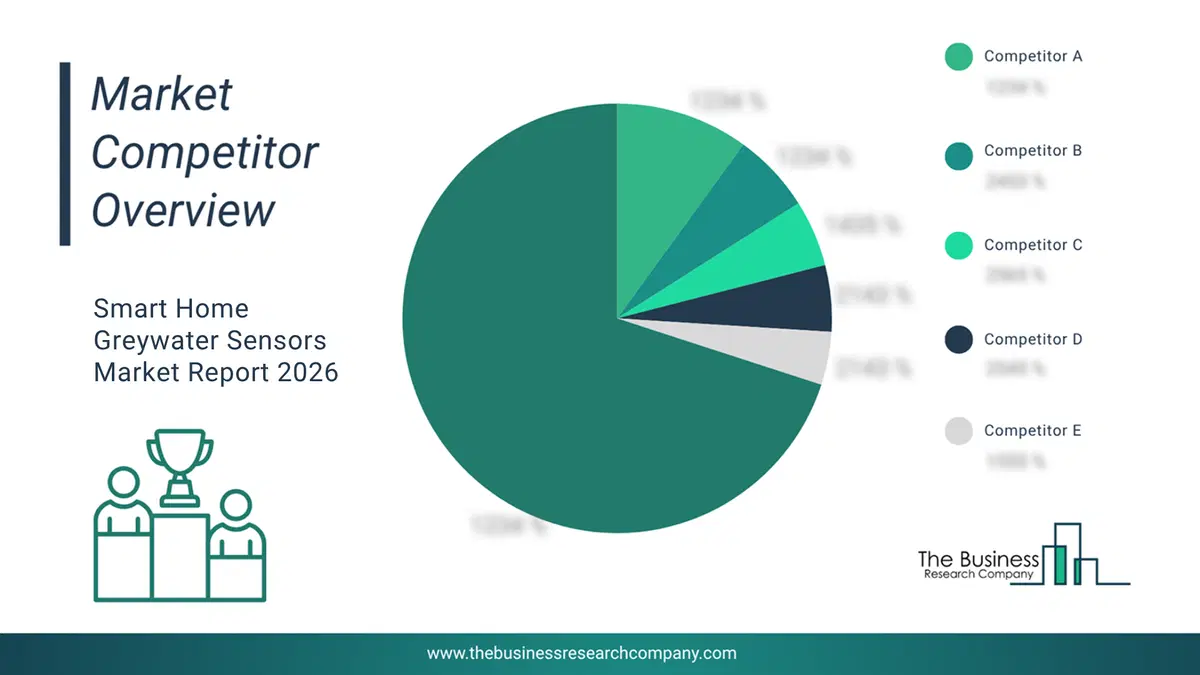
This chart is for illustrative purposes; the full report includes a detailed competitor analysis and comprehensive overview of the top 10 companies in the market.
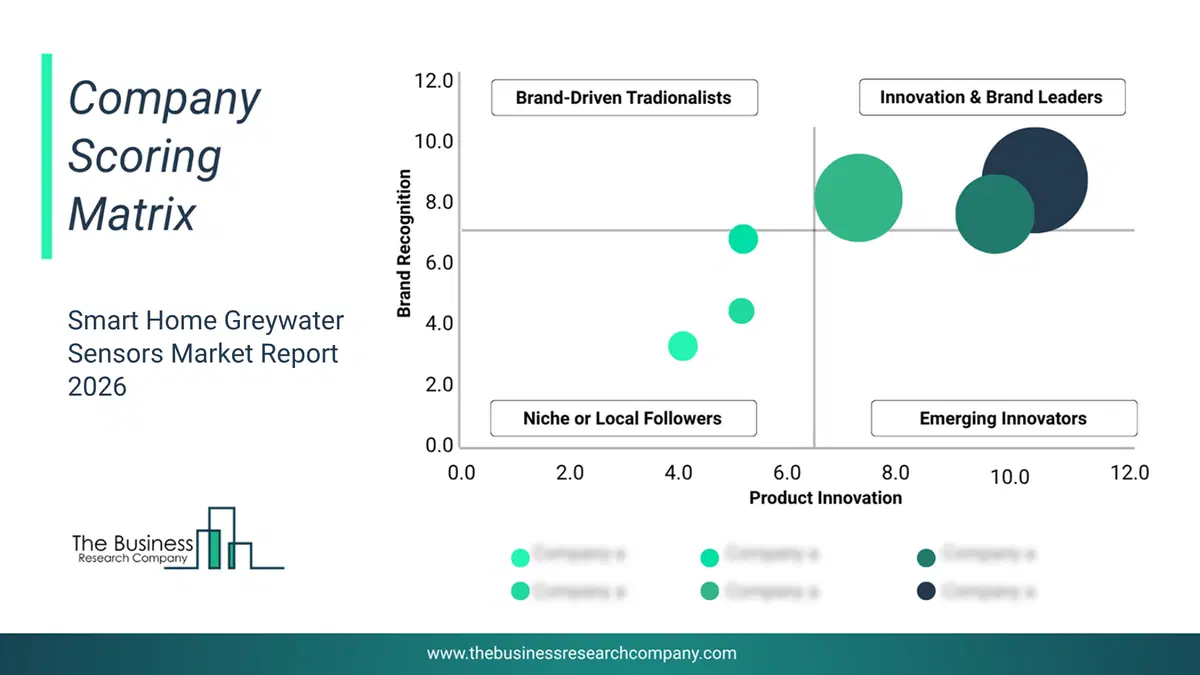
This chart maps companies by product innovation and brand strength, with bubble size indicating relative revenue, helping identify market leaders, challengers, and niche players. This is an illustrative chart; the full report provides a complete and accurate competitive analysis.
Global Smart Home Greywater Sensors Market Trends and Insights
Major companies operating in the smart home greywater sensors market are focusing on developing advanced real‑time water usage monitoring technology to enhance household sustainability and efficiency. Real‑time water monitoring is a digital sensing system that continuously captures and reports data on water flow and usage patterns to help consumers manage and conserve water more effectively. For instance, in January 2025, LIXIL Corporation a Japan-based Technology company launched its smart home water sensor, Droplet, featuring best‑in‑class accuracy and intuitive design at CES 2025 with a focus on accelerating water conservation efforts among homeowners. Droplet installs in just five minutes without tools or a plumber and measures water flow up to 50 times per second providing detailed insights into consumption habits and enabling advanced leak detection. The solution empowers users with actionable data to optimize efficiency, reduce waste and save on utility costs while contributing to sustainable living practices. Hydrific’s debut at a premier technology event underlines the industry’s shift toward accessible smart sensors that make environmental impact tangible for consumers.What Are Latest Mergers And Acquisitions In The Smart Home Greywater Sensors Market?
In May 2025, Belkin International Inc., a US-based consumer electronics company, acquired Phyn LLC for $24.9 million. Through this acquisition, Phyn gains independence from Belkin and secures strategic backing to accelerate its growth, expand market reach, and enhance adoption of its smart water management solutions. Phyn LLC is a US-based company that provides intelligent water solutions, with a core focus on leak detection and water monitoring using ultrasonic sensors and advanced artificial intelligence (AI).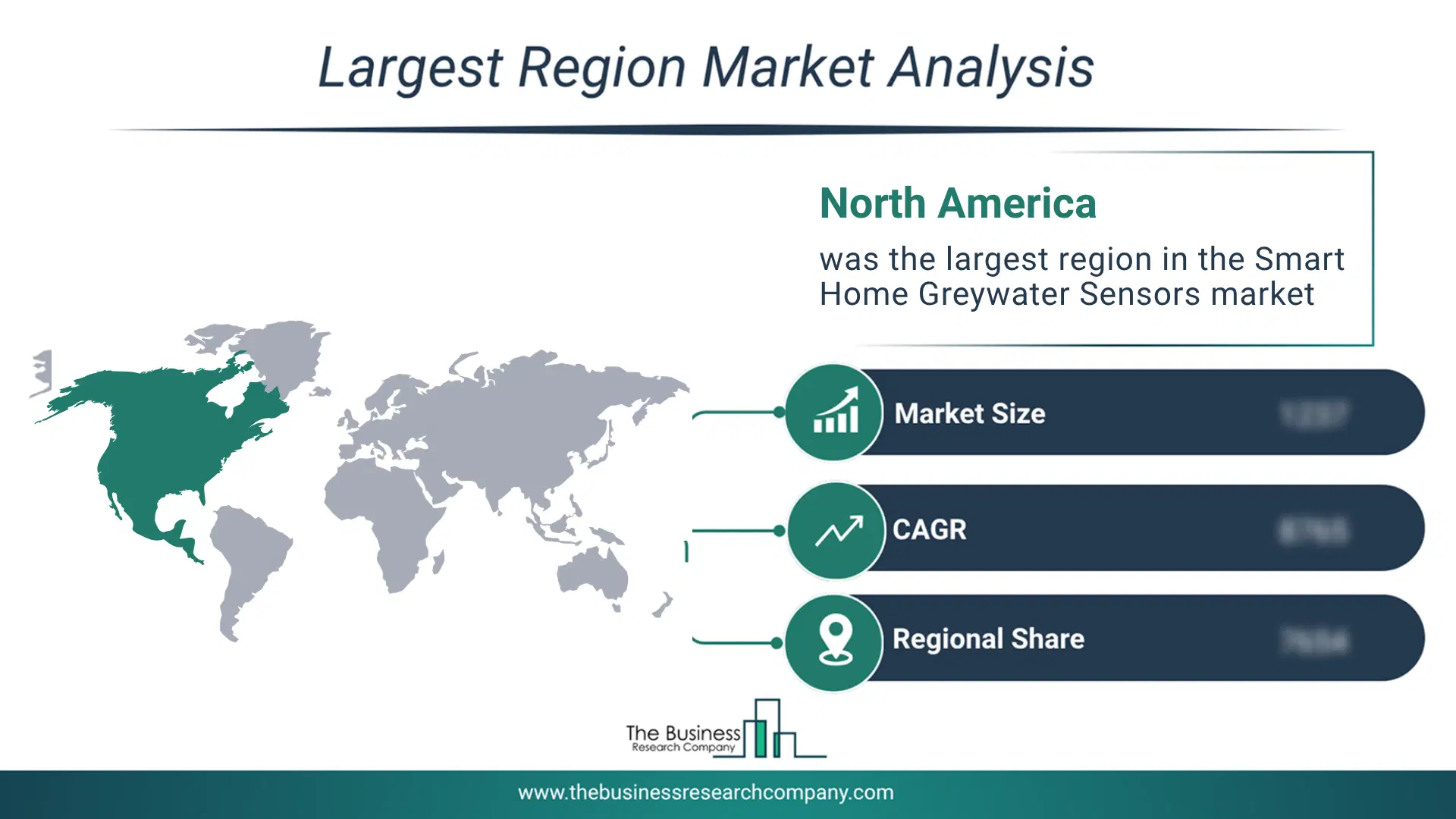
Regional Outlook
North America was the largest region in the smart home greywater sensor market in 2025. Asia-Pacific is expected to be the fastest-growing region in the forecast period. The regions covered in this market report are Asia-Pacific, South East Asia, Western Europe, Eastern Europe, North America, South America, Middle East, Africa. The countries covered in this market report are Australia, Brazil, China, France, Germany, India, Indonesia, Japan, Taiwan, Russia, South Korea, UK, USA, Canada, Italy, SpainWhat Defines the Smart Home Greywater Sensors Market?
The smart home greywater sensor market consists of sales of smart water quality sensors, greywater recycling sensors, water flow monitoring devices, internet of things enabled water management sensors, and automated greywater diversion systems. Values in this market are ‘factory gate’ values, that is the value of goods sold by the manufacturers or creators of the goods, whether to other entities (including downstream manufacturers, wholesalers, distributors and retailers) or directly to end customers. The value of goods in this market includes related services sold by the creators of the goods.How is Market Value Defined and Measured?
The market value is defined as the revenues that enterprises gain from the sale of goods and/or services within the specified market and geography through sales, grants, or donations in terms of the currency (in USD unless otherwise specified). The revenues for a specified geography are consumption values that are revenues generated by organizations in the specified geography within the market, irrespective of where they are produced. It does not include revenues from resales along the supply chain, either further along the supply chain or as part of other products.
This chart presents market attractiveness based on a quantitative evaluation of growth, competition, strategic alignment, and risk, offering a clear view of opportunity areas for decision-making. This chart is for illustrative purposes; the full report contains the complete analysis.

This chart highlights the Total Addressable Market (TAM) by estimating the maximum revenue opportunity using an assumption-driven approach, supporting strategic planning and opportunity sizing across markets. The chart is illustrative; the full report provides a more comprehensive analysis.
What Key Data and Analysis Are Included in the Smart Home Greywater Sensors Market Report 2026?
The smart home greywater sensors market research report is one of a series of new reports from The Business Research Company that provides market statistics, including Market Report 2026?global market size, regional shares, competitors with the market share, detailed market segments, market trends and opportunities, and any further data you may need to thrive in the smart home greywater sensors Market Report 2026? The market research report delivers a complete perspective of everything you need, with an in-depth analysis of the current and future state of the Market Report 2026?Smart Home Greywater Sensors Market Report Forecast Analysis
| Report Attribute | Details |
|---|---|
| Market Size Value In 2026 | $1.12 billion |
| Revenue Forecast In 2030 | $2 billion |
| Growth Rate | CAGR of 15.5% from 2026 to 2030 |
| Base Year For Estimation | 2025 |
| Actual Estimates/Historical Data | 2020-2025 |
| Forecast Period | 2026 - 2030 - 2030 |
| Market Representation | Revenue in USD Billion and CAGR from 2026 to 2030 |
| Segments Covered | Product Type, Connectivity, Application, Distribution Channel, End-User |
| Regional Scope | Asia-Pacific, Western Europe, Eastern Europe, North America, South America, Middle East, Africa |
| Country Scope | The countries covered in the report are Australia, Brazil, China, France, Germany, India, Indonesia, Japan, Taiwan, Russia, South Korea, UK, USA, Canada, Italy, Spain. |
| Key Companies Profiled | Samsung Electronics Co. Ltd., Roca Sanitario S.A., Resideo Technologies Inc., Xylem Inc., Grundfos Holding A/S, Moen Incorporated, SDS Infrastructure Private Limited, SwitchBot Inc., Monnit Corporation, INTEWA GmbH, Proteus Sensor, Flume Inc., Hydraloop Systems B.V., Honeywell International Inc., Siemens AG, Schneider Electric SE, Aqualabo Group, Sensaphone Inc., Aquamonix Inc., Greyter Water Systems |
| Customization Scope | Request for Customization |
| Pricing And Purchase Options | Explore Purchase Options |