
Smart Home Security Camera Market Report 2026
Global Outlook – By Product ( Wired, Wireless), By Resolution ( HD, Non-HD), By Distribution Channel ( Online, Offline), By Applications ( Doorbell Camera, Indoor Camera, Outdoor Camera) – Market Size, Trends, Strategies, and Forecast to 2030
Smart Home Security Camera Market Overview
• Smart Home Security Camera market size has reached to $6.87 billion in 2025 • Expected to grow to $8.98 billion in 2030 at a compound annual growth rate (CAGR) of 5.4% • Growth Driver: Surging Crime Rates Fuels Growth In The Smart Home Security Camera Market • Market Trend: Introducing Home Security Camera 2K With Advanced AI And Two-Way Voice Calling • North America was the largest region in 2025 and Asia-Pacific is the fastest growing region.Market Gains By 2030 – Top Opportunities By Segment
Market Gain identifies the most promising market opportunities by highlighting the segments or products expected to generate the highest incremental revenue growth over the next five years.
What Is Covered Under Smart Home Security Camera Market?
A smart home security camera refers to a device equipped with advanced features and connectivity capabilities designed to monitor and secure residential properties remotely. These cameras are typically part of a larger smart home ecosystem and can be integrated with other devices and systems for enhanced functionality and convenience. The main types of smart home security camera products are wired and wireless. Wired refers to devices or connections that utilize physical cables for data transmission. The main types of resolution include HD and non-HD, which are sold through several distribution channels, including online and offline. It is used for several applications, including doorbell cameras, indoor cameras, and outdoor cameras.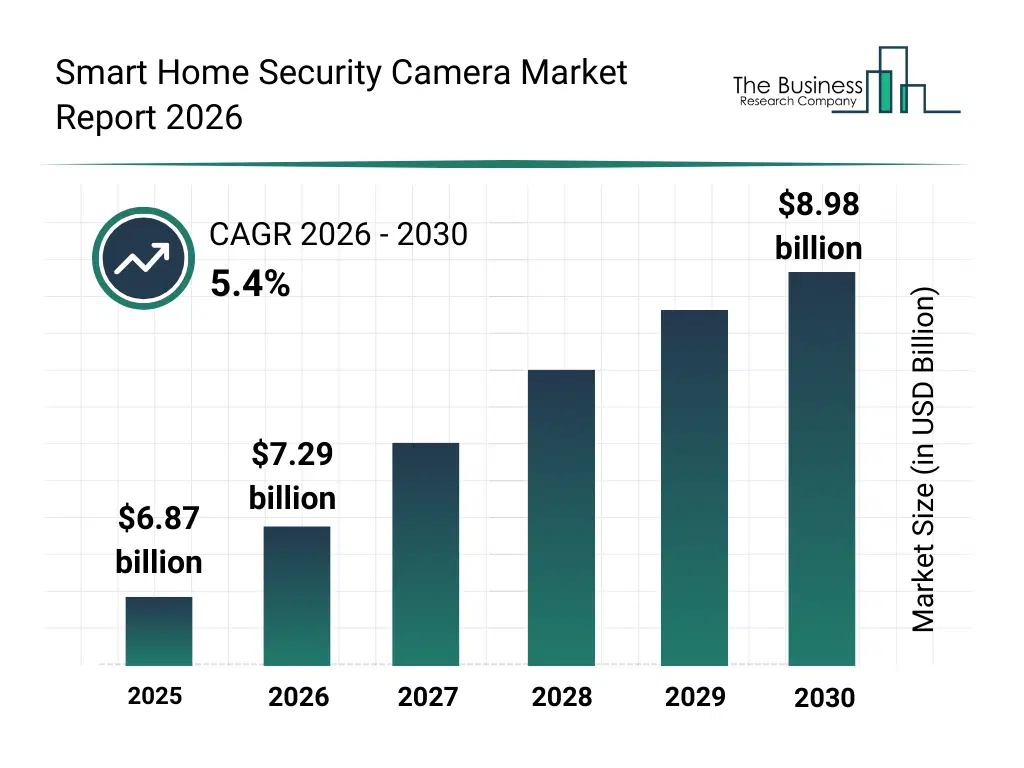
What Is The Smart Home Security Camera Market Size 2026 And Growth Rate?
The smart home security camera market size has grown strongly in recent years. It will grow from $6.87 billion in 2025 to $7.29 billion in 2026 at a compound annual growth rate (CAGR) of 6.0%. The growth in the historic period can be attributed to rising urbanization and residential construction, increasing crime rates in urban areas, declining costs of camera hardware, growth of broadband and wi-fi penetration, early adoption of smart home devices.What Is The Smart Home Security Camera Market Growth Forecast?
The smart home security camera market size is expected to see strong growth in the next few years. It will grow to $8.98 billion in 2030 at a compound annual growth rate (CAGR) of 5.4%. The growth in the forecast period can be attributed to increasing consumer focus on home safety, expansion of smart home ecosystems, advancements in AI and edge computing, growing adoption of subscription-based security services, rising penetration of connected homes. Major trends in the forecast period include growing adoption of ai-based video analytics in home security cameras, increasing demand for wireless and battery-operated security cameras, rising integration of smart home security cameras with voice assistants, expansion of cloud-based video storage and remote monitoring, growing preference for high-resolution and night vision cameras.
Global Smart Home Security Camera Market Segmentation
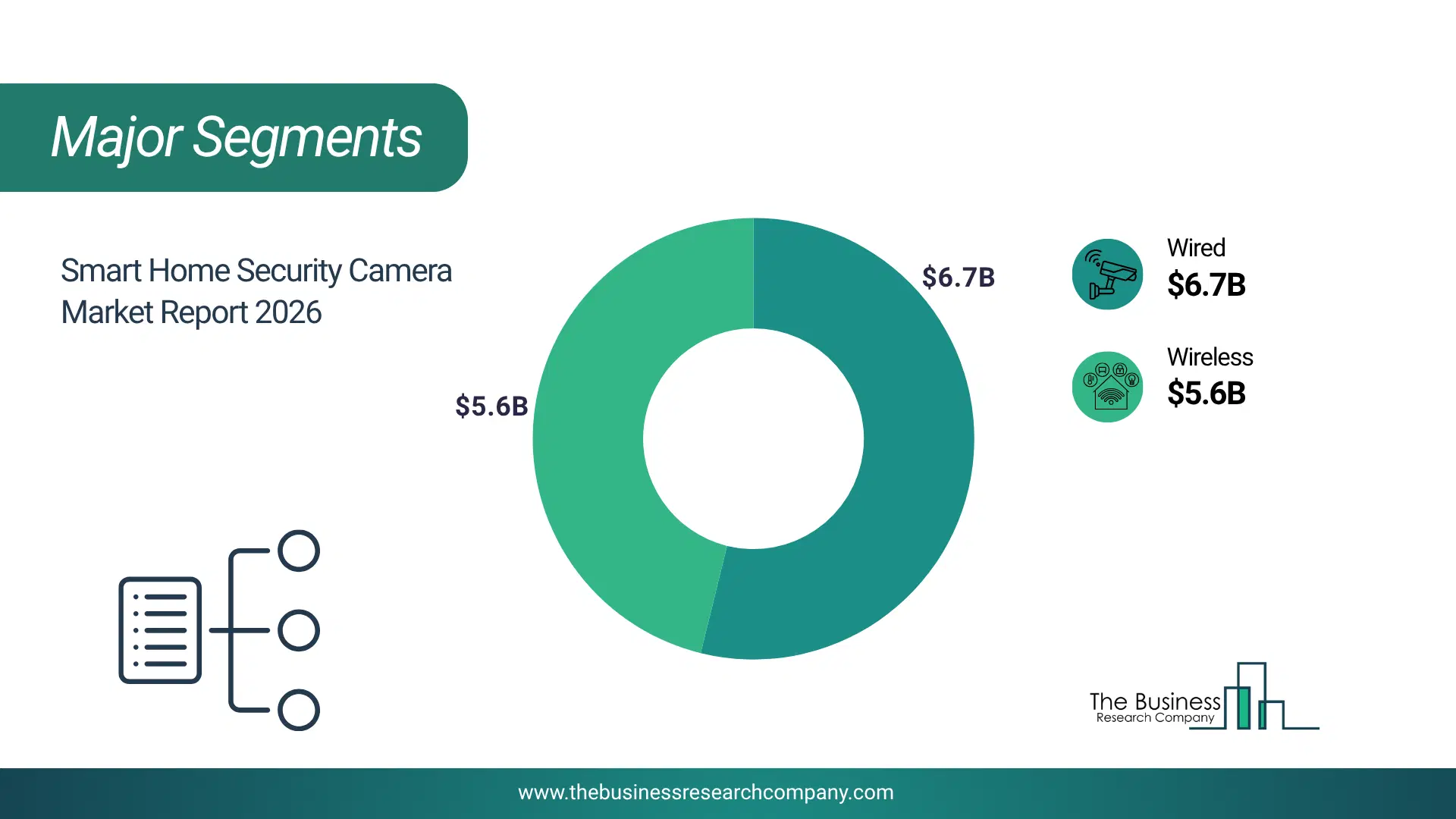
1) By Product: Wired, Wireless 2) By Resolution: HD, Non-HD 3) By Distribution Channel: Online, Offline 4) By Applications: Doorbell Camera, Indoor Camera, Outdoor Camera Subsegments: 1) By Wired: Analog Wired Cameras, IP Wired Cameras, PoE (Power Over Ethernet) Cameras 2) By Wireless: Wi-Fi Cameras, Battery-Operated Cameras, Cloud-Based Cameras The top segments in the smart home security camera market will be: • Wired will reach $6.67 billion by 2030. • Wireless will reach $5.5 billion by 2030.What Is The Driver Of The Smart Home Security Camera Market?
The rising crime rates are expected to propel the growth of the smart home security camera market going forward. Crime rates refer to statistical measures used to quantify the prevalence and frequency of criminal activities within a specific geographical area or jurisdiction over a defined period. Rising crime rates can be attributed to factors such as socio-economic disparities, urbanization, drug-related activities, and insufficient law enforcement resources. Smart home security cameras help reduce crime by serving as a visible deterrent, providing real-time monitoring, and facilitating the identification and apprehension of criminals through recorded footage. For instance, in April 2025, according to Eurostat, a Luxembourg-based statistical office of the European Union, in 2023, the EU recorded a 1.5% increase in intentional homicides compared to 2022. Therefore, rising crime rates are driving the growth of the smart home security camera industry.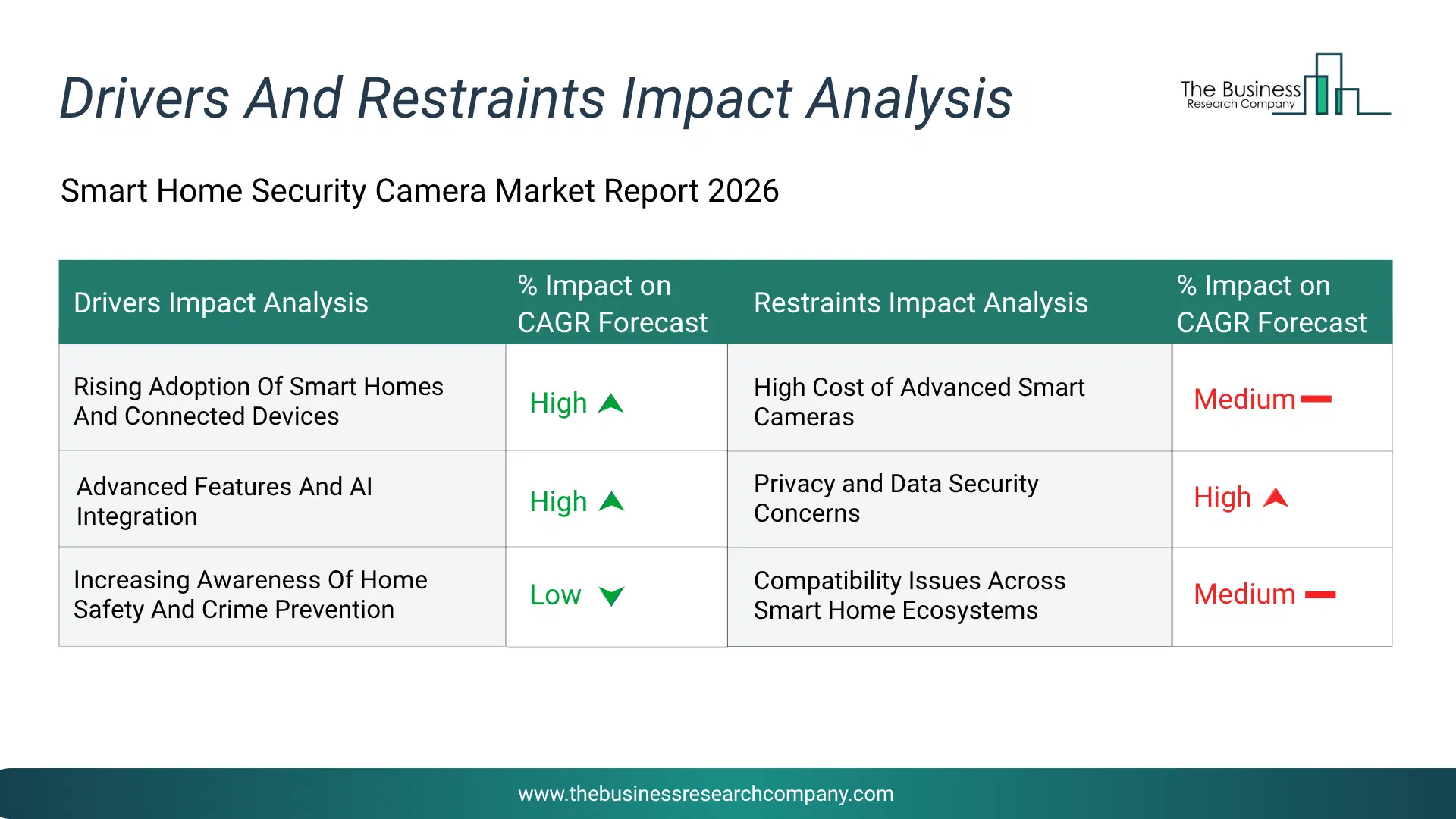
Infographic Chart Showing Key Market Drivers Analysis And Restraints For Smart Home Security Camera Market
The chart presents an impact analysis of key drivers and restraints, quantifying their relative influence on the market's growth rate and helping assess the balance between growth enablers and limiting factors. This chart offers a high-level perspective; the full report contains more detailed insights.
How Will The Drivers Impact Growth In The Global Smart Home Security Camera Market?
• Rising Adoption Of Smart Homes And Connected Devices (High) – During the forecast period, the rising adoption of smart homes and connected devices is expected to become a key growth driver for the smart home security camera market by 2030. Consumers are increasingly looking for smart home security cameras that integrate seamlessly with other connected systems, offering centralized control and real -time monitoring. Features like motion detection, remote live streaming, and automated alerts enhance both convenience and safety. As more households embrace connected lifestyles, demand for intelligent, integrated surveillance solutions continues to drive growth in the smart home security camera market. • Advanced Features And AI Integration (High) – During the forecast period, the advanced features and ai integration is expected to emerge as a major factor driving the expansion of the smart home security camera market by 2030. Smart home security cameras are increasingly integrating artificial intelligence, machine learning, and computer vision to enhance threat detection, reduce false alerts, and enable features such as facial recognition and package detection. Ai-powered analytics help distinguish between humans, pets, and other movements, improving security accuracy. Combined with cloud connectivity, high-definition video, night vision, and two-way audio, these technological advancements and feature-rich capabilities are driving adoption of smart home security cameras. • Increasing Awareness Of Home Safety And Crime Prevention (Low) – During the forecast period, the increasing awareness of home safety and crime prevention is expected to act as a key growth catalyst for the smart home security camera market by 2030. Growing concerns over burglary, property theft, and neighborhood security are driving homeowners to adopt smart surveillance solutions. Smart home security cameras offer real-time monitoring, evidence recording, and remote alerts, improving overall safety. Insurance incentives and government awareness campaigns further promote adoption, making proactive home safety a key driver of market growth, especially in urban and high-crime areas.How Will The Restraints Impact Growth In The Global Smart Home Security Camera Market?
• High Cost of Advanced Smart Cameras (Medium) – During the forecast period, the while basic smart cameras are affordable, models featuring ai analytics, 4k video, cloud storage, and smart integration are costly. Multi-camera setups for larger homes further increase expenses. High upfront costs, coupled with recurring subscription fees for cloud storage and ai services, may deter price-sensitive consumers. These financial barriers act as a restraint, especially in developing markets where affordability remains a key consideration. • Privacy and Data Security Concerns (High) – During the forecast period, the smart home security cameras collect sensitive video and personal data, raising concerns over potential hacking, unauthorized access, and breaches of privacy. Consumers and regulatory authorities increasingly demand encryption, secure cloud storage, and adherence to privacy guidelines. Any security lapse can harm user trust and affect adoption rates. The need for robust cybersecurity and compliance measures acts as a significant restraint, influencing market growth. • Compatibility Issues Across Smart Home Ecosystems (Medium) – During the forecast period, the smart home security cameras often need to integrate with multiple connected devices and home automation platforms. Compatibility challenges between ecosystems can create installation difficulties and reduce user convenience. Consumers may face limitations when combining products from different manufacturers. These integration issues can slow adoption and increase customer dissatisfaction.Key Players In The Global Smart Home Security Camera Market
Major companies operating in the smart home security camera market are Amazon.com Inc., Alphabet Inc., Samsung Electronics Co. Ltd., Robert Bosch, Panasonic Holdings Corporation, Xiaomi Inc., Honeywell International Inc., Hangzhou Hikvision Digital Technology Co. Ltd., Motorola Solutions Inc., ADT Inc., Vivint Smart Home Inc., Netgear, Alarm.com, Brinks Home Security, Arlo Technologies Inc., SimpliSafe Inc., D-Link Global, Wyze Lab Inc., Frontpoint Security Solution LLC, Skylinkhome, Shenzhen Leshi Video Tech. Co. Ltd., Eufy Anker Innovations, Zmodo Direct Electronics, Godrej Security Solutions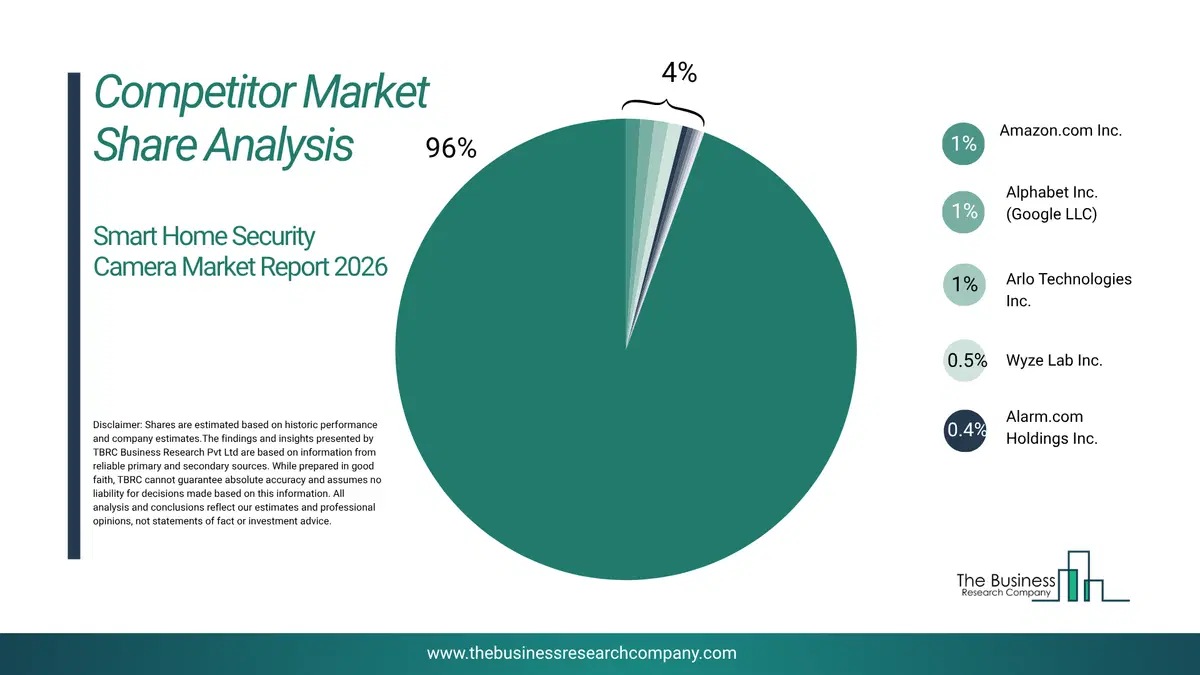
This chart is for illustrative purposes; the full report includes a detailed competitor analysis and comprehensive overview of the top 10 companies in the market.
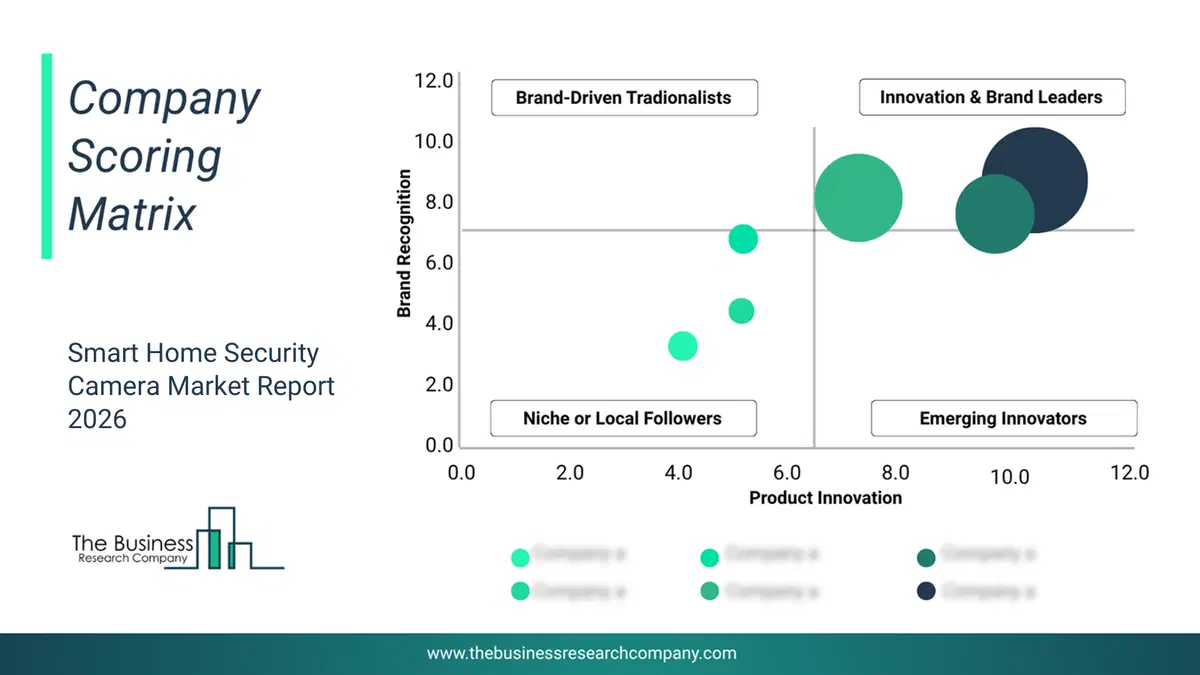
This chart maps companies by product innovation and brand strength, with bubble size indicating relative revenue, helping identify market leaders, challengers, and niche players. This is an illustrative chart; the full report provides a complete and accurate competitive analysis.
Global Smart Home Security Camera Market Trends and Insights
Major companies operating in the smart home security camera market are developing smart 360° home security cameras leveraging advanced features, such as two-way voice calling support, to gain a competitive edge in the market. A two-way voice calling support enhances the security, convenience, and connectivity provided by smart home security cameras, empowering homeowners to actively monitor and interact with their home environment, whether they are at home or away. For instance, in January 2024, Xiaomi Inc., a China-based electronics company, launched the Mi 360° Home Security Camera 2K. This innovative camera boasts super-clear 2K image quality and upgraded AI, offering enhanced surveillance capabilities for homes. With a 3-megapixel sensor and F1.4 large aperture, it ensures detailed images even in low-light conditions, while the upgraded 6P lens delivers clearer visuals by reducing light refraction. It also features improved infrared night vision, AI human detection, and seamless monitoring with a 360° panoramic view. Users can stay connected with real-time, two-way voice calls and save storage space with advanced video encoding technology.What Are Latest Mergers And Acquisitions In The Smart Home Security Camera Market?
In January 2025, Arlo Technologies, a US-based provider of smart home security solutions, video doorbells, security cameras, and cloud-based monitoring services, entered into a strategic partnership with Origin AI to enhance smart home security with AI-powered human presence detection. The partnership aims to integrate Origin AI’s advanced sensing technology into Arlo’s smart home solutions, improving presence detection accuracy, reducing false alarms, and enabling innovative AI-driven security products. Origin AI is a US-based provider of AI sensing technology.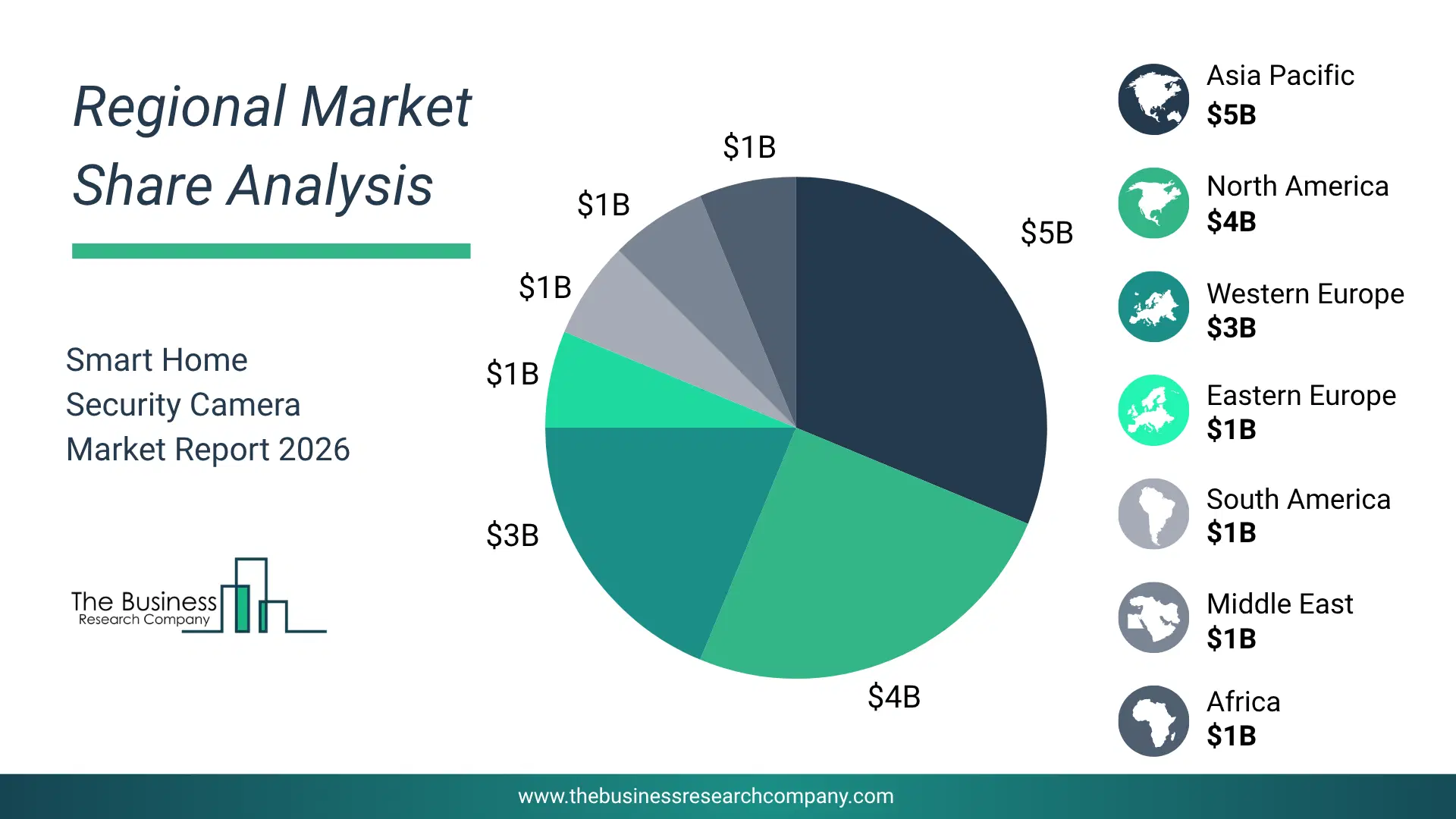
Regional Outlook
North America was the largest region in the smart home security camera market in 2025. Asia-Pacific is expected to be the fastest-growing region in the forecast period. The regions covered in this market report are Asia-Pacific, South East Asia, Western Europe, Eastern Europe, North America, South America, Middle East, Africa. The countries covered in this market report are Australia, Brazil, China, France, Germany, India, Indonesia, Japan, Taiwan, Russia, South Korea, UK, USA, Canada, Italy, Spain.What Defines the Smart Home Security Camera Market?
The smart home security camera market consists of sales of doorbell cameras, motion sensors, security lighting, and drone cameras. Values in this market are ‘factory gate’ values, that is the value of goods sold by the manufacturers or creators of the goods, whether to other entities (including downstream manufacturers, wholesalers, distributors and retailers) or directly to end customers. The value of goods in this market includes related services sold by the creators of the goods.How is Market Value Defined and Measured?
The market value is defined as the revenues that enterprises gain from the sale of goods and/or services within the specified market and geography through sales, grants, or donations in terms of the currency (in USD unless otherwise specified). The revenues for a specified geography are consumption values that are revenues generated by organizations in the specified geography within the market, irrespective of where they are produced. It does not include revenues from resales along the supply chain, either further along the supply chain or as part of other products.
This chart presents market attractiveness based on a quantitative evaluation of growth, competition, strategic alignment, and risk, offering a clear view of opportunity areas for decision-making. This chart is for illustrative purposes; the full report contains the complete analysis.

This chart highlights the Total Addressable Market (TAM) by estimating the maximum revenue opportunity using an assumption-driven approach, supporting strategic planning and opportunity sizing across markets. The chart is illustrative; the full report provides a more comprehensive analysis.
What Key Data and Analysis Are Included in the Smart Home Security Camera Market Report 2026?
The smart home security camera market research report is one of a series of new reports from The Business Research Company that provides market statistics, including industry global market size, regional shares, competitors with the market share, detailed market segments, market trends and opportunities, and any further data you may need to thrive in the smart home security camera industry. The market research report delivers a complete perspective of everything you need, with an in-depth analysis of the current and future state of the industry.Smart Home Security Camera Market Report 2026 Market Report Forecast Analysis
| Report Attribute | Details |
|---|---|
| Market Size Value In 2026 | $7.29 billion |
| Revenue Forecast In 2030 | $8.98 billion |
| Growth Rate | CAGR of 5.4% from 2026 to 2030 |
| Base Year For Estimation | 2025 |
| Actual Estimates/Historical Data | 2020-2025 |
| Forecast Period | 2026 - 2030 |
| Market Representation | Revenue in USD Billion and CAGR from 2026 to 2030 |
| Segments Covered | Product, Resolution, Distribution Channel, Applications |
| Regional Scope | Asia-Pacific, Western Europe, Eastern Europe, North America, South America, Middle East, Africa |
| Country Scope | The countries covered in the report are Australia, Brazil, China, France, Germany, India, ... |
| Key Companies Profiled | Amazon.com Inc., Alphabet Inc., Samsung Electronics Co. Ltd., Robert Bosch, Panasonic Holdings Corporation, Xiaomi Inc., Honeywell International Inc., Hangzhou Hikvision Digital Technology Co. Ltd., Motorola Solutions Inc., ADT Inc., Vivint Smart Home Inc., Netgear, Alarm.com, Brinks Home Security, Arlo Technologies Inc., SimpliSafe Inc., D-Link Global, Wyze Lab Inc., Frontpoint Security Solution LLC, Skylinkhome, Shenzhen Leshi Video Tech. Co. Ltd., Eufy Anker Innovations, Zmodo Direct Electronics, Godrej Security Solutions |
| Customization Scope | Request for Customization |
| Pricing And Purchase Options | Explore Purchase Options |