
Smart Home Security Market Report 2026
Global Outlook – By Product (Smart Alarms, Smart Camera And Monitoring System, Smart Locks And Sensors, Smart Detectors), By Component (Hardware, Software, Service), By Application (Independent Homes, Apartments, Condominiums) – Market Size, Trends, Strategies, and Forecast to 2030
Smart Home Security Market Overview
• Smart Home Security market size has reached to $37.84 billion in 2025 • Expected to grow to $80.54 billion in 2030 at a compound annual growth rate (CAGR) of 16.2% • Growth Driver: Elevated Crime Rates Fueling Growth In The Smart Home Security Market • Market Trend: Elevating Home Security Solutions To Gain Competitive Edge • Asia-Pacific was the largest region and fastest growing region.Market Gains By 2030 – Top Opportunities By Segment
Market Gain identifies the most promising market opportunities by highlighting the segments or products expected to generate the highest incremental revenue growth over the next five years.
What Is Covered Under Smart Home Security Market?
Smart home security is a group of physical and technological components that work together to allow users to remotely monitor and manage their houses in real-time, alerting homeowners to strange behavior or unwanted attempts to enter doors or windows. The main products of smart home security are smart alarms, smart cameras and monitoring systems, smart locks and sensors, and smart detectors. A smart alarm is a system that uses wireless technology, home networks, and mobile phones to integrate security with day-to-day life. The components of smart home security are hardware, software, and service. The various types of applications are in independent homes, apartments, and condominiums.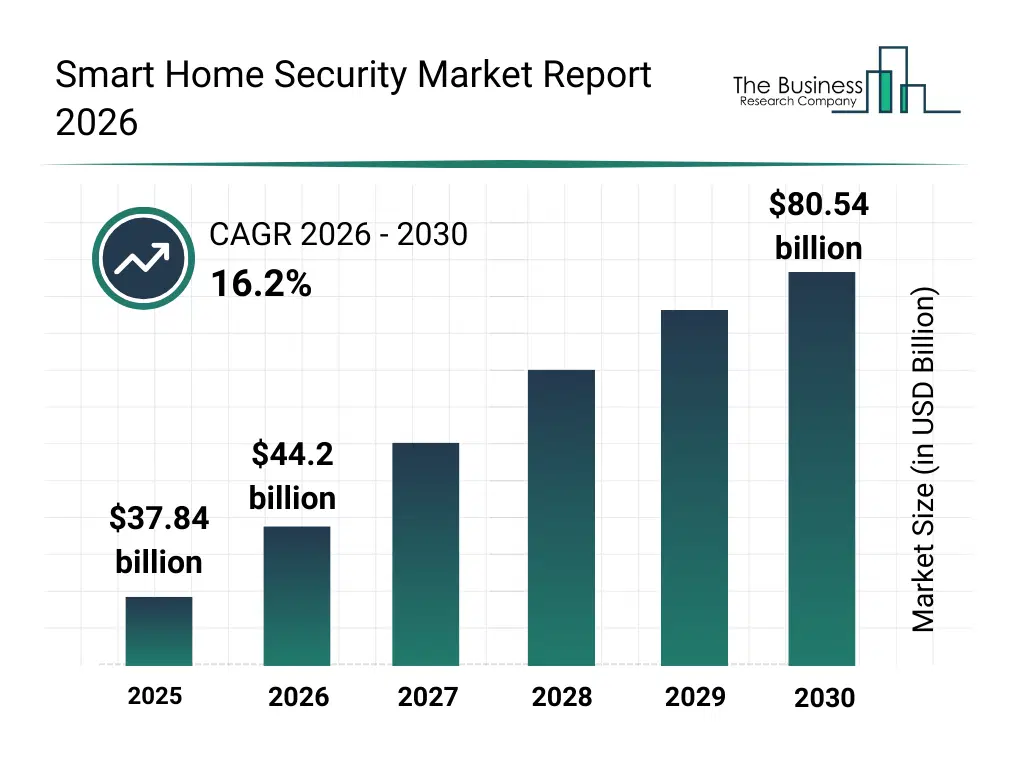
What Is The Smart Home Security Market Size and Share 2026?
The smart home security market size has grown rapidly in recent years. It will grow from $37.84 billion in 2025 to $44.2 billion in 2026 at a compound annual growth rate (CAGR) of 16.8%. The growth in the historic period can be attributed to adoption of basic alarm systems, rise in residential IoT devices, demand for enhanced home safety, growth of wireless security cameras, early adoption of smart locks.What Is The Smart Home Security Market Growth Forecast?
The smart home security market size is expected to see rapid growth in the next few years. It will grow to $80.54 billion in 2030 at a compound annual growth rate (CAGR) of 16.2%. The growth in the forecast period can be attributed to integration of ai-driven monitoring, expansion of cloud-based security platforms, development of energy-efficient smart devices, increased adoption of video doorbells and remote surveillance, growth in multi-family residential smart security systems. Major trends in the forecast period include remote home monitoring solutions, smart alert and notification systems, integration with home automation platforms, cloud-based video surveillance, energy-efficient security devices.
Global Smart Home Security Market Segmentation
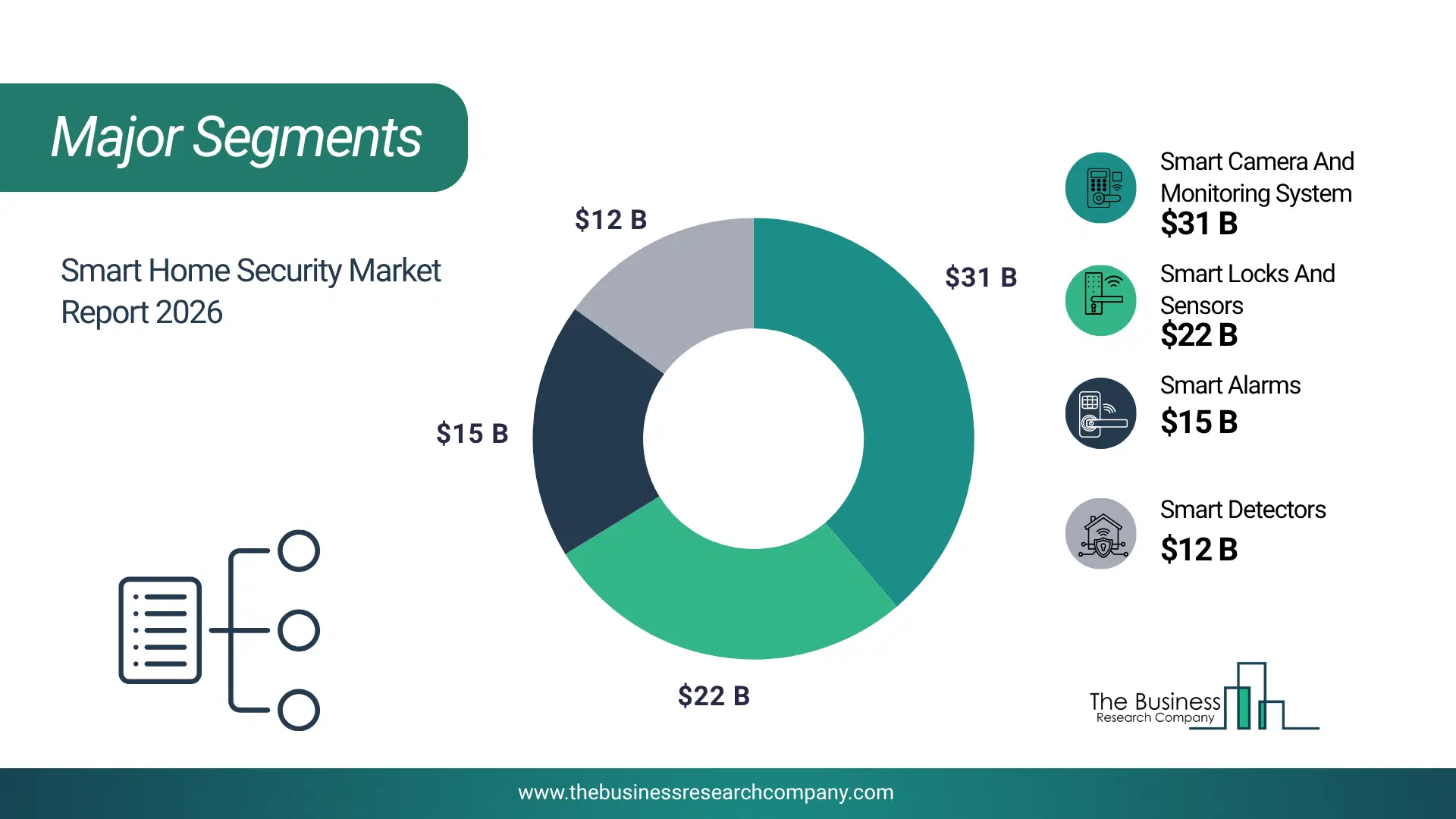
1) By Product: Smart Alarms, Smart Camera And Monitoring System, Smart Locks And Sensors, Smart Detectors 2) By Component: Hardware, Software, Service 3) By Application: Independent Homes, Apartments, Condominiums Subsegments: 1) By Smart Alarms: Motion Sensors, Door Or Window Sensors, Smart Sirens, Smart Alert Systems 2) By Smart Camera And Monitoring System: Indoor Security Cameras, Outdoor Security Cameras, Video Doorbells, Smart Surveillance Systems 3) By Smart Locks And Sensors: Smart Deadbolts, Keyless Entry Systems, Smart Door Sensors, Smart Padlocks 4) By Smart Detectors: Smoke Detectors, Carbon Monoxide Detectors, Water Leak Detectors, Glass Break Sensors The top segments in the smart home security market will be: • Smart Camera And Monitoring System will reach $31.29 Billion by 2030. • Smart Locks And Sensors will reach $22.22 Billion by 2030. • Smart Alarms will reach $14.88 Billion by 2030. • Smart Detectors will reach $11.82 Billion by 2030.What Is The Driver Of The Smart Home Security Market?
The smart home security market is driven by increasing crime rates across the globe. With the increasing crime rates, the consumers are increasingly focusing on safety and security systems especially in residential areas. Smart home devices such as smart alarms, smart cameras, and smart lockers are being preferred by the households to be safer and secure. For instance, in October 2023, according to United States Department of Justice, a US-based government department, the number of reported hate crime incidents increased from 11,634 in 2022 to 11,862 in 2023, a 2% rise. Therefore, the increasing crime rates across the globe are driving the smart home security industry growth.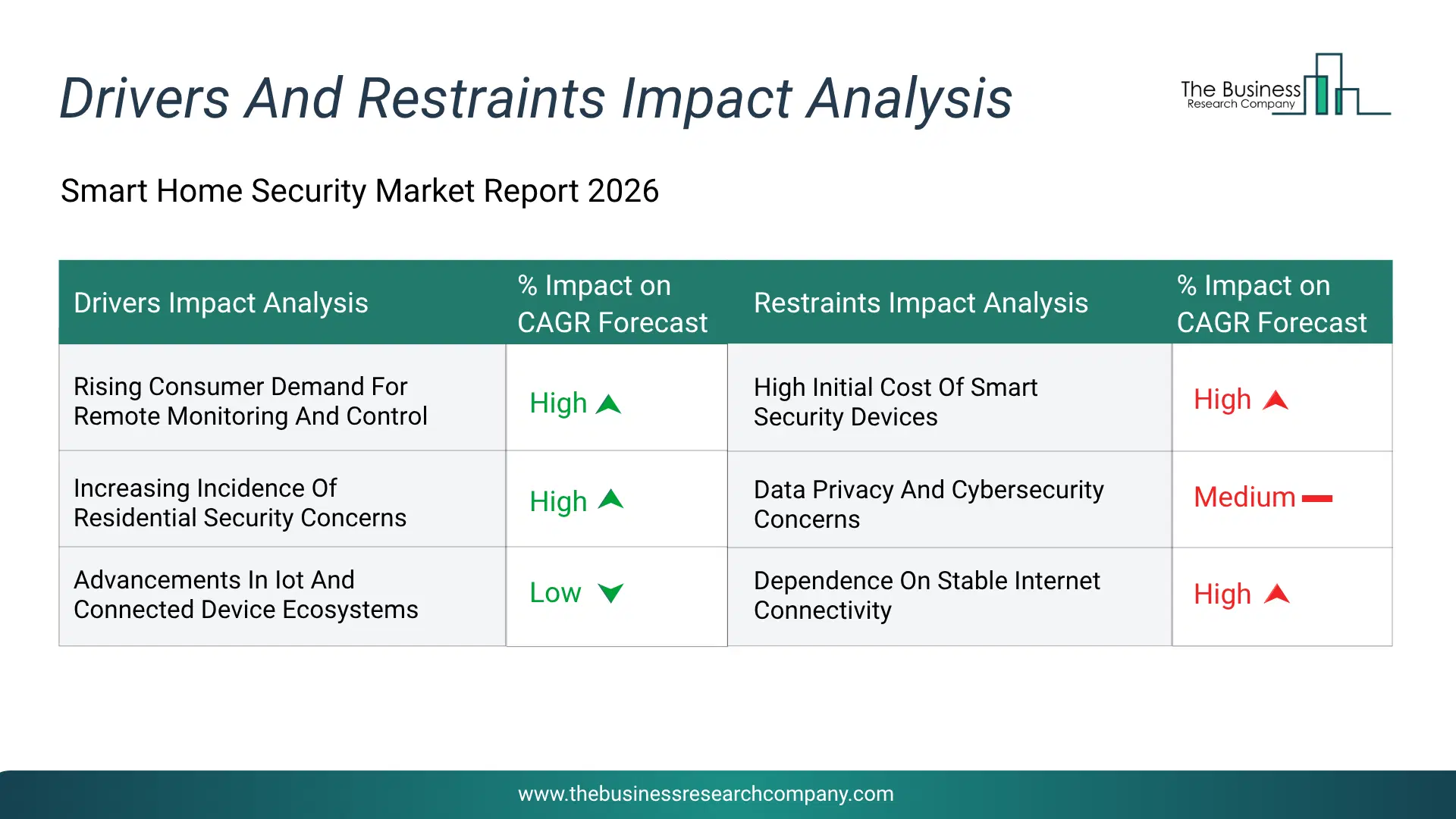
Infographic Chart Showing Key Market Drivers Analysis And Restraints For Smart Home Security Market
The chart presents an impact analysis of key drivers and restraints, quantifying their relative influence on the market's growth rate and helping assess the balance between growth enablers and limiting factors. This chart offers a high-level perspective; the full report contains more detailed insights.
How Will The Drivers Impact Growth In The Global Smart Home Security Market?
• Rising Consumer Demand For Remote Monitoring And Control (High) – During the forecast period, the rising consumer demand for remote monitoring and control is expected to become a key growth driver for the smart home security market by 2030. The growing preference for real-time monitoring and remote access is significantly driving demand for smart home security systems. Consumers increasingly seek solutions that allow them to monitor their homes through smartphones, smartwatches, or voice-enabled devices from any location. This aligns with the core functionality of these systems, which provide real-time alerts and control. Busy lifestyles and increased mobility further strengthen this demand. Additionally, user-friendly mobile applications and cloud-based platforms enhance accessibility. The ability to manage home security remotely improves convenience and peace of mind. • Increasing Incidence Of Residential Security Concerns (High) – During the forecast period, the increasing incidence of residential security concerns is expected to emerge as a major factor driving the expansion of the smart home security market by 2030. Rising concerns related to home safety, theft, and unauthorized access are major contributors to the adoption of smart security devices. These systems offer proactive protection through features such as motion detection, surveillance cameras, and instant alerts. Consumers are shifting from traditional security methods to smart solutions that provide enhanced control and monitoring. Real-time notifications and recorded evidence increase reliability and effectiveness. Growing awareness about personal safety further accelerates adoption. Insurance benefits and safety initiatives also support demand. • Advancements In Iot And Connected Device Ecosystems (Low) – During the forecast period, the advancements in Iot and connected device ecosystems is expected to act as a key growth catalyst for the smart home security market by 2030. Continuous advancements in IoT and connectivity technologies are enhancing the capabilities of smart home security systems. Devices can now seamlessly connect via Wi-Fi and integrate with other smart home components. Improved features such as AI-based analytics, facial recognition, and automation increase efficiency and accuracy. These innovations make systems more reliable and attractive to consumers. Additionally, declining hardware costs and improved battery performance support wider adoption. Integration with voice assistants further enhances usability. As technology evolves, it drives increased demand for advanced and interconnected security devices.How Will The Restraints Impact Growth In The Global Smart Home Security Market?
• High Initial Cost Of Smart Security Devices (High) – During the forecast period, high initial cost of smart security devices is significantly restricting the growth of the smart home security market. The substantial upfront investment required for advanced cameras, sensors, control systems, and installation services is limiting adoption, particularly among price-sensitive consumers and middle-income households. • Data Privacy And Cybersecurity Concerns (High) – During the forecast period, data privacy and cybersecurity concerns are significantly restricting the growth of the smart home security market. Increasing risks of data breaches, unauthorized access, and hacking of connected devices are reducing consumer trust and creating hesitation in adopting fully integrated smart security solutions. • Dependence On Stable Internet Connectivity (Low) – During the forecast period, dependence on stable internet connectivity is restricting the growth of the smart home security market. Unreliable or inconsistent network access can disrupt system performance, limit real-time monitoring capabilities, and reduce the effectiveness of connected security solutions, particularly in regions with weak digital infrastructure.Key Players In The Global Smart Home Security Market
Major companies operating in the smart home security market are Amazon.com Inc.; Google LLC; Comcast Corporation; AT&T Inc.; Robert Bosch GmbH; Honeywell International Inc.; Assa Abloy AB; ADT Inc.; Vivint Smart Home Inc.; NETGEAR Inc.; Alarm.com Holdings Inc.; Legrand North America LLC; SimpliSafe Inc.; Samsung Electronics Co. Ltd.; Protect America Inc.; August Home Inc.; SkyBell Technologies Inc.; Canary Connect Inc.; Frontpoint Security Solutions LLC; LiveWatch Security LLC; Allegion plc; Control4 Corporation; Godrej & Boyce Manufacturing Company Limited; Nortek Security & Control LLC; Abode Systems Inc.; Zmodo Technology Corporation Ltd.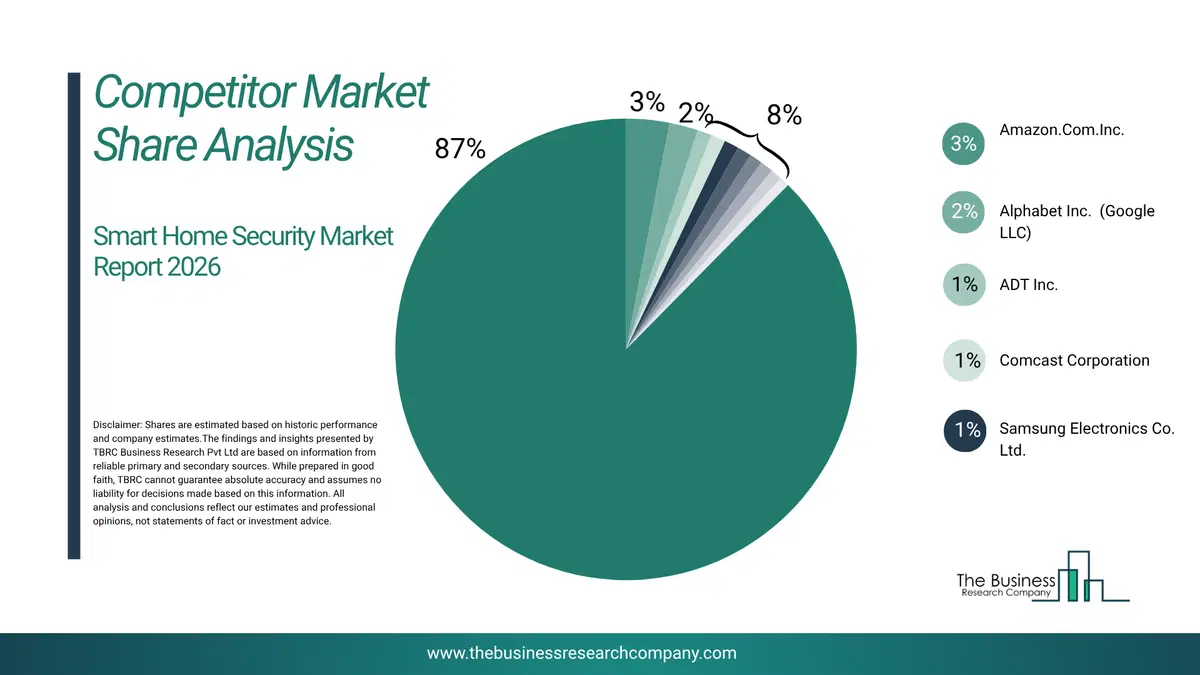
This chart is for illustrative purposes; the full report includes a detailed competitor analysis and comprehensive overview of the top 10 companies in the market.
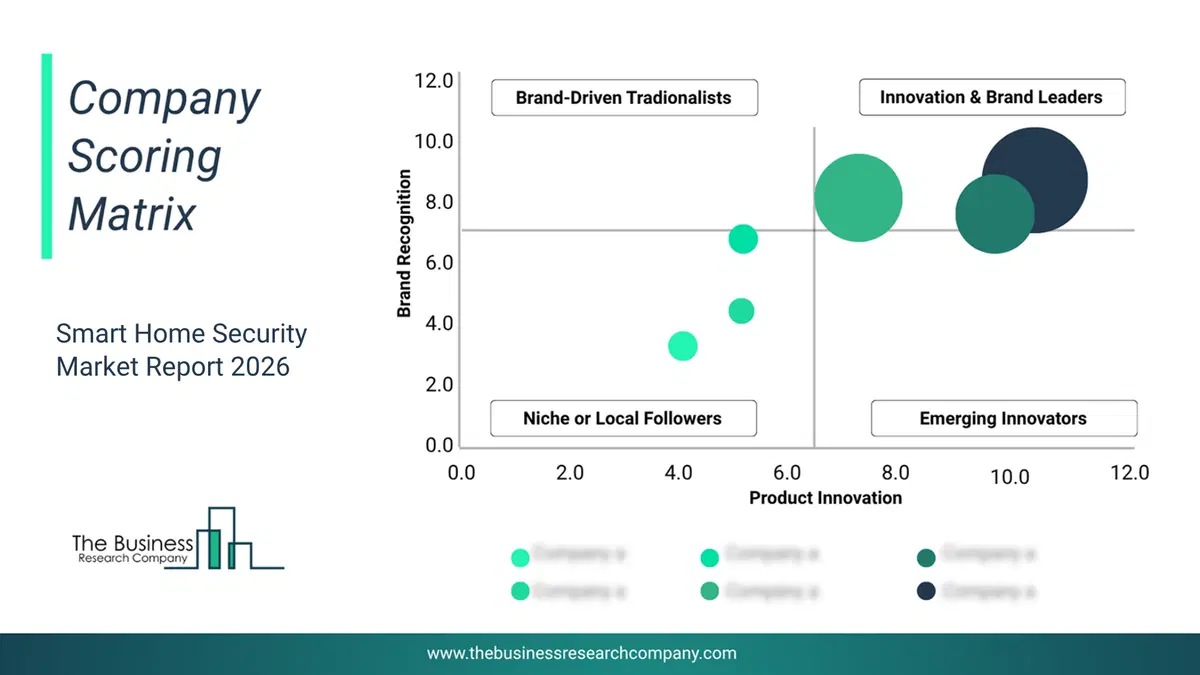
This chart maps companies by product innovation and brand strength, with bubble size indicating relative revenue, helping identify market leaders, challengers, and niche players. This is an illustrative chart; the full report provides a complete and accurate competitive analysis.
Global Smart Home Security Market Trends and Insights
Major companies operating in the smart home security market are increasing their focus on introducing convenient and efficient home security solutions to gain a competitive edge in the market. Convenient and efficient home security solutions refer to systems and technologies that provide ease of use, time-saving features, and effective protection for homeowners and their properties. For instance, in September 2023, Yale, a US-based door company, launched a new line of home security products specifically designed for the European market. The new product line includes a video doorbell, the next generation of its smart alarm system, and the Smart Indoor Camera. The Smart Indoor Camera captures 1080p footage, has a 110-degree field of view and night vision, and records motion-triggered events. It also offers customizable coverage zones, AI-powered human detection, and motion scheduling. The device has a privacy mode that can be activated whenever the door is unlocked, which stops it from recording while the user is at home. The Smart Alarm system can be used to secure both the inside and outside of the home and integrates with the Yale Home app. This allows users to remotely arm and disarm the device and receive real-time notifications whenever its alarm sensors are triggered.What Are Latest Mergers And Acquisitions In The Smart Home Security Market?
In July 2024, LG Electronics Inc., a South Korea-based technology company, acquired Athom B.V. for anundisclosed amount. With this acquisition, LG Electronics Inc. aims to strengthen its position in the smart home market by integrating Athom B.V.'s Homey platform, which enables seamless connectivity and automation across a wide range of devices, enhancing LG's ability to offer comprehensive and customizable smart home security and automation solutions to its global consumer base. Athom B.V. is a Netherlands-based company that offers smart home security.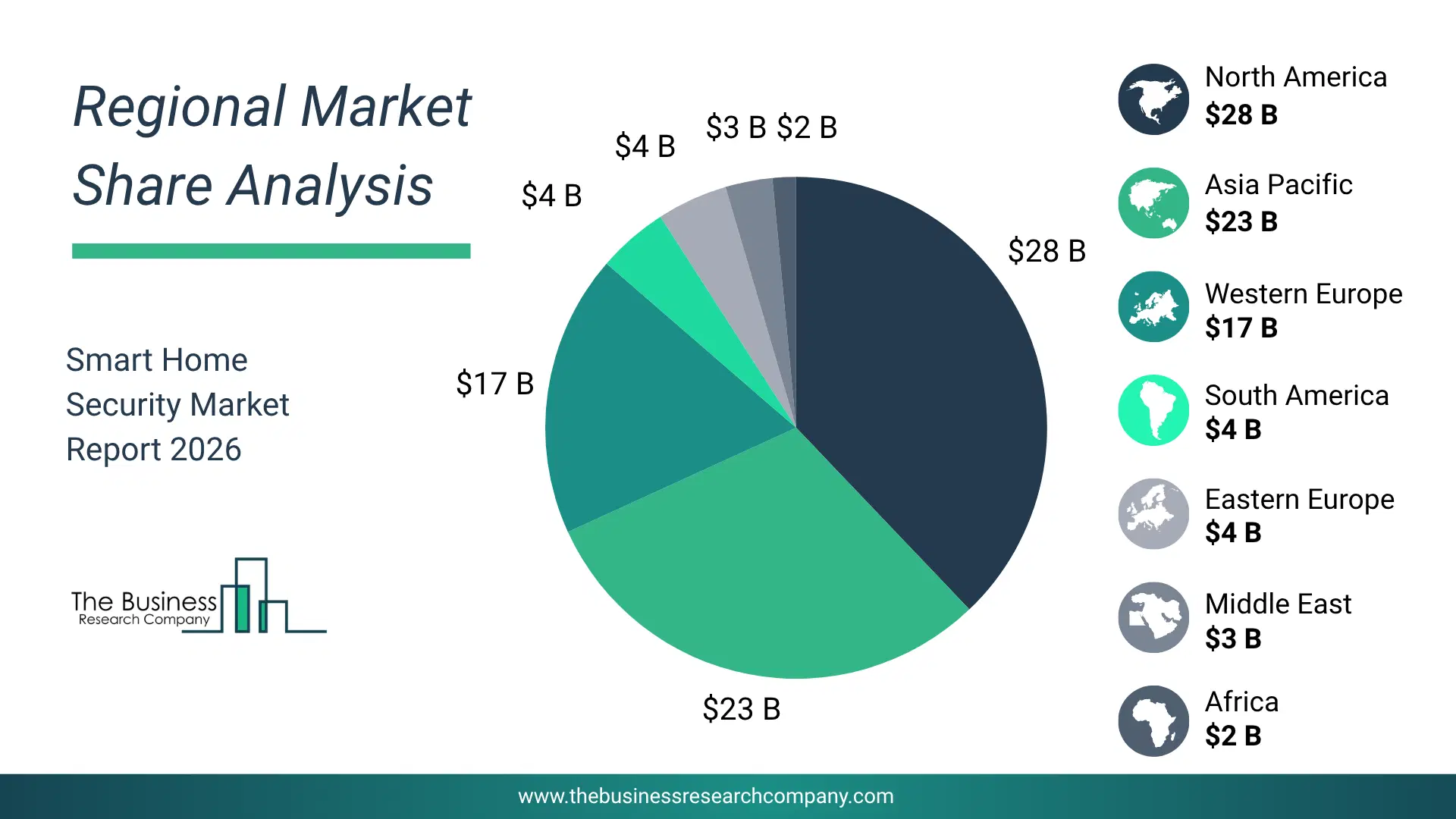
Regional Insights
Asia-Pacific was the largest region in the smart home security market in 2025. Asia-Pacific is expected to be the fastest-growing region in the global smart home security market report during the forecast period. The regions covered in this market report are Asia-Pacific, South East Asia, Western Europe, Eastern Europe, North America, South America, Middle East, Africa. The countries covered in this market report are Australia, Brazil, China, France, Germany, India, Indonesia, Japan, Taiwan, Russia, South Korea, UK, USA, Canada, Italy, SpainWhat Defines the Smart Home Security Market?
The smart home security market consists of sales of security devices for household use that can be connected to Wi-Fi and accessed from anywhere using smartphones, smartwatches or voice. The security devices produced include devices such as smart alarms, smart cameras, smart locks, smart detectors, and others. This market does not include the installation of these devices and/or integration with the home set-up. Values in this market are factory gate values, that is the value of goods sold by the manufacturers or creators of the goods, whether to other entities (including downstream manufacturers, wholesalers, distributors and retailers) or directly to end customers. The value of goods in this market includes related services sold by the creators of the goods. Only goods and services traded between entities or sold to end consumers are included.How is Market Value Defined and Measured?
The market value is defined as the revenues that enterprises gain from the sale of goods and/or services within the specified market and geography through sales, grants, or donations in terms of the currency (in USD unless otherwise specified). The revenues for a specified geography are consumption values that are revenues generated by organizations in the specified geography within the market, irrespective of where they are produced. It does not include revenues from resales along the supply chain, either further along the supply chain or as part of other products.
This chart presents market attractiveness based on a quantitative evaluation of growth, competition, strategic alignment, and risk, offering a clear view of opportunity areas for decision-making. This chart is for illustrative purposes; the full report contains the complete analysis.

This chart highlights the Total Addressable Market (TAM) by estimating the maximum revenue opportunity using an assumption-driven approach, supporting strategic planning and opportunity sizing across markets. The chart is illustrative; the full report provides a more comprehensive analysis.
What Key Data and Analysis Are Included in the Smart Home Security Market Report 2026?
The smart home security market research report is one of a series of new reports from The Business Research Company that provides market statistics, including industry global market size, regional shares, competitors with the market share, detailed market segments, market trends and opportunities, and any further data you may need to thrive in the smart home security industry. The market research report delivers a complete perspective of everything you need, with an in-depth analysis of the current and future state of the industry.Smart Home Security Market Report Forecast Analysis
| Report Attribute | Details |
|---|---|
| Market Size Value In 2026 | $44.2 billion |
| Revenue Forecast In 2030 | $80.54 billion |
| Growth Rate | CAGR of 16.8% from 2026 to 2030 |
| Base Year For Estimation | 2025 |
| Actual Estimates/Historical Data | 2020-2025 |
| Forecast Period | 2026 - 2030 |
| Market Representation | Revenue in USD Billion and CAGR from 2026 to 2030 |
| Segments Covered | Product, Component, Application |
| Regional Scope | Asia-Pacific, Western Europe, Eastern Europe, North America, South America, Middle East, Africa |
| Country Scope | The countries covered in the report are Australia, Brazil, China, France, Germany, India, Indonesia, Japan, Taiwan, Russia, South Korea, UK, USA, Canada, Italy, Spain. |
| Key Companies Profiled | Amazon.com Inc.; Google LLC; Comcast Corporation; AT&T Inc.; Robert Bosch GmbH; Honeywell International Inc.; Assa Abloy AB; ADT Inc.; Vivint Smart Home Inc.; NETGEAR Inc.; Alarm.com Holdings Inc.; Legrand North America LLC; SimpliSafe Inc.; Samsung Electronics Co. Ltd.; Protect America Inc.; August Home Inc.; SkyBell Technologies Inc.; Canary Connect Inc.; Frontpoint Security Solutions LLC; LiveWatch Security LLC; Allegion plc; Control4 Corporation; Godrej & Boyce Manufacturing Company Limited; Nortek Security & Control LLC; Abode Systems Inc.; Zmodo Technology Corporation Ltd. |
| Customization Scope | Request for Customization |
| Pricing And Purchase Options | Explore Purchase Options |