
Smart In-Vitro Fertilization (IVF) Lab Monitoring Market Report 2026
Global Outlook – By Component (Hardware, Software, Services), By Deployment Mode (Cloud Based, On Premises), By Distribution Channel (Direct Sales, Distributors, Online Sales), By Application (Embryo Culture Monitoring, Cryogenic Storage Monitoring, Environmental Condition Monitoring, Sample Tracking And Witnessing, Equipment Performance Monitoring, In Vitro Fertilisation Workflow Management), By End User (Fertility Clinics, In Vitro Fertilisation Centers, Hospitals, Embryology Laboratories, Cryobanks, Research And Academic Institutes) – Market Size, Trends, Strategies, and Forecast to 2030
Smart In-Vitro Fertilization (IVF) Lab Monitoring Market Report 2026 Market Overview
• Smart In-Vitro Fertilization (IVF) Lab Monitoring Market Report 2026 market size has reached to $0.36 billion in 2025 • Expected to grow to $0.68 billion in 2030 at a compound annual growth rate (CAGR) of 13.8% • Growth Driver: Rising Infertility Rates Driving Growth In The Market Due To Increasing Stress Levels • Market Trend: Real-Time Lab Monitoring and Integrated Management Solutions Enhance IVF Workflow Efficiency And Laboratory Compliance • North America was the largest region in 2025 and Asia-Pacific is the fastest growing region.What Is Covered Under Smart In-Vitro Fertilization (IVF) Lab Monitoring Market?
Smart in vitro fertilization (IVF) lab monitoring is an intelligent laboratory management system that uses connected devices, sensors, automation, and data analytics to monitor critical IVF lab parameters such as temperature, humidity, air quality, and equipment performance in real time. It supports improved embryo safety, operational efficiency, regulatory compliance, and consistent fertility treatment outcomes. The main components of smart in-vitro fertilization (IVF) lab monitoring include hardware, software, and services. Hardware refers to physical monitoring devices and equipment used to track and manage critical laboratory conditions and processes within in-vitro fertilization environments. These solutions are deployed through cloud based and on premises modes and are distributed through direct sales, distributors, and online sales channels. They find application in embryo culture monitoring, cryogenic storage monitoring, environmental condition monitoring, sample tracking and witnessing, equipment performance monitoring, and in vitro fertilisation workflow management, serving end users including fertility clinics, in vitro fertilisation centers, hospitals, embryology laboratories, cryobanks, and research and academic institutes.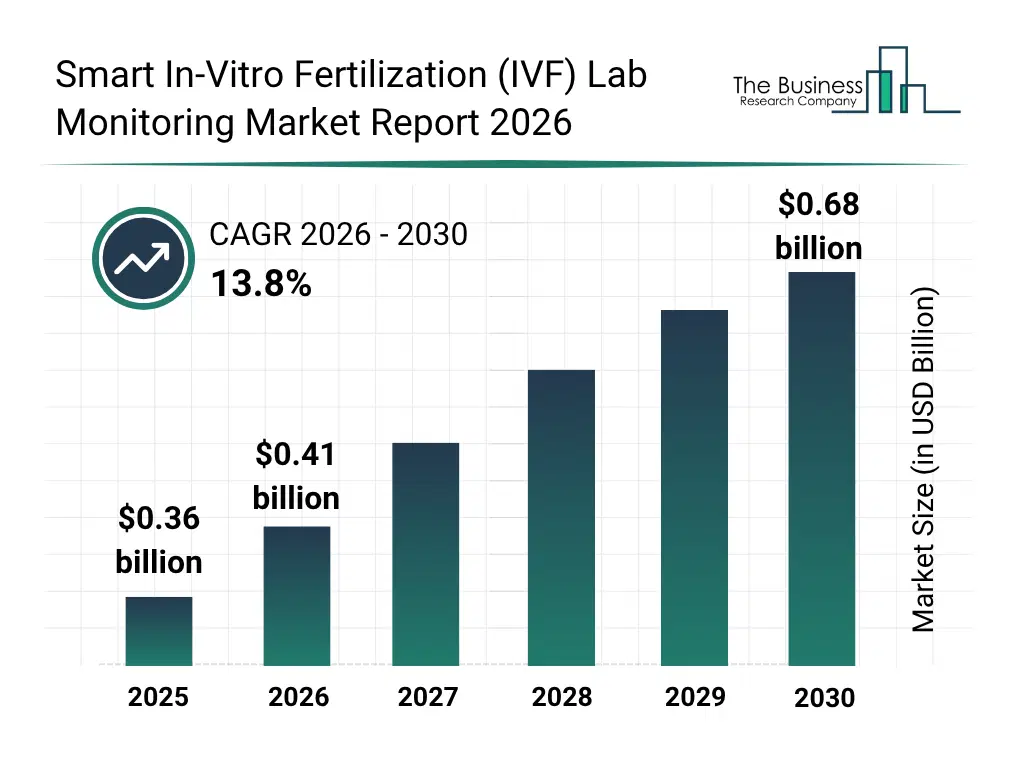
What Is The Smart In-Vitro Fertilization (IVF) Lab Monitoring Market Size and Share 2026?
The smart in-vitro fertilization (IVF) lab monitoring market size has grown rapidly in recent years. It will grow from $0.36 billion in 2025 to $0.41 billion in 2026 at a compound annual growth rate (CAGR) of 14.2%. The growth in the historic period can be attributed to manual ivf laboratory monitoring practices, limited environmental control systems in embryology labs, rising infertility rates globally, expansion of fertility clinics and ivf centers, increasing awareness of assisted reproductive technologies.What Is The Smart In-Vitro Fertilization (IVF) Lab Monitoring Market Growth Forecast?
The smart in-vitro fertilization (IVF) lab monitoring market size is expected to see rapid growth in the next few years. It will grow to $0.68 billion in 2030 at a compound annual growth rate (CAGR) of 13.8%. The growth in the forecast period can be attributed to integration of advanced embryo safety protocols in laboratory workflows, increasing regulatory scrutiny and compliance requirements in fertility treatments, growing demand for high precision environmental stability in ivf labs, rising adoption of automated quality assurance frameworks in reproductive medicine, expansion of fertility services in emerging healthcare markets. Major trends in the forecast period include embryo handling standardization and protocol optimization, contamination risk reduction protocols in ivf laboratories, incubator opening frequency minimization practices to maintain stable embryo culture conditions, cryopreservation quality assurance scheduling and lifecycle control, laboratory personnel competency certification and compliance frameworks.
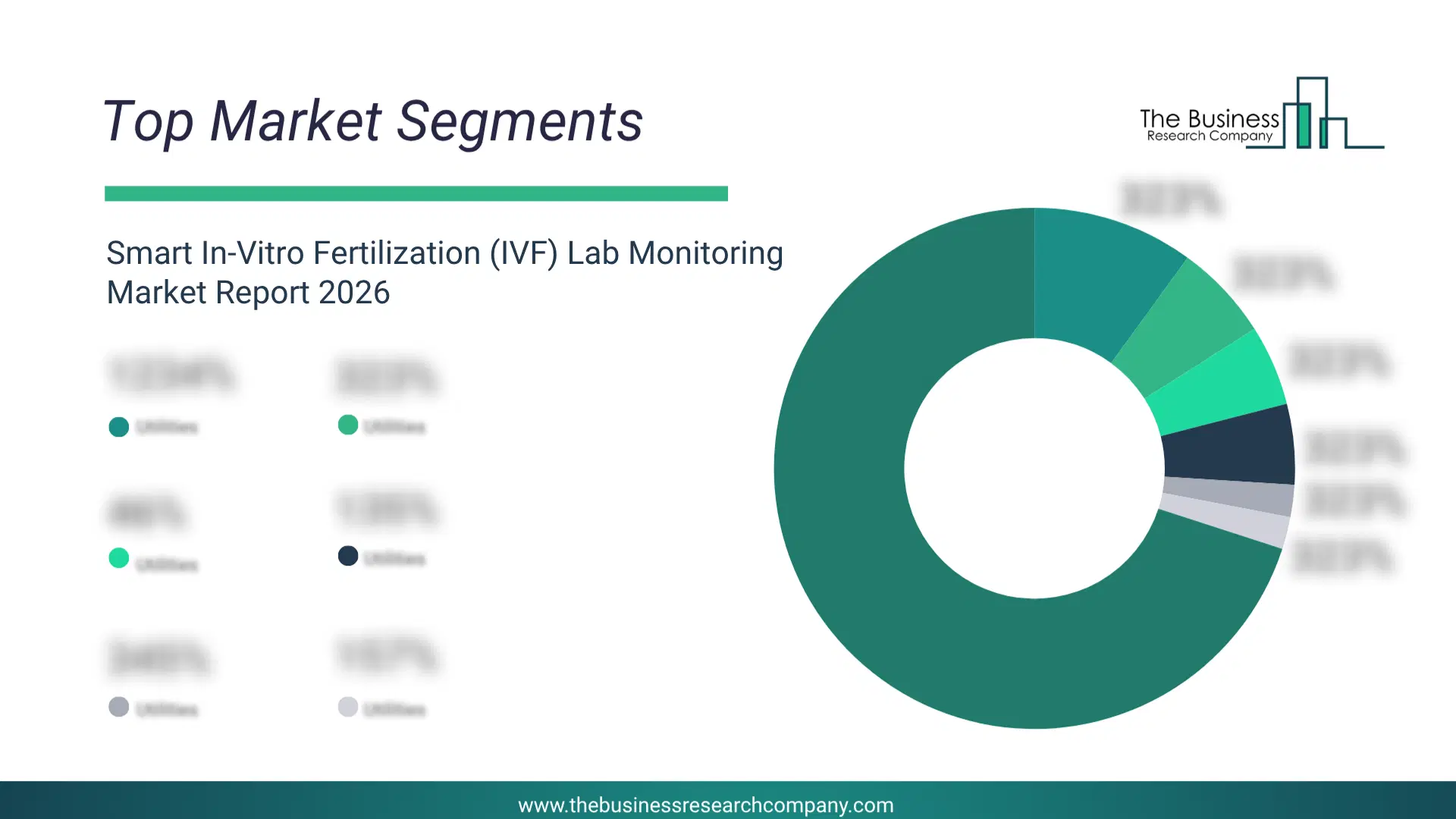
Global Smart In-Vitro Fertilization (IVF) Lab Monitoring Market Segmentation
1) By Component: Hardware, Software, Services 2) By Deployment Mode: Cloud Based, On Premises 3) By Distribution Channel: Direct Sales, Distributors, Online Sales 4) By Application: Embryo Culture Monitoring, Cryogenic Storage Monitoring, Environmental Condition Monitoring, Sample Tracking And Witnessing, Equipment Performance Monitoring, In Vitro Fertilisation Workflow Management 5) By End User: Fertility Clinics, In Vitro Fertilisation Centers, Hospitals, Embryology Laboratories, Cryobanks, Research And Academic Institutes Subsegments: 1) By Hardware: Environmental Monitoring Sensors, Temperature Monitoring Devices, Humidity Monitoring Devices, Carbon Dioxide And Oxygen Monitoring Systems, Air Quality And Volatile Organic Compound Sensors 2) By Software: In Vitro Fertilisation Laboratory Management Software, Cloud Based Monitoring Platforms, Embryo Monitoring Software, Artificial Intelligence Based Embryo Assessment Software, Data Analytics And Reporting Software 3) By Services: Real Time Monitoring Services, Remote In Vitro Fertilisation Laboratory Monitoring Services, Installation And Integration Services, Calibration And Validation Services, Equipment Maintenance ServicesWhat Is The Driver Of The Smart In-Vitro Fertilization (IVF) Lab Monitoring Market?
The rising infertility rates are expected to propel the growth of the smart in-vitro fertilization (IVF) lab monitoring market going forward. Infertility rates refer to the proportion of individuals or couples who are unable to achieve pregnancy after 12 months of regular unprotected intercourse. Infertility rates are increasing due to rising stress levels, as chronic stress can disrupt hormone balance, affect ovulation and sperm production, and reduce overall reproductive health. Smart in-vitro fertilization (IVF) lab monitoring helps address infertility rates by enabling real-time monitoring and precise control of laboratory conditions, improving embryo development, treatment accuracy, and overall IVF success rates. For instance, in August 2025, according to the Office for National Statistics (ONS), a UK government department, the total fertility rate (TFR) in England and Wales remained at a historic low of 1.41 children per woman in 2024, compared with 1.42 in 2023, highlighting the ongoing decline in fertility rates and the growing incidence of infertility-related challenges. Therefore, the rising infertility rates are driving the growth of the smart in vitro fertilization (IVF) lab monitoring market.Key Players In The Global Smart In-Vitro Fertilization (IVF) Lab Monitoring Market
Major companies operating in the smart in-vitro fertilization (ivf) lab monitoring market report are ASTEC Co. Ltd., CooperSurgical Inc., Process Sensing Technologies Ltd., Vitrolife AB, Rees Scientific Corporation, Nexpring Health, ELPRO-BUCHS AG, TMRW Life Sciences Inc., LABOTECT GmbH, Shivani Scientific Industries Pvt. Ltd., XiltriX International B.V., IMT International Ltd., Thermo Fisher Scientific, Merck Millipore, Kitazato Corporation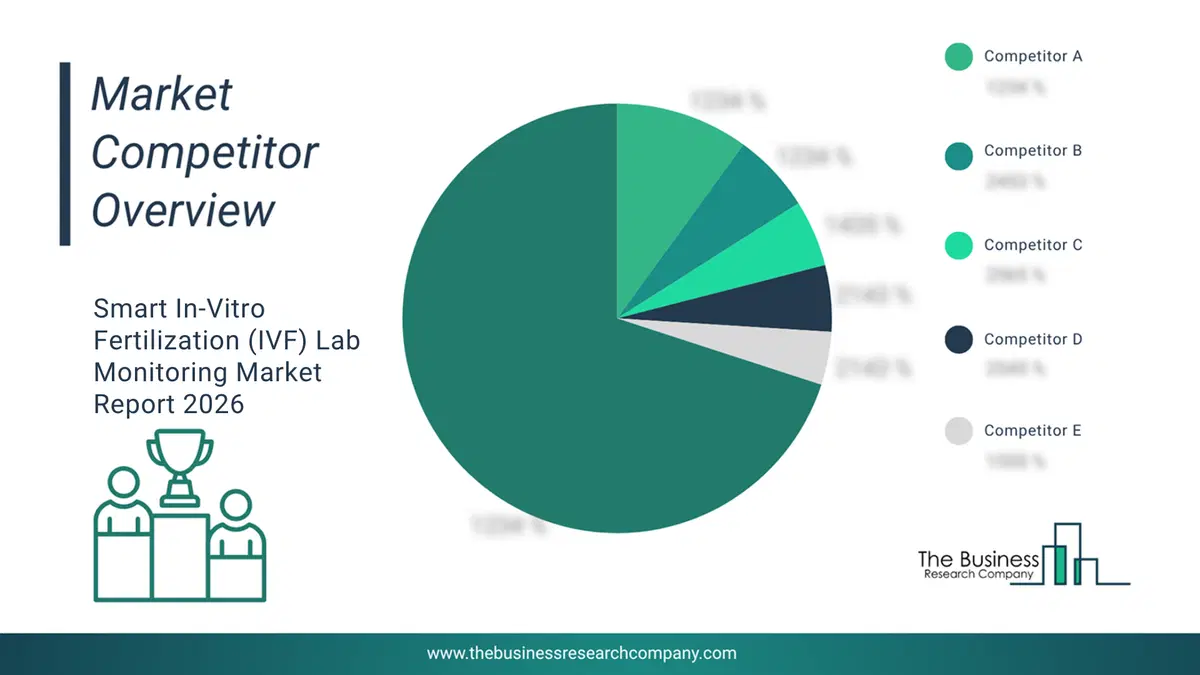
This chart is for illustrative purposes; the full report includes a detailed competitor analysis and comprehensive overview of the top 10 companies in the market.
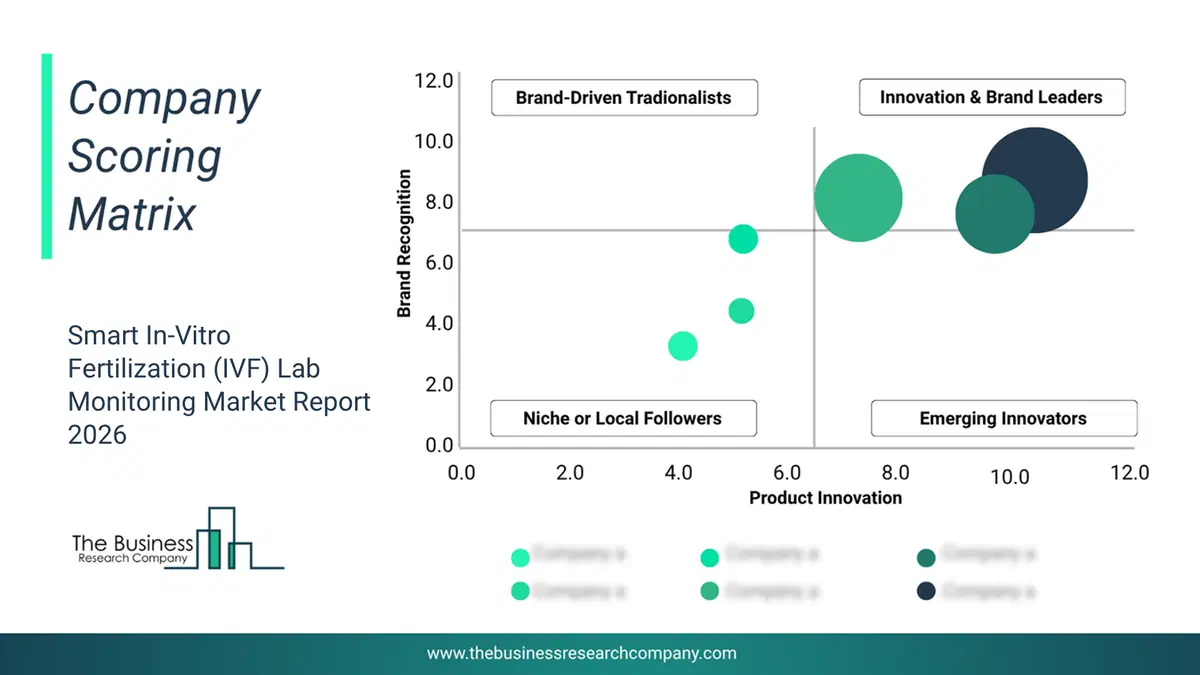
This chart maps companies by product innovation and brand strength, with bubble size indicating relative revenue, helping identify market leaders, challengers, and niche players. This is an illustrative chart; the full report provides a complete and accurate competitive analysis.
Global Smart In-Vitro Fertilization (IVF) Lab Monitoring Market Trends and Insights
Major companies operating in the smart in vitro fertilization (IVF) lab monitoring market are focusing on developing advanced monitoring-as-a-service (MaaS) platforms to improve laboratory safety, workflow efficiency, regulatory compliance, and patient outcomes. The monitoring-as-a-service (MaaS) platform is a cloud-based monitoring solution that provides real-time visibility, automated alerts, and predictive insights for critical systems, assets, and environmental conditions through connected devices and analytics. For instance, in January 2025, SpOvum Technologies, an India-based IVF technology company, introduced its Integrated IVF Management Solution, a monitoring-as-a-service (MaaS) platform designed to transform IVF workflows. The solution features real-time lab health monitoring, smart witness technology, seamless patient data integration, automated reporting, and compliance management for assisted reproductive technology (ART) laboratories. The platform enables continuous monitoring of critical laboratory conditions, transparent workflow traceability, electronic witnessing, and instant alerts, helping IVF clinics enhance operational efficiency, reduce errors, maintain quality standards, and improve patient care outcomes.What Are Latest Mergers And Acquisitions In The Smart In-Vitro Fertilization (IVF) Lab Monitoring Market?
In May 2025, SpOvum Technologies Pvt. Ltd., an India-based technology company that specializes in assisted reproductive technology (ART) and IVF laboratory automation solutions, partnered with Khushi Fertility & IVF Centre to deploy AI-powered IVF lab management systems and smart monitoring solutions to enhance embryology accuracy, workflow efficiency, and clinical outcomes. With this partnership, companies aim to build an AI-driven smart IVF ecosystem that improves lab efficiency, reduces human error, and enhances embryo tracking accuracy to support better fertility treatment outcomes. Khushi Fertility & IVF Centre is an India-based assisted reproductive technology (ART) clinic.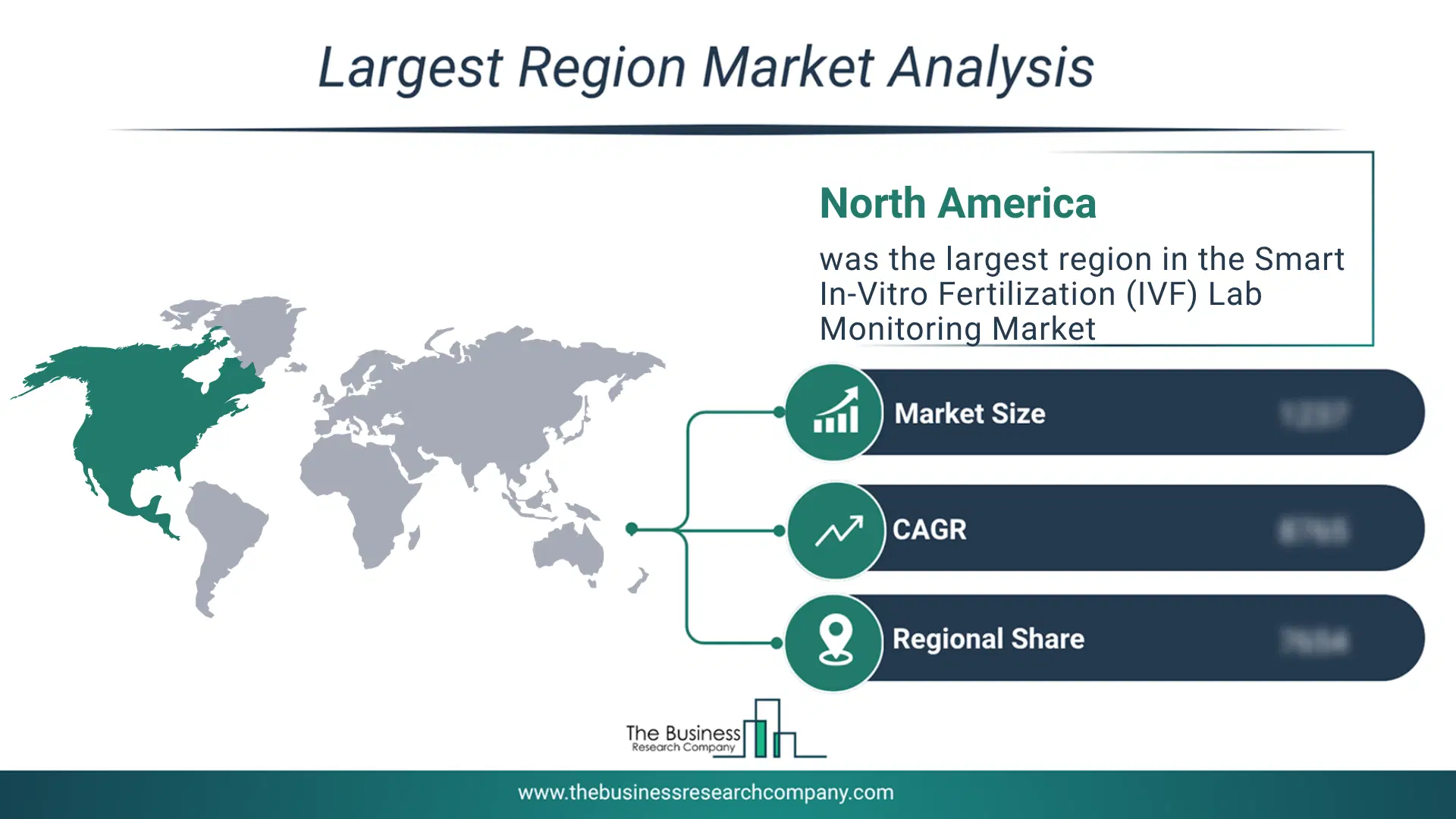
Regional Outlook
North America was the largest region in the smart in-vitro fertilization (IVF) lab monitoring market in 2025. Asia-Pacific is expected to be the fastest-growing region in the forecast period. The regions covered in this market report are Asia-Pacific, South East Asia, Western Europe, Eastern Europe, North America, South America, Middle East, Africa. The countries covered in this market report are Australia, Brazil, China, France, Germany, India, Indonesia, Japan, Taiwan, Russia, South Korea, UK, USA, Canada, Italy, Spain.What Defines the Smart In-Vitro Fertilization (IVF) Lab Monitoring Market?
The smart in vitro fertilization (IVF) lab monitoring market consists of revenues earned by entities by providing services such as predictive maintenance alerts, remote system diagnostics, quality control analytics, workflow automation, and optimization. The market value includes the value of related goods sold by the service provider or included within the service offering. The smart in vitro fertilization (IVF) lab monitoring market also includes sales of environmental monitoring systems, smart incubators, and equipment performance monitoring systems. Values in this market are ‘factory gate’ values, that is, the value of goods sold by the manufacturers or creators of the goods, whether to other entities (including downstream manufacturers, wholesalers, distributors, and retailers) or directly to end customers. The value of goods in this market includes related services sold by the creators of the goods.How is Market Value Defined and Measured?
The market value is defined as the revenues that enterprises gain from the sale of goods and/or services within the specified market and geography through sales, grants, or donations in terms of the currency (in USD unless otherwise specified). The revenues for a specified geography are consumption values that are revenues generated by organizations in the specified geography within the market, irrespective of where they are produced. It does not include revenues from resales along the supply chain, either further along the supply chain or as part of other products.
This chart presents market attractiveness based on a quantitative evaluation of growth, competition, strategic alignment, and risk, offering a clear view of opportunity areas for decision-making. This chart is for illustrative purposes; the full report contains the complete analysis.

This chart highlights the Total Addressable Market (TAM) by estimating the maximum revenue opportunity using an assumption-driven approach, supporting strategic planning and opportunity sizing across markets. The chart is illustrative; the full report provides a more comprehensive analysis.
What Key Data and Analysis Are Included in the Smart In-Vitro Fertilization (IVF) Lab Monitoring Market Report 2026?
The smart in-vitro fertilization (ivf) lab monitoring market research report is one of a series of new reports from The Business Research Company that provides market statistics, including industry global market size, regional shares, competitors with the market share, detailed market segments, market trends and opportunities, and any further data you may need to thrive in the smart in-vitro fertilization (ivf) lab monitoring industry. The market research report delivers a complete perspective of everything you need, with an in-depth analysis of the current and future state of the industry.Smart In-Vitro Fertilization (IVF) Lab Monitoring Market Report Forecast Analysis
| Report Attribute | Details |
|---|---|
| Market Size Value In 2026 | $0.41 billion |
| Revenue Forecast In 2030 | $0.68 billion |
| Growth Rate | CAGR of 13.8% from 2026 to 2030 |
| Base Year For Estimation | 2025 |
| Actual Estimates/Historical Data | 2020-2025 |
| Forecast Period | 2026 - 2030 |
| Market Representation | Revenue in USD Billion and CAGR from 2026 to 2030 |
| Segments Covered | Component, Deployment Mode, Distribution Channel, Application, End User |
| Regional Scope | Asia-Pacific, Western Europe, Eastern Europe, North America, South America, Middle East, Africa |
| Country Scope | The countries covered in the report are Australia, Brazil, China, France, Germany, India, Indonesia, Japan, Taiwan, Russia, South Korea, UK, USA, Canada, Italy, Spain. |
| Key Companies Profiled | ASTEC Co. Ltd., CooperSurgical Inc., Process Sensing Technologies Ltd., Vitrolife AB, Rees Scientific Corporation, Nexpring Health, ELPRO-BUCHS AG, TMRW Life Sciences Inc., LABOTECT GmbH, Shivani Scientific Industries Pvt. Ltd., XiltriX International B.V., IMT International Ltd., Thermo Fisher Scientific, Merck Millipore, Kitazato Corporation |
| Customization Scope | Request for Customization |
| Pricing And Purchase Options | Explore Purchase Options |