
Smart Irrigation Market Report 2026
Global Outlook – By Type (Climate-Based, Sensor-Based), By Technology (Evapotranspiration, Soil Moisture), By Component (Sensors, Controllers, Water Flow Meters, Software, Other Components) – Market Size, Trends, Strategies, and Forecast to 2030
Smart Irrigation Market Overview
• Smart Irrigation market size has reached to $2.14 billion in 2025 • Expected to grow to $4.15 billion in 2030 at a compound annual growth rate (CAGR) of 14.2% • Growth Driver: Adapting To Climate Change's Thirst For Sustainability • Market Trend: AI-Driven Irrigation Systems Revolutionize Sustainable And Efficient Agricultural Practices • North America was the largest region in 2025.What Is Covered Under Smart Irrigation Market?
Smart irrigation refers to a technique that calculates the landscape's irrigation needs using meteorological or soil moisture data. It analyzes weather information or measurements of soil moisture to assess the landscape's requirement for irrigation. These solutions increase irrigation effectiveness by minimizing water waste while maintaining plant health and quality. The main types of smart irrigation are climate-based and sensor-based. Climate-based smart irrigation refers to devices and related services by entities that manufacture climate-based controllers used for local weather data. Climate-based controllers, also known as evapotranspiration controllers, work by gathering local weather information and making irrigation run-time adjustments to receive the appropriate amount of water. The different technologies include evapotranspiration, and soil moisture and involve various components such as sensors, controllers, water flow meters, software, and others. It is employed in several sectors including agriculture, golf course, residential, and others.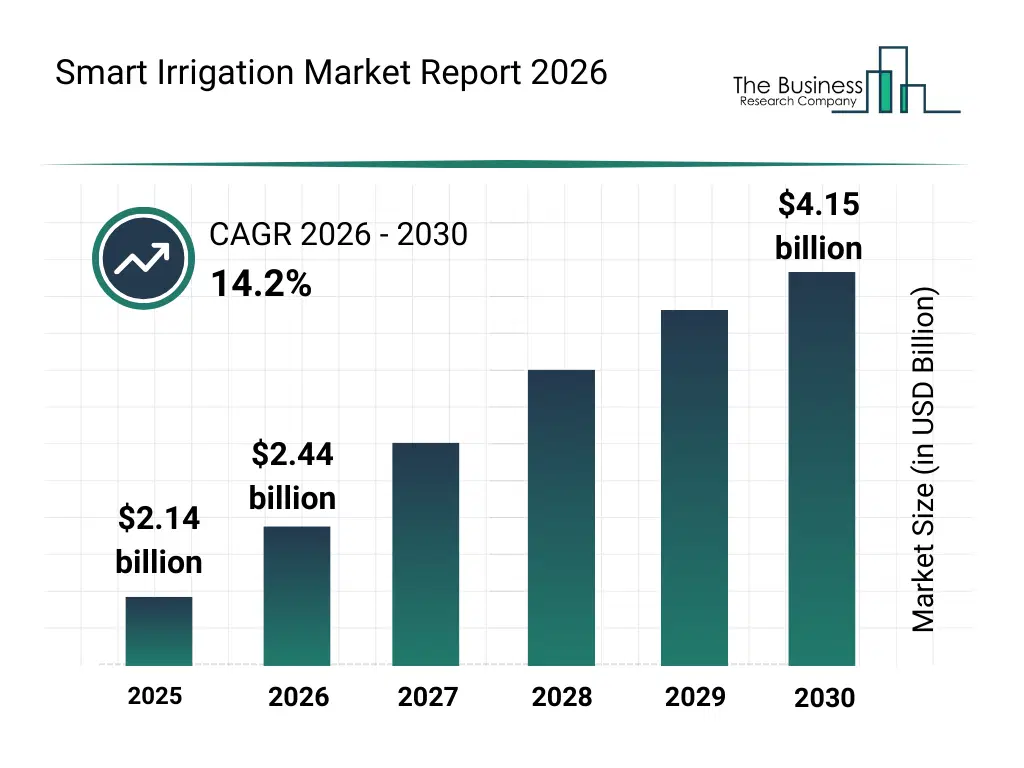
What Is The Smart Irrigation Market Size and Share 2026?
The smart irrigation market size has grown rapidly in recent years. It will grow from $2.14 billion in 2025 to $2.44 billion in 2026 at a compound annual growth rate (CAGR) of 14.1%. The growth in the historic period can be attributed to traditional overuse of water in irrigation, limited availability of moisture-based irrigation tools, rising demand for improved landscape maintenance, early adoption of climate-based controllers, increasing awareness of water conservation.What Is The Smart Irrigation Market Growth Forecast?
The smart irrigation market size is expected to see rapid growth in the next few years. It will grow to $4.15 billion in 2030 at a compound annual growth rate (CAGR) of 14.2%. The growth in the forecast period can be attributed to growing emphasis on sustainable water management, rising adoption of IoT-enabled irrigation controllers, increasing integration of predictive climate analytics, expanding use of soil moisture sensing technology, rising investment in smart landscaping solutions. Major trends in the forecast period include increasing demand for water-efficient irrigation systems, rising adoption of automated landscape irrigation, growth in real-time moisture and weather monitoring, expansion of smart irrigation in residential and commercial spaces, rising use of precision water flow control solutions.
Global Smart Irrigation Market Segmentation
1) By Type: Climate-Based, Sensor-Based 2) By Technology: Evapotranspiration, Soil Moisture 3) By Component: Sensors, Controllers, Water Flow Meters, Software, Other Components Subsegments: 1) By Climate-Based: Evapotranspiration Controllers, Weather-Based Irrigation Controllers, Climate Data Monitoring Systems 2) By Sensor-Based: Soil Moisture Sensors, Rain Sensors, Temperature Sensors, Flow SensorsWhat Is Driver Of The Smart Irrigation Market?
The increase in climate change is expected to propel the smart irrigation market going forward. Climate change refers to the long-term alteration of global or regional climate patterns, primarily characterized by shifts in temperature, precipitation, and weather extremes resulting from both natural processes and human activities. The principal factor driving the increase in climate change is the excessive emission of greenhouse gases from the combustion of fossil fuels, which traps heat in the Earth’s atmosphere and disrupts the natural energy balance, thereby intensifying global warming and altering climatic systems. Smart irrigation mitigates the impacts of increasing climate change by optimizing water usage through data-driven control systems, reducing resource wastage, and promoting sustainable agricultural practices that conserve energy and lower environmental stress. For instance, in May 2023, according to the World Meteorological Organization, Switzerland-based agency, the global near-surface temperature for each year between 2023 and 2027 is predicted to be between 1.1°C and 1.8°C higher than the previous years. Therefore, the increase in climate change is driving the smart irrigation industry.Key Players In The Global Smart Irrigation Market
Major companies operating in the smart irrigation market are AquaSpy Inc., Calsense, Galcon Ltd., Hunter Industries Inc., HydroPoint Data Systems Inc., Netafim USA, Rachio Inc., Rain Bird Corporation, Stevens Water Monitoring Systems Inc., The Toro Company, Weathermatic Industries Inc., Banyan Water Inc., Caipos GmbH, Delta-T Devices Ltd., Jain Irrigation Systems Ltd., Manna Irrigation Ltd., Orbit Irrigation Products LLC, Soil Scout Oy, Valmont Industries Inc., Nelson Irrigation Corporation, Tucor Inc., Irritec S. p. A., Antelco Pty Ltd., Conserva Irrigation Holdings LLC, WaterBit Inc., Hortau Inc., Ewing Irrigation & Landscape Supply Inc., Signature Control Systems Inc., Green IQ Ltd., Hortech Systems Ltd., Acclima Inc., HortControl LLC
This chart is for illustrative purposes; the full report includes a detailed competitor analysis and comprehensive overview of the top 10 companies in the market.
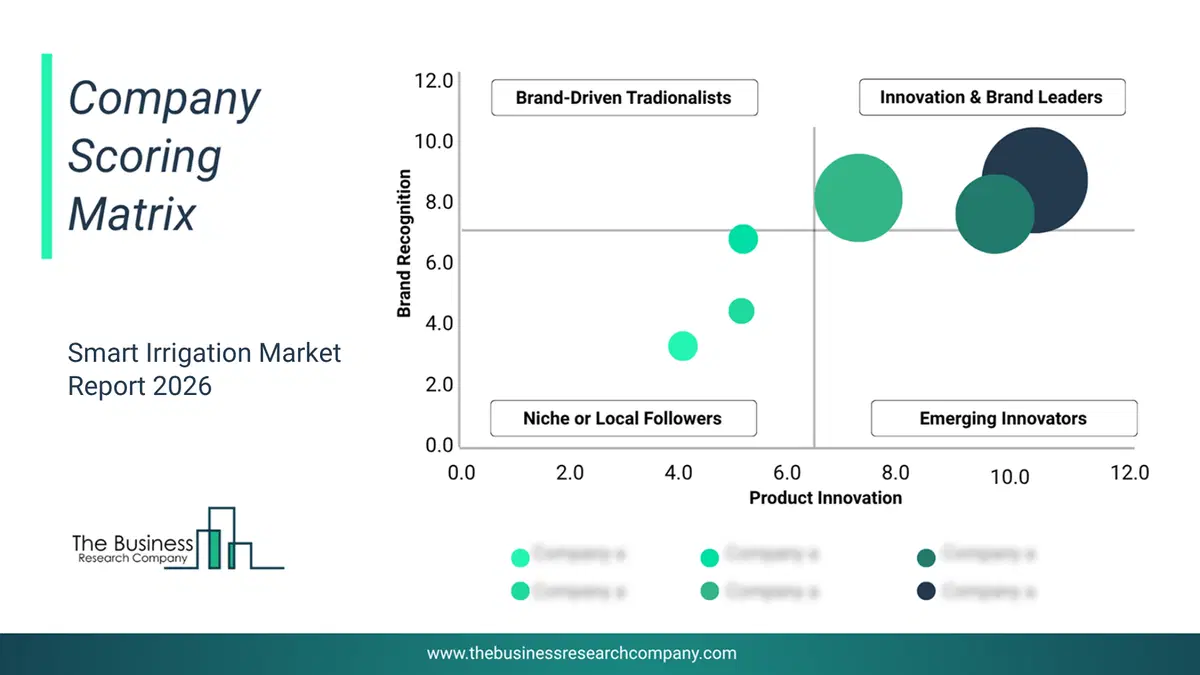
This chart maps companies by product innovation and brand strength, with bubble size indicating relative revenue, helping identify market leaders, challengers, and niche players. This is an illustrative chart; the full report provides a complete and accurate competitive analysis.
Global Smart Irrigation Market Trends and Insights
Major companies operating in the smart irrigation market are focusing on developing technological advancements such as AI-powered automated irrigation systems to optimize water use, enhance crop productivity, and promote sustainable agricultural practices. An AI-powered automated irrigation system is an advanced water management solution that combines artificial intelligence with environmental sensors to monitor soil, crop, and climatic conditions, enabling precise, data-driven irrigation control. For instance, in January 2025, Full Nature Farms, a Hong Kong-based provider of vertical farming and agricultural technology solutions, launched the Rocket 2.0 Smart Irrigation Platform. The platform integrates advanced sensors with artificial intelligence to deliver automated, real-time irrigation management that minimizes water waste and improves plant health. Its adaptable design and cost-effective model make advanced irrigation technology accessible to a wide range of agricultural operations, supporting global efforts toward sustainable and efficient farming practices.What Are Latest Mergers And Acquisitions In The Smart Irrigation Market? Lindsay Corporation's Strategic Acquisition Of Fieldwise LLC Strengthens Smart Irrigation Portfolio
In July 2023, Lindsay Corporation, a USA-based company that manufactures irrigation tools and systems has acquired FieldWise LLC, for an undisclosed amount. This acquisition aims to expand and strengthen Lindsay Corporation’s position in smart irrigation and other AgTech markets. Through this acquisition, Lindsay will now be the force propelling two market-leading solutions and serving a broader customer base through a greatly expanded distribution network. FieldWise LLC is a USA-based company that manufactures agricultural technology products with a focus on subscription-based, precision irrigation solutions.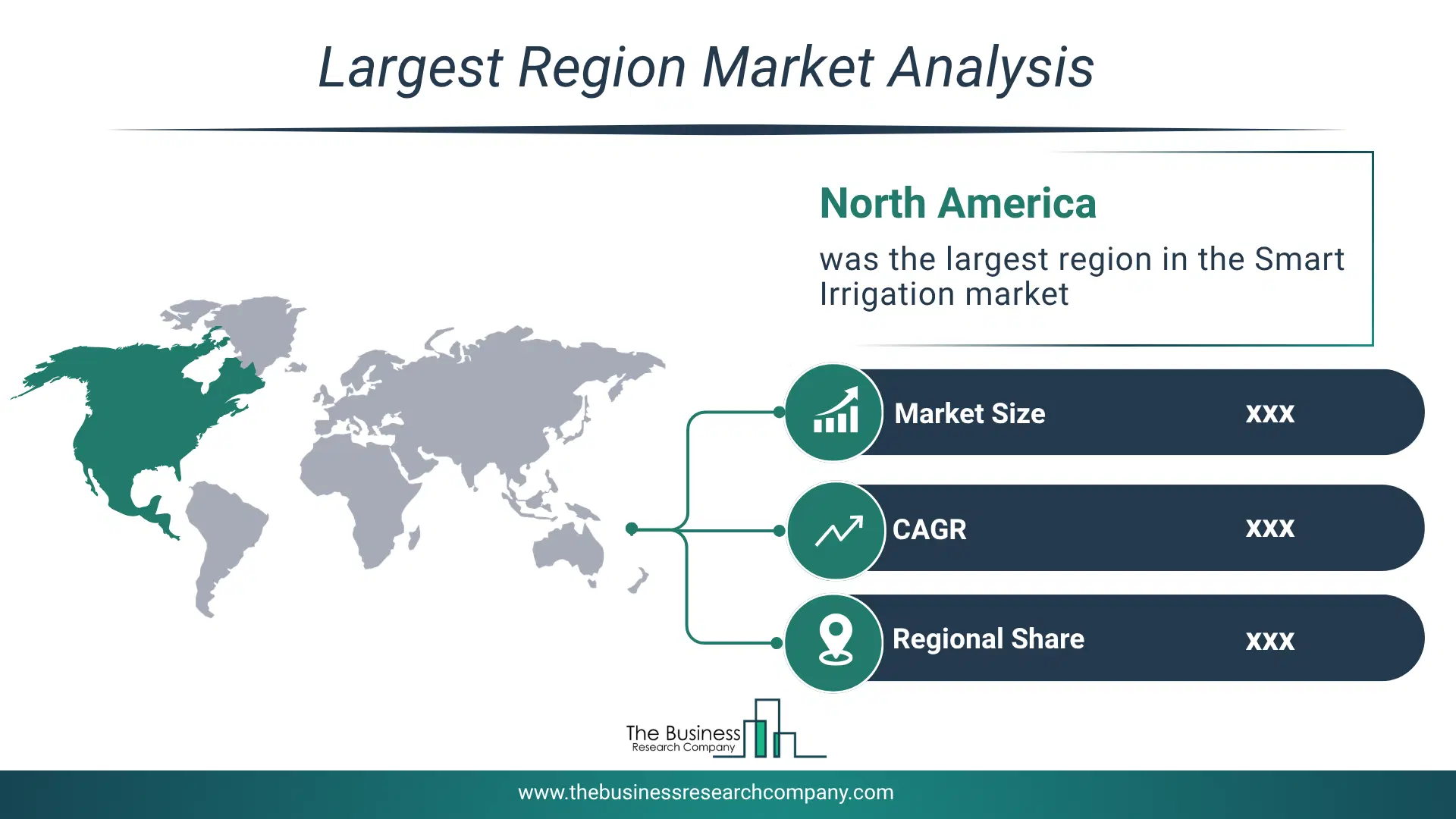
Regional Outlook
North America was the largest region in the smart irrigation market in 2025. The regions covered in the smart irrigation market report are Asia-Pacific, South East Asia, Western Europe, Eastern Europe, North America, South America, Middle East, Africa. The countries covered in the smart irrigation market report are Australia, Brazil, China, France, Germany, India, Indonesia, Japan, Taiwan, Russia, South Korea, UK, USA, Canada, Italy, SpainWhat Defines the Smart Irrigation Market?
The smart irrigation market includes revenues earned by entities by maximize irrigation efficiency, reducing water waste, and maintaining plant health and quality. The market value includes the value of related goods sold by the service provider or included within the service offering. Only goods and services traded between entities or sold to end consumers are included.How is Market Value Defined and Measured?
The market value is defined as the revenues that enterprises gain from the sale of goods and/or services within the specified market and geography through sales, grants, or donations in terms of the currency (in USD unless otherwise specified). The revenues for a specified geography are consumption values that are revenues generated by organizations in the specified geography within the market, irrespective of where they are produced. It does not include revenues from resales along the supply chain, either further along the supply chain or as part of other products.
This chart presents market attractiveness based on a quantitative evaluation of growth, competition, strategic alignment, and risk, offering a clear view of opportunity areas for decision-making. This chart is for illustrative purposes; the full report contains the complete analysis.

This chart highlights the Total Addressable Market (TAM) by estimating the maximum revenue opportunity using an assumption-driven approach, supporting strategic planning and opportunity sizing across markets. The chart is illustrative; the full report provides a more comprehensive analysis.
What Key Data and Analysis Are Included in the Smart Irrigation Market Report 2026?
The smart irrigation market research report is one of a series of new reports from The Business Research Company that provides market statistics, including industry global market size, regional shares, competitors with the market share, detailed market segments, market trends and opportunities, and any further data you may need to thrive in the smart irrigation industry. The market research report delivers a complete perspective of everything you need, with an in-depth analysis of the current and future state of the industry.Smart Irrigation Market Report Forecast Analysis
| Report Attribute | Details |
|---|---|
| Market Size Value In 2026 | $2.44 billion |
| Revenue Forecast In 2030 | $4.15 billion |
| Growth Rate | CAGR of 14.2% from 2026 to 2030 |
| Base Year For Estimation | 2025 |
| Actual Estimates/Historical Data | 2020-2025 |
| Forecast Period | 2026 - 2030 |
| Market Representation | Revenue in USD Billion and CAGR from 2026 to 2030 |
| Segments Covered | Type, Technology, Component |
| Regional Scope | Asia-Pacific, Western Europe, Eastern Europe, North America, South America, Middle East, Africa |
| Country Scope | The countries covered in the report are Australia, Brazil, China, France, Germany, India, Indonesia, Japan, Taiwan, Russia, South Korea, UK, USA, Canada, Italy, Spain |
| Key Companies Profiled | AquaSpy Inc., Calsense, Galcon Ltd., Hunter Industries Inc., HydroPoint Data Systems Inc., Netafim USA, Rachio Inc., Rain Bird Corporation, Stevens Water Monitoring Systems Inc., The Toro Company, Weathermatic Industries Inc., Banyan Water Inc., Caipos GmbH, Delta-T Devices Ltd., Jain Irrigation Systems Ltd., Manna Irrigation Ltd., Orbit Irrigation Products LLC, Soil Scout Oy, Valmont Industries Inc., Nelson Irrigation Corporation, Tucor Inc., Irritec S. p. A., Antelco Pty Ltd., Conserva Irrigation Holdings LLC, WaterBit Inc., Hortau Inc., Ewing Irrigation & Landscape Supply Inc., Signature Control Systems Inc., Green IQ Ltd., Hortech Systems Ltd., Acclima Inc., HortControl LLC |
| Customization Scope | Request for Customization |
| Pricing And Purchase Options | Explore Purchase Options |