
Smart Irrigation Systems Market Report 2026
Global Outlook – By Component (Controllers, Sensors, Water Flow Meters, Software, Other Components), By Irrigation Type (Drip Irrigation, Sprinkler Irrigation, Surface Irrigation, Center Pivot Irrigation), By Deployment (On-Premise, Cloud-Based), By End User (Agriculture, Residential, Commercial, Municipal) – Market Size, Trends, Strategies, and Forecast to 2030
Smart Irrigation Systems Market Overview
• Smart Irrigation Systems market size has reached to $2.4 billion in 2025 • Expected to grow to $4.17 billion in 2030 at a compound annual growth rate (CAGR) of 11.6% • Growth Driver: Increasing Water Scarcity Drives The Market Due To The Need To Optimize Water Use And Reduce Irrigation Wastage • Market Trend: Artificial Intelligence (AI) And Sensor-Based Technologies Enhance Smart Irrigation Efficiency • Asia-Pacific was the largest region and fastest growing region.What Is Covered Under Smart Irrigation Systems Market?
Smart irrigation systems are automated watering systems that use real-time data such as soil moisture, weather conditions, and plant water requirements to optimize irrigation. They automatically adjust watering schedules and water quantities to improve water-use efficiency, reduce waste, and maintain optimal soil moisture. The main components in the smart irrigation systems market include controllers, sensors, water flow meters, software, and other components. Controllers refer to devices that automatically regulate irrigation schedules and water delivery based on programmed settings and field conditions. These systems operate support drip irrigation, sprinkler irrigation, surface irrigation, and center pivot irrigation. They are deployed through on-premise and cloud-based systems and are used by end users including agriculture, residential, commercial, and municipal.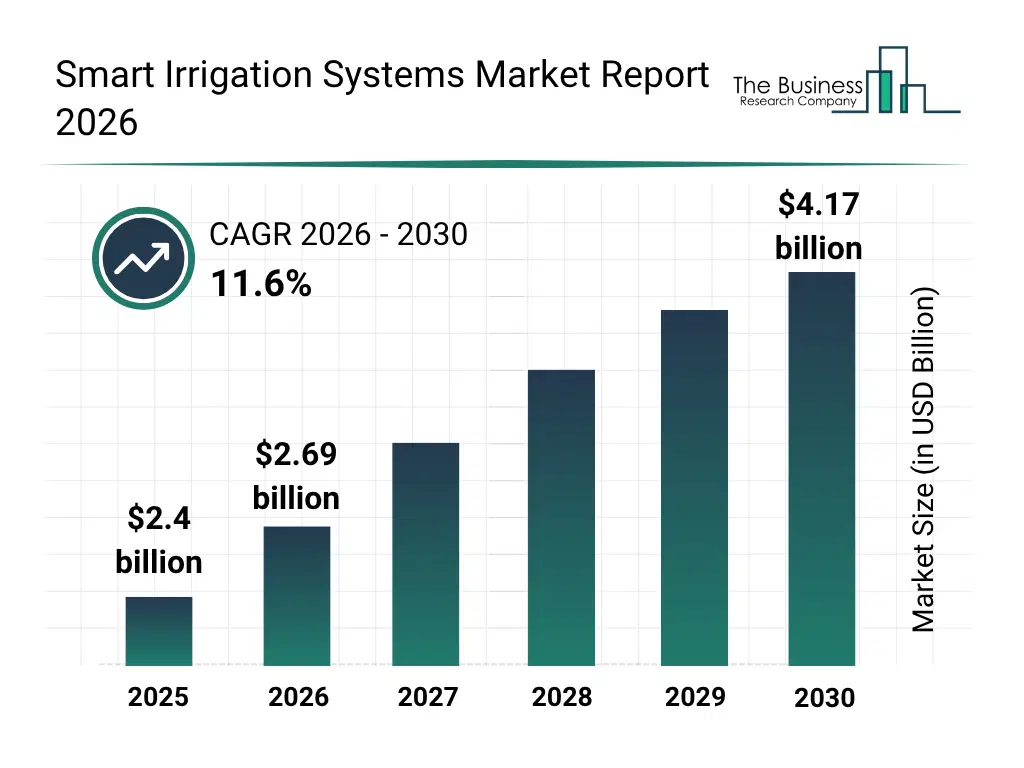
What Is The Smart Irrigation Systems Market Size and Share 2026?
The smart irrigation systems market size has grown rapidly in recent years. It will grow from $2.4 billion in 2025 to $2.69 billion in 2026 at a compound annual growth rate (CAGR) of 12.1%. The growth in the historic period can be attributed to increasing adoption of water conservation practices, rising agricultural water scarcity, growing use of drip irrigation systems, increasing demand for automated irrigation control, rising need to reduce irrigation water waste.What Is The Smart Irrigation Systems Market Growth Forecast?
The smart irrigation systems market size is expected to see rapid growth in the next few years. It will grow to $4.17 billion in 2030 at a compound annual growth rate (CAGR) of 11.6%. The growth in the forecast period can be attributed to expanding precision agriculture practices, growing demand for crop yield optimization, increasing adoption of cloud-connected irrigation management, rising need for efficient irrigation across commercial landscapes, expanding government support for water conservation. Major trends in the forecast period include increasing adoption of soil moisture-based irrigation scheduling, rising use of weather-responsive irrigation control, growing demand for automated water flow management, increasing integration of remote irrigation monitoring, rising preference for water-efficient irrigation systems.Tariff Impact On Smart Irrigation Systems Market
Tariffs are impacting the smart irrigation systems market by increasing the cost of imported controllers, sensors, water flow meters, smart valves, communication equipment, and semiconductor-based components required for automated irrigation deployments. This is slowing the adoption of smart irrigation systems, particularly in regions dependent on imported agricultural and irrigation equipment. Hardware-intensive segments such as controllers, sensors, and water flow meters are most affected due to their reliance on imported electronic and precision components. However, tariffs are also encouraging local manufacturing, regional supplier diversification, and increased investment in domestic irrigation equipment ecosystems, creating long-term supply-chain resilience in the market.
Global Smart Irrigation Systems Market Segmentation
1) By Component: Controllers, Sensors, Water Flow Meters, Software, Other Components 2) By Irrigation Type: Drip Irrigation, Sprinkler Irrigation, Surface Irrigation, Center Pivot Irrigation 3) By Deployment: On-Premise, Cloud-Based 4) By End User: Agriculture, Residential, Commercial, Municipal Subsegments: 1) By Controllers: Weather Based Controllers, Sensor Based Controllers, Time Based Controllers, Centralized Controllers, Standalone Controllers 2) By Sensors: Soil Moisture Sensors, Rain Sensors, Temperature Sensors, Humidity Sensors, Flow Sensors 3) By Water Flow Meters: Mechanical Water Flow Meters, Electromagnetic Water Flow Meters, Ultrasonic Water Flow Meters, Turbine Water Flow Meters, Positive Displacement Water Flow Meters 4) By Software: Mobile Irrigation Management Software, Farm Irrigation Management Software, Landscape Irrigation Management Software 5) By Other Components: Smart Valves, Weather Stations, Communication Gateways, Pump Control Units, Power Supply UnitsWhat Is The Driver Of The Smart Irrigation Systems Market?
The increasing water scarcity is expected to propel the growth of the smart irrigation system market going forward. Water scarcity is the condition in which available water resources are insufficient to meet the demand for drinking, agriculture, industry, and other essential needs. Water scarcity is increasing due to climate change, which is intensifying droughts and disrupting rainfall patterns, thereby reducing the availability of freshwater. Water scarcity drives smart irrigation systems by encouraging farmers and water managers to adopt precise, automated irrigation technologies that optimize water use and minimize wastage. For instance, In September 2025, according to the World Meteorological Organization (WMO), a Switzerland-based specialized agency of the United Nations, 3.6 billion people faced inadequate access to water for at least one month per year, a figure expected to exceed 5 billion by 2050. Therefore, the increasing water scarcity is driving the growth of the smart irrigation system industry.Key Players In The Global Smart Irrigation Systems Market
Major companies operating in the smart irrigation systems market are Valmont Industries Inc., Orbia Advance Corporation S.A.B. de C.V., The Toro Company, Lindsay Corporation, Husqvarna AB, Rivulis Pte. Ltd., Rain Bird Corporation, Hunter Industries Inc., Reinke Manufacturing Company Inc., HydroPoint Data Systems Inc., Telsco Industries Inc., T-L Irrigation Company, Nelson Irrigation Corporation, Phytech Ltd., CropX Technologies Ltd., Mahindra EPC Irrigation Limited, K-Rain Manufacturing Corp., Mottech Water Management Ltd., Galcon Bakarim Agricultural Cooperative Society Ltd., WiseConn Engineering Inc., AquaSpy Inc., Fasal, Netro Inc.
This chart is for illustrative purposes; the full report includes a detailed competitor analysis and comprehensive overview of the top 10 companies in the market.
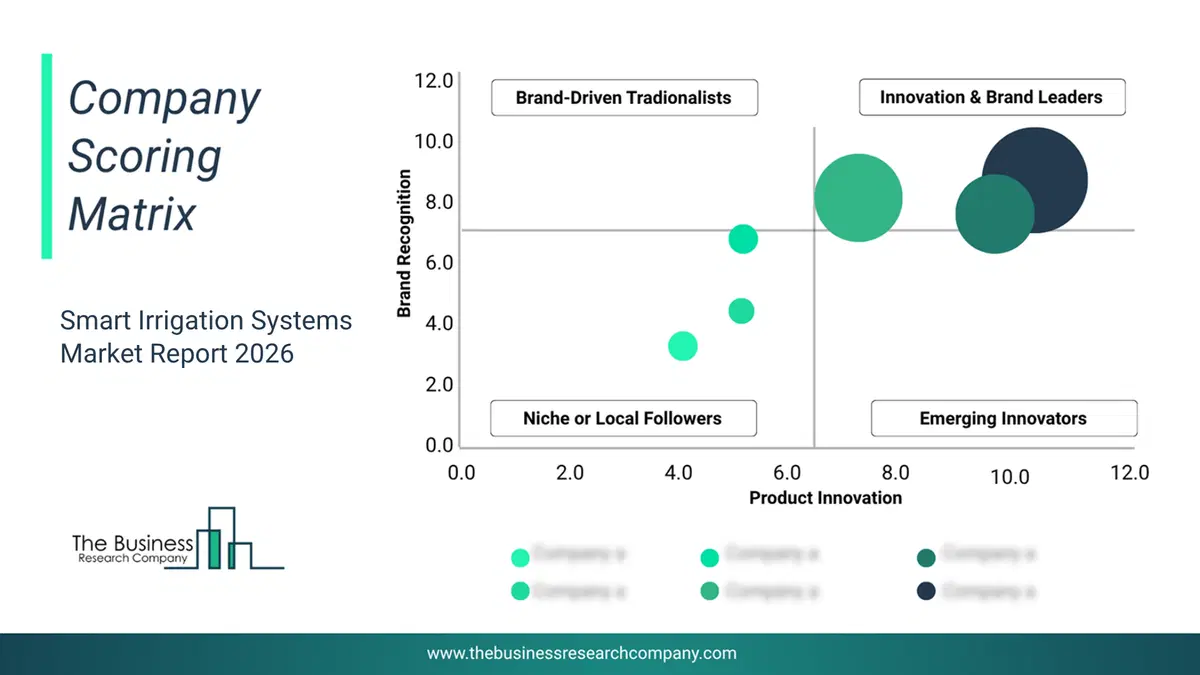
This chart maps companies by product innovation and brand strength, with bubble size indicating relative revenue, helping identify market leaders, challengers, and niche players. This is an illustrative chart; the full report provides a complete and accurate competitive analysis.
Global Smart Irrigation Systems Market Trends and Insights
Major companies operating in the smart irrigation systems market are focusing on developing advanced solutions, such as AI-powered irrigation platforms, to optimize water usage, automate irrigation control, and improve crop productivity. AI-powered irrigation platforms refer to smart irrigation solutions that analyze sensor data, weather information, and crop conditions to generate precise irrigation schedules and deliver water according to plant requirements. For instance, in January 2025, Full Nature Farms, a Hong Kong-based agricultural technology company, launched its Rocket 2.0 Smart Irrigation Platform at CES 2025, an AI-powered irrigation system designed to reduce agricultural water waste and improve crop yields. The platform integrates crop, soil, and climate sensors with AI and weather forecasts to generate dynamic irrigation schedules and provide automated irrigation control, helping optimize water usage, reduce energy consumption, and improve plant health and productivity.What Are Latest Mergers And Acquisitions In The Smart Irrigation Systems Market?
In October 2025, Rain Bird Corporation, a US-based irrigation technology company, acquired Rachio Inc. for an undisclosed amount. Through this acquisition, Rain Bird aims to expand its smart and sustainable irrigation solutions by integrating Rachio’s cloud-connected smart irrigation controllers and connected irrigation technologies into its portfolio. Rachio, Inc. is a US-based smart irrigation technology company that designs and manufactures cloud-connected irrigation and smart home technologies, including smart irrigation controllers and smart hose-end timers.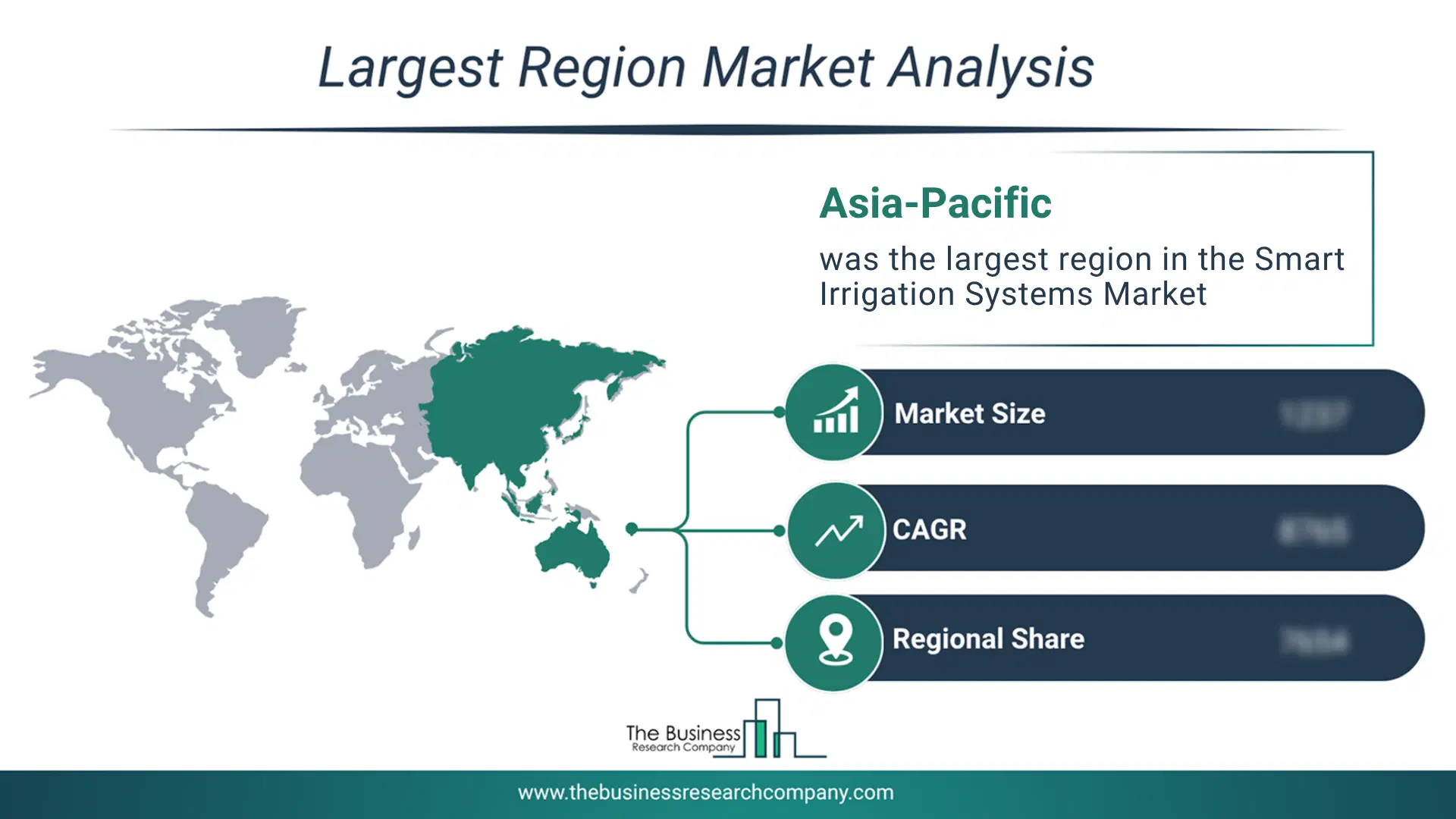
Regional Outlook
Asia-Pacific was the largest region in the smart irrigation systems market in 2025. Asia-Pacific is expected to be the fastest-growing region in the forecast period. The regions covered in this market report are Asia-Pacific, South East Asia, Western Europe, Eastern Europe, North America, South America, Middle East, Africa. The countries covered in this market report are Australia, Brazil, China, France, Germany, India, Indonesia, Japan, Taiwan, Russia, South Korea, UK, USA, Canada, Italy, Spain.What Defines the Smart Irrigation Systems Market?
The smart irrigation systems market consists of revenues earned by entities by providing services such as automated irrigation scheduling, soil moisture monitoring, weather-based irrigation management, and remote irrigation monitoring. The market value includes the value of related goods sold by the service provider or included within the service offering. The smart irrigation systems market also includes sales of smart irrigation valves, smart sprinkler heads, drip irrigation systems, and automated irrigation pumps. Values in this market are ‘factory gate’ values, that is, the value of goods sold by the manufacturers or creators of the goods, whether to other entities (including downstream manufacturers, wholesalers, distributors, and retailers) or directly to end customers. The value of goods in this market includes related services sold by the creators of the goods.How is Market Value Defined and Measured?
The market value is defined as the revenues that enterprises gain from the sale of goods and/or services within the specified market and geography through sales, grants, or donations in terms of the currency (in USD unless otherwise specified). The revenues for a specified geography are consumption values that are revenues generated by organizations in the specified geography within the market, irrespective of where they are produced. It does not include revenues from resales along the supply chain, either further along the supply chain or as part of other products.
This chart presents market attractiveness based on a quantitative evaluation of growth, competition, strategic alignment, and risk, offering a clear view of opportunity areas for decision-making. This chart is for illustrative purposes; the full report contains the complete analysis.

This chart highlights the Total Addressable Market (TAM) by estimating the maximum revenue opportunity using an assumption-driven approach, supporting strategic planning and opportunity sizing across markets. The chart is illustrative; the full report provides a more comprehensive analysis.
What Key Data and Analysis Are Included in the Smart Irrigation Systems Market Report 2026?
The smart irrigation systems market research report is one of a series of new reports from The Business Research Company that provides market statistics, including industry global market size, regional shares, competitors with the market share, detailed market segments, market trends and opportunities, and any further data you may need to thrive in the smart irrigation systems industry. The market research report delivers a complete perspective of everything you need, with an in-depth analysis of the current and future state of the industry.Smart Irrigation Systems Market Report Forecast Analysis
| Report Attribute | Details |
|---|---|
| Market Size Value In 2026 | $2.69 billion |
| Revenue Forecast In 2030 | $4.17 billion |
| Growth Rate | CAGR of 11.6% from 2026 to 2030 |
| Base Year For Estimation | 2025 |
| Actual Estimates/Historical Data | 2020-2025 |
| Forecast Period | 2026 - 2030 |
| Market Representation | Revenue in USD Billion and CAGR from 2026 to 2030 |
| Segments Covered | Component, Irrigation Type, Deployment, End User |
| Regional Scope | Asia-Pacific, Western Europe, Eastern Europe, North America, South America, Middle East, Africa |
| Country Scope | The countries covered in the report are Australia, Brazil, China, France, Germany, India, Indonesia, Japan, Taiwan, Russia, South Korea, UK, USA, Canada, Italy, Spain. |
| Key Companies Profiled | Valmont Industries Inc., Orbia Advance Corporation S.A.B. de C.V., The Toro Company, Lindsay Corporation, Husqvarna AB, Rivulis Pte. Ltd., Rain Bird Corporation, Hunter Industries Inc., Reinke Manufacturing Company Inc., HydroPoint Data Systems Inc., Telsco Industries Inc., T-L Irrigation Company, Nelson Irrigation Corporation, Phytech Ltd., CropX Technologies Ltd., Mahindra EPC Irrigation Limited, K-Rain Manufacturing Corp., Mottech Water Management Ltd., Galcon Bakarim Agricultural Cooperative Society Ltd., WiseConn Engineering Inc., AquaSpy Inc., Fasal, Netro Inc. |
| Customization Scope | Request for Customization |
| Pricing And Purchase Options | Explore Purchase Options |