
Smart Kitchens Market Report 2026
Global Outlook – By Product Type ( Smart Refrigerators, Smart Oven, Smart Dishwashers, Smart Cooktops, Other Product Types), By Technology ( Wireless Fidelity Enabled Appliances, Bluetooth Enabled Appliances, Radio-Frequency Identification Enabled Appliances, Voice-Activated Appliances, Sensor-Based Appliances), By End-User ( Residential And Home Users, Commercial Users) – Market Size, Trends, Strategies, and Forecast to 2030
Smart Kitchens Market Overview
• Smart Kitchens market size has reached to $45.68 billion in 2025 • Expected to grow to $141.78 billion in 2030 at a compound annual growth rate (CAGR) of 25.4% • Growth Driver: Increasing Focus On Energy Efficiency And Sustainability Drives Market Growth Due To Rising Demand For Smart Technology And Resource Optimization • Market Trend: Innovative Solutions Driving Enhanced Connectivity And User Experience • North America was the largest region in 2025 and Asia-Pacific is the fastest growing region.What Is Covered Under Smart Kitchens Market?
Smart kitchens refer to modern kitchens that incorporate advanced technologies to improve cooking, food storage, and overall kitchen management. These kitchens utilize connected devices such as smart refrigerators, ovens, dishwashers, and lighting systems, all of which can be controlled remotely through smartphones, voice commands, or automation systems. The main types of products in smart kitchens are smart refrigerators, smart ovens, smart dishwashers, smart cooktops, and others. Smart refrigerators are internet-connected appliances that use advanced features like touchscreens, AI, and remote monitoring to enhance convenience, energy efficiency, and food management. These appliances incorporate technologies such as wireless fidelity-enabled appliances, Bluetooth-enabled appliances, radio-frequency identification-enabled appliances, voice-activated appliances, and sensor-based appliances, catering to various end users such as residential and home users and commercial users.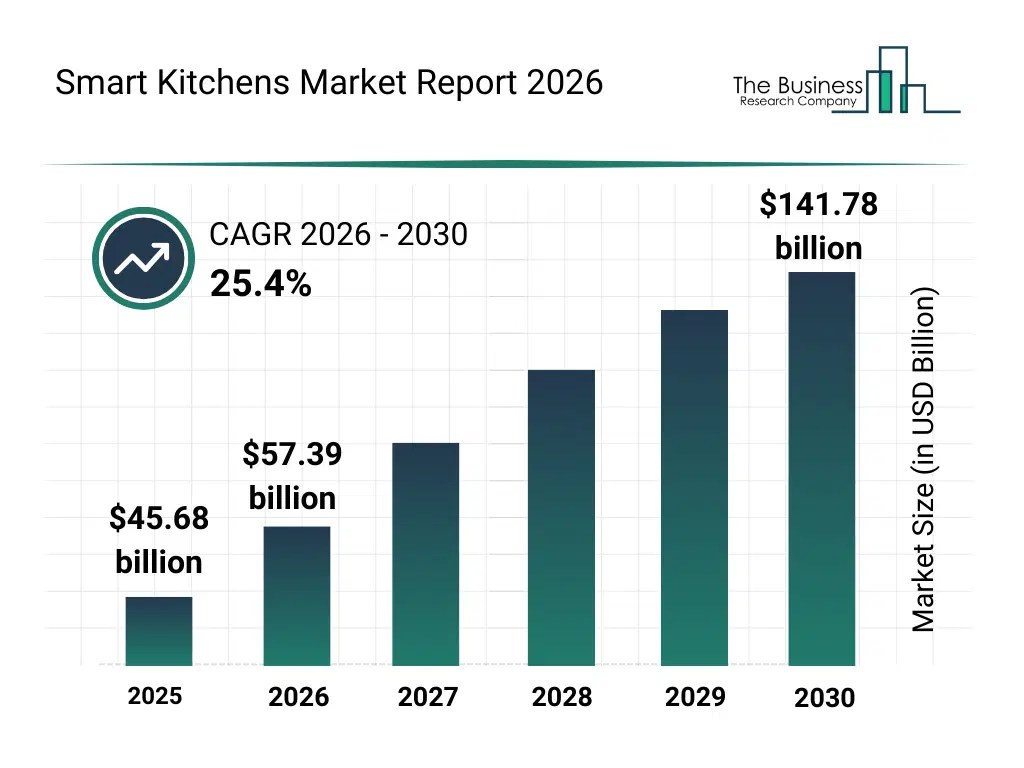
What Is The Smart Kitchens Market Size 2026 And Growth Rate?
The smart kitchens market size has grown exponentially in recent years. It will grow from $45.68 billion in 2025 to $57.39 billion in 2026 at a compound annual growth rate (CAGR) of 25.6%. The growth in the historic period can be attributed to growing adoption of connected home devices, increasing awareness about energy efficiency, rise in urbanization and modern housing, development of IoT-enabled kitchen appliances, increasing disposable income in developed countries.What Is The Smart Kitchens Market Growth Forecast?
The smart kitchens market size is expected to see exponential growth in the next few years. It will grow to $141.78 billion in 2030 at a compound annual growth rate (CAGR) of 25.4%. The growth in the forecast period can be attributed to advancements in AI-powered kitchen solutions, integration of robotics in cooking, rising demand for sustainable and energy-efficient appliances, expansion of smart home ecosystems in emerging markets, development of cloud-based appliance management platforms. Major trends in the forecast period include voice-activated kitchens, smart appliance integration, remote kitchen monitoring, energy-efficient smart appliances, automated cooking & meal planning.
Global Smart Kitchens Market Segmentation
1) By Product Type: Smart Refrigerators, Smart Oven, Smart Dishwashers, Smart Cooktops, Other Product Types 2) By Technology: Wireless Fidelity Enabled Appliances, Bluetooth Enabled Appliances, Radio-Frequency Identification Enabled Appliances, Voice-Activated Appliances, Sensor-Based Appliances 3) By End-User: Residential And Home Users, Commercial Users Subsegments: 1) By Smart Refrigerators: French Door Smart Refrigerators, Side-by-Side Smart Refrigerators, Bottom Freezer Smart Refrigerators, Top Freezer Smart Refrigerators 2) By Smart Oven: Convection Smart Ovens, Microwave Smart Ovens, Steam Smart Ovens, Countertop Smart Ovens 3) By Smart Dishwashers: Built-in Smart Dishwashers, Freestanding Smart Dishwashers, Drawer Smart Dishwashers 4) By Smart Cooktops: Induction Smart Cooktops, Gas Smart Cooktops, Electric Smart Cooktops 5) By Other Product Types: Smart Coffee Makers, Smart Kettles, Smart ToastersWhat Is The Driver Of The Smart Kitchens Market?
The increasing focus on energy efficiency and sustainability is expected to propel the growth of the smart kitchens market going forward. Energy efficiency and sustainability can be attributed to factors such as rising energy costs, growing environmental concerns, regulatory pressures, technological advancements, consumer demand for greener products, and the need to mitigate climate change impacts. Smart kitchens enhance energy efficiency and sustainability by optimizing energy use through automated systems, energy-saving appliances, and smart technology that reduce waste and improve resource management. For instance, in 2024, according to the International Energy Agency (IEA), a France-based intergovernmental organization, total net electricity production within the OECD amounted to 882.1 TWh, marking a 1.2% year-over-year growth compared to 2023. Additionally, electricity generation for the first three quarters of 2024 increased by 2.5% relative to the same period in 2023. Therefore, increasing focus on energy efficiency and sustainability is driving the smart kitchens industry.Key Players In The Global Smart Kitchens Market
Major companies operating in the smart kitchens market are Samsung Electronics Co. Ltd., Robert Bosch GmbH, Siemens AG, LG Electronics Inc., General Electric, Panasonic Corporation, Midea Group Co. Ltd., Haier Group Corporation, KitchenAid Inc., Whirlpool Corporation, Koninklijke Philips N.V, BSH Hausgerate GmbH, Electrolux AB, Groupe SEB S.A., Miele And Cie. KG, Beko Elektronik A.S, Zerowatt S.p.A, Tovala Inc., Brava Home Inc., Anova Culinary LLC, Cosori Inc., Daewoo Electronics Corporation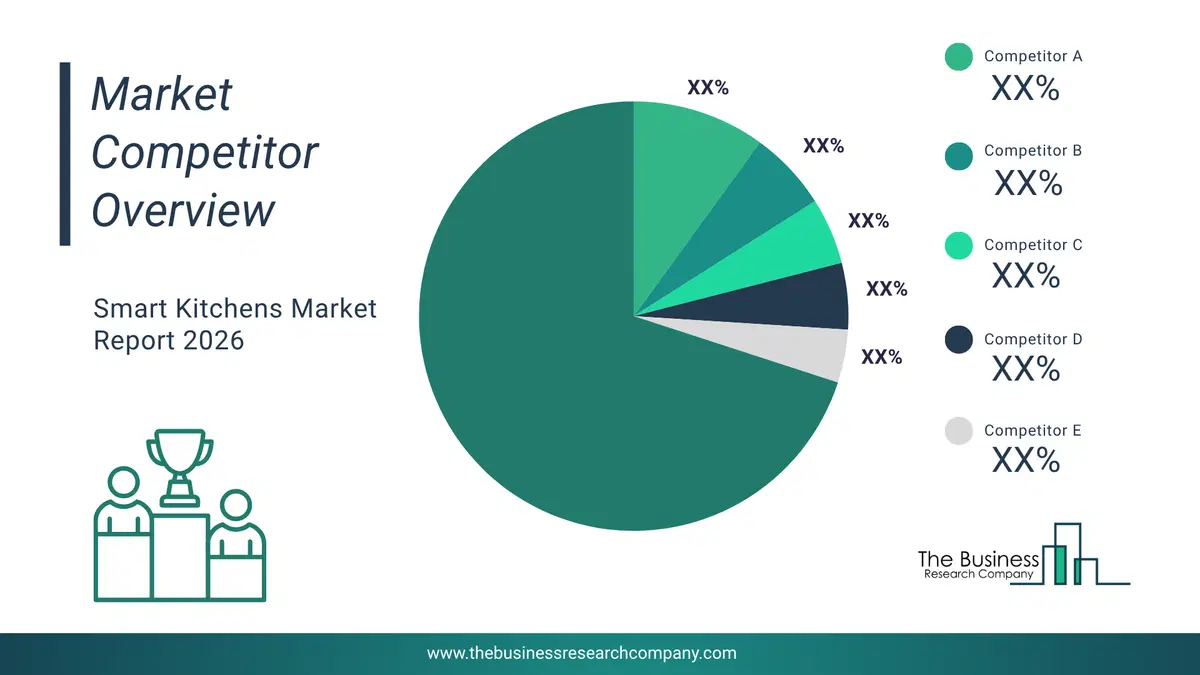
This chart is for illustrative purposes; the full report includes a detailed competitor analysis and comprehensive overview of the top 10 companies in the market.
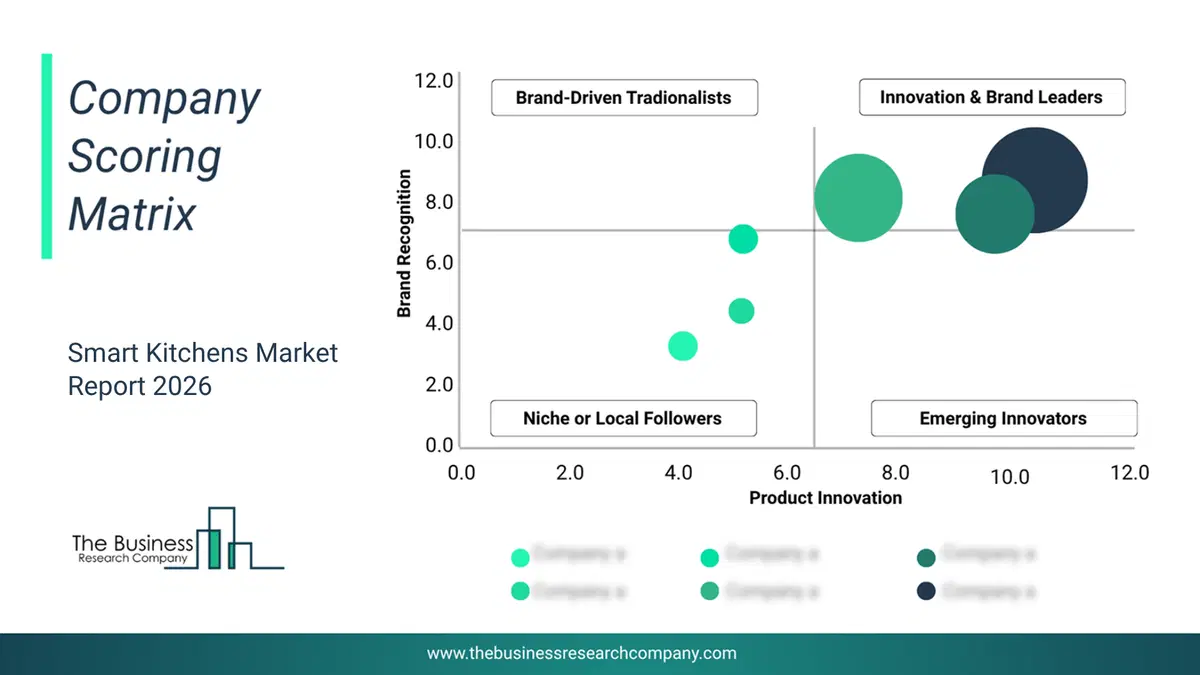
This chart maps companies by product innovation and brand strength, with bubble size indicating relative revenue, helping identify market leaders, challengers, and niche players. This is an illustrative chart; the full report provides a complete and accurate competitive analysis.
Global Smart Kitchens Market Trends and Insights
Major companies operating in the smart kitchen market are focusing on developing technologically advanced solutions, such as all-in-one connected kitchen platforms, to enhance convenience, functionality, and user experience. An all-in-one connected kitchen platform is a comprehensive system that integrates various smart kitchen devices and appliances into a unified network, allowing them to communicate with each other for seamless control and automation. For instance, in September 2023, Fresc Technologies Inc., an Ireland-based technology company, launched KitchenOS to deliver true multi-brand device control for smart kitchen appliances. KitchenOS is an integrated operating system for smart kitchens, offering features like device integration, voice control, AI-driven assistance, energy management, and remote control, with types ranging from basic systems that connect essential appliances to advanced systems that offer full automation and personalized cooking experiences.What Are Latest Mergers And Acquisitions In The Smart Kitchens Market?
In March 2023, Kitchens Centre Private Limited, an India-based food technology and kitchen infrastructure company, acquired Swiggy Private Limited’s kitchens business for an undisclosed amount. With this acquisition, Kitchens Centre Private Limited aims to expand its footprint across major Indian cities, strengthen its cloud kitchen infrastructure, and accelerate the growth of its partner-first kitchen-as-a-service model. Swiggy Private Limited is an India-based food services company that specializes in providing shared kitchen spaces and infrastructure solutions for food brands and restaurant partners.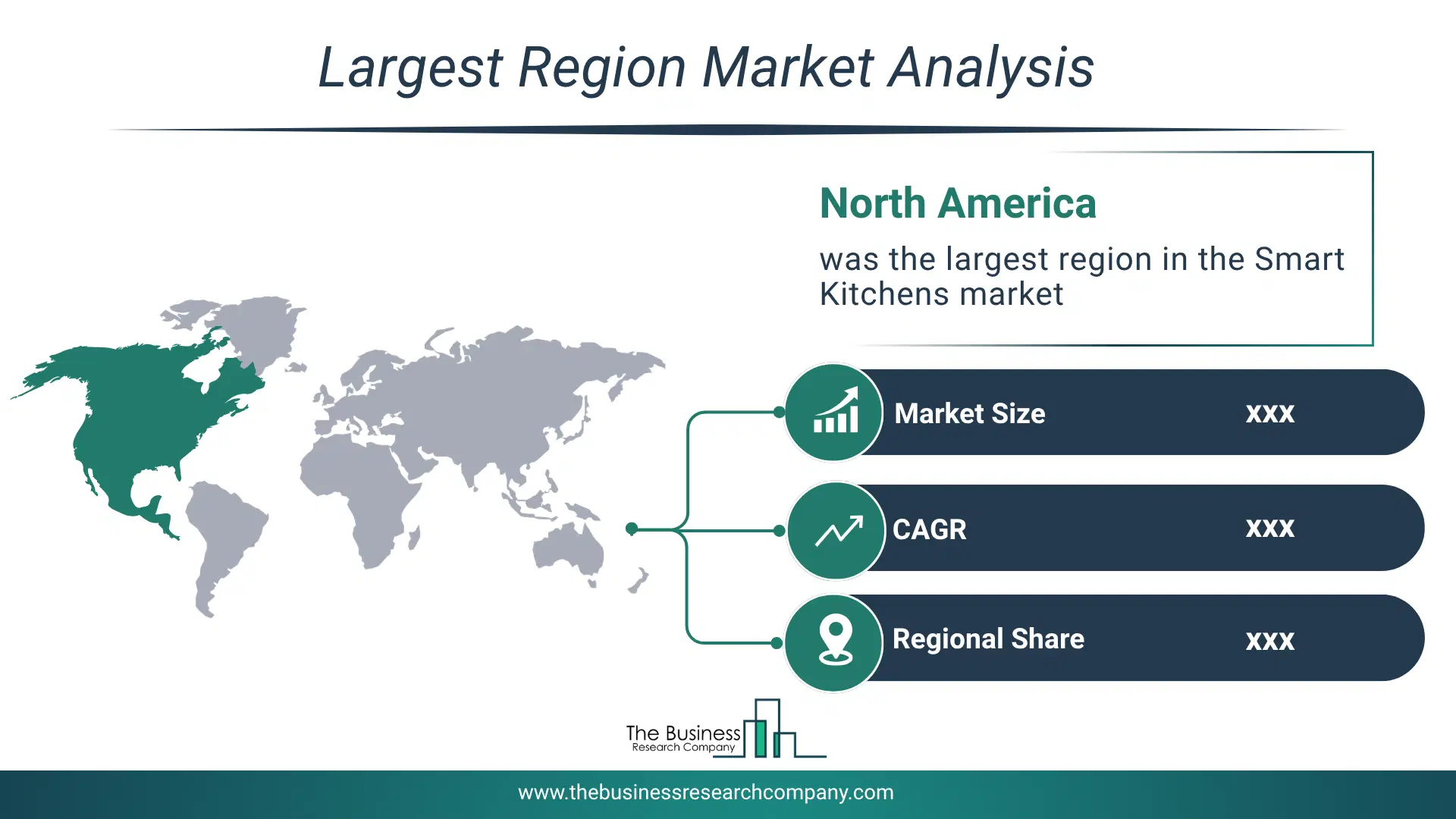
Regional Outlook
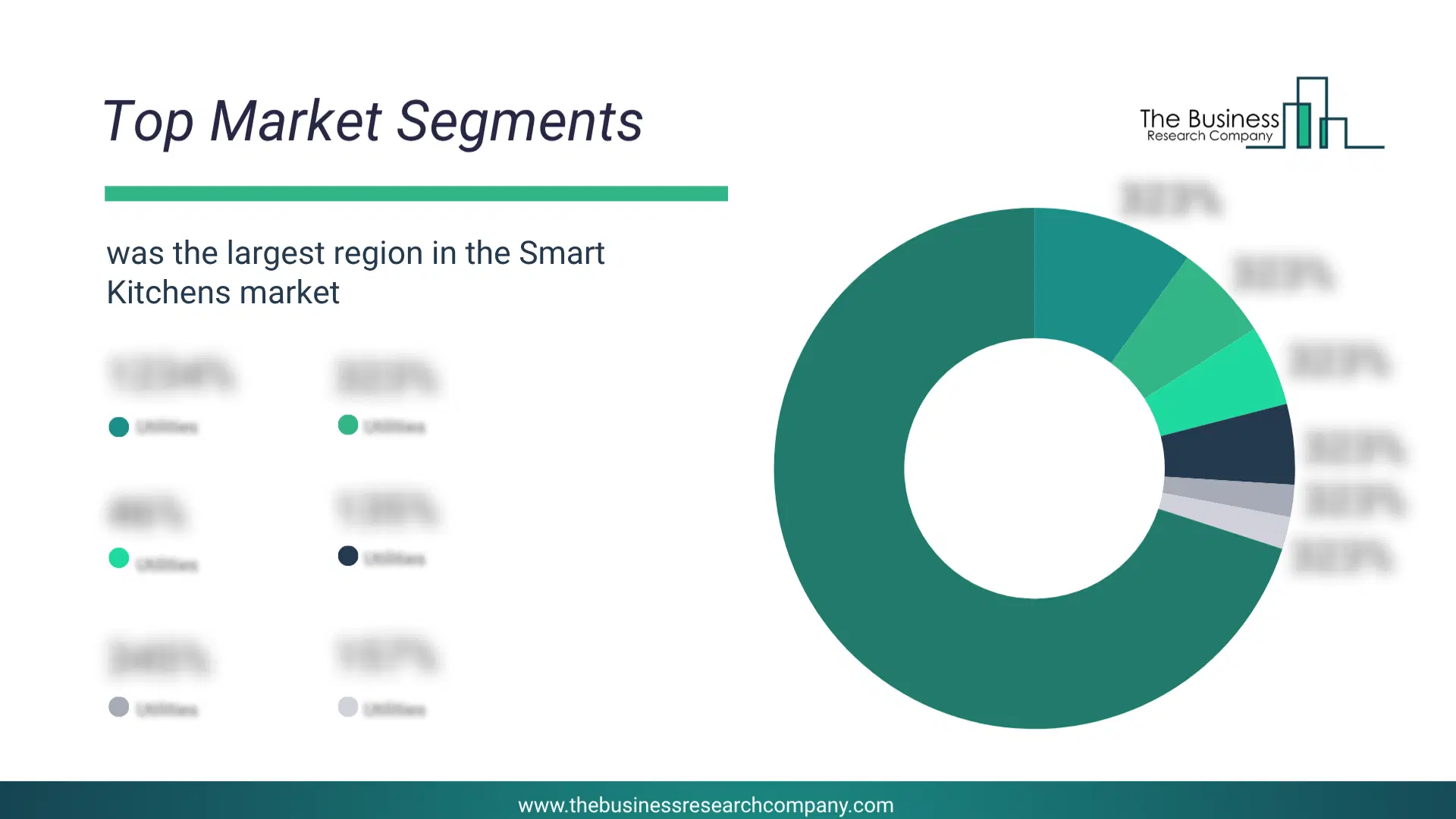
North America was the largest region in the smart kitchens market in 2025. Asia-Pacific is expected to be the fastest-growing region in the forecast period. The regions covered in this market report are Asia-Pacific, South East Asia, Western Europe, Eastern Europe, North America, South America, Middle East, Africa. The countries covered in this market report are Australia, Brazil, China, France, Germany, India, Indonesia, Japan, Taiwan, Russia, South Korea, UK, USA, Canada, Italy, Spain.What Defines the Smart Kitchens Market?
The smart kitchens market consists of revenues earned by entities by providing services such as customization, smart home integration, consultation and design, data monitoring and analytics, installation and setup, and connected kitchen platforms. The market value includes the value of related goods sold by the service provider or included within the service offering. The smart kitchens market also includes sales of smart trash bins, smart faucets, smart cooktops, smart dishwashers, smart toasters, and blenders and sensors. Values in this market are ‘factory gate’ values, that is, the value of goods sold by the manufacturers or creators of the goods, whether to other entities (including downstream manufacturers, wholesalers, distributors, and retailers) or directly to end customers. The value of goods in this market includes related services sold by the creators of the goods.How is Market Value Defined and Measured?
The market value is defined as the revenues that enterprises gain from the sale of goods and/or services within the specified market and geography through sales, grants, or donations in terms of the currency (in USD unless otherwise specified). The revenues for a specified geography are consumption values that are revenues generated by organizations in the specified geography within the market, irrespective of where they are produced. It does not include revenues from resales along the supply chain, either further along the supply chain or as part of other products.
This chart presents market attractiveness based on a quantitative evaluation of growth, competition, strategic alignment, and risk, offering a clear view of opportunity areas for decision-making. This chart is for illustrative purposes; the full report contains the complete analysis.

This chart highlights the Total Addressable Market (TAM) by estimating the maximum revenue opportunity using an assumption-driven approach, supporting strategic planning and opportunity sizing across markets. The chart is illustrative; the full report provides a more comprehensive analysis.
What Key Data and Analysis Are Included in the Smart Kitchens Market Report 2026?
The smart kitchens market research report is one of a series of new reports from The Business Research Company that provides market statistics, including industry global market size, regional shares, competitors with the market share, detailed market segments, market trends and opportunities, and any further data you may need to thrive in the smart kitchens industry. The market research report delivers a complete perspective of everything you need, with an in-depth analysis of the current and future state of the industry.Smart Kitchens Market Report Forecast Analysis
| Report Attribute | Details |
|---|---|
| Market Size Value In 2026 | $57.39 billion |
| Revenue Forecast In 2030 | $141.78 billion |
| Growth Rate | CAGR of 25.4% from 2026 to 2030 |
| Base Year For Estimation | 2025 |
| Actual Estimates/Historical Data | 2020-2025 |
| Forecast Period | 2026 - 2030 |
| Market Representation | Revenue in USD Billion and CAGR from 2026 to 2030 |
| Segments Covered | Product Type, Technology, End-User |
| Regional Scope | Asia-Pacific, Western Europe, Eastern Europe, North America, South America, Middle East, Africa |
| Country Scope | The countries covered in the report are Australia, Brazil, China, France, Germany, India, Indonesia, Japan, Taiwan, Russia, South Korea, UK, USA, Canada, Italy, Spain. |
| Key Companies Profiled | Samsung Electronics Co. Ltd., Robert Bosch GmbH, Siemens AG, LG Electronics Inc., General Electric, Panasonic Corporation, Midea Group Co. Ltd., Haier Group Corporation, KitchenAid Inc., Whirlpool Corporation, Koninklijke Philips N.V, BSH Hausgerate GmbH, Electrolux AB, Groupe SEB S.A., Miele And Cie. KG, Beko Elektronik A.S, Zerowatt S.p.A, Tovala Inc., Brava Home Inc., Anova Culinary LLC, Cosori Inc., Daewoo Electronics Corporation |
| Customization Scope | Request for Customization |
| Pricing And Purchase Options | Explore Purchase Options |