
Smart Labelling In Logistics Market Report 2026
Global Outlook – By Product (Radio Frequency Identification (RFID) Labels; Near Field Communication (NFC) Labels; Electronic Shelf Labels (ESL); Other Products), By Component (Hardware; Software; Services), By Deployment Type (Cloud-Based; On-Premises), By Company Size (Small And Medium-Sized Enterprises (SMEs); Large Enterprises), By Application (Inventory Management; Asset Tracking; Parcel Tracking And Delivery; Cold Chain Monitoring; Other Applications) – Market Size, Trends, Strategies, and Forecast to 2035
Smart Labelling In Logistics Market Overview
• Smart Labelling In Logistics market size has reached to $7.1 billion in 2025 • Expected to grow to $9.34 billion in 2030 at a compound annual growth rate (CAGR) of 5.6% • Growth Driver: The Impact Of Internet Of Things (IoT) Integration On The Growth Of Smart Labels In The Logistics Market • Market Trend: Advancements In Smart Labels Enhances Supply Chain Efficiency And Accuracy • North America was the largest region in 2025.What Is Covered Under Smart Labelling In Logistics Market?
Smart labeling in logistics refers to the use of advanced labeling technologies that enhance the tracking, management, and efficiency of supply chains. These labels often incorporate features such as radio frequency identification (RFID), QR codes, barcodes, or near-field communication (NFC), allowing for real-time data capture and transmission. This technology enables companies to monitor inventory, improve accuracy in order fulfillment, reduce errors, and enhance transparency across the logistics network. The main types of smart labelling in logistics are radio frequency identification (RFID) labels, near field communication (NFC) labels, electronic shelf labels (ESL), and others. Radiofrequency identification (RFID) labels are tags embedded with a chip and antenna that use radio waves to transmit data for tracking and identification purposes. The components of smart labeling systems include hardware, software, and services, and these systems can be deployed through cloud-based or on-premises solutions. They are utilized by various companies, including small and medium-sized enterprises (SMEs) and large enterprises, for applications such as inventory management, asset tracking, parcel tracking and delivery, cold chain monitoring, and others.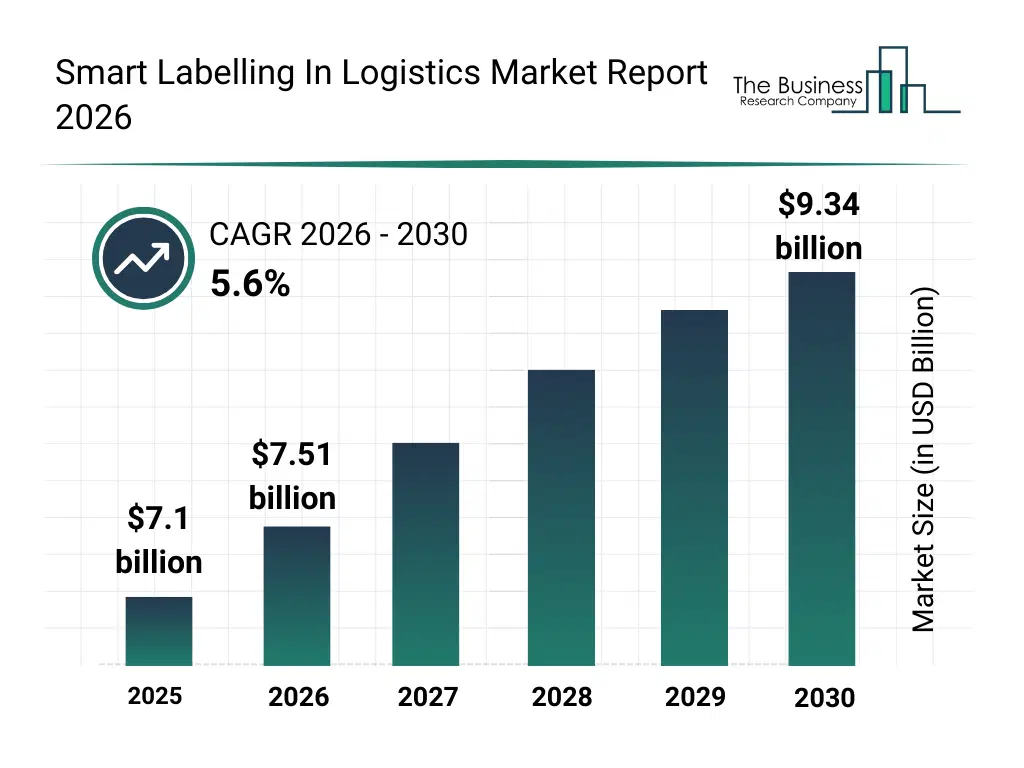
What Is The Smart Labelling In Logistics Market Size and Share 2026?
The smart labelling in logistics market size has grown strongly in recent years. It will grow from $7.1 billion in 2025 to $7.51 billion in 2026 at a compound annual growth rate (CAGR) of 5.7%. The growth in the historic period can be attributed to expansion of global logistics operations, increased use of barcode-based identification, rising demand for accurate inventory tracking, growth in cross-border trade, adoption of digital logistics solutions.What Is The Smart Labelling In Logistics Market Growth Forecast?
The smart labelling in logistics market size is expected to see strong growth in the next few years. It will grow to $9.34 billion in 2030 at a compound annual growth rate (CAGR) of 5.6%. The growth in the forecast period can be attributed to increasing investments in smart supply chain infrastructure, rising demand for end-to-end shipment visibility, expansion of cold chain monitoring applications, growing adoption of nfc-enabled consumer engagement, increasing focus on traceability and compliance. Major trends in the forecast period include increasing adoption of rfid-based tracking solutions, rising deployment of nfc and smart qr labels, growing integration of real-time inventory visibility systems, expansion of cloud-based label management platforms, enhanced focus on supply chain transparency.
Global Smart Labelling In Logistics Market Segmentation
1) By Product: Radio Frequency Identification (RFID) Labels, Near Field Communication (NFC) Labels, Electronic Shelf Labels (ESL), Other Products 2) By Component: Hardware, Software, Services 3) By Deployment Type: Cloud-Based, On-Premises 4) By Company Size: Small And Medium-Sized Enterprises (SMEs), Large Enterprises 5) By Application: Inventory Management, Asset Tracking, Parcel Tracking And Delivery, Cold Chain Monitoring, Other Applications Subsegments: 1) By Radio Frequency Identification (RFID) Labels: Passive RFID Labels, Active RFID Labels, Semi-Passive RFID Labels, High-Frequency RFID Labels (HF), Ultra-High Frequency RFID Labels (UHF) 2) By Near Field Communication (NFC) Labels: NFC Stickers, NFC Tags, NFC-Enabled Smart Labels, NFC Interactive Labels 3) By Electronic Shelf Labels (ESL): E-Paper ESL, LED-based ESL, Full-Color ESL, Bluetooth Low Energy (BLE)-Enabled ESL 4) By Other Products: Smart QR Code Labels, Smart Barcode Labels, Augmented Reality (AR) Labels, Wireless Temperature Monitoring Labels, Digital Price TagsWhat Is The Driver Of The Smart Labelling In Logistics Market?
The expansion of Internet of Things (IoT) integration is expected to propel the growth of smart labelling in logistics market going forward. IoT integration refers to the process of connecting and coordinating Internet of Things (IoT) devices and systems to enable seamless data exchange and automation. The increase in IoT integration is due to several factors, such as advancements in technology, increasing connectivity, reduced costs of IoT devices, and the growing demand for smart solutions across various industries. Smart labels in logistics enhance IoT integration by providing real-time data and seamless connectivity for tracking, monitoring, and managing goods throughout the supply chain. For instance, in August 2025, according to Eurostat, the Luxembourg-based statistical office of the European Union, 70.9% of people in the EU used internet-connected devices or internet of things (IoT) in 2024, with the Netherlands reporting the highest usage at 94.8%. Therefore, the expansion of Internet of Things (IoT) integration will drive the growth of smart labelling in logistics industry.Key Players In The Global Smart Labelling In Logistics Market
Major companies operating in the smart labelling in logistics market are Oracle Corporation, Honeywell International Inc., 3M Company, NXP Semiconductors N.V., Avery Dennison Corporation, Zebra Technologies Corporation, CCL Industries Inc., Toshiba Tec Corporation, Cognex Corporation, Sato Holdings Corporation, Checkpoint Systems Inc., Mimaki Engineering Co. Ltd., Impinj Inc., Identiv Inc., Barcodes Inc., Alien Technology LLC., Roambee Services Private Limited, William Frick & Company, Scanbuy Inc., Thin Film Electronics ASA, SMARTRAC TECHNOLOGY GmbH, KSW Microtec AG, Invengo Information Technology Co. Ltd, TSC Auto ID Technology Co. Ltd.Global Smart Labelling In Logistics Market Trends and Insights
Major companies operating in the smart labels in logistics market are focusing on developing advanced solutions such as unified visibility platform-based labeling to improve supply chain efficiency and accuracy. Unified visibility platform-based labeling refers to a system that integrates and provides comprehensive, real-time tracking and management of goods across the supply chain through a single, unified interface. For instance, in May 2024, Roambee Corporation, a US-based supply chain visibility and intelligence provider, launched a 5G global positioning system (GPS) smart label with a peel-and-ship design measuring 4 inches by 6 inches. This advanced label utilizes 5G technology, GPS, and sensors calibrated by the National Institute of Standards and Technology (NIST) to monitor environmental factors including temperature, humidity, shock, and light, providing exceptional real-time visibility for shipments. It functions similarly to a barcode, allowing users to easily scan the label for shipment information without requiring complex infrastructure such as printers. The smart label seamlessly integrates with Roambee's unified visibility platform, delivering accurate insights into the estimated time of arrival (ETA), shipment quality, and security throughout the entire supply chain.What Are Latest Mergers And Acquisitions In The Smart Labelling In Logistics Market?
In September 2025, Trackonomy Systems Inc., a US-based technology company, acquired InPlay Inc. for an undisclosed amount. With this acquisition, Trackonomy sought to enhance its smart labeling and asset visibility offerings by integrating ultra-low-power Bluetooth semiconductor technology to strengthen its product portfolio and support broader deployment across logistics and supply chain use cases. InPlay Inc. is a US-based technology company that specializes in developing ultra-low-power Bluetooth Low Energy system-on-chip solutions used in smart labels, asset tracking devices, and industrial Internet of Things applications.Regional Outlook
North America was the largest region in the smart labelling in logistics market in 2025. The regions covered in this market report are Asia-Pacific, South East Asia, Western Europe, Eastern Europe, North America, South America, Middle East, Africa. The countries covered in this market report are Australia; Brazil; China; France; Germany; India; Indonesia; Japan; Taiwan; Russia; South Korea; UK; USA; Canada; Italy; Spain.What Defines the Smart Labelling In Logistics Market?
The smart labeling in logistics market consists of revenues earned by entities by providing services such as real-time tracking, automated data capture, inventory management, and error reduction. The market value includes the value of related goods sold by the service provider or included within the service offering. The smart labeling in the logistics market also includes sales of quick response codes, barcode labels, digital sensors, smart stickers, augmented reality labels, and temperature sensors. Values in this market are ‘factory gate’ values, that is the value of goods sold by the manufacturers or creators of the goods, whether to other entities (including downstream manufacturers, wholesalers, distributors, and retailers) or directly to end customers. The value of goods in this market includes related services sold by the creators of the goods. Smart labeling in the logistics market is segmented into products, components, deployment types, company size, and application.How is Market Value Defined and Measured?
The market value is defined as the revenues that enterprises gain from the sale of goods and/or services within the specified market and geography through sales, grants, or donations in terms of the currency (in USD unless otherwise specified). The revenues for a specified geography are consumption values that are revenues generated by organizations in the specified geography within the market, irrespective of where they are produced. It does not include revenues from resales along the supply chain, either further along the supply chain or as part of other products.What Key Data and Analysis Are Included in the Smart Labelling In Logistics Market Report 2026?
The smart labelling in logistics market research report is one of a series of new reports from The Business Research Company that provides market statistics, including Market Report 2026?global market size, regional shares, competitors with the market share, detailed market segments, market trends and opportunities, and any further data you may need to thrive in the smart labelling in logistics Market Report 2026? The market research report delivers a complete perspective of everything you need, with an in-depth analysis of the current and future state of the Market Report 2026?Smart Labelling In Logistics Market Report Forecast Analysis
| Report Attribute | Details |
|---|---|
| Market Size Value In 2026 | $7.51 billion |
| Revenue Forecast In 2035 | $9.34 billion |
| Growth Rate | CAGR of 5.7% from 2026 to 2035 |
| Base Year For Estimation | 2025 |
| Actual Estimates/Historical Data | 2020-2025 |
| Forecast Period | 2026 - 2030 - 2035 |
| Market Representation | Revenue in USD Billion and CAGR from 2026 to 2035 |
| Segments Covered | Product, Component, Deployment Type, Company Size, Application |
| Regional Scope | Asia-Pacific, Western Europe, Eastern Europe, North America, South America, Middle East, Africa |
| Country Scope | The countries covered in the report are Australia, Brazil, China, France, Germany, India, ... |
| Key Companies Profiled | Oracle Corporation, Honeywell International Inc., 3M Company, NXP Semiconductors N.V., Avery Dennison Corporation, Zebra Technologies Corporation, CCL Industries Inc., Toshiba Tec Corporation, Cognex Corporation, Sato Holdings Corporation, Checkpoint Systems Inc., Mimaki Engineering Co. Ltd., Impinj Inc., Identiv Inc., Barcodes Inc., Alien Technology LLC., Roambee Services Private Limited, William Frick & Company, Scanbuy Inc., Thin Film Electronics ASA, SMARTRAC TECHNOLOGY GmbH, KSW Microtec AG, Invengo Information Technology Co. Ltd, TSC Auto ID Technology Co. Ltd. |
| Customization Scope | Request for Customization |
| Pricing And Purchase Options | Explore Purchase Options |