

Contact Us
  Search
The Business Research Company Logo
Smart Life Sciences Manufacturing Global Market Opportunities And Strategies To 2035
Published :June 2026
Pages :361
Format :PDF
Delivery Time :2-3 Business Days
Why 2-3 days? We update the report with the latest data and news before delivery. Let us know if you need us to expedite.
Report Price :$4,490.00

Smart Life Sciences Manufacturing Global Market Opportunities And Strategies To 2035

By Component (Solution, Services), By Technology (Internet of Things (IoT), Artificial Intelligence, Cybersecurity, Big Data, Other Technologies), By Application (Pharma, Bio-Pharma, Medical Device, Other Applications), And By Region, Opportunities And Strategies – Global Forecast To 2035

Smart life sciences manufacturing refers to the application of advanced digital technologies—such as artificial intelligence, IoT, robotics, digital twins, advanced analytics, and automation—across pharmaceutical, biotechnology, and medical device production processes. It enables real-time monitoring, adaptive control, and data-driven optimization of manufacturing operations in highly regulated environments. The primary purpose of smart life sciences manufacturing is to enhance product quality, process efficiency, and regulatory compliance while accelerating time-to-market. The smart life sciences manufacturing market consists of sales of smart life sciences manufacturing by entities (organizations, sole traders and partnerships) that provide digital technologies, platforms and services designed to enhance manufacturing processes within the life sciences industry. These solutions are used to enable connected, automated and data-driven manufacturing environments that support the production of pharmaceutical products, biologics and medical devices. Smart life sciences manufacturing solutions are designed to improve production efficiency, ensure product quality, support regulatory compliance and enable scalable and flexible manufacturing operations.
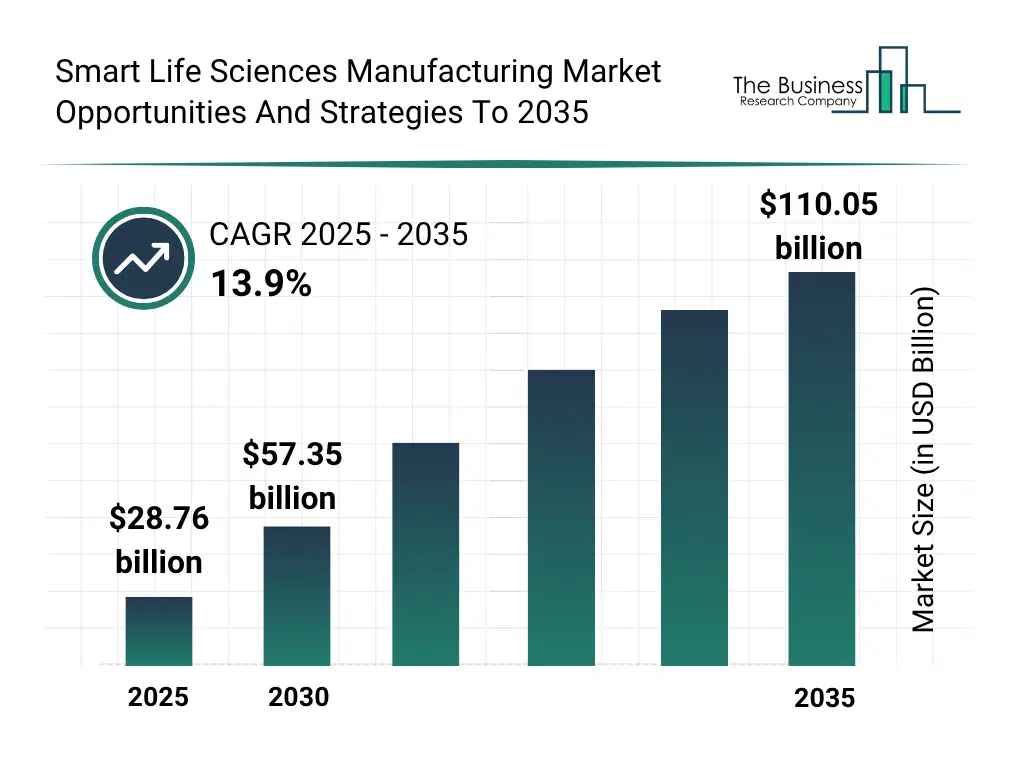
Smart Life Sciences Manufacturing Global Market Opportunities And Strategies To 2035 Market Size and growth rate 2026 to 2030: Graph

Smart Life Sciences Manufacturing Market Size

The global smart life sciences manufacturing market reached a value of nearly $28,757.5 million in 2025, having grown at a compound annual growth rate (CAGR) of 15.1% since 2020. The market is expected to grow from $28,757.5 million in 2025 to $57,350.7 million in 2030 at a rate of 14.8%. The market is then expected to grow at a CAGR of 13.9% from 2029 and reach $110,047.8 million in 2035. Growth in the historic period resulted from rising adoption of personalized medicine, rising research and development spending in the life sciences industry, expansion of smart factories in the pharmaceutical and biotechnology sectors and rising government support towards digital transformation across the life sciences industry. Factors that negatively affected growth in the historic period were high initial capital investment and data security and privacy concerns. Going forward, expansion of the pharmaceutical sector, increasing adoption of pharma 4.0 technologies, growth in biopharmaceutical and biologics production and expansion of vaccine manufacturing capacity globally will drive the growth. Factors that could hinder the growth of the smart life sciences manufacturing market in the future include complex regulatory compliance, interoperability issues and impact of trade wars and tariffs.
Research Expert

Book your 30 minutes free consultation with our research experts

Smart Life Sciences Manufacturing Market Segmentation The smart life sciences manufacturing market is segmented by component, by technology, and by application.

By Component –
The smart life sciences manufacturing market is segmented by component into:
    • a) Solution
    • b) Services
The solution market was the largest segment of the smart life sciences manufacturing market segmented by component, accounting for 67.8% or $19,500.1 million of the total in 2025. Going forward, the services segment is expected to be the fastest-growing segment in the smart life sciences manufacturing market segmented by component, at a CAGR of 15.2% during 2025-2030.

By Technology –
The smart life sciences manufacturing market is segmented by technology into:
    • a) Internet Of Things (IOT)
    • b) Artificial Intelligence
    • c) Cybersecurity
    • d) Big Data
    • e) Other Technologies
The internet of things (IoT) was the largest segment of the smart life sciences manufacturing market segmented by technology, accounting for 34.9% or $10,046.5 million of the total in 2025. Going forward, the artificial intelligence segment is expected to be the fastest-growing segment in the smart life sciences manufacturing market segmented by technology, at a CAGR of 16.0% during 2025-2030.

By Application –
The smart life sciences manufacturing market is segmented by application into:
  1. a) Pharma
  2. b) Bio-Pharma
  3. c) Medical Device
  4. d) Other Application
The pharma market was the largest segment of the smart life sciences manufacturing market segmented by application, accounting for 43.2% or $12,430.3 million of the total in 2025. Going forward, the bio-pharma segment is expected to be the fastest-growing segment in the smart life sciences manufacturing market segmented by application, at a CAGR of 16.8% during 2025-2030.

By Geography - The smart life sciences manufacturing market is segmented by geography into:
      o Asia Pacific
      • China
      • India
      • Japan
      • Australia
      • Indonesia
      • South Korea
      o North America
      • USA
      • Canada
      o South America
      • Brazil
      o Western Europe
      • France
      • Germany
      • UK
      • Italy
      • Spain
      o Eastern Europe
      • Russia
      o Middle East
      o Africa
North America was the largest region in the smart life sciences manufacturing market, accounting for 36.1% or $10,375.5 million of the total in 2025. It was followed by Asia Pacific, Western Europe and then the other regions. Going forward, the fastest-growing regions in the smart life sciences manufacturing market will be Asia Pacific and Eastern Europe where growth will be at CAGRs of 17.2% and 14.8% respectively. These will be followed by Western Europe and North America where the markets are expected to grow at CAGRs of 14.6% and 13.5% respectively.

Smart Life Sciences Manufacturing Market Drivers

The key drivers of the smart life sciences manufacturing market include: Expansion Of The Pharmaceutical Sector The expansion of the pharmaceutical sector is driving increased demand for smart life sciences manufacturing. Rapid growth in global pharmaceutical infrastructure has enhanced production capabilities and expanded research facilities, enabling the development and manufacturing of advanced therapies and precision medicines. Investments in state-of-the-art labs, automated production lines, and quality control systems facilitate higher output with consistent quality, directly supporting smarter manufacturing practices. Increased capacity also allows companies to integrate digital tracking and data analytics, improving efficiency and compliance with regulatory standards. This expansion encourages adoption of more sophisticated production methods and innovative drug formulations. The expansion of the pharmaceutical sector growth contribution during the forecast period in 2025 is 1.5%.

Smart Life Sciences Manufacturing Market Restraints

The key restraints on the smart life sciences manufacturing market include: Complex Regulatory Compliance The complex regulatory compliance limits a significant barrier to market expansion. Stringent and evolving regulations in pharmaceuticals, biotechnology, and medical devices create significant hurdles for manufacturers. Companies must invest heavily in compliance systems, staff training, and frequent audits to meet global standards. Delays in approvals and certifications can slow down production and innovation cycles. Non-compliance risks legal penalties, product recalls, and reputational damage, making organizations cautious about adopting new manufacturing technologies. This can limit the pace at which advanced digital and automated processes are implemented. Growth affected by complex regulatory compliance during the forecast period in 2025 is -1.5%.

Smart Life Sciences Manufacturing Market Competitive Landscape

Major Competitors are:

  • Siemens AG
  • ABB Ltd.
  • Schneider Electric SE
  • Rockwell Automation Inc.
  • Honeywell International Inc.
  • Other Competitors Include:

  • Emerson Electric Co.
  • SAP SE
  • Dassault Systemes SE
  • International Business Machines Corporation
  • Nukon Pty Ltd
  • TilliT Pty Ltd
  • Infodot Pty Ltd
  • CSL Limited
  • KPMG China
  • WuXi Biologics
  • WuXi AppTec
  • GenScript Biotech Corporation
  • Innovent Biologics
  • OMRON Corporation
  • Serum Institute of India Pvt. Ltd.
  • Bio Farma
  • Kalbe Farma
  • Dexa Medica
  • Indofarma
  • Takeda Pharmaceutical Company Limited
  • Cellares Corporation
  • Astellas Pharma Inc.
  • Daiichi Sankyo Company, Limited
  • Chugai Pharmaceutical Co., Ltd.
  • Celonis SE
  • Samsung Biologics Co., Ltd.
  • Celltrion
  • SK Bioscience
  • Lotte Biologics
  • Taiwan Bio-Manufacturing Corporation (TBMC)
  • PharmaEssentia Corporation
  • ScinoPharm Taiwan Ltd.
  • EirGenix, Inc.
  • Menicon Malaysia Sdn. Bhd.
  • Esco Lifesciences Group Ltd.
  • MiRXES Pte. Ltd.
  • Thermo Fisher Scientific
  • Catalent, Inc.
  • AGC Biologics
  • Bristol Myers Squibb
  • Eli Lilly and Company
  • Amgen Inc.
  • Gilead Sciences, Inc.
  • Biogen Inc.
  • OmniaBio Inc.
  • BIOVECTRA Inc.
  • Biodextris Inc.
  • AbCellera Biologics Inc.
  • Aspect Biosystems
  • Sanofi S.A.
  • GlaxoSmithKline plc
  • AstraZeneca plc
  • Boehringer Ingelheim
  • Bosch Rexroth
  • Cognizant Technology Solutions
  • Pfizer Inc.
  • Johnson & Johnson
  • Novartis AG
  • Bayer AG
  • F. Hoffmann-La Roche AG
  • Teva Pharmaceutical Industries Ltd.
  • Need data on a specific region in this market?

    Opportunities And Recommendations In The Smart Life Sciences Manufacturing Market

    Opportunities – The top opportunities in the smart life sciences manufacturing market segmented by type will arise in the solution segment, which will gain $19,088.5 million of global annual sales by 2030. The top opportunities in the smart life sciences manufacturing market segmented by sales channel will arise in the internet of things (IoT) segment, which will gain $9,778.0 million of global annual sales by 2030. The top opportunities in the smart life sciences manufacturing market segmented by application will arise in the pharma segment, which will gain $11,596.2 million of global annual sales by 2030. The smart life sciences manufacturing market size will gain the most in the USA at $8,275.2 million. Recommendations- To take advantage of the opportunities, The Business Research Company recommends the smart life sciences manufacturing companies to focus on physical ai integration in smart biomanufacturing, focus on advanced mes platforms for scalable compliant life sciences manufacturing, focus on ai-assisted cloud-native platforms for compliant and scalable life sciences manufacturing, focus on ai enabled validation platforms for integrated manufacturing efficiency, focus on services-led expansion in smart life sciences manufacturing, expand in emerging markets, continue to focus on developed markets, focus on distribution network expansion and localized channel integration, focus on value-based and tiered pricing for smart life sciences manufacturing, focus on digital and scientific promotion channels, focus on kol partnerships and industry events promotion, focus on workforce capability and bio-pharma engagement in smart life sciences manufacturing.
    Chat with us