

Smart Machines Market Report 2026
Global Outlook – By Component (Hardware, Software, Services, ), By Technology (Cloud Computing Technology, Big Data Technology, Internet of Everything, Robotics, Cognitive Technology, Affective Technology), By Machine (Robots, Autonomous Cars, Drones, Wearable Devices, Other Machines), By Verticals (Manufacturing, Transportation And Logistics, Healthcare, Consumer Goods And Retail, Aerospace And Defense, Other Verticals) – Market Size, Trends, Strategies, and Forecast to 2030
Smart Machines Market Overview
• Smart Machines market size has reached to $224.38 billion in 2025 • Expected to grow to $414.91 billion in 2030 at a compound annual growth rate (CAGR) of 13.1% • Growth Driver: Increasing Requirement For Enhanced Data Accessibility In Various Industries • Market Trend: Advancements In AI-Powered Humanoid Robots Driving Growth In The Smart Machine Market To Enhance Operational Efficiency And Workforce Productivity • North America was the largest region in 2025 and Asia-Pacific is the fastest growing region.What Is Covered Under Smart Machines Market?
Smart machines refer to cognitive computing systems that can make decisions and solve problems without the help of a human. The purpose of smart machines is to leverage machine-to-machine and cognitive computing technologies, such as machine learning and deep learning, to solve problems, make decisions, and take action. The main components of smart machines are hardware, software, and services. Hardware refers to the computer's tangible components or delivery systems that store and run the written instructions provided by the software. The various technologies involved are cloud computing technology, big data technology, the internet of everything, robotics, cognitive technology, and affective technology, which are utilized by machines such as robots, autonomous cars, drones, wearable devices, and other. The end users are manufacturing, transportation and logistics, healthcare, consumer goods and retail, aerospace and defense, and others.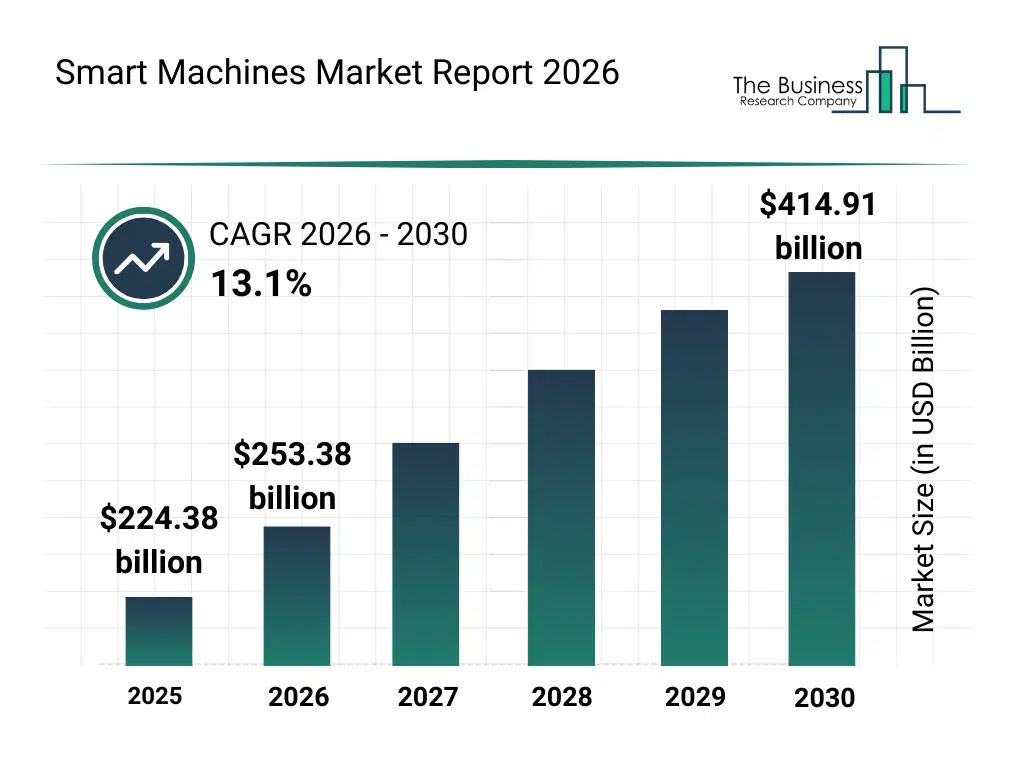
What Is The Smart Machines Market Size and Share 2026?
The smart machines market size has grown rapidly in recent years. It will grow from $224.38 billion in 2025 to $253.38 billion in 2026 at a compound annual growth rate (CAGR) of 12.9%. The growth in the historic period can be attributed to advancements in computing power, growth in data availability, early adoption of industrial automation, expansion of cloud infrastructure, rising demand for operational efficiency.What Is The Smart Machines Market Growth Forecast?
The smart machines market size is expected to see rapid growth in the next few years. It will grow to $414.91 billion in 2030 at a compound annual growth rate (CAGR) of 13.1%. The growth in the forecast period can be attributed to AI model performance improvements, expansion of autonomous systems adoption, increased investment in smart infrastructure, growing demand for predictive decision making, rising enterprise digital transformation initiatives. Major trends in the forecast period include rising deployment of self learning machines, growing integration of cognitive decision systems, increased adoption of machine to machine communication, higher demand for autonomous operational capabilities, expansion of real time data driven automation.Tariff Impact On Smart Machines Market
Tariffs have impacted the smart machines market by increasing costs of imported semiconductors, sensors, processors, and connectivity modules used in intelligent hardware systems. Hardware intensive segments such as robots, autonomous vehicles, and drones are most affected, particularly in asia pacific and north america where global electronics supply chains are deeply integrated. Higher component costs have raised deployment expenses and extended implementation timelines. At the same time, tariffs are encouraging localized manufacturing, regional semiconductor investments, and development of resilient smart machine supply ecosystems.
Global Smart Machines Market Segmentation
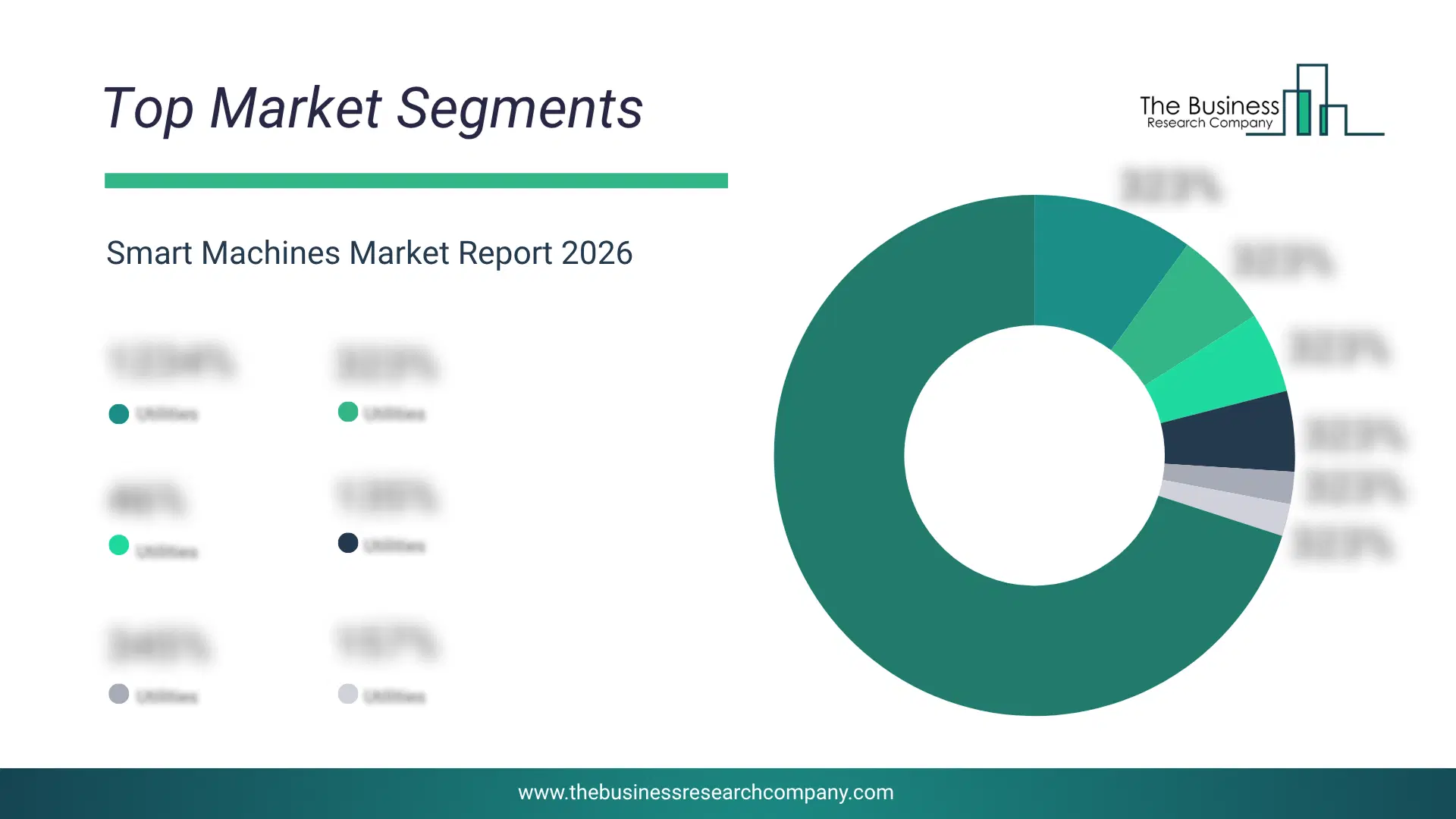
1) By Component: Hardware, Software, Services, 2) By Technology: Cloud Computing Technology, Big Data Technology, Internet of Everything, Robotics, Cognitive Technology, Affective Technology 3) By Machine: Robots, Autonomous Cars, Drones, Wearable Devices, Other Machines 4) By Verticals: Manufacturing, Transportation And Logistics, Healthcare, Consumer Goods And Retail, Aerospace And Defense, Other Verticals Subsegments: 1) By Hardware: Sensors, Actuators, Processors, Communication Devices, Connectivity Modules 2) By Software: Operating Systems, Application Software, Data Analytics Software, Artificial Intelligence (AI) Software, Security Software 3) By Services: Consulting Services, Integration Services, Maintenance And Support Services, Training Services, Managed ServicesWhat Is The Driver Of The Smart Machines Market?
The increasing requirement for enhanced data accessibility in various industries is expected to propel the growth of the smart machine market going forward. Data accessibility refers to an organization's employees' capacity to retrieve information from databases and make the most of it. Smart machines rely heavily on data accessibility for their accessibility to diverse and relevant data, which ensures better performance and adaptability. For instance, in December 2024, according to the Hitachi Vantara, a US-based data foundation for innovation, 37% of U.S. companies identified data quality or data infrastructure readiness as a major concern when implementing AI indicating that as firms push for AI, they increasingly see data accessibility as a bottleneck. Therefore, the increasing requirement for enhanced data accessibility in various industries will drive the growth of the smart machine industry.Key Players In The Global Smart Machines Market
Major companies operating in the smart machines market are Alphabet Inc., Microsoft Corporation, Amazon.com Inc., IBM Corporation, Siemens AG, General Electric Company, ABB Ltd., Robert Bosch GmbH, Honeywell International Inc., Schneider Electric SE, Rockwell Automation Inc., Emerson Electric Co., KUKA AG, FANUC Corporation, Yaskawa Electric Corporation, Boston Dynamics Inc., Tesla Inc., NVIDIA Corporation, Intel Corporation, Qualcomm Technologies Inc., Baidu Inc., Toyota Motor Corporation, Hyundai Motor Company, BAE Systems plc, Lockheed Martin Corporation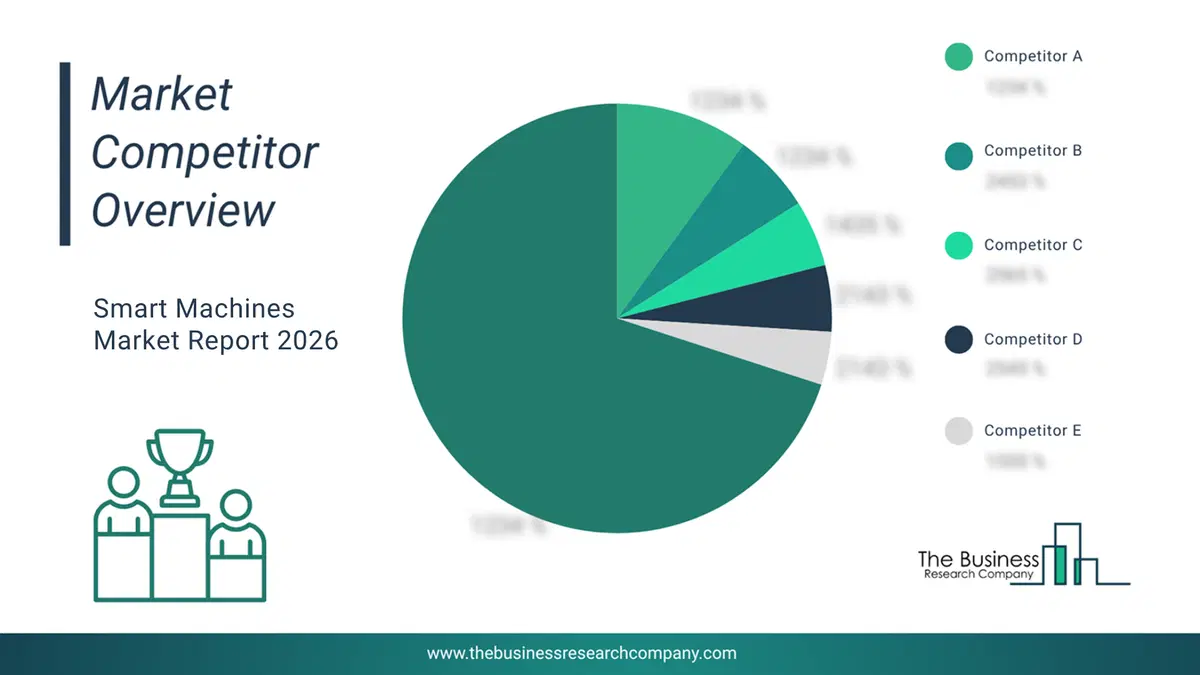
This chart is for illustrative purposes; the full report includes a detailed competitor analysis and comprehensive overview of the top 10 companies in the market.
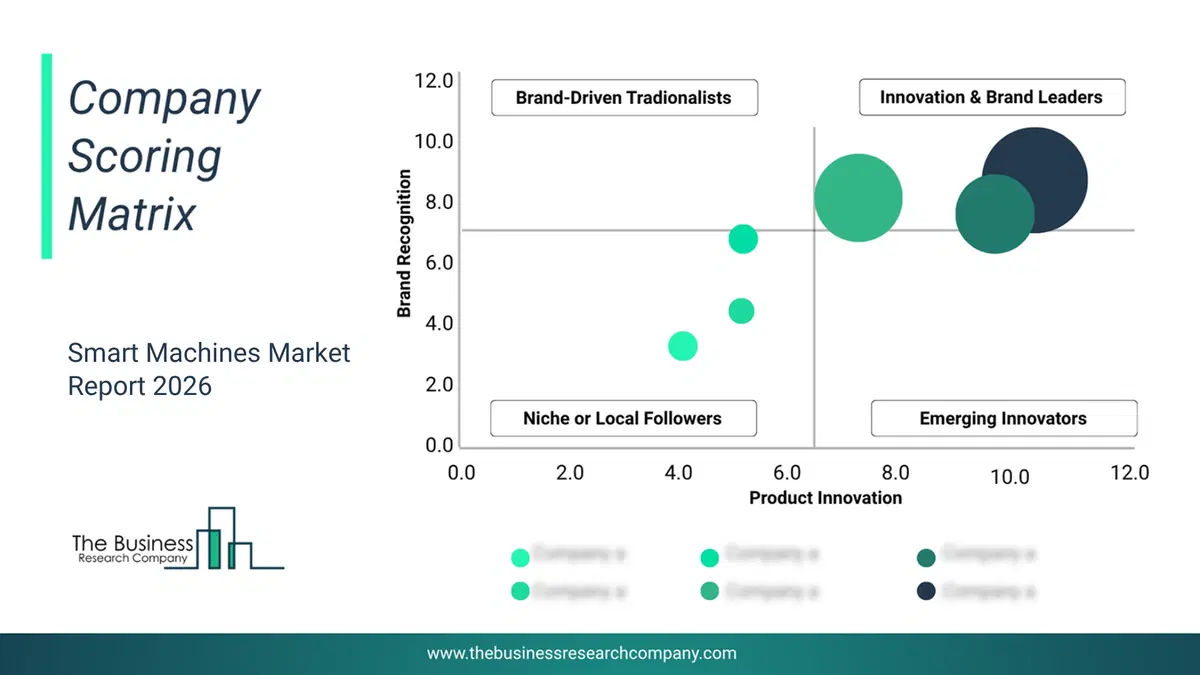
This chart maps companies by product innovation and brand strength, with bubble size indicating relative revenue, helping identify market leaders, challengers, and niche players. This is an illustrative chart; the full report provides a complete and accurate competitive analysis.
Global Smart Machines Market Trends and Insights
Major companies operating in the smart machine market are focusing on technological advancements, such as AI-powered humanoid robots with integrated vision-language-action systems, to meet the rising demand for automation amid labor shortages, increased need for flexible production, and growing demand for adaptable, general-purpose machines across manufacturing, logistics, and service sectors. AI-powered humanoid robots combine advanced robotics hardware (articulated limbs, sensors, cameras) with on-board artificial intelligence enabling them to perceive their environment, understand natural-language instructions, and execute a wide variety of tasks something far more flexible than traditional fixed automation (e.g., conveyors or robotic arms with pre-programmed motions) or human labor. For instance, in August 2024, Figure AI, a US-based robotics company, launched Figure 02, an advanced humanoid robot designed for industrial and commercial deployment. The Figure 02 features six RGB cameras paired with an onboard visual-language model, speakers and microphones for natural speech interaction, and improved hands with high dexterity; its upgrades also include substantially enhanced computing power for real-time vision, reasoning and control. This enables the robot to understand spoken commands, visually assess its surroundings, and perform tasks such as moving totes or manipulating objects allowing it to operate alongside or instead of human workers in factories, warehouses, or even service settings. This development underscores the market’s shift from rigid, task-specific machinery toward intelligent, flexible “smart machines” capable of adapting to varied tasks on demand.What Are Latest Mergers And Acquisitions In The Smart Machines Market?
In July 2025, Comau, an Italy-based industrial automation company, acquired Automha S.p.A. for an undisclosed amount. With this acquisition, Comau aims to expand and diversify its smart-machine and automation offerings by integrating Automha’s automated warehousing and intralogistics systems thereby strengthening its footprint in the fast-growing logistics & warehouse-automation segment and broadening its customer reach globally. Automha S.p.A. is an Italy-based company that specializes in manufacturing smart machines, including intelligent automated storage systems.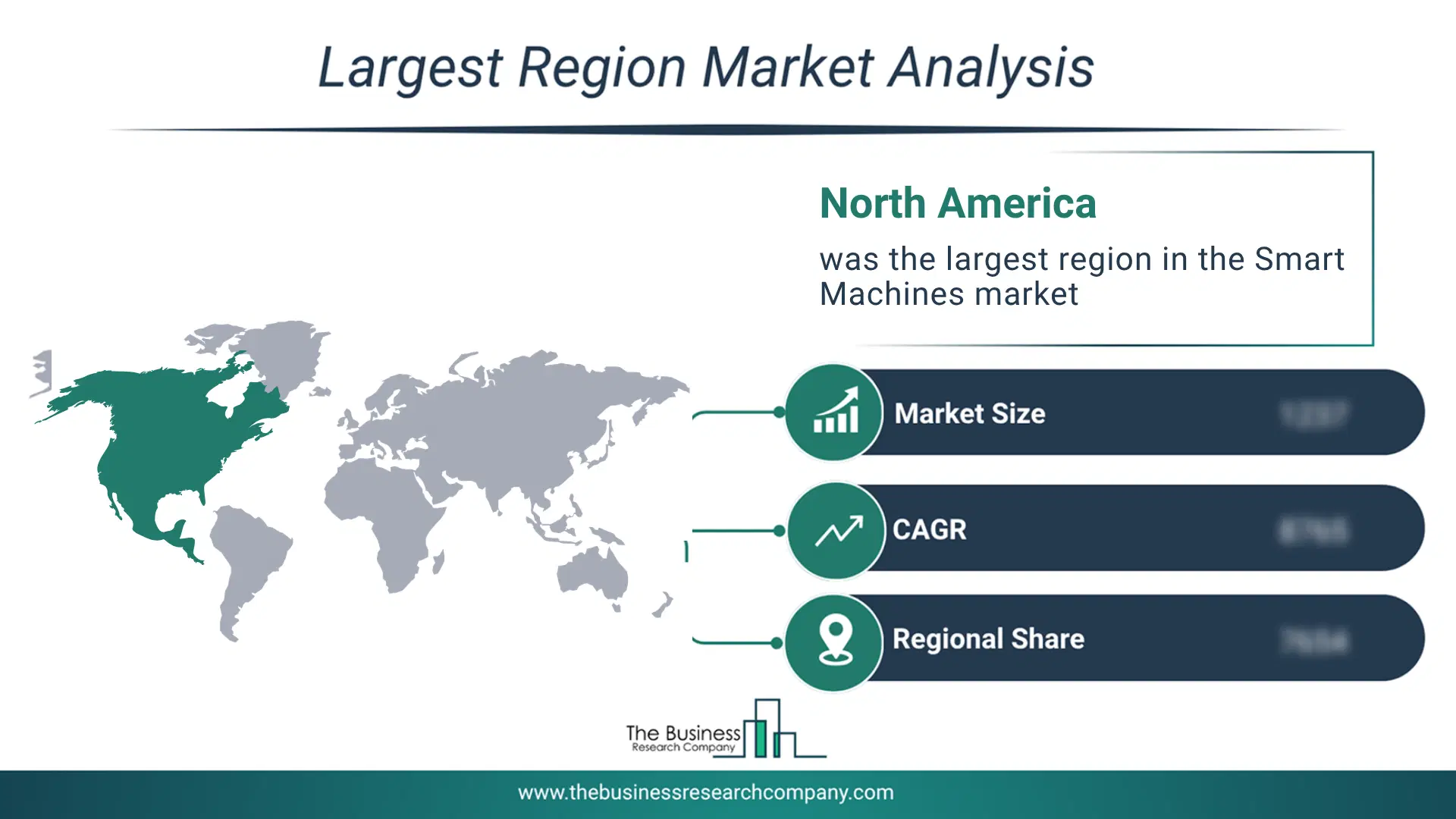
Regional Outlook
North America was the largest region in the smart machines market in 2025. Asia-Pacific is expected to be the fastest-growing region in the forecast period. The regions covered in this market report are Asia-Pacific, South East Asia, Western Europe, Eastern Europe, North America, South America, Middle East, Africa The countries covered in this market report are Australia, Brazil, China, France, Germany, India, Indonesia, Japan, Taiwan, Russia, South Korea, UK, USA, Canada, Italy, Spain.What Defines the Smart Machines Market?
The smart machines market consists of revenues earned by entities by services such as maintenance, updates, and support through subscription models, cloud-based services for data storage, processing, or communication, consulting and implementation services. The market value includes the value of related goods sold by the service provider or included within the service offering. The smart machines market also includes sales of physical smart machines, such as robots, drones, and autonomous vehicles. Values in this market are ‘factory gate’ values, that is the value of goods sold by the manufacturers or creators of the goods, whether to other entities (including downstream manufacturers, wholesalers, distributors and retailers) or directly to end customers. The value of goods in this market includes related services sold by the creators of the goods.How is Market Value Defined and Measured?
The market value is defined as the revenues that enterprises gain from the sale of goods and/or services within the specified market and geography through sales, grants, or donations in terms of the currency (in USD unless otherwise specified). The revenues for a specified geography are consumption values that are revenues generated by organizations in the specified geography within the market, irrespective of where they are produced. It does not include revenues from resales along the supply chain, either further along the supply chain or as part of other products.
This chart presents market attractiveness based on a quantitative evaluation of growth, competition, strategic alignment, and risk, offering a clear view of opportunity areas for decision-making. This chart is for illustrative purposes; the full report contains the complete analysis.

This chart highlights the Total Addressable Market (TAM) by estimating the maximum revenue opportunity using an assumption-driven approach, supporting strategic planning and opportunity sizing across markets. The chart is illustrative; the full report provides a more comprehensive analysis.
What Key Data and Analysis Are Included in the Smart Machines Market Report 2026?
The smart machines market research report is one of a series of new reports from The Business Research Company that provides market statistics, including industry global market size, regional shares, competitors with the market share, detailed market segments, market trends and opportunities, and any further data you may need to thrive in the smart machines industry. The market research report delivers a complete perspective of everything you need, with an in-depth analysis of the current and future state of the industry.Smart Machines Market Report Forecast Analysis
| Report Attribute | Details |
|---|---|
| Market Size Value In 2026 | $253.38 billion |
| Revenue Forecast In 2030 | $414.91 billion |
| Growth Rate | CAGR of 13.1% from 2026 to 2030 |
| Base Year For Estimation | 2025 |
| Actual Estimates/Historical Data | 2020-2025 |
| Forecast Period | 2026 - 2030 |
| Market Representation | Revenue in USD Billion and CAGR from 2026 to 2030 |
| Segments Covered | Component, Technology, Machine, Verticals |
| Regional Scope | Asia-Pacific, Western Europe, Eastern Europe, North America, South America, Middle East, Africa |
| Key Companies Profiled | Alphabet Inc., Microsoft Corporation, Amazon.com Inc., IBM Corporation, Siemens AG, General Electric Company, ABB Ltd., Robert Bosch GmbH, Honeywell International Inc., Schneider Electric SE, Rockwell Automation Inc., Emerson Electric Co., KUKA AG, FANUC Corporation, Yaskawa Electric Corporation, Boston Dynamics Inc., Tesla Inc., NVIDIA Corporation, Intel Corporation, Qualcomm Technologies Inc., Baidu Inc., Toyota Motor Corporation, Hyundai Motor Company, BAE Systems plc, Lockheed Martin Corporation |
| Customization Scope | Request for Customization |
| Pricing And Purchase Options | Explore Purchase Options |