
Smart Mobility Market Report 2026
Global Outlook – By Type (Integrated Mobility Platforms, Smart Transportation Solutions, Connected Vehicle Solutions, Mobility As A Service, Traffic Management Systems), By Technology (Internet Of Things, Artificial Intelligence, Blockchain, Big Data Analytics, Cloud Computing), By Transport Mode (Public Transport, Private Transport, Shared Mobility, Electric Vehicles, Rail Transport), By End-User (Government, Transportation Service Providers, Fleet Operators, Corporate, Individuals) – Market Size, Trends, Strategies, and Forecast to 2030
Smart Mobility Market Overview
• Smart Mobility market size has reached to $61.92 billion in 2025 • Expected to grow to $136.06 billion in 2030 at a compound annual growth rate (CAGR) of 17% • Growth Driver: The Rise In Smart City Initiatives Fueling The Growth Of The Market Due To Increasing Demand For Efficient Urban Infrastructure And Sustainable Transportation Solutions • Market Trend: Artificial Intelligence Integration Accelerates The Market Growth By Enhancing Safety And Efficiency • North America was the largest region in 2025 and Asia-Pacific is the fastest growing region.Market Gains By 2030 – Top Opportunities By Segment
Market Gain identifies the most promising market opportunities by highlighting the segments or products expected to generate the highest incremental revenue growth over the next five years.
What Is Covered Under Smart Mobility Market?
Smart mobility refers to integrating advanced technologies and innovative transportation solutions to make the movement of people and goods more efficient, sustainable, and user-friendly. It leverages smart tools to optimize traffic flow, reduce environmental impact, and enhance travel experience. The main types in the smart mobility market are integrated mobility platforms, smart transportation solutions, connected vehicle solutions, mobility as a service, and traffic management systems. Integrated mobility platforms refer to digital systems or applications that combine multiple transportation services into a single, unified platform. The various technologies include internet of things, artificial intelligence, blockchain, big data analytics, and cloud computing. The various modes of transport include public transport, private transport, shared mobility, electric vehicles, and rail transport. The different end-users encompass government, transportation service providers, fleet operators, corporate, and individuals.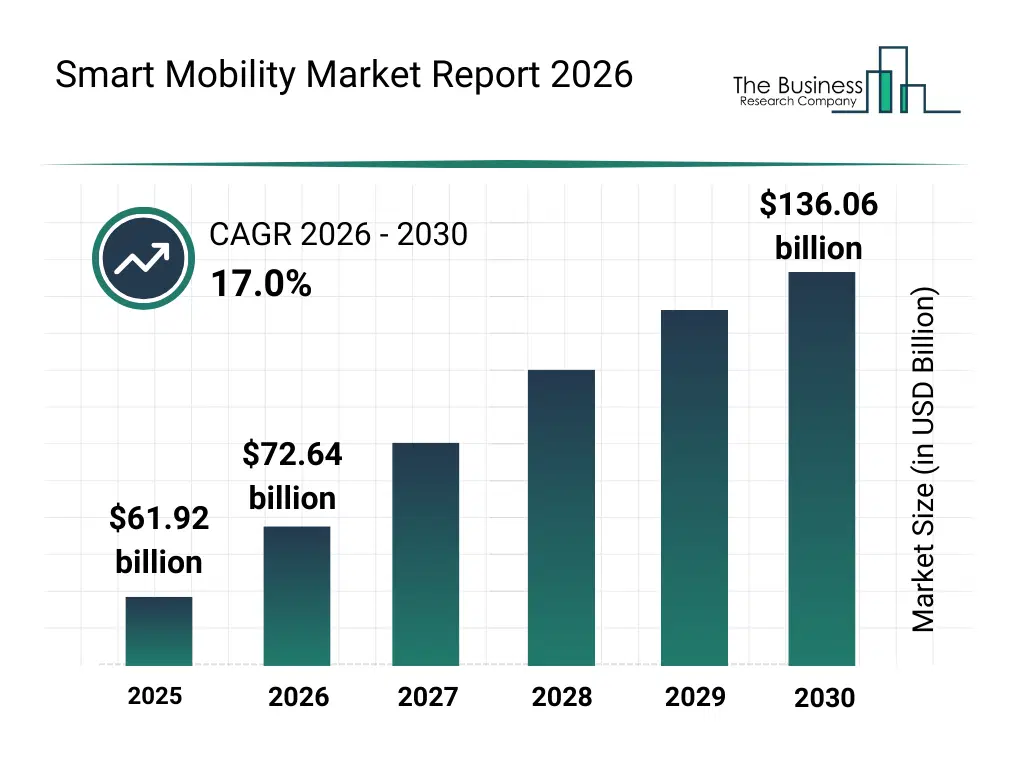
What Is The Smart Mobility Market Size and Share 2026?
The smart mobility market size has grown rapidly in recent years. It will grow from $61.92 billion in 2025 to $72.64 billion in 2026 at a compound annual growth rate (CAGR) of 17.3%. The growth in the historic period can be attributed to urban congestion challenges, expansion of public transport systems, early intelligent traffic systems, growth of shared mobility services, fuel efficiency regulations.What Is The Smart Mobility Market Growth Forecast?
The smart mobility market size is expected to see rapid growth in the next few years. It will grow to $136.06 billion in 2030 at a compound annual growth rate (CAGR) of 17.0%. The growth in the forecast period can be attributed to autonomous vehicle adoption, electric vehicle infrastructure expansion, smart city transport investments, data driven mobility planning, demand for low emission transport solutions. Major trends in the forecast period include integrated mobility platforms, connected vehicle ecosystems, AI driven traffic management, mobility as a service models, sustainable urban transportation.

Global Smart Mobility Market Segmentation
1) By Type: Integrated Mobility Platforms, Smart Transportation Solutions, Connected Vehicle Solutions, Mobility As A Service, Traffic Management Systems 2) By Technology: Internet Of Things, Artificial Intelligence, Blockchain, Big Data Analytics, Cloud Computing 3) By Transport Mode: Public Transport, Private Transport, Shared Mobility, Electric Vehicles, Rail Transport 4) By End-User: Government, Transportation Service Providers, Fleet Operators, Corporate, Individuals Subsegments: 1) By Integrated Mobility Platforms: Multimodal Trip Planning, Real-Time Transit Information, Payment And Ticketing Integration, Mobility Aggregator Apps 2) By Smart Transportation Solutions: Intelligent Public Transport, Smart Parking Systems, Dynamic Traffic Signal Control, Electric Vehicle Charging Infrastructure 3) By Connected Vehicle Solutions: Vehicle-to-Vehicle (V2V) Communication, Vehicle-to-Infrastructure (V2I) Communication, Telematics And Infotainment Systems, Advanced Driver Assistance Systems (ADAS) 4) By Mobility As A Service (MaaS): Ride-Hailing Services, Car-Sharing Services, Bike And Scooter Sharing, Subscription-Based Mobility Plans 5) By Traffic Management Systems: Adaptive Traffic Control Systems, Incident Detection Systems, Traffic Data Analytics, Electronic Toll Collection Systems The top segments in the pet care e-commerce market will be: • Pet Food will reach $31.02 Billion by 2030. • Pet Grooming Products will reach $13.17 Billion by 2030. • Medications (OTC Or Supplies) will reach $9.57 Billion by 2030. • Other Products will reach $5.9 Billion by 2030. The top segments in the smart mobility market will be: • Connected Vehicle Solutions will reach $49.25 Billion by 2030. • Mobility As A Service (MaaS) will reach $30.84 Billion by 2030. • Smart Transportation Solutions will reach $27.34 Billion by 2030. • Integrated Mobility Platforms will reach $19.03 Billion by 2030. • Traffic Management Systems will reach $8.73 Billion by 2030.What Is The Driver Of The Smart Mobility Market?
The rise in smart city initiatives is expected to propel the growth of the smart mobility market going forward. A smart city is an urban area that uses digital technology and data-driven solutions to improve the quality of life for its citizens, enhance urban services, and promote sustainable development. The rise in smart city initiatives is due to rapid urbanization and the need for sustainable urban development. As more people move into cities, there is increasing pressure on infrastructure, resources, and public services such as transportation, energy, and waste management. Smart mobility in smart cities uses technologies to optimize transportation, reduce congestion, and promote sustainability. It includes smart traffic management, electric vehicles, shared mobility services, and autonomous vehicles, all aimed at making urban transport more efficient, connected, and eco-friendly. For instance, in June 2023, according to the Cities Today, a UK-based magazine, the German federal government committed to promoting smart cities and smart regions more vigorously, allocating a total of €820 million ($918.4 million) for this purpose. The smart cities model projects (Modellprojekte Smart Cities) support 73 projects, creating best practices for 11,000 municipalities across Germany. Therefore, the rise in smart city initiatives drives the smart mobility industry.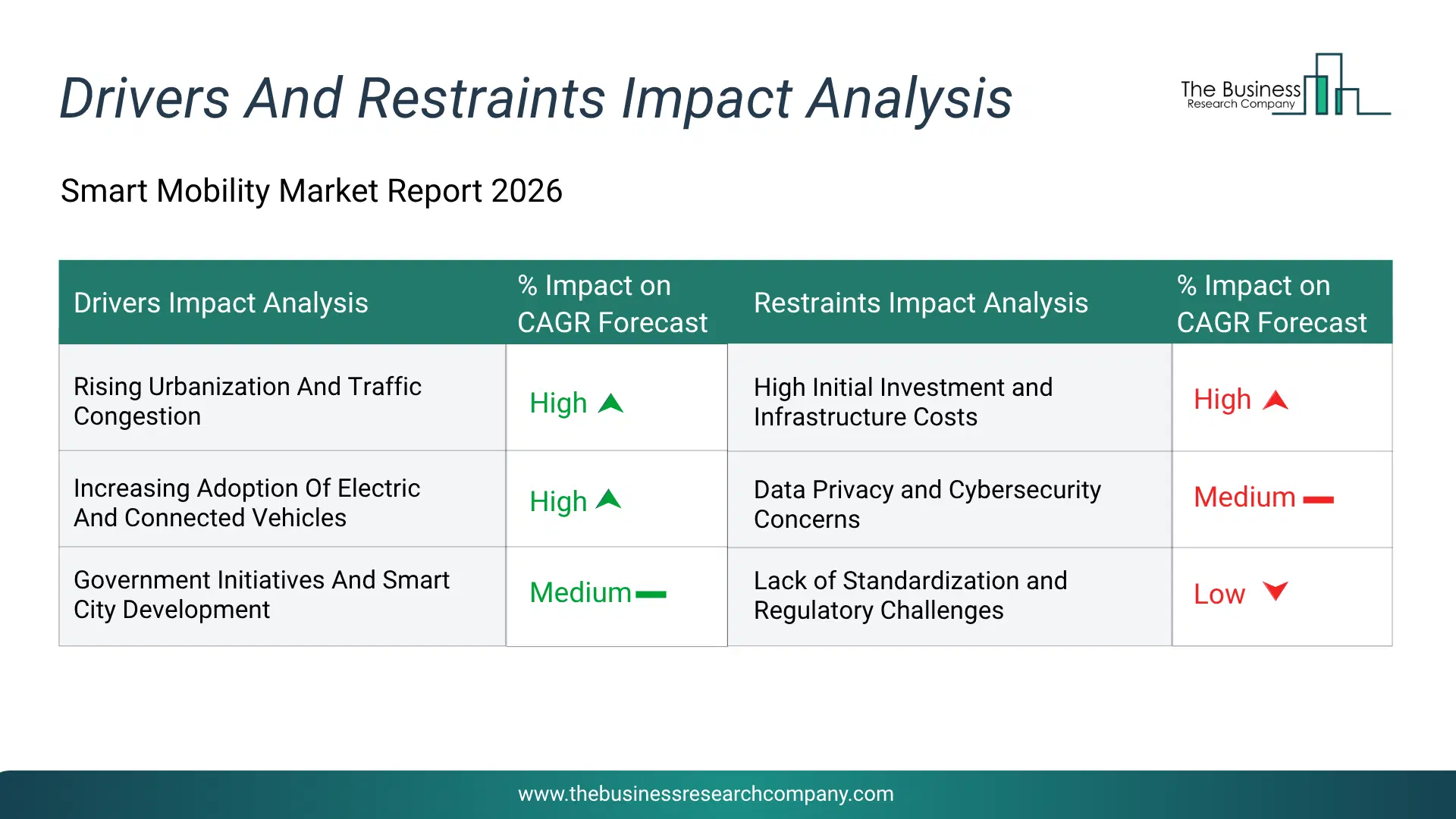
Infographic Chart Showing Key Market Drivers Analysis And Restraints For Smart Mobility Market
The chart presents an impact analysis of key drivers and restraints, quantifying their relative influence on the market's growth rate and helping assess the balance between growth enablers and limiting factors. This chart offers a high-level perspective; the full report contains more detailed insights.
How Will The Drivers Impact Growth In The Global Smart Mobility Market?
• Rising Urbanization And Traffic Congestion (High) – During the forecast period, the rising urbanization and traffic congestion are expected to become a major growth driver for the smart mobility market by 2030. Rapid population growth in urban areas is increasing pressure on existing transportation infrastructure, leading to higher traffic congestion and longer commute times. Governments and city planners are increasingly adopting smart mobility solutions to improve traffic flow, optimize transportation efficiency, and reduce urban transportation challenges. This trend is accelerating investments in intelligent traffic management systems, connected public transportation platforms, and real-time mobility monitoring technologies. Additionally, growing demand for efficient urban mobility services is encouraging the deployment of integrated digital transportation networks and data-driven mobility solutions. • Increasing Adoption Of Electric And Connected Vehicles (High) – During the forecast period, the increasing adoption of electric and connected vehicles is expected to emerge as a major factor driving the expansion of the smart mobility market by 2030. Rising consumer preference for connected and electrified transportation is accelerating the integration of digital communication technologies across modern mobility ecosystems. Automotive manufacturers and mobility providers are increasingly deploying connected vehicle platforms, telematics systems, and vehicle-to-everything communication technologies to improve safety, navigation, and operational efficiency. The growing penetration of electric vehicles is also encouraging the development of smart charging infrastructure and intelligent fleet management systems. Furthermore, advancements in cloud connectivity and real-time data analytics are enhancing vehicle performance monitoring and mobility optimization capabilities. • Government Initiatives And Smart City Development (Medium) – During the forecast period, the government initiatives and smart city development are expected to act as a key growth catalyst for the smart mobility market by 2030. Increasing government focus on sustainable transportation and digital urban infrastructure is accelerating investments in smart mobility technologies worldwide. Public authorities are actively supporting the deployment of intelligent transportation systems, integrated public transit platforms, and smart traffic monitoring solutions to improve urban mobility efficiency and environmental sustainability. In addition, smart city development programs are encouraging the adoption of advanced mobility technologies capable of supporting connected transportation ecosystems and data-driven urban planning. Regulatory initiatives promoting low-emission transportation and digital infrastructure modernization are further strengthening market demand.How Will The Restraints Impact Growth In The Global Smart Mobility Market?
• High Initial Investment and Infrastructure Costs (High) – During the forecast period, the high initial investment acts as a major restraint in the smart mobility market due to the significant capital required for infrastructure development. Deployment of smart transportation systems, including IoT-enabled traffic management, EV charging stations, and connected vehicle ecosystems, demands heavy upfront spending. Governments and private entities must invest in advanced digital infrastructure, which can be financially challenging, especially in developing regions. Additionally, integration of technologies such as AI, sensors, and communication networks increases overall project costs. These financial barriers can delay adoption and limit market expansion despite strong long-term benefits. • Data Privacy and Cybersecurity Concerns (High) – During the forecast period, the data privacy and cybersecurity concerns significantly restrain the growth of smart mobility solutions. These systems rely heavily on real-time data collection from users, vehicles, and infrastructure, raising risks of data breaches and unauthorized access. Increasing connectivity in transportation networks makes them more vulnerable to cyberattacks, which can disrupt operations and compromise user safety. Regulatory frameworks around data protection further add complexity for service providers. As a result, concerns over data misuse and security vulnerabilities hinder consumer trust and slow adoption of smart mobility services. • Lack of Standardization and Regulatory Challenges (Medium) – During the forecast period, the the absence of standardized regulations and frameworks across regions acts as a key restraint in the smart mobility market. Different countries and regions have varying policies regarding autonomous vehicles, EV adoption, and shared mobility services, creating operational inconsistencies. This lack of uniformity complicates large-scale deployment and integration of smart mobility solutions. Regulatory uncertainty also increases compliance costs and delays project approvals. Consequently, companies face challenges in scaling solutions globally, which slows down overall market growth.Key Players In The Global Smart Mobility Market
Major companies operating in the smart mobility market are Volkswagen AG, Toyota Motor Corporation, Ford Motor Company, General Motors, Bayerische Motoren Werke AG, HyundAI Motor Company, Robert Bosch GmbH, Siemens AG, Intel Corporation, Cisco Systems Inc., Škoda Auto AS, Uber Technologies Inc., Lyft Inc., TomTom International BV, Waymo LLC, Lime Electric Scooter Sharing Company, Gett Inc, Mindteck, QuaLiX Information System LLP, Excelfore Corporation, Innoviz Technologies Ltd.
This chart is for illustrative purposes; the full report includes a detailed competitor analysis and comprehensive overview of the top 10 companies in the market.

This chart maps companies by product innovation and brand strength, with bubble size indicating relative revenue, helping identify market leaders, challengers, and niche players. This is an illustrative chart; the full report provides a complete and accurate competitive analysis.
Global Smart Mobility Market Trends and Insights
Major companies operating in the smart mobility market are focusing on adopting artificial intelligence (AI) to enhance transportation efficiency, safety, and sustainability. Adopting artificial intelligence in smart mobility helps optimize traffic flow and reduce congestion through real-time data analysis. It also enhances predictive maintenance and route planning, improving efficiency and safety in transportation systems. For instance, in September 2023, HyundAI Motor Company, a US-based automotive manufacturer, launched the Venue and Venue N Line in India, equipped with advanced driver assistance systems (ADAS), making them the most affordable sports utility vehicle (SUV) with this technology in the sub-4m segment. The introduction of ADAS aims to enhance road safety and cater to the growing consumer demand for advanced features in compact SUVs. Hyundai's focus on affordability and technological innovation positions the Venue as a competitive option against rivals like Tata Nexon and Maruti Suzuki Brezza.What Are Latest Mergers And Acquisitions In The Smart Mobility Market?
In May 2023, Siemens, a Germany-based technology company, acquired Mass-Tech Controls Private Limited for Rs. 380 million ($4.40 million). With this acquisition, Siemens aims to strengthen its eMobility portfolio in India by leveraging Mass-Tech Controls Private Limited’s expertise in power infrastructure and EV charging technology to accelerate the deployment of sustainable, high-quality electric vehicle charging solutions nationwide. Mass-Tech Controls Private Limited is an India-based power infrastructure company specializing in low and medium-voltage power equipment and electric vehicle charging systems.
Regional Insights
North America was the largest region in the smart mobility market in 2025. Asia-Pacific is expected to be the fastest-growing region in the forecast period. The regions covered in this market report are Asia-Pacific, South East Asia, Western Europe, Eastern Europe, North America, South America, Middle East, Africa. The countries covered in this market report are Australia, Brazil, China, France, Germany, India, Indonesia, Japan, Taiwan, Russia, South Korea, UK, USA, Canada, Italy, Spain.What Defines the Smart Mobility Market?
The smart mobility market consists of revenues earned by entities by providing services such as ride-sharing, car-sharing, bike commuting, traffic management, parking solutions, and mobility management. The market value includes the value of related goods sold by the service provider or included within the service offering. The smart mobility market also includes sales of electric vehicles (EVs), autonomous vehicles and connected vehicles. Values in this market are ‘factory gate’ values, that is the value of goods sold by the manufacturers or creators of the goods, whether to other entities (including downstream manufacturers, wholesalers, distributors and retailers) or directly to end customers. The value of goods in this market includes related services sold by the creators of the goods.How is Market Value Defined and Measured?
The market value is defined as the revenues that enterprises gain from the sale of goods and/or services within the specified market and geography through sales, grants, or donations in terms of the currency (in USD unless otherwise specified). The revenues for a specified geography are consumption values that are revenues generated by organizations in the specified geography within the market, irrespective of where they are produced. It does not include revenues from resales along the supply chain, either further along the supply chain or as part of other products.
This chart presents market attractiveness based on a quantitative evaluation of growth, competition, strategic alignment, and risk, offering a clear view of opportunity areas for decision-making. This chart is for illustrative purposes; the full report contains the complete analysis.

This chart highlights the Total Addressable Market (TAM) by estimating the maximum revenue opportunity using an assumption-driven approach, supporting strategic planning and opportunity sizing across markets. The chart is illustrative; the full report provides a more comprehensive analysis.
What Key Data and Analysis Are Included in the Smart Mobility Market Report 2026?
The smart mobility market research report is one of a series of new reports from The Business Research Company that provides market statistics, including industry global market size, regional shares, competitors with the market share, detailed market segments, market trends and opportunities, and any further data you may need to thrive in the smart mobility industry. The market research report delivers a complete perspective of everything you need, with an in-depth analysis of the current and future state of the industry.Smart Mobility Market Report Forecast Analysis
| Report Attribute | Details |
|---|---|
| Market Size Value In 2026 | $72.64 billion |
| Revenue Forecast In 2030 | $136.06 billion |
| Growth Rate | CAGR of 17.3% from 2026 to 2030 |
| Base Year For Estimation | 2025 |
| Actual Estimates/Historical Data | 2020-2025 |
| Forecast Period | 2026 - 2030 |
| Market Representation | Revenue in USD Billion and CAGR from 2026 to 2030 |
| Segments Covered | Type, Technology, Transport Mode, End-User |
| Regional Scope | Asia-Pacific, Western Europe, Eastern Europe, North America, South America, Middle East, Africa |
| Country Scope | The countries covered in the report are Australia, Brazil, China, France, Germany, India, Indonesia, Japan, Taiwan, Russia, South Korea, UK, USA, Canada, Italy, Spain. |
| Key Companies Profiled | Volkswagen AG, Toyota Motor Corporation, Ford Motor Company, General Motors, Bayerische Motoren Werke AG, HyundAI Motor Company, Robert Bosch GmbH, Siemens AG, Intel Corporation, Cisco Systems Inc., Škoda Auto AS, Uber Technologies Inc., Lyft Inc., TomTom International BV, Waymo LLC, Lime Electric Scooter Sharing Company, Gett Inc, Mindteck, QuaLiX Information System LLP, Excelfore Corporation, Innoviz Technologies Ltd. |
| Customization Scope | Request for Customization |
| Pricing And Purchase Options | Explore Purchase Options |